


Eli Lilly and Company LLY boasts a wide range of products across cardiometabolic health, neuroscience, oncology and immunology. Cardiometabolic Health is Lilly’s largest therapeutic area by a wide margin, particularly with the success of its tirzepatide medicines, Mounjaro and Zepbound. Its cardiometabolic products accounted for approximately 80% of Lilly’s total revenues in the first half of 2026.
However, Lilly is gradually building a more diversified portfolio by expanding in oncology, immunology and neuroscience. Lilly has also embarked on an aggressive M&A spree in the past couple of years, acquiring biotech companies across oncology, neuroscience, cardiovascular disease, gene editing, inflammation, cell therapy and vaccines to diversify its long-term growth drivers beyond GLP-1 therapies.
In this article, we will discuss Lilly’s position in the neuroscience space and how it is expanding its presence in this area.
Neuroscience Still Small but Has Significant Growth Potential
Neuroscience currently represents only a small portion of Lilly's sales, around 2%. In the first six months of 2026, neuroscience revenues increased around 32% to $811 million. The portfolio currently has two major marketed products — Emgality, an anti-CGRP monoclonal antibody for migraine prevention and Kisunla, an anti-amyloid beta antibody for early symptomatic Alzheimer's disease. Of these, Kisunla is seeing rapid year-over-year sales growth.
The relatively small contribution means neuroscience is not yet an important earnings driver for Lilly, but it also means the upside could be substantial if its neuroscience pipeline succeeds.
Lilly Building a Broader Neuroscience Pipeline Through M&A
Lilly has built a considerably deeper neuroscience pipeline. Key candidates are remternetug, a next-generation anti-amyloid antibody being developed for Alzheimer's disease in phase III, cleminorexton, an orexin receptor 2 agonist in phase II/III for hypersomnia and a GBA1 gene therapy for Parkinson's disease in phase II.
Acquisitions have played an important role in building Lilly’s neuroscience franchise. In July, Lilly agreed to acquire AtaiBeckley ATAI, which is advancing a pipeline of rapid-acting neuroplastogens for treatment-resistant depression (TRD) and other mental health conditions. ATAI’s lead asset, BPL-003, an intranasal formulation of mebufotenin benzoate, is being developed as a potential treatment for people living with TRD. The candidate has shown encouraging mid-stage data in TRD.
The acquisition of Centessa added cleminorexton to the pipeline. In previous years, acquisitions like Prevail Therapeutics and Disarm Therapeutics added candidates to treat neurological diseases.
Overall, Lilly’s neuroscience pipeline now spans Alzheimer's, sleep disorders, pain, schizophrenia, neurodegeneration and other neurological conditions.
Conclusion
Lilly’s neuroscience business is still small, but its strong growth, expanding pipeline and M&A-driven additions could make it an increasingly important long-term growth driver. The success of key candidates could help Lilly diversify its revenue base and reduce its reliance on cardiometabolic therapies.
Competition to LLY’s Neuroscience Products
Kisunla’s single biggest competitor is Eisai/Biogen’s BIIB Leqembi, both being amyloid-targeting treatments. Other companies are also developing next-generation Alzheimer's therapies, including Roche/Genentech and several biotech companies.
Emgality (galcanezumab) competes in the highly competitive CGRP migraine market, which includes Teva’s Ajovy, Amgen/Novartis’ Aimovig, Pfizer’s PFE Nurtec ODT and AbbVie’s Qulipta.
LLY’s Stock Price, Valuation and Estimates
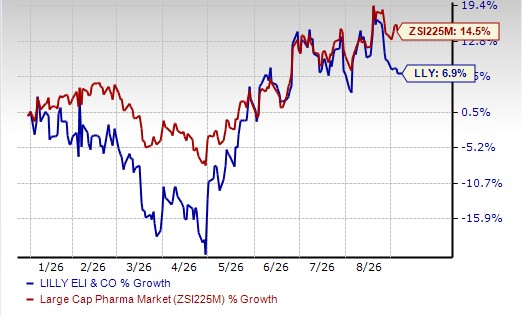
Lilly’s stock has risen 6.9% so far this year compared with the industry’s increase of 14.5%.
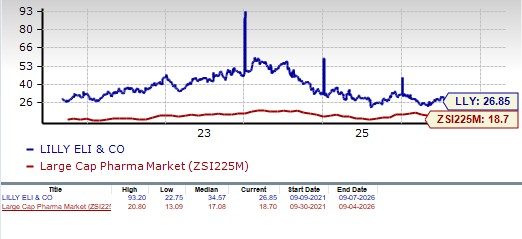
From a valuation standpoint, Lilly’s stock is expensive. Going by the price/earnings ratio, the company’s shares currently trade at 26.85 forward earnings, higher than 18.70 for the industry. However, the stock is trading below its 5-year mean of 34.57.
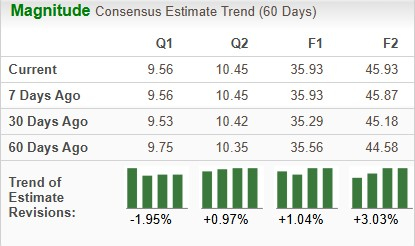
The Zacks Consensus Estimate for 2026 has risen from $35.56 to $35.93 per share over the past 60 days, while that for 2027 has risen from $44.58 to $45.93 per share over the same timeframe.
Lilly has a Zacks Rank #3 (Hold). You can see the complete list of today’s Zacks #1 Rank (Strong Buy) stocks here.
Zacks' Research Chief Names "Stock Most Likely to Double"
Our team of experts has just released the 5 stocks with the greatest probability of gaining +100% or more in the coming months. Of those 5, Director of Research Sheraz Mian highlights the one stock set to climb highest.
This top pick is a little-known satellite-based communications firm. Space is projected to become a trillion dollar industry, and this company's customer base is growing fast. Analysts have forecasted a major revenue breakout in 2025. Of course, all our elite picks aren't winners but this one could far surpass earlier Zacks' Stocks Set to Double like Hims & Hers Health, which shot up +209%.
Free: See Our Top Stock And 4 Runners UpWant the latest recommendations from Zacks Investment Research? Today, you can download 7 Best Stocks for the Next 30 Days. Click to get this free report
Eli Lilly and Company (LLY): Free Stock Analysis Report
Biogen Inc. (BIIB): Free Stock Analysis Report
Pfizer Inc. (PFE): Free Stock Analysis Report
AtaiBeckley Inc (ATAI): Free Stock Analysis Report
This article originally published on Zacks Investment Research (zacks.com).