


As fuel prices surge globally, Amazon (AMZN) is beginning to pass through rising logistics costs to its vast third-party seller ecosystem, a notable shift for a company that has historically absorbed such pressures to protect growth and customer pricing. Starting April 17, the company will introduce a 3.5% fuel and logistics surcharge on Fulfillment by Amazon (FBA) orders across the U.S. and Canada, including cross-border shipments to Canada, Mexico, and Brazil, with additional surcharges extending to Buy with Prime and Multi-Channel Fulfillment beginning May 2.
This marks Amazon's latest response to escalating transportation expenses driven by geopolitical disruptions and higher oil prices. Calculated on fulfillment fees rather than product prices, the surcharge will add about $0.17 per unit on average, reflecting fuel cost increases since the onset of the Iran war.
More Top Stocks Daily: Go behind Wall Street’s hottest headlines with Barchart’s Active Investor newsletter.
With third-party sellers accounting for a majority of units sold on the platform, it remains to be seen how much of the cost will be absorbed by merchants versus passed on to consumers, and how this affects Amazon’s competitive positioning and long-term strategy.
About Amazon Stock
Amazon is a global technology and e-commerce behemoth headquartered in Seattle, Washington. Today, the company operates across a dazzling range of businesses, cloud services via Amazon Web Services (AWS), digital streaming, subscription services, advertising, physical retail, consumer electronics, and more. Its diversified growth model has placed it among the world’s most valuable public companies, with a market capitalization of $2.37 trillion, and it has a secure position in the “Magnificant Seven” group.
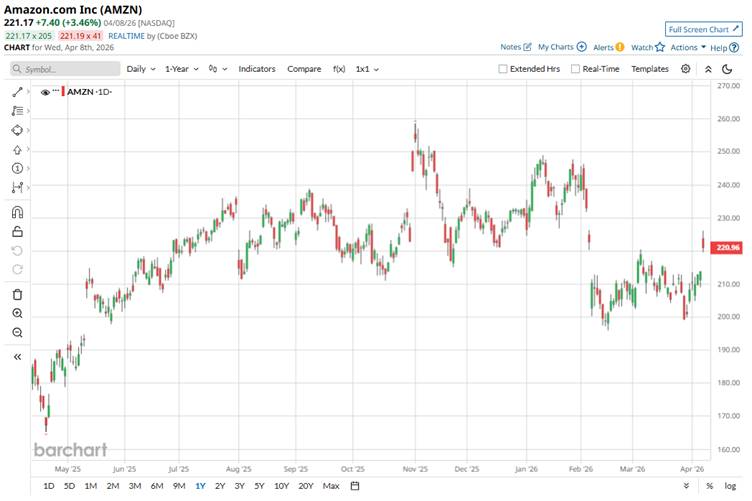
AMZN stock has delivered solid long-term gains but entered 2026 with noticeable volatility, reflecting both macro pressures and company-specific developments. Over the past 52 weeks, Amazon stock has generated a return of 21%, supported by strength in AWS, advertising, and artificial intelligence (AI) optimism. The stock climbed to a 52-week high of $258.60 on Nov. 3, 2025, before pulling back. On a year-to-date (YTD) basis, AMZN stock is roughly flat amid a sharp selloff driven by margin concerns, elevated capex expectations, and macro uncertainty.
More recently, the stock has shown short-term resilience. The announcement of the 3.5% fuel surcharge appears to have been received positively by the market, contributing to a modest upward move over the past few sessions. Investors might view the surcharge as margin protection, signaling Amazon’s growing willingness to pass on cost inflation rather than fully absorb it. AMZN rose 1.4% following the news on April 6, experienced marginal gains on April 7, and climbed 3.5% on April 8.
 www.barchart.com
 AMZN stock currently trades at a premium compared to the sector median but below its own historical average at 27.4 times forward earnings.
Mixed Financial Performance
Amazon reported its fourth-quarter and full-year 2025 results on Feb. 5. In Q4 2025, net sales climbed to $213.4 billion, representing a 14% year-over-year (YOY) increase. AWS generated $35.6 billion in revenue, up 24% YOY, marking its fastest growth rate in years and underscoring continued strength in cloud demand, particularly around AI and enterprise workloads. Advertising revenue also contributed to upside, rising about 22% YOY to $21.3 billion. Diluted EPS came in at $1.95, up from $1.86 in the prior-year period but slightly missing Street forecasts.
AMZN stock saw a sharp selloff in response to the report as investors digested the company’s outlook and spending plans. Shares slumped more than 4% on Feb. 5 and fell nearly 6% on Feb. 6.
For full-year 2025, Amazon delivered double-digit net sales growth of around 12% YOY to $716.9 billion. However, free cash flow contracted sharply, falling to roughly $11.2 billion, down significantly from prior periods largely due to aggressive capital expenditures and strategic investments.
Management’s guidance for 2026 signaled both continuity and escalation of these trends. Amazon forecast capex of roughly $200 billion for the year — a substantial increase over prior estimates — aimed at expanding AI data centers, custom silicon production, robotics, and emerging businesses such as low-Earth-orbit (LEO) satellite infrastructure. While this aggressive spending underpins the company’s long-term strategic thrust into AI and cloud leadership, it contributed to downward pressure on near-term profitability and cash flow, making investors cautious.
For Q1 2026, Amazon projects revenue in the range of $173.5 billion to $178.5 billion, implying YOY growth between 11% and 15%. Analysts remain upbeat, projecting EPS of $7.78 for fiscal 2026, up 8.5% YOY. Analysts anticipate a further 20% YOY increase to $9.32 in fiscal 2027.
What Do Analysts Expect for Amazon Stock?
Last month, Amazon received a bullish outlook from Tigress Financial, which raised its price target to $315 and maintained a “Buy” rating, citing strong AI-driven growth across AWS, retail, advertising, and logistics. JPMorgan also raised its price target to $280 from $265 while maintaining an “Overweight” rating, citing strong AWS demand, AI-driven growth, and capacity expansion.
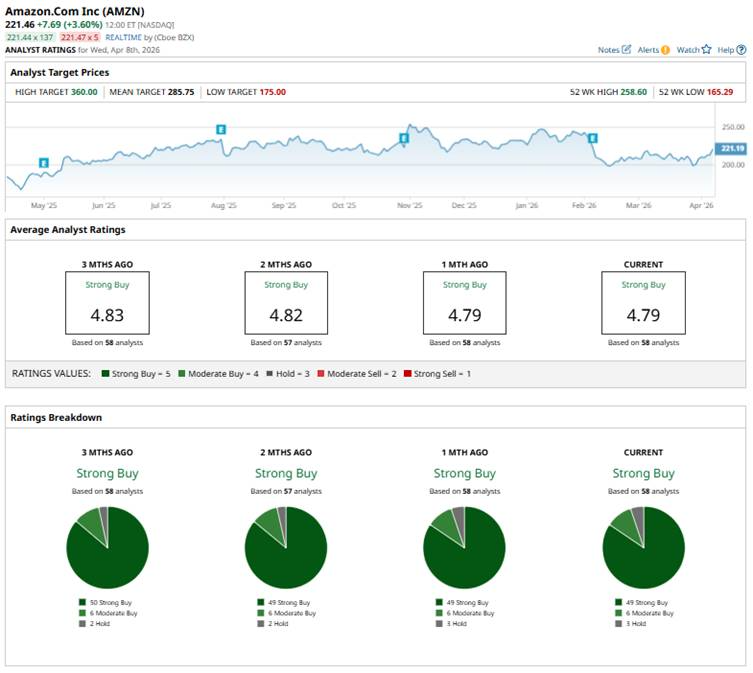
Overall, AMZN stock has a consensus “Strong Buy” rating. Of the 58 analysts covering the stock, 49 advise a “Strong Buy,” six suggest a “Moderate Buy,” and three analysts recommend a “Hold” rating.
The average analyst price target for AMZN is $285.75, indicating potential upside of 24% from current levels. The Street-high target price of $360 suggests that the stock could rally as much as 56% from here.
 www.barchart.com
 On the date of publication, Subhasree Kar did not have (either directly or indirectly) positions in any of the securities mentioned in this article. All information and data in this article is solely for informational purposes. For more information please view the Barchart Disclosure Policy here.
More news from Barchart
As Fuel Costs Skyrocket, Amazon Is Adding in New Fuel Surcharges. What Does That Mean for AMZN Stock? Alibaba Just Unveiled a Massive AI Chip Cluster. Does That Make BABA Stock a Buy Here? Foldable iPhones Are Reportedly Still on Track for September. Should You Buy AAPL Stock Here? As Meta Platforms Unveils Muse Spark, Should You Buy META Stock Now?