


Black Diamond Therapeutics BDTX is a clinical-stage oncology company with an investment story that largely runs through a single program: silevertinib, its brain-penetrant, fourth-generation epidermal growth factor receptor (EGFR) MasterKey inhibitor.
What makes the setup investable and risky is the same thing. Encouraging early signals in EGFR-mutant non-small cell lung cancer (NSCLC) and an expansion path into glioblastoma could reset expectations, but execution on upcoming readouts remains the primary swing factor.
BDTX’s Investment Thesis
BDTX’s thesis is anchored to silevertinib because the company’s growth prospects are highly concentrated in this asset. The key opportunity is EGFR-mutant NSCLC, where brain metastases are common and central nervous system (CNS) activity can meaningfully differentiate therapies in real-world practice.
The next expectation-setters are the 2026 clinical updates on durability, including a progression-free survival update that the company expects to report in the second quarter of 2026. Those readouts can either validate the early efficacy and CNS signals or pull the story back toward a longer, higher-risk development timeline.
Black Diamond’s Lead Asset and the MasterKey Platform
Black Diamond’s MasterKey approach is built to target families of oncogenic driver mutations by exploiting shared activating conformations. Its proprietary Mutation-Allostery-Pharmacology (MAP) engine groups mutations based on structural effect and drug selectivity profile, aiming to match a single drug concept to a broader mutation set than traditional one-mutation strategies.
Within that framework, a brain-penetrant EGFR inhibitor is strategically relevant in NSCLC because CNS metastases can affect up to half of patients with EGFR-mutant disease and remain a major driver of poor outcomes. Silevertinib is being positioned as a CNS-active option in a setting where existing therapies can have limited CNS activity.
BDTX Data Snapshot in Non-Classical EGFR NSCLC
In first-line NSCLC patients with non-classical EGFR mutations, top-line phase II results showed a 60% objective response rate and an 86% CNS response rate across patients with diverse non-classical EGFR mutations. These early efficacy signals are central to the differentiation case, particularly in a brain-metastasis–prone population.
Just as important for long-term adoption is tolerability. The safety profile has been described as manageable and class-consistent, with no new safety concerns observed to date, which supports the possibility of sustained dosing needed to demonstrate durability outcomes.
Black Diamond’s Next Readouts Investors Should Track
The most important near-term catalyst is the expected progression-free survival update in the second quarter of 2026, which should help investors evaluate whether early response and CNS activity translate into meaningful disease control over time.
Beyond that single event, 2026 updates on the duration of response and broader durability discussion are positioned as valuation catalysts. For a company whose equity story depends on one lead program, any clarity on durability can move expectations quickly in either direction.
BDTX Expansion Into Glioblastoma Adds Optionality
BDTX is extending silevertinib into glioblastoma (GBM), framing this as a second major value lever in an area with poor prognosis and limited effective options, especially for EGFR-altered populations. The company has pointed to consistent CNS activity across NSCLC and GBM studies as a rationale for this expansion.
The planned randomized phase II study in newly diagnosed GBM is expected to begin in the first half of 2026, with interim data anticipated in 2028. That timing matters for long-duration investors because it creates a later, but potentially consequential, optionality catalyst that can extend the narrative beyond the 2026 NSCLC durability window.
Black Diamond Therapeutics, Inc. Price and Consensus
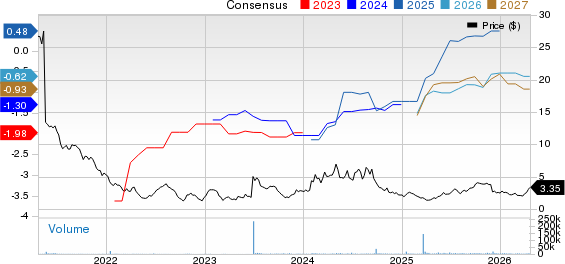
Black Diamond Therapeutics, Inc. price-consensus-chart | Black Diamond Therapeutics, Inc. Quote
Black Diamond’s Biggest Swing Factors and Failure Points
The biggest risk is pipeline concentration. Silevertinib is currently the only wholly owned clinical asset, leaving valuation unusually sensitive to clinical execution, regulatory outcomes, and development timelines tied to a single candidate.
BDTX also has no approved products and has generated revenue solely from licensing intellectual property, reinforcing the reality that commercialization remains several years away. In this context, any clinical, regulatory, or development setback can disproportionately impact investor confidence and long-term valuation.
BDTX Competitive Context in EGFR NSCLC
Competition in NSCLC is intense, and that matters even for differentiated assets. AstraZeneca AZN remains a central force in EGFR-mutant NSCLC through Tagrisso, a leading third-generation, irreversible EGFR tyrosine kinase inhibitor widely approved across major markets. That established standard raises the bar for new entrants to prove differentiated outcomes, not just early response.
Johnson & Johnson JNJ has also strengthened its first-line presence with the FDA approval of Rybrevant in combination with Lazcluze for specific EGFR-mutant NSCLC populations. Newly approved regimens add to the competitive headwinds BDTX must navigate as it advances silevertinib toward later-stage decision points.
Black Diamond’s Bottom Line for a Neutral View
For upside to emerge, investors will likely look for 2026 durability signals, including progression-free survival and duration of response updates, that reinforce the early efficacy and CNS activity story and support a credible path to late-stage development.
Conversely, results that weaken the durability narrative, or any meaningful clinical or regulatory setback, would reinforce market-like expectations given the company’s single-asset dependence and lack of near-term product revenue.
BDTX Zacks Rank
Black Diamond currently carries a Zacks Rank #3 (Hold). You can see the complete list of today’s Zacks #1 Rank (Strong Buy) stocks here.
Research Chief Names "Single Best Pick to Double"
From thousands of stocks, 5 Zacks experts each have chosen their favorite to skyrocket +100% or more in months to come. From those 5, Director of Research Sheraz Mian hand-picks one to have the most explosive upside of all.
This company targets millennial and Gen Z audiences, generating nearly $1 billion in revenue last quarter alone. A recent pullback makes now an ideal time to jump aboard. Of course, all our elite picks aren’t winners but this one could far surpass earlier Zacks’ Stocks Set to Double like Nano-X Imaging which shot up +129.6% in little more than 9 months.
Free: See Our Top Stock And 4 Runners UpWant the latest recommendations from Zacks Investment Research? Today, you can download 7 Best Stocks for the Next 30 Days. Click to get this free report
AstraZeneca PLC (AZN): Free Stock Analysis Report
Johnson & Johnson (JNJ): Free Stock Analysis Report
Black Diamond Therapeutics, Inc. (BDTX): Free Stock Analysis Report
This article originally published on Zacks Investment Research (zacks.com).