

Intel (INTC) just delivered one of its strongest quarters in years, and at least one prominent money manager is not even thinking about cashing out. According to reports, KKM Financial CEO Jeff Kilburg has held his Intel position through years of doubt and is now more convinced than ever.
Kilburg's reasoning goes well beyond quarterly earnings. To him, Intel is a foundational piece of the U.S. economy. Let’s take a closer look.
More Top Stocks Daily: Go behind Wall Street’s hottest headlines with Barchart’s Active Investor newsletter.
 www.barchart.com
 Intel's Q1 Earnings Beat Blew Past Wall Street
Intel's first-quarter results came in well above what analysts had expected. Revenue reached $13.6 billion, more than $1.4 billion above the midpoint of the company's own guidance. It marked the sixth straight quarter Intel beat its financial targets. The company's data center and AI segment, known as DCAI, posted revenue of $5.1 billion in Q1 2026. That was up 22% year-over-year (YoY) and 7% from the prior quarter. Server CPU demand is so high that Intel CEO Lip-Bu Tan said supply is still struggling to keep up with customer demand. "Demand continues to outpace our growing supply," CFO David Zinsner said during the call.
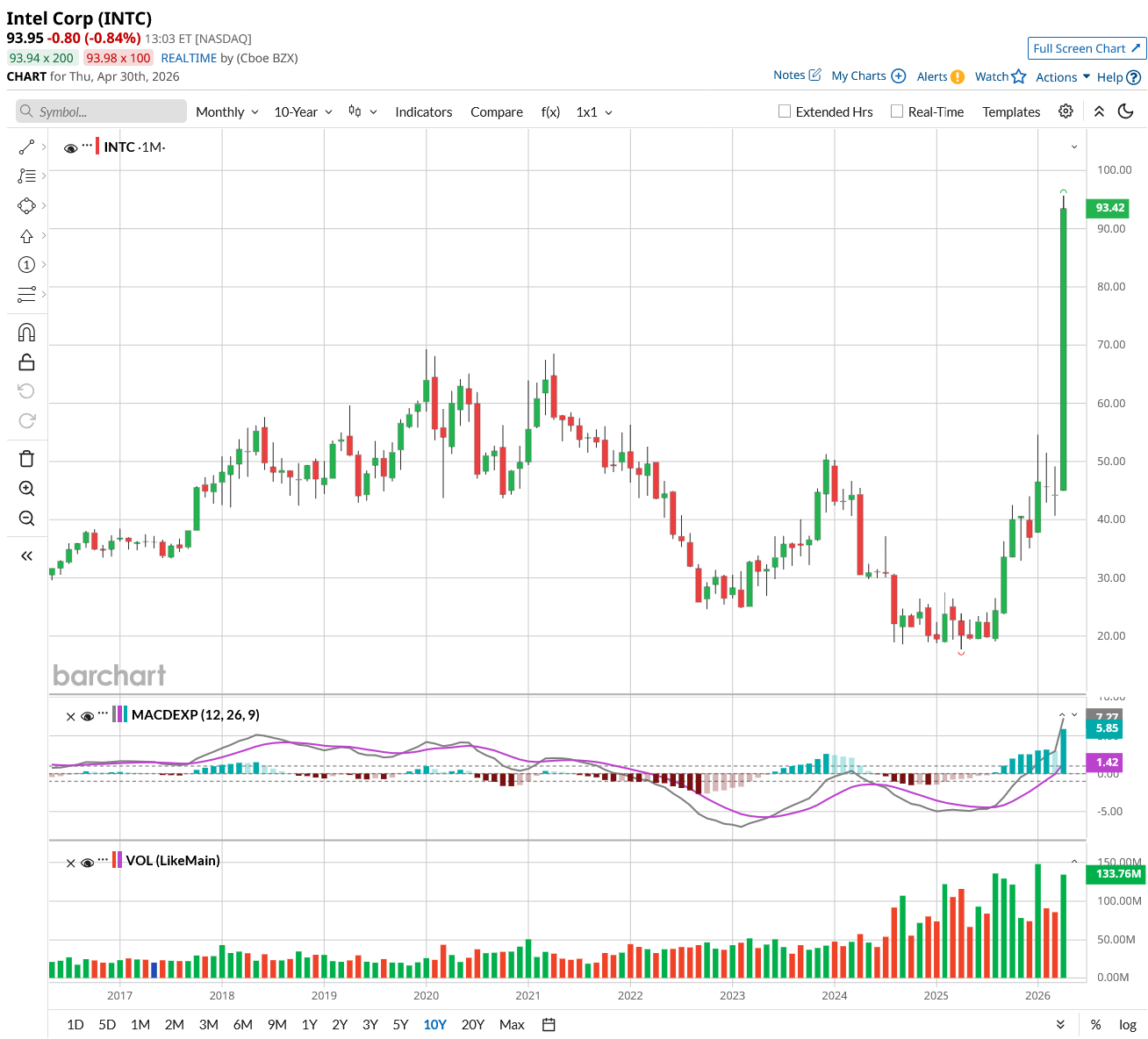
For Q2, Intel guided revenue between $13.8 billion and $14.8 billion, with DCAI expected to grow in the double digits sequentially. Shares surged as much as 22% following the results, briefly touching $85.
Why KKM Is Bullish on INTC Stock
Kilburg told CNBC that Intel has now gained around 300% since the start of 2025. He describes the tech giant as an essential American asset, not just a chip stock.
His conviction has grown alongside Intel's foundry turnaround. The foundry division, which was once a drag on the business with no profit to show for it, is now expected to generate $3 billion next year. Kilburg pointed to the Terafab development as the deal that meaningfully shifted the company's trajectory.
On the earnings call, Tan confirmed that Intel recently announced a partnership with SpaceX, xAI, and Tesla (TSLA) to support Terafab. He and Elon Musk share the view that global semiconductor supply is not keeping pace with demand, and the two are exploring ways to improve manufacturing efficiency at scale.
This kind of deal signals a different Intel from the one trading below $20 just a couple of years ago, when the U.S. government stepped in as a stakeholder. Kilburg acknowledged the current media attention makes him slightly cautious but said the momentum is real.
The CPU Is Back at the Center of the AI Boom
One of the bigger shifts driving Intel's comeback is happening inside the AI infrastructure itself.
For years, graphics processing units (GPUs) dominated the conversation around artificial intelligence. But the workloads are changing as training models require massive numbers of GPUs. Running those models, and especially running AI agents that make decisions in real time, requires far more central processing units (CPUs).
Intel says the ratio of GPUs to CPUs in AI systems has shifted from roughly 8:1 in training environments to closer to 3:1 or 4:1 in inference settings. In agentic AI, that ratio could flip further toward parity or even favor CPUs.
"CPU now serves as the orchestration layer and critical control plane for the entire AI stack," Tan said on the call.
Intel signed multiple long-term agreements in Q1, including a deal with Alphabet's (GOOG) (GOOGL) Google to supply Xeon processors. Zinsner said these contracts typically run three to five years with committed volumes and pricing, giving the company real revenue visibility.
Intel's ASIC business, which builds purpose-built chips tailored to specific customer workloads, is already running at over $1 billion annually and growing fast. Kilburg summed it up plainly. This is a workhorse company that has earned its place back at the table. "I want to own it," he said.
What Do Analysts Think of INTC Stock?
Analysts tracking INTC stock forecast adjusted earnings to expand from $0.42 per share in 2025 to $4.16 per share in 2030. If INTC is priced at 30x forward earnings, it could surge over 50% within the next four years.
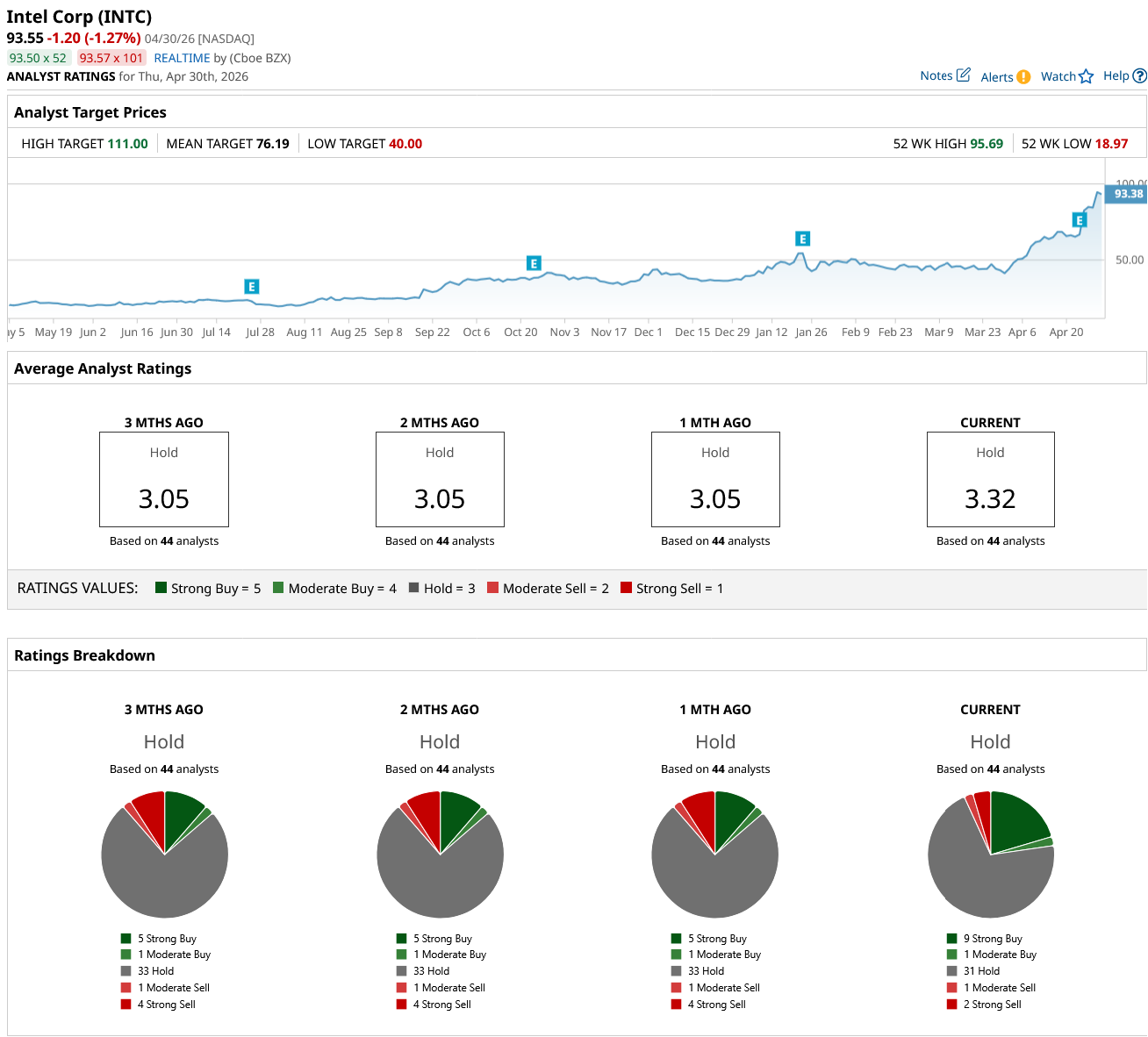
Out of the 44 analysts covering INTC stock, nine recommend a “Strong Buy,” one recommends a “Moderate Buy,” 31 recommend a “Hold” rating, one recommends a “Moderate Sell,” and two recommend a “Strong Sell” rating. The average price target for INTC stock is $74.54, below the current price of $82.
 www.barchart.com
 On the date of publication, Aditya Raghunath did not have (either directly or indirectly) positions in any of the securities mentioned in this article. All information and data in this article is solely for informational purposes. For more information please view the Barchart Disclosure Policy here.
More news from Barchart
Why Should You Buy Intel Stock in Q2? According to This Analyst, It's Critical for the 'American Way of Life' Up Over 17% in the Past 5 Days, Should You Keep Buying Sandisk Stock in May 2026? Micron Stock to $1,000? Surging Memory Demand Could Take MU to New Highs, Says DA Davidson Dozens of Experts Built This Simple Stock Screener for Traders & Investors. It Was Me.