

Artificial intelligence (AI) darling Nvidia Corporation (NVDA) has hit a strange phase lately. The chip giant keeps delivering blockbuster earnings, and yet investors barely seem impressed. And notably, the issue has little to do with Nvidia’s underlying business fundamentals. On May 20, the chip giant once again delivered a stellar fiscal 2027 first-quarter earnings report that checked virtually every box Wall Street was looking for.
Nvidia posted double-digit revenue growth, record-breaking sales, stronger-than-expected top- and bottom-line results, relentless demand for its data center business, and even announced a meaningful increase to its capital return program for shareholders. On paper, it looked like the perfect recipe for a stock rally. Instead, shares slipped about 1.8% following the earnings release. But this isn’t exactly new territory for Nvidia investors. Nvidia’s stock has repeatedly sold off after earnings over the past year, even while the company continued to shatter expectations and raise guidance.
More Yield, Less Trap: Sign up free to get Barchart’s daily Dividend Investor newsletter straight to your inbox.
For instance, shares fell about 5.5% following Nvidia’s fiscal 2026 fourth-quarter report on Feb. 25 and dropped another 3.2% after its fiscal 2026 third-quarter earnings release on Nov. 19, 2025. The pattern is becoming increasingly difficult to ignore. Despite delivering some of the strongest growth numbers in the market and remaining at the center of the AI boom, Nvidia stock has struggled to generate the explosive post-earnings rallies investors once expected.
So, is Wall Street finally growing tired of Nvidia, or are investors simply waiting for the next major catalyst to fuel another leg higher in the AI trade?
About Nvidia Stock
Nvidia didn’t just benefit from the tech boom. It became one of the biggest reasons behind it. Founded in 1993 and based in Santa Clara, California, Nvidia originally made its name by building graphics processing units (GPUs) for gaming. Over time, however, the company expanded far beyond gaming, turning its chips into essential technology powering the modern digital world.
Today, Nvidia’s hardware supports everything from advanced AI systems and massive data centers to autonomous machines and scientific breakthroughs, transforming the company from a gaming-focused chipmaker into one of the key forces driving the AI era. Nvidia is now the leading supplier of infrastructure for generative AI, backed by powerful products such as the H100, Blackwell, and the recently introduced Rubin architecture.
That incredible rise has pushed Nvidia to historic levels, making it the most valuable company in history with an enormous market capitalization of roughly $5.15 trillion as of writing. Like many technology stocks, Nvidia has experienced periods of volatility this year amid muted investor reactions to earnings and a broader semiconductor selloff driven by concerns about AI spending and changing market demand. Even so, the company continues to prove its dominance as a player in the AI and data center market.
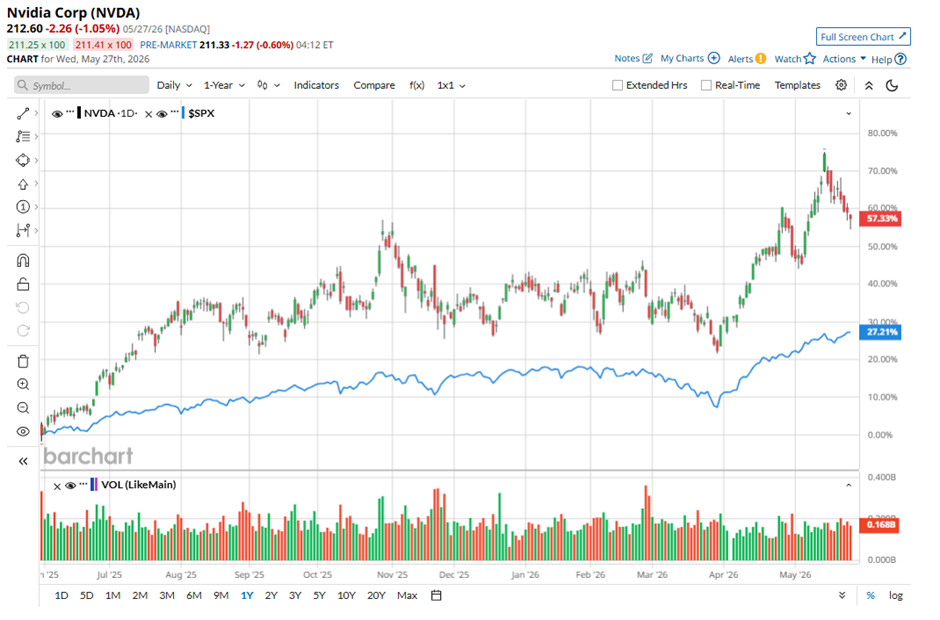
That strength is also evident in Nvidia’s stock performance, which has continued to outperform the broader market. Although Nvidia shares have pulled back 9% from a 52-week high of $236.54 achieved on May 14, the stock is still up an impressive 58.2% over the past year, significantly outperforming the broader S&P 500 Index ($SPX), which gained a much more modest 28.37% during the same period. The momentum has continued into 2026, with Nvidia stock already up another 14.35% year-to-date (YTD), once again staying well ahead of the broader market’s 10.42% gain.
 www.barchart.com
 Deep Diving into Nvidia’s Q1 Earnings Report
Nvidia pulled back the curtain on its fiscal 2027 first-quarter earnings report on May 20, and the results were nothing short of spectacular. The AI chip giant delivered another blockbuster quarter that comfortably crushed Wall Street expectations across the board, further cementing its dominance at the center of the global AI boom. The company reported record-breaking total revenue of $81.6 billion, representing a massive 85% jump from the $44.1 billion reported in the same quarter last year, alongside a strong 20% sequential increase. Furthermore, the figure easily surpassed Wall Street’s consensus estimate of $78.84 billion.
The bottom-line performance was even more remarkable. Adjusted earnings per share surged 140% year-over-year (YOY) to $1.87, easily topping analysts’ expectations of $1.77 per share and further cementing Nvidia’s position as one of the biggest financial growth engines in the global technology sector. Nvidia is reshaping its reporting structure to better align with the company’s evolving business model and future growth opportunities. Nvidia now operates under two primary market platforms, Data Center and Edge Computing, reflecting the company’s expanding reach across the AI ecosystem.
The undisputed star of the quarter remained Nvidia’s Data Center business, which generated an unprecedented $75.2 billion in revenue and accounted for more than 92% of the company’s total sales. The segment posted blistering 92% YOY growth, fueled by relentless demand for generative AI infrastructure and hyperscale cloud deployments as companies continue racing to build out AI capabilities.
Meanwhile, Nvidia’s Edge Computing segment, which now includes data processing devices and systems powering agentic and physical AI applications such as PCs, gaming consoles, workstations, AI-RAN base stations, robotics, and automotive technologies, generated $6.4 billion in revenue during the quarter, reflecting solid 29% YOY growth. Financially, Nvidia continued to demonstrate exceptional operational strength.
The company maintained a robust GAAP gross margin of 74.9%, remaining nearly flat compared to the prior quarter while improving a remarkable 14.4 percentage points from the year-ago period. Nvidia also significantly expanded its shareholder return efforts during the quarter. In the first quarter of fiscal 2027 alone, the company returned a record $20 billion to shareholders through share repurchases and cash dividends.
More notably, Nvidia’s Board of Directors approved an additional massive $80 billion share repurchase authorization on May 18, signaling strong confidence in the company’s long-term growth outlook. Moreover, Nvidia announced a dramatic 25-fold increase to its quarterly cash dividend, raising the payout from just $0.01 per share to $0.25 per share. The dividend is scheduled to be paid on June 26. Looking ahead, Nvidia’s forward guidance suggests the AI capital expenditure supercycle remains far from slowing down.
For the second quarter of fiscal 2027, the company projected revenue of approximately $91 billion at the midpoint, comfortably above Wall Street’s consensus estimate of roughly $86.11 billion. Nvidia also clarified that its outlook does not include any contribution from Data Center compute revenue from China. Additionally, the company expects GAAP and non-GAAP gross margins of 74.9% and 75%, respectively, plus or minus 50 basis points, signaling continued confidence in both profitability and long-term AI demand momentum.
Why Nvidia’s Blowout Earnings Weren’t Enough to Ignite the Stock
Nvidia certainly delivered exactly what Wall Street wanted. Strong earnings, better-than-expected guidance, more details about its business segments, and even a bigger shareholder return program. In short, CEO Jensen Huang checked almost every box investors had hoped for. But despite all that good news, the first-quarter earnings report failed to excite investors.
According to analysts at Goldman Sachs, the main reason is that investors were already heavily positioned in Nvidia before earnings. Many traders already expected strong results, so there wasn’t much surprise left to push the stock sharply higher. Another factor is that investors are now searching for the next AI winner instead of piling further into Nvidia, which is already one of the market’s most-owned stocks.
There’s also a technical reason tied to options trading. Large investors have been actively selling covered calls on Nvidia shares, which has left market makers “long gamma.” In simple terms, that setup tends to reduce sharp price swings, even after major news. So while Nvidia’s results were impressive, the market reaction stayed muted because expectations were already sky-high and much of the good news had likely already been priced into the stock.
How Are Analysts Viewing Nvidia Stock?
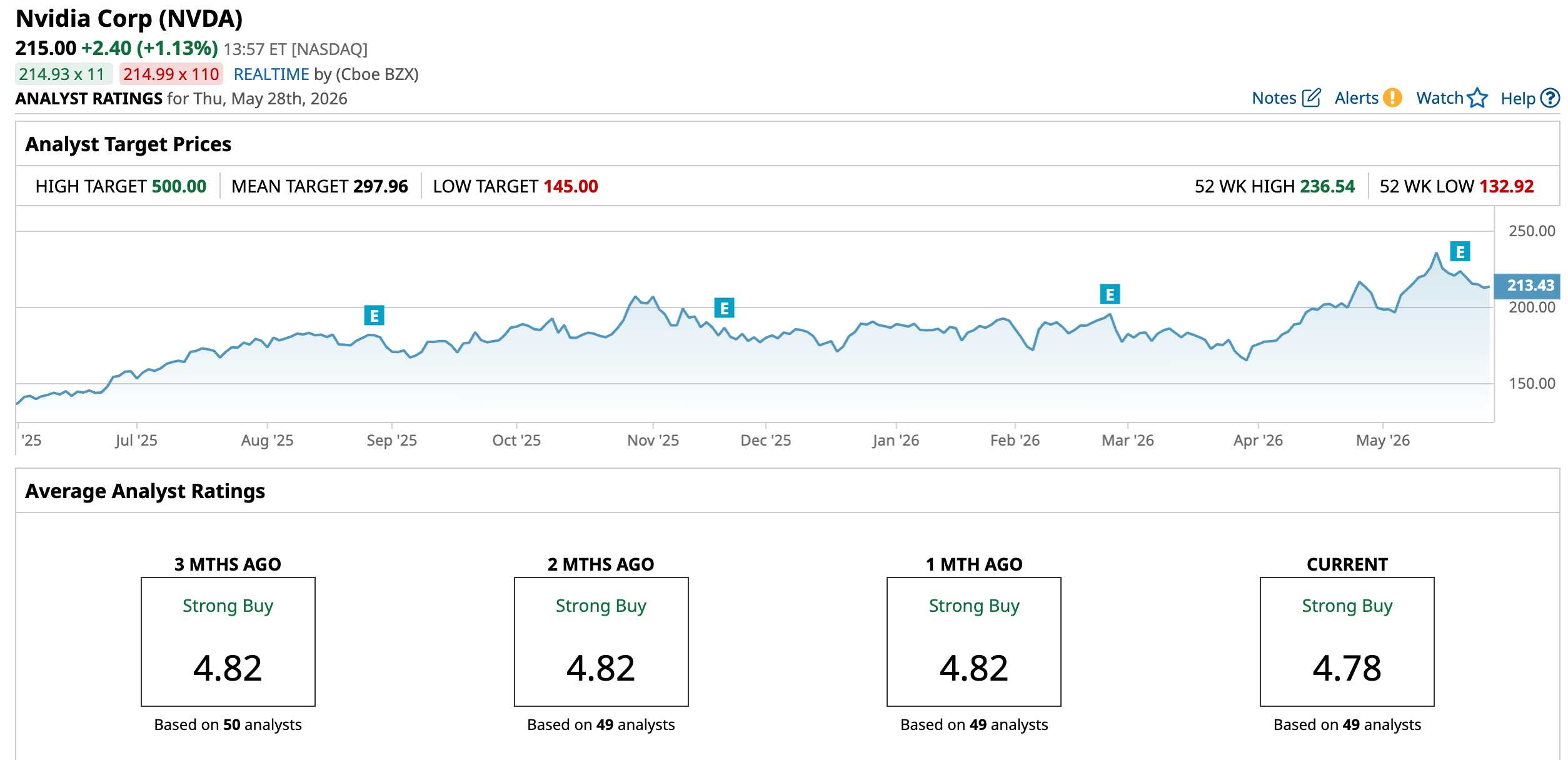
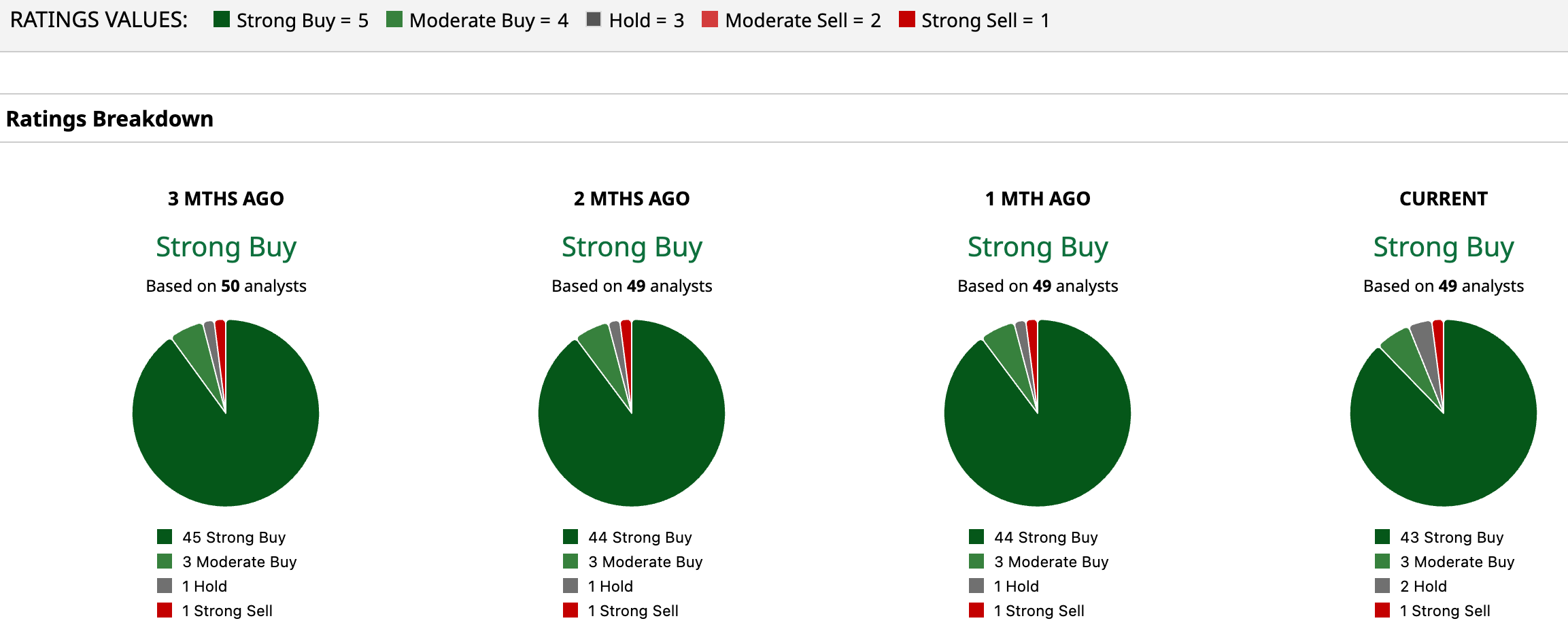
Even though Nvidia’s blockbuster earnings failed to ignite a major post-report rally, Wall Street’s confidence in the AI giant remains overwhelmingly strong. Analysts continue to see massive upside ahead for NVDA, with the stock earning a consensus “Strong Buy” rating. Among the 49 analysts covering the company, 43 recommend “Strong Buy,” three rate it “Moderate Buy,” two remain on the sidelines with “Hold,” and only one carries a “Strong Sell” recommendation.
The average price target of $297.96 points to potential upside of 38.59%, while the Street-high target of $500 suggests Nvidia shares could soar an eye-popping 132.56% from current levels.
 www.barchart.com
  www.barchart.com
 On the date of publication, Anushka Mukherji did not have (either directly or indirectly) positions in any of the securities mentioned in this article. All information and data in this article is solely for informational purposes. For more information please view the Barchart Disclosure Policy here.
More news from Barchart
Nvidia Stock Has Been Muted After Excellent Earnings. Investors Are Ready for the Next Big Thing. Visa vs. Mastercard Stock: Using Barchart Data to Pick the Best Payments Giant Now Ford Stock Is Moving Like Tesla Now. Its Results Can’t Justify the Premium. 3 Dividend Kings to Buy Now to Replace the Social Security Income You're About to Lose