


The space industry is enjoying a fresh wave of investor excitement, and the catalyst is none other than Elon Musk’s SpaceX (SPCX). Following its blockbuster Nasdaq debut on Friday, the space giant commanded a staggering valuation of nearly $2.1 trillion, cementing its place among the world's most valuable companies. Investors are looking beyond the billions SpaceX is spending today and betting that its massive investments in satellites, orbital data centers, and artificial intelligence (AI) could deliver enormous rewards down the road.
Moreover, the enthusiasm seems to have spilled across the entire space sector, creating a halo effect for smaller public companies tied to launches, satellites, and orbital services. And one of the biggest winners has been Momentus (MNTS). Shares of the small-cap space company rocketed nearly 43.74% on June 11 as anticipation surrounding the SpaceX debut reached a fever pitch. However, the stock surrendered some of those gains a day later, falling almost 27% after the company announced a $25 million equity offering.
More Top Stocks Daily: Go behind Wall Street’s hottest headlines with Barchart’s Active Investor newsletter.
While raising capital is often necessary for small space companies developing and launching new technologies, issuing additional shares can dilute existing investors and weigh on the stock price. Even so, with Momentus still up by triple digits in 2026, the company remains a high-flying name that investors may want to examine more closely.
About Momentus Stock
Founded in 2017, California-based Momentus is a small U.S. commercial space company aiming to build the infrastructure needed for the next era of the space economy. The company provides satellites, satellite components, and a range of in-space transportation and infrastructure services for both government and commercial customers. Its offerings support missions spanning communications, missile tracking, and advanced scientific research.
Beyond satellite hardware, Momentus provides hosted payload services, support for in-space assembly, on-orbit servicing and refueling, and the transportation of satellites to precise orbital destinations. Momentus stepped into the spotlight in 2021 when it went public through a special purpose acquisition company (SPAC) merger, a path many emerging space companies pursued during the industry's boom period.
However, life as a public company has been far from easy. The company has navigated regulatory hurdles, leadership transitions, funding challenges, and delays in commercializing its technology. Like many early-stage space ventures, Momentus has invested heavily in research, development, and testing while generating relatively modest revenue.
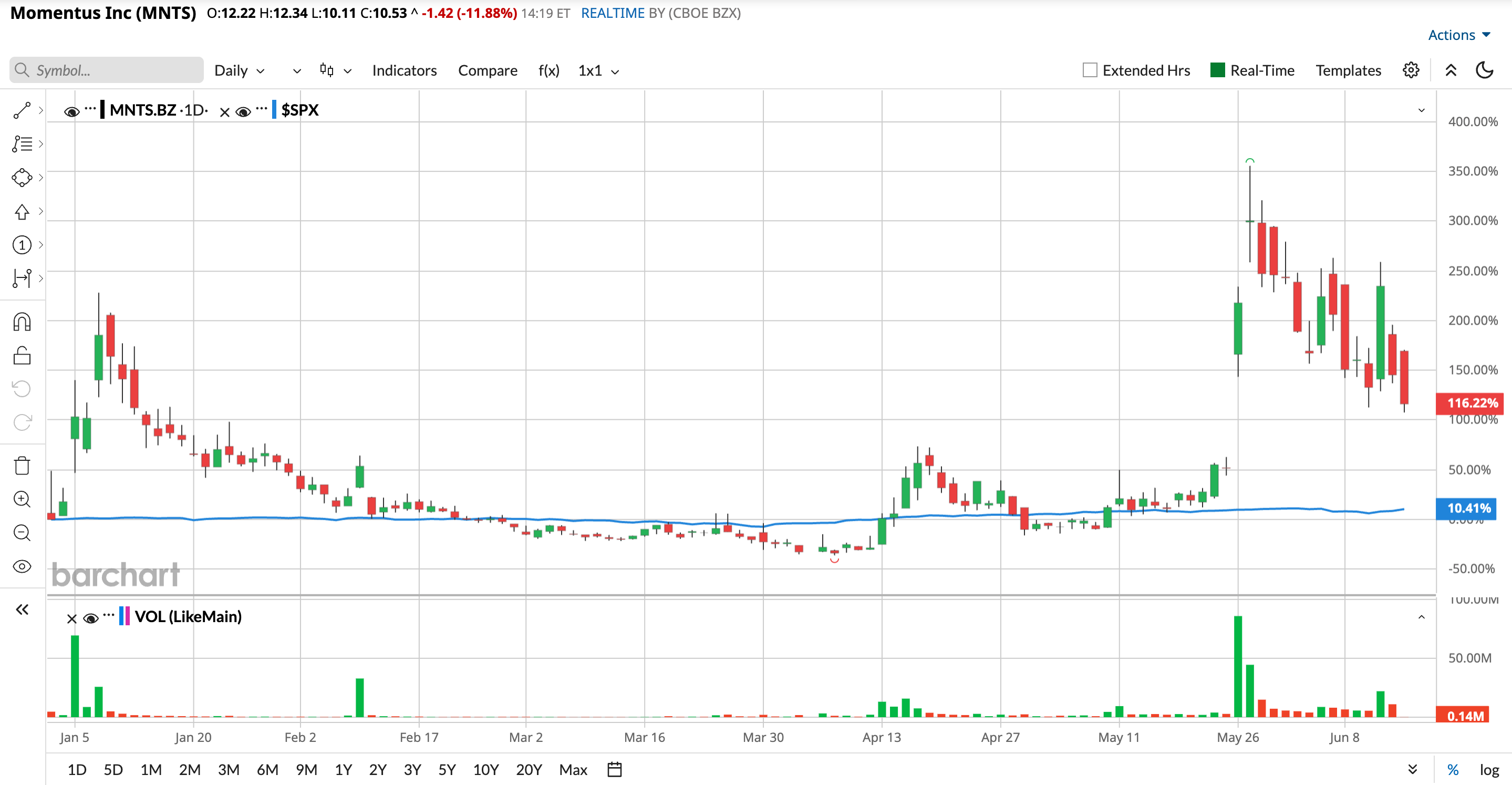
At the heart of its strategy is Vigoride, the company's orbital service vehicle designed to shuttle satellites to different orbits after launch and potentially provide a variety of in-space services. Through a series of missions and technical milestones, Momentus has been working to demonstrate that its technology can operate reliably in the demanding conditions of space. After a punishing stretch that saw its shares plunge nearly 91.7% over the past two years, Momentus is finally giving investors something to cheer about.
The space company, currently valued at a market capitalization of $126.1 million, has emerged as one of 2026’s standout performers, with its stock soaring 117% year-to-date (YTD) and an astonishing 160% over the past three months. In comparison, the broader S&P 500 Index ($SPX) has posted gains of just 10.5% and 14% over those respective periods, underscoring the magnitude of Momentus’ remarkable comeback.
 www.barchart.com
 Momentus’ Q1 Earnings Snapshot
Momentus delivered a strong first quarter in 2026 in May, reporting revenue of $3.22 million, a dramatic increase from just $0.32 million in Q1 2025. The explosive top-line growth was driven primarily by the successful deployment and operational scaling of the Vigoride-7 Orbital Service Vehicle (OSV), which carried 10 hosted payloads into space in late March, alongside growing engineering contract services for major defense and space agencies. The results marked a significant step forward in the company’s efforts to commercialize its space infrastructure and expand its presence in the rapidly evolving orbital services market.
However, the company’s aggressive growth investments continued to pressure profitability. Net loss widened to $9.48 million in the first quarter, compared to a net loss of $6.17 million in the year-ago period. Management attributed the larger loss to higher operating expenses, including increased research and development spending and SG&A costs tied to managing complex orbital operations, integrating advanced navigation systems, and scaling fulfillment capabilities to support future missions.
Operationally, Momentus continued to strengthen its standing with government and institutional customers. The company highlighted ongoing work with DARPA, SpaceWERX, the U.S. Air Force, and NASA, while noting that its upcoming Vigoride-8 mission successfully progressed through its Preliminary Design Review under fixed NASA contracts. These developments underscore growing customer confidence in the company’s technology and execution capabilities as it expands its mission pipeline.
Looking ahead, Momentus forecasts revenue of $10 million in 2026, representing a roughly 9x increase from $1.1 million in 2025, driven by milestone-based contracts with NASA and the U.S. Department of Defense. Cash on hand stood at $26.2 million as of April 23, 2026, up from $12.8 million at the end of 2025, which management estimates provides at least a 12-month operational runway.
In a separate press release, Momentus revealed that it had substantially strengthened its financial position, increasing cash reserves to approximately $76 million while maintaining zero debt on its balance sheet. The improved liquidity was achieved through the full utilization of a $50 million at-the-market (ATM) program, a $25 million institutional private placement, and significant warrant exercises. With a fortified balance sheet and enhanced financial flexibility, the aerospace company appears better positioned to execute its 2026 and 2027 launch manifests and pursue its long-term growth objectives.
Key Takeaways
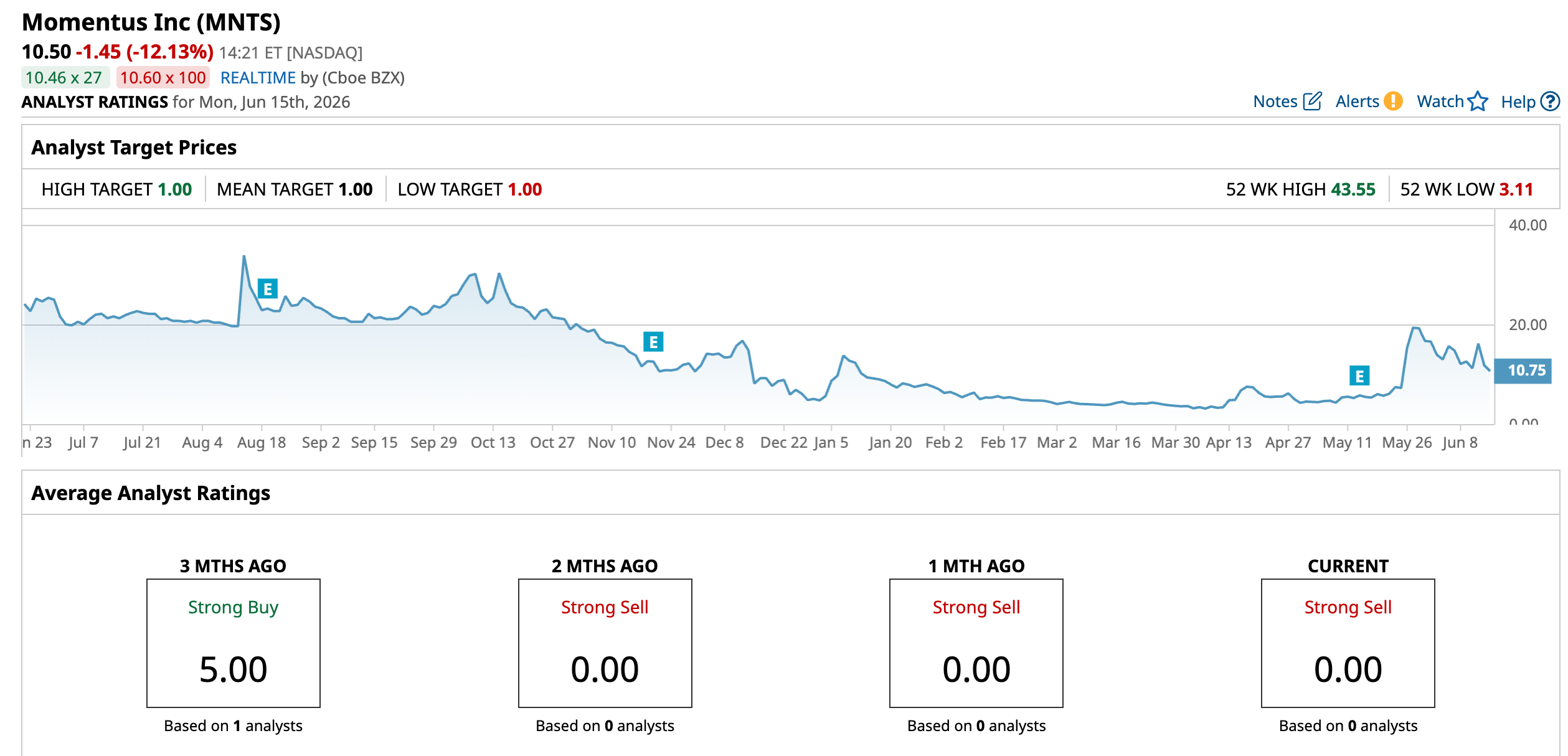
Momentus has emerged as one of the hottest space stocks of 2026, fueled by the excitement surrounding SpaceX’s blockbuster IPO and growing confidence in its own business execution. While the company remains unprofitable, its rapid revenue growth, expanding roster of government customers, successful Vigoride missions, and significantly strengthened balance sheet suggest it is making meaningful progress toward commercial scale.
The recent equity offering may have weighed on the stock in the short term, but the additional capital provides valuable runway to fund future launches and technology development. For investors willing to tolerate the risks that come with an early-stage space company, Momentus offers exposure to a potentially massive long-term opportunity.
 www.barchart.com
  www.barchart.com
 On the date of publication, Anushka Mukherji did not have (either directly or indirectly) positions in any of the securities mentioned in this article. All information and data in this article is solely for informational purposes. For more information please view the Barchart Disclosure Policy here.
More news from Barchart
Momentus Stock Is Up 145% In 2026. How to Play MNTS After the SpaceX IPO. NVDA Stock Alert: Nvidia Aims to Raise $20 Billion From Bond Offering Elon Musk Needs ASML for Terafab. You Don’t Need ASML Stock in Your Portfolio. If You’re Looking for the ‘Next Big Thing’ Before the OpenAI and Anthropic IPOs, Try This Barchart Stock Screener