

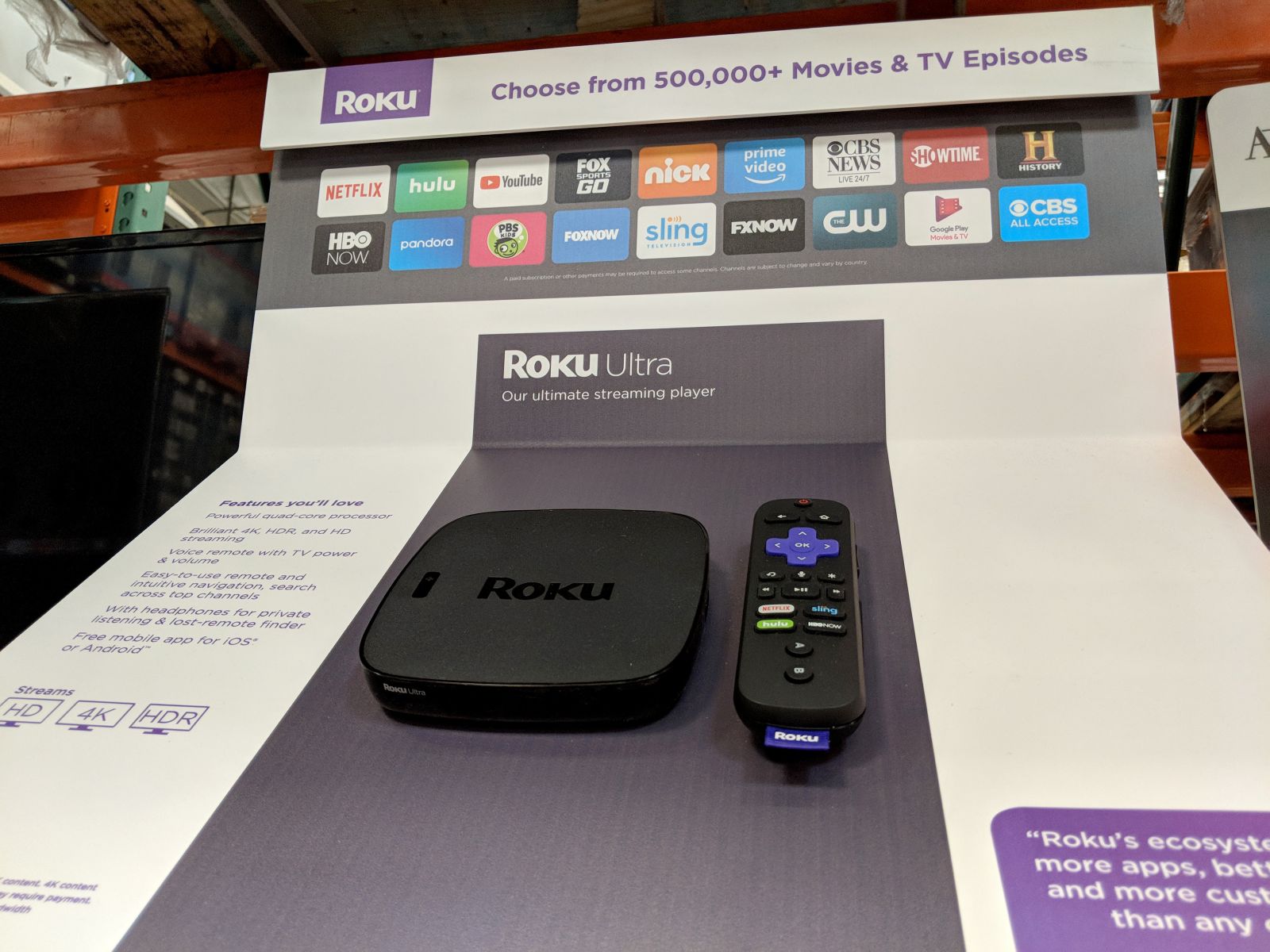
The announcement that Roku (ROKU) is officially being acquired marks the end of an era for one of the original darlings of the streaming revolution.
For years, the company was the gold standard of disruptive technology. Its platform transformed how millions of households consumed media, and its equity performance subsequently turned early believers into millionaires.
More Top Stocks Daily: Go behind Wall Street’s hottest headlines with Barchart’s Active Investor newsletter.
But for investors who refused to separate the company’s real-world long-term application from its equity valuation, the journey became a painful exercise in capital erosion. Roku eventually accepted a buyout offer that represents a mere fraction of its all-time high. This is far from unique.
The corporate lifecycle of Roku offers a timeless, urgent lesson for anyone currently throwing capital at AI stocks and ETFs. An innovative product does not automatically guarantee a forever-compounding stock price.
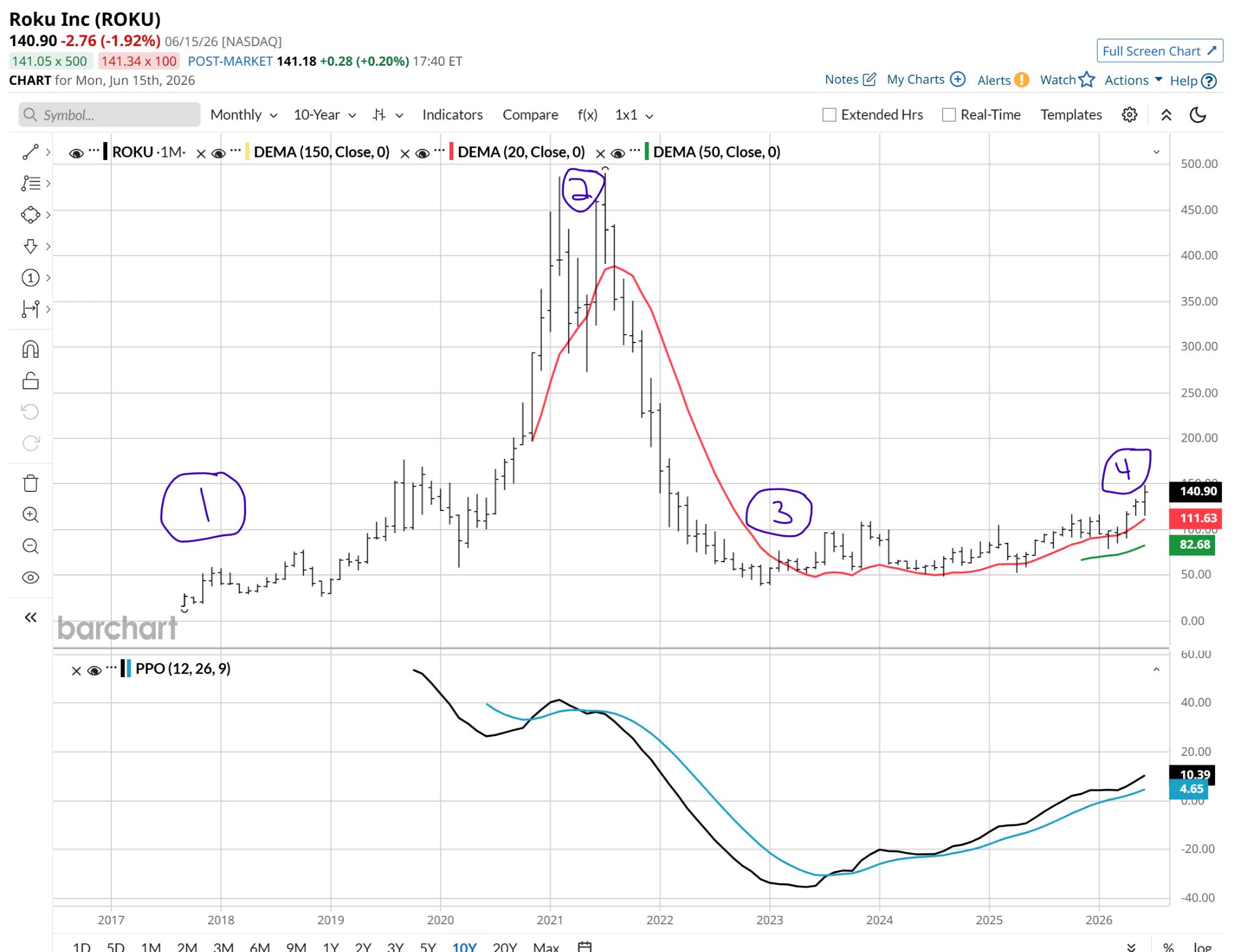
In fact, the whole cycle from IPO to untouchable market icon to the dustbin can all happen in under a decade. As was the case with ROKU. It went public in late 2017… and here we are.
 www.barchart.com
 The chart above is monthly prices, to accommodate ROKU’s entire time as a public company. I labeled four phases:
IPO and escalator up, which then turned into more of a rocket ship advance. A steep fall from that peak, never to be seen again. A period of “consolidated price action” as we technicians say. That is, it went everywhere, but ultimately nowhere, until it became in play. And then it sold, as was just announced.Which ROKU Shareholder Type Are You?
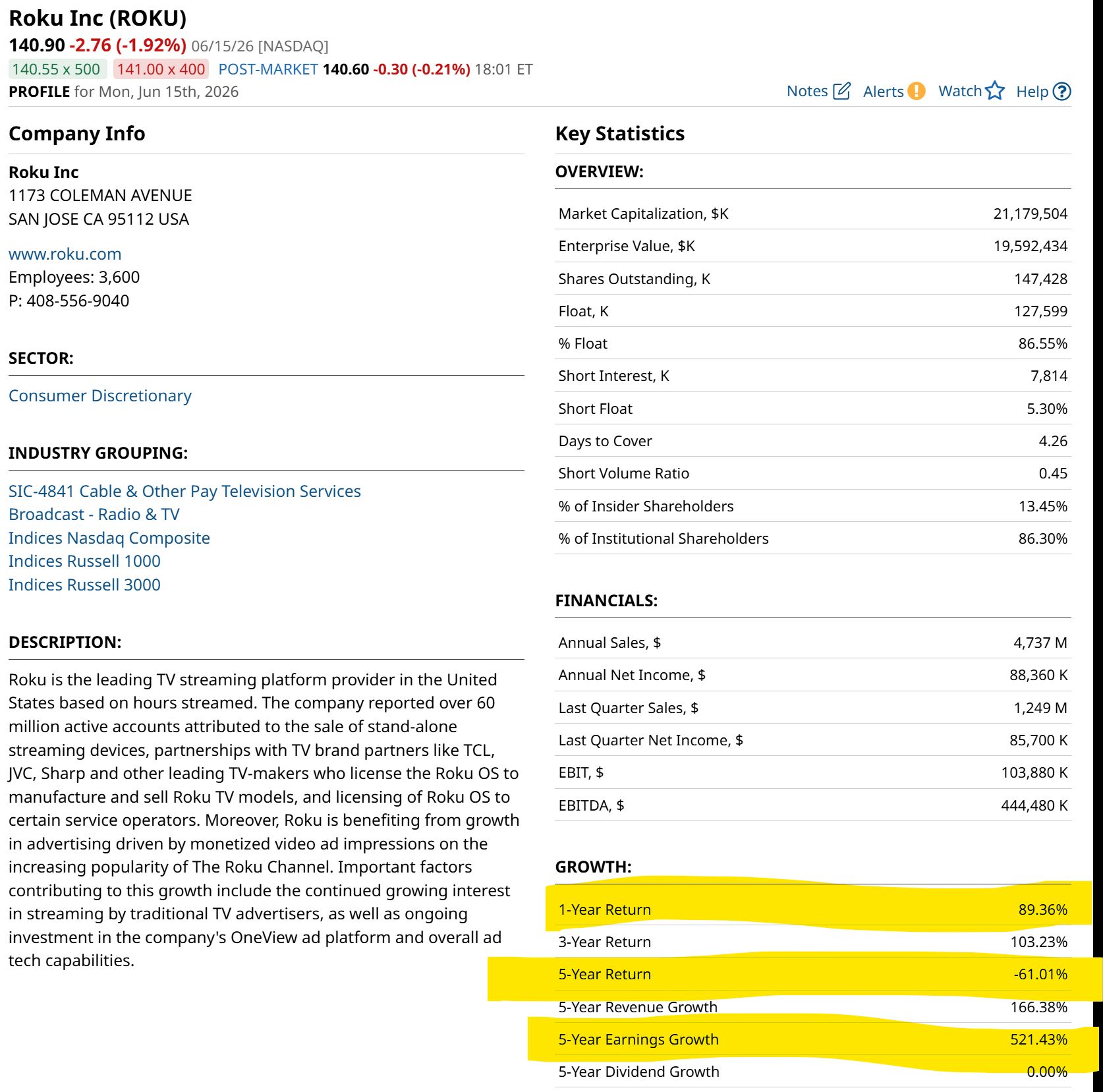
This statistics page has a few yellow highlights of note. If you bought ROKU stock a year ago, you’ve nearly doubled your money. That’s roughly the same statement one can make if they held it for three years. And five years back, the decline of more than 60% is what long-term holders endured.
 www.barchart.com
 That came despite an astronomical rate of earnings growth. Not all stocks move higher when earnings do. Not when that growth is baked into the stock price years ahead of time. Which is, in my view, the very biggest risk to many AI stocks. That includes the hyperscalers.
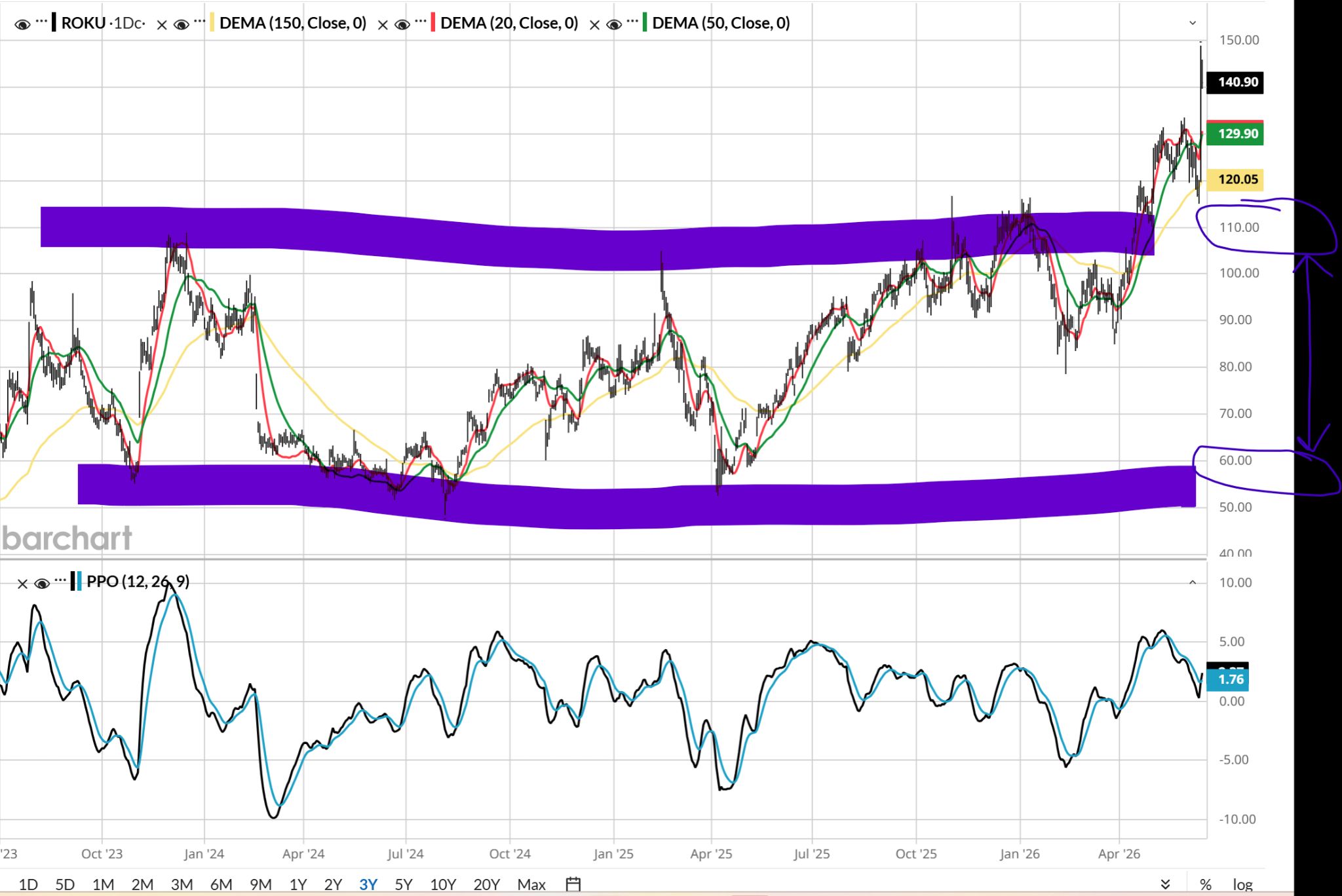
This covers the last three years. As you can see, there’s a wide trading range here. About 100% from top to bottom. This is what the broad stock market has looked like in the past at times. In fact, frequently.
It serves as both a warning, and as part of my rationale for the way I’m approaching stock selection going forward. I am expecting more charts to resemble ROKU’s. It follows that a trader’s mentality can exploit this, while buy-and-hold investors suffer.
 www.barchart.com
 How Did ROKU Get to This Point?
When Roku was executing its historic ascent, the consensus narrative surrounding the company felt bulletproof. The legacy cable bundle was disintegrating, connected television advertising was expanding exponentially, and Roku sat comfortably as the independent operating system of choice for major television manufacturers.
During this peak expansion phase, standard valuation metrics like free cash flow or price-earnings ratios were cast aside. The market began pricing the stock based on blue-sky assumptions of infinite global scale. Investors fell into the psychological trap of believing that because the streaming shift was permanent, the stock’s upward trajectory must be permanent too.
The market routinely confuses rapid revenue growth with long-term profitability. That’s like assuming all tall people will grow up to be great basketball players. I am one of many human examples of how that is not true!
As the streaming arena matured, massive hardware competitors with deeper pockets aggressively subsidized their own operating systems, compressing Roku’s hardware margins. Simultaneously, the skyrocketing cost of user acquisition began eating away at platform revenue.
That technology succeeded in changing the world. HOWEVER, the stock had run too far, too fast. Those who treated it as a perpetual hold were severely penalized. In time, sensible valuation reasserted itself, culminating in a buyout that created capital losses for late-stage buyers.
In fact, based on ROKU’s price around $120 a share, its high until the announcement of the acquisition, anyone who bought the stock since the spring of 2022 was under water. And those who bought it as far back as 2019 ended up in the neighborhood of break-even. Think about that, especially given where the S&P 500 Index ($SPX) has traded since that time.
Why AI Stock Prices Might Go the Way of ROKU
The direct parallel to the current AI landscape is similar. Right now, the investing public is operating under the exact same assumption that drove the Roku bubble: the belief that because AI is a transformative technological breakthrough, every stock associated with it is a safe bet to compound higher indefinitely.
We are seeing the identical behavior play out across the semiconductor, hardware, and enterprise software sectors. Trillions of dollars are chasing a handful of corporate leaders, pushing multiples to levels that require absolute, flawless financial execution for the next decade.
History tells us that this perfect execution rarely happens. Maybe this time really IS different. But I’m neither counting on that, nor investing with that assumption.
Rob Isbitts created the ROAR Score, based on his 40+ years of technical analysis experience. ROAR helps DIY investors manage risk and create their own portfolios. For Rob’s written research, check out ETFYourself.com.
On the date of publication, Rob Isbitts did not have (either directly or indirectly) positions in any of the securities mentioned in this article. All information and data in this article is solely for informational purposes. For more information please view the Barchart Disclosure Policy here.
More news from Barchart
Shorting Out-of-the-Money Cisco Puts and Calls Provides Shareholders Extra Income Why the Roku Buyout Is a Cautionary Tale for AI Stocks Apple Is Betting That Its Next Big Product Could Be AirPods with Cameras The ‘Mini Vertiv’ AI Stock Wall Street Is Strongly Bullish About