

Microsoft Corporation (MSFT) investors have grown accustomed to watching Azure margins and artificial intelligence (AI) spending for clues about the direction its stock heads next, but this week the bigger signal came from Europe instead.
On Tuesday, July 21, Microsoft and French AI start-up Mistral AI announced a major expansion of their strategic partnership through a multi-billion-euro agreement. Under the deal, Microsoft will gain greater access to European GPU infrastructure, while Mistral will deepen the integration of its AI models across Microsoft's enterprise ecosystem.
More Yield, Less Trap: Sign up free to get Barchart’s daily Dividend Investor newsletter straight to your inbox.
As part of the collaboration, Microsoft will use portions of Mistral's expanded European GPU capacity to help meet growing regional demand. Mistral's Medium 3.5 and OCR 4 models will also be added to Microsoft Foundry, with Medium 3.5 becoming available in Copilot Studio as well.
The technology heavyweight has additionally committed to directly using dedicated segments of this European infrastructure, reinforcing its digital sovereignty commitments first outlined in 2025.
While Microsoft continues to rely heavily on OpenAI, enterprise customers are asking for greater flexibility in choosing AI models, and European regulators remain cautious about AI capabilities becoming too concentrated within U.S.-based platforms.
By strengthening its partnership with Mistral, Microsoft will gain a credible European AI offering that OpenAI cannot provide. This can become an important indicator of Microsoft's competitive positioning and a development investors should watch closely.
About Microsoft Stock
Currently headquartered in Redmond, Washington, Microsoft's journey began in Albuquerque in 1975, selling software for early hobbyist computers. It rose to dominance through MS-DOS and Windows, becoming synonymous with the personal computer itself.
Through the 90s and 2000s, it built an empire on desktop software, though it stumbled badly when mobile and internet-first computing arrived. Under Satya Nadella since 2014, Microsoft reinvented itself around the cloud, betting big on Azure and subscription software.
The reinvention has paid off spectacularly with its early, aggressive push into AI through OpenAI, transforming a once-fading giant into one of the most valuable and relevant companies on Earth again. The comeback is clear in the numbers today, with Microsoft commanding a market cap of $2.96 trillion.
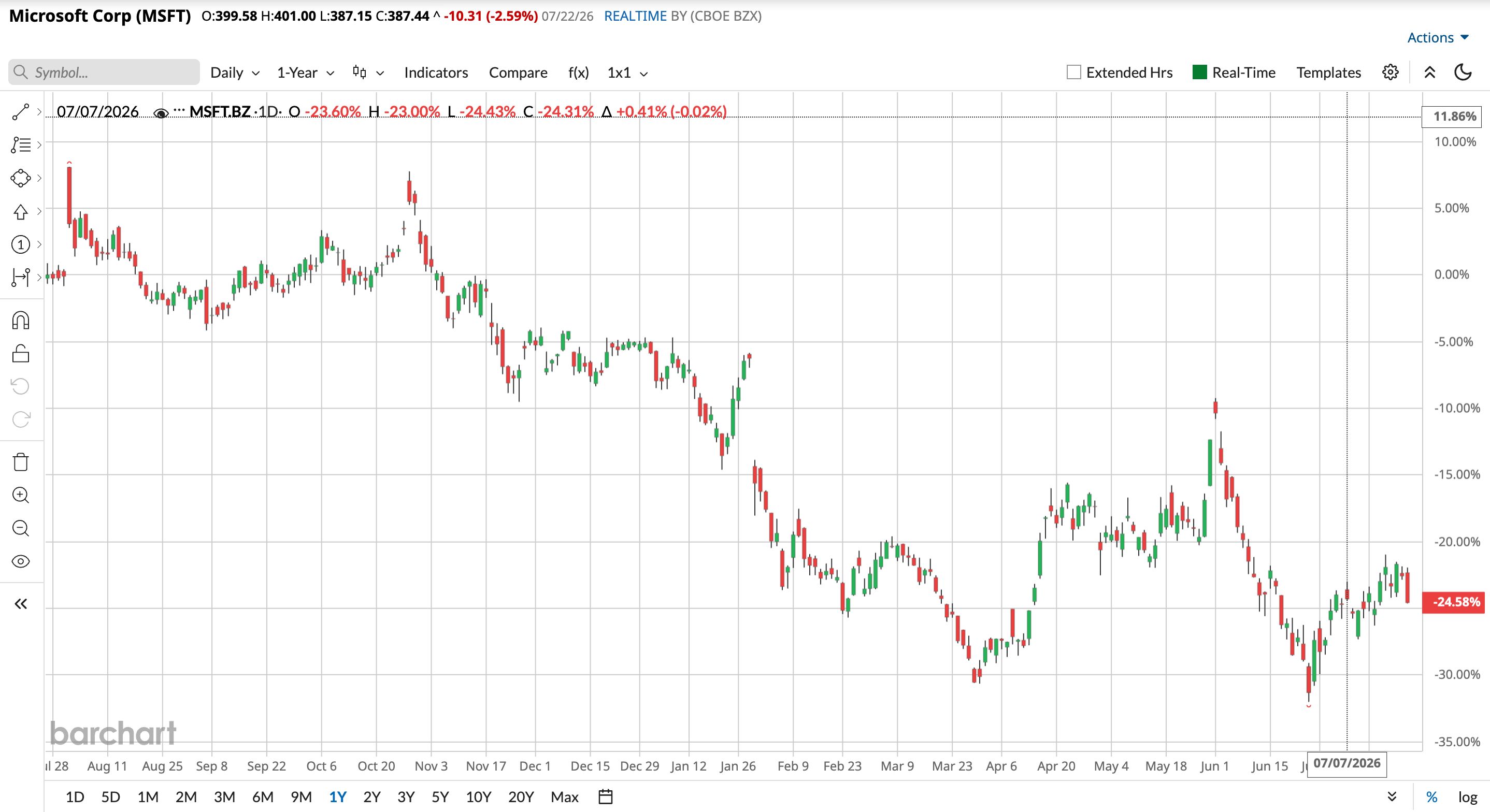
Even so, size offers no immunity when the broader market turns sour, and Microsoft has felt its share of that pain recently. MSFT stock has declined 23% over the past 52 weeks, and 2026 hasn't brought much relief either, with shares slipping another 19.6% so far this year.
 www.barchart.com
 The pullback has left the stock looking considerably more reasonably priced than it has in some time. Its shares are currently trading at 23.63 times forward adjusted price-to-earnings non-GAAP. The figure sits below the industry benchmark and its own five-year average multiple, seeming less as a warning sign and more as an opening worth a second look.
Dividend investors have little to grumble about in the meantime. Microsoft has raised its payout for 21 straight years and currently distributes an annual dividend of $3.64 per share, yielding 0.90%. The next payment of $0.91 per share is set to go out on Sept. 10 to shareholders on record as of Aug. 20.
Microsoft Surpasses Q3 Earnings
On April 29, Microsoft unveiled its Q3 FY2026 financial results, wherein revenue climbed 18.3% year-over-year (YOY) to $82.89 billion, sailing past analyst estimates of $81.39 billion. Meanwhile, EPS jumped 23.4% from the year-ago period to $4.27, clearing the Street's forecast of $4.06.
The real muscle showed up once you looked past the headline figures. Microsoft Cloud pulled in more than $54 billion in revenue, up 29% from the prior year, while the AI segment ran away with the spotlight. Its annual revenue run rate crossed $37 billion, a 123% YOY leap that few businesses of Microsoft's size ever manage to pull off.
None of that momentum arrived free of cost, though. Building out AI infrastructure at this pace demands serious capital, and the strain landed squarely on profitability, with gross margin easing down to 68% for the quarter.
Heavier AI usage across the board piled on additional pressure, but tighter efficiency within Azure and Microsoft 365 Commercial cloud managed to absorb part of that squeeze and kept margins from sliding further.
Money kept flowing out the door on the infrastructure side as well. Capital expenditures, including finance leases, totaled $31.9 billion for the quarter, and Microsoft has given no indication of slowing that pace anytime soon.
Looking ahead, management has guided Q4 FY2026 revenue toward a range of $86.7 billion to $87.8 billion, implying growth between 13% and 15%. The spending commitment runs far deeper than any single quarter suggests. Across all of CY2026, Microsoft expects capital expenditures to be near $190 billion, with rising memory costs accounting for a sizable share of that total.
Despite the scale of that outlay, confidence on Wall Street hasn't wavered. Microsoft is scheduled to report its Q4 FY2026 results on Wednesday, July 29, after the close, and analysts currently expect EPS of $4.21, representing 15.3% YOY growth. For full-year FY2026, EPS could rise 22.5% from last year to reach $16.71, with FY2027 projected to climb a further 15.5% to $19.30.
What Do Analysts Expect for Microsoft Stock?
Brad Zelnick at Deutsche Bank has reiterated his “Buy” rating on MSFT stock, setting a price target of $550, calling the stock's current level a solid buying opportunity and pointing to expected annual EPS growth of 15% or more over the coming years.
Josh Baer at Morgan Stanley shares that optimism, backing a “Buy” rating with a price target of $650, citing Microsoft's leadership in generative AI along with strengthening demand trends across Azure and M365 paired with Copilot.
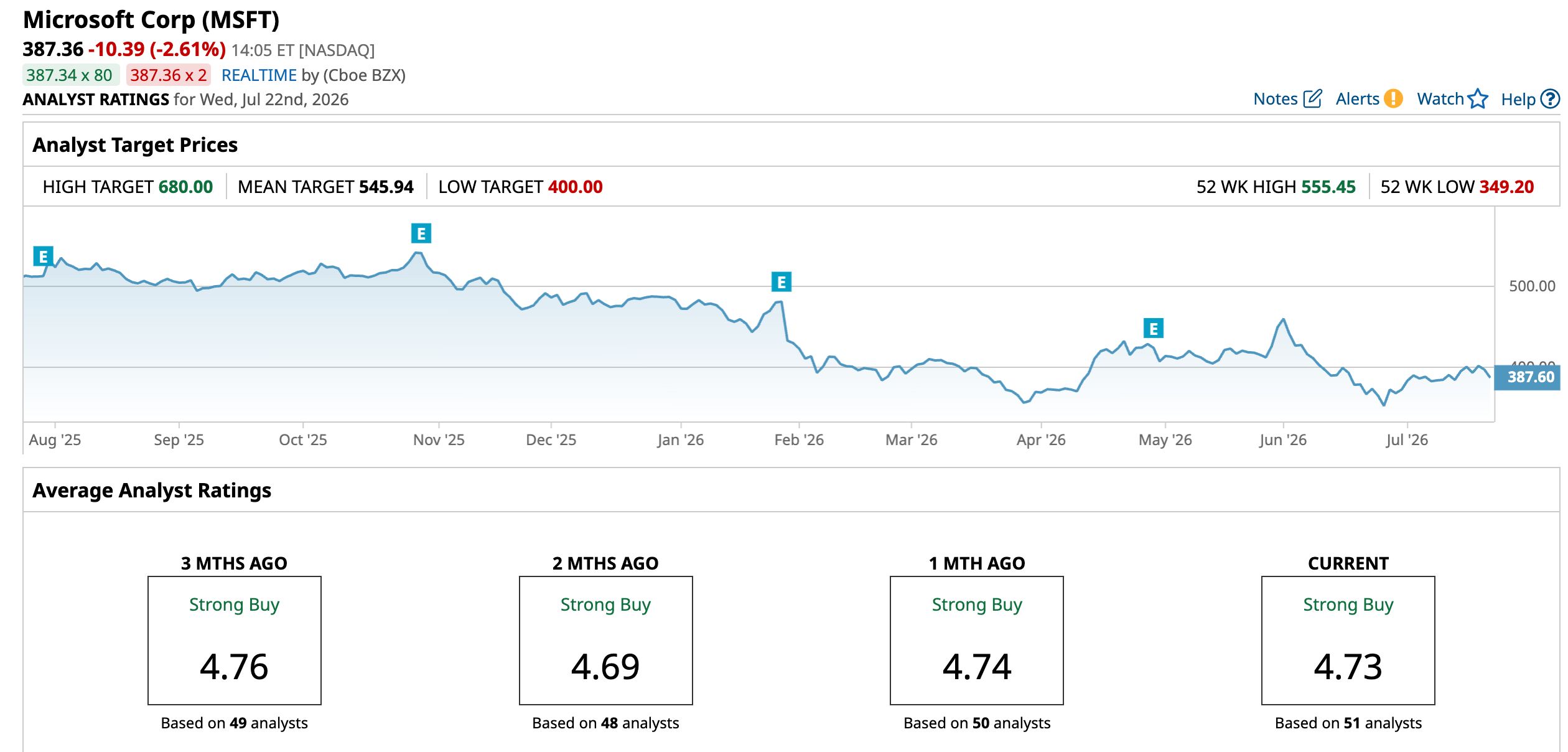
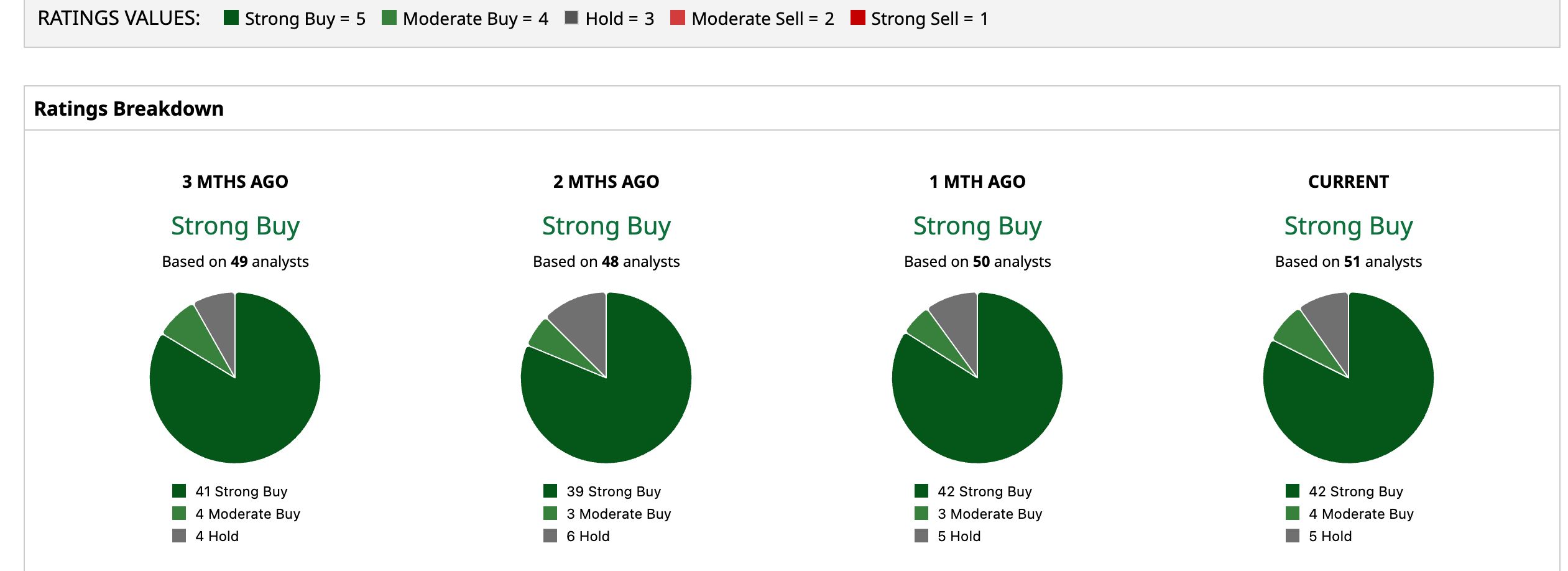
Taken together, the confidence adds up to an overall “Strong Buy” rating for MSFT stock. Among the 51 analysts covering the name, 42 rate it a “Strong Buy,” four call it a “Moderate Buy,” and just five prefer to sit on the sidelines with a “Hold.”
To that end, the average price target of $545.94 represents potential upside of 40.9%. Meanwhile, the Street-High target of $680 implies a 75.6% gain from current levels. This leaves investors with a wide runway to weigh just how far Microsoft's AI ambitions, Mistral partnership included, might carry the stock from here.
 www.barchart.com
  www.barchart.com
 On the date of publication, Aanchal Sugandh did not have (either directly or indirectly) positions in any of the securities mentioned in this article. All information and data in this article is solely for informational purposes. For more information please view the Barchart Disclosure Policy here.
More news from Barchart
Microsoft Is Deepening Ties with AI Giant Mistral. What That Actually Means for MSFT Stock Investors. Chevron Leads 3 Dividend Aristocrats Paying Up to 4% and Beating the S&P 500 This High-Yield Bank Stock Just Raised Its Dividend by 11% TSMC’s AI Boom Is Just Getting Started: Why Investors Should Buy the Pullback in TSM Stock Now