

Nvidia Corporation’s (NVDA) reported decision to delay the launch of its RTX 50 Super due to soaring GDDR7 memory prices may seem like bad news for the GPU market, but it could create an unexpected opportunity for Micron Technology (MU). According to Wedbush, the delay highlights just how tight the memory market has become, reinforcing the pricing power of memory suppliers like Micron rather than signaling weakening demand.
The reported issue is not with Nvidia’s GPU chips themselves but with the cost of the new 3GB GDDR7 memory modules used in the upgraded graphics cards. Industry reports suggest these chips now cost roughly three times as much as traditional 2GB modules, making it difficult for Nvidia and its board partners to launch new products without significantly increasing retail prices. So, Nvidia has allegedly postponed the rollout despite hardware already being ready for distribution.
More Top Stocks Daily: Go behind Wall Street’s hottest headlines with Barchart’s Active Investor newsletter.
For Micron, however, these elevated prices underscore a fundamentally favorable supply-demand environment. As one of the world’s leading suppliers of advanced DRAM and GDDR memory, Micron stands to benefit from sustained pricing strength driven by AI infrastructure, high-performance computing, and gaming demand.
Wedbush believes this dynamic strengthens Micron’s investment case. If memory shortages persist, Micron could continue enjoying higher average selling prices across multiple product categories, including graphics DRAM and high-bandwidth memory (HBM), both of which are seeing robust demand from artificial-intelligence (AI) applications. While Nvidia may face near-term launch challenges, Micron appears well positioned to capture more value.
About Micron Technology Stock
Micron Technology is a semiconductor company that designs, develops, manufactures and sells memory and storage products globally, including DRAM, NAND flash memory, HBM, solid-state drives (SSDs) and other memory modules. Headquartered in Boise, Idaho, Micron operates multiple business units serving cloud/data-center, mobile and client, automotive/embedded, and enterprise segments worldwide. Micron has reached $1.1 trillion market cap, putting it among the largest and most valuable players in the global semiconductor industry.
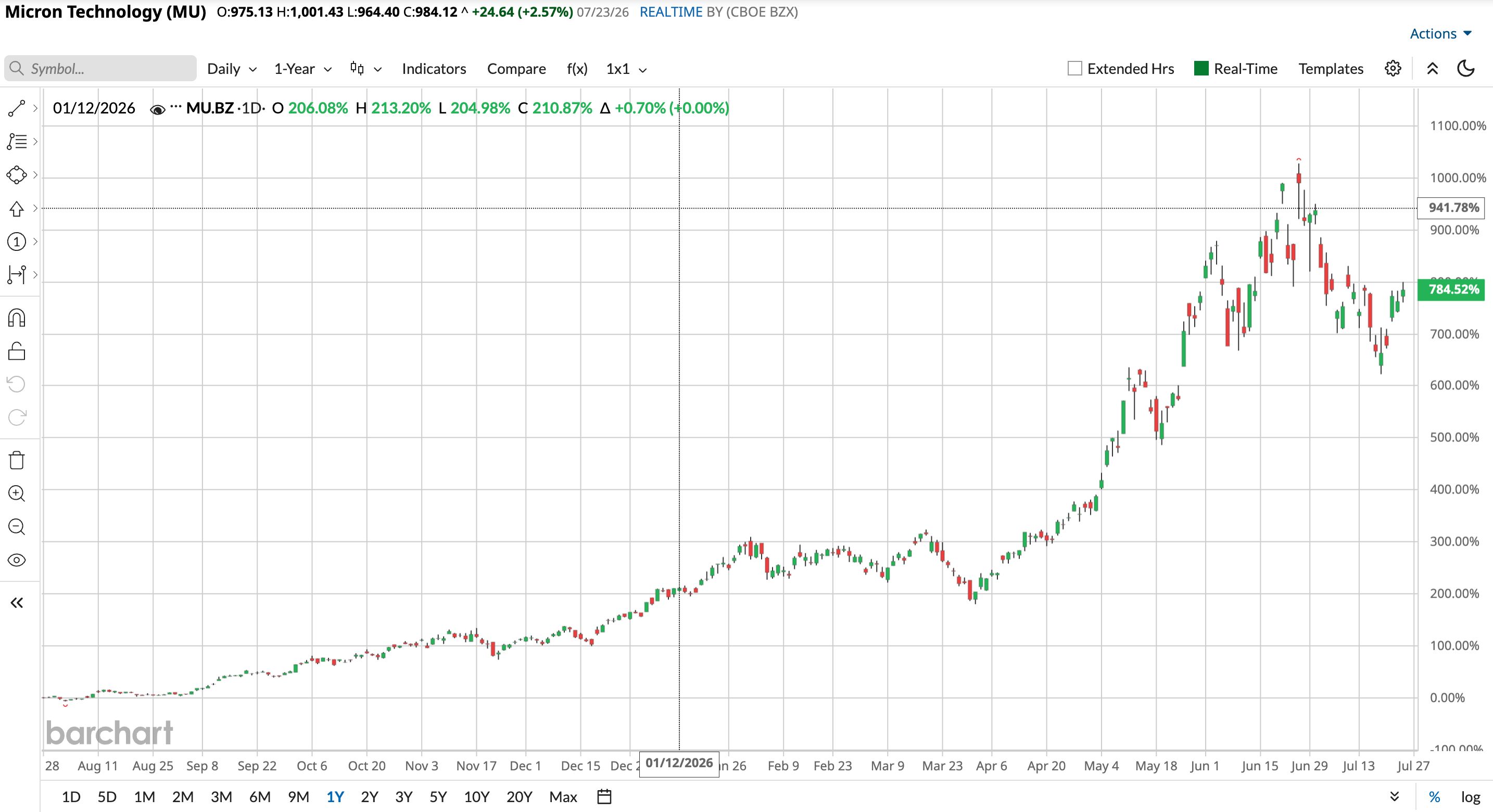
Micron has been one of the best-performing semiconductor stocks this year, delivering solid gains of 236.2% on a year-to-date (YTD) basis and 778.5% over the past 52 weeks as investors have grown increasingly bullish on the company’s position in the AI memory market. Strong demand for high-bandwidth memory and DRAM, combined with tight industry supply and improving pricing, has supported the stock’s strong performance.
Moreover, on July 21, Micron shares surged 12.2% intraday driven by reports that Nvidia had delayed the launch of its RTX 50 Super GPUs because of soaring GDDR7 memory prices.
Wedbush viewed the development as a positive for Micron, arguing that the delay underscores the industry’s tight memory supply and the growing pricing power of memory manufacturers. According to the firm, elevated memory prices reinforce Micron’s favorable supply-demand dynamics and strengthen its earnings outlook, as the company remains a key supplier of advanced memory chips.
 www.barchart.com
 Even so, the stock still seems to be trading at a discount compared to industry peers at 13.31 times forward price-to-earnings.
Strong Q3 Results
Micron Technology delivered a solid third-quarter fiscal 2026 (which ended May 28) report on June 24. Micron reported record quarterly revenue of $41.46 billion, representing year-over-year (YOY) growth of 345.8%. Also, revenue jumped from $23.9 billion in fiscal Q2 2026, highlighting the strength.
The company’s earnings recovery was even more impressive, with non-GAAP EPS rising to $25.11 from $1.91 in the prior-year quarter, which was above expectations, while non-GAAP net income increased to $28.9 billion from $2.2 billion in the prior-year period.
Profit margins expanded sharply as Micron benefited from strong pricing, tight memory supply, and rising demand for AI infrastructure. Non-GAAP gross margin reached 84.9% in Q3 FY2026, compared with 39% a year earlier, showing the significant operating leverage created by the memory recovery. Operating cash flow also surged to $25.4 billion, compared with $4.6 billion in fiscal Q3 2025, giving Micron greater financial flexibility to invest in next-generation memory production.
The biggest growth driver remains AI. Micron has been capitalizing on demand for HBM memory used in advanced AI systems and data centers, where limited supply and accelerating AI adoption have improved pricing power across the memory industry.
Furthermore, Micron provided a strong outlook for fiscal fourth quarter 2026, expecting revenue of $50 billion (plus or minus $1 billion), non-GAAP gross margin of about 86%, and non-GAAP EPS of $31 (plus or minus $1).
Also, the consensus EPS estimate of $72.93 for fiscal 2026 reflects an increase of 849.6%, while the EPS estimate of $158 for fiscal 2027 indicates a 116.7% rise YOY.
What Do Analysts Expect for Micron Stock?
On July 14, KeyBanc reiterated its “Overweight” rating on Micron and raised its price target from $1,600 to $1,750, reflecting increased confidence in the company’s growth prospects.
Also, last month, Susquehanna maintained its “Positive” rating on Micron and raised its price target from $1,750 to $2,000 after the company reported stronger-than-expected results and guidance. The firm cited growing confidence in Micron’s ability to sustain high margins, improving AI-driven memory demand, and increased server demand, supported by long-term supply agreements.
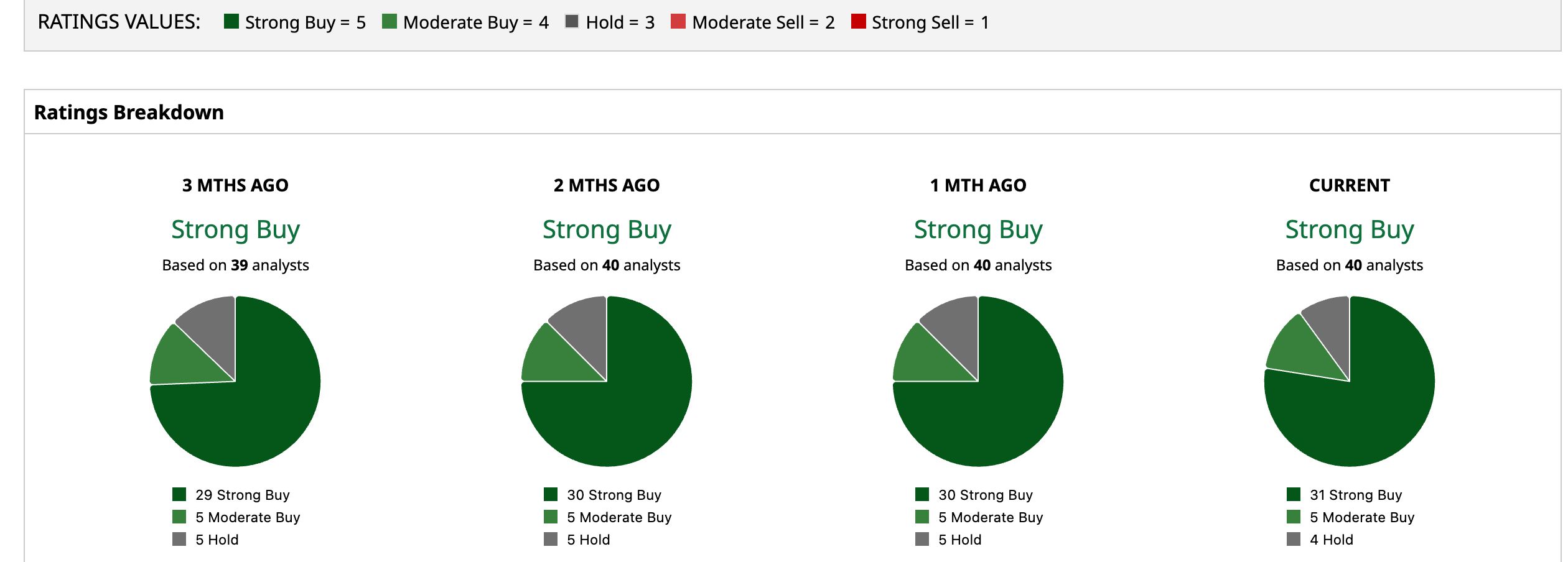
Overall, MU has a consensus “Strong Buy” rating. Of the 40 analysts covering the stock, 31 advise a “Strong Buy,” five suggest a “Moderate Buy,” and four analysts are on the sidelines, giving it a “Hold” rating.
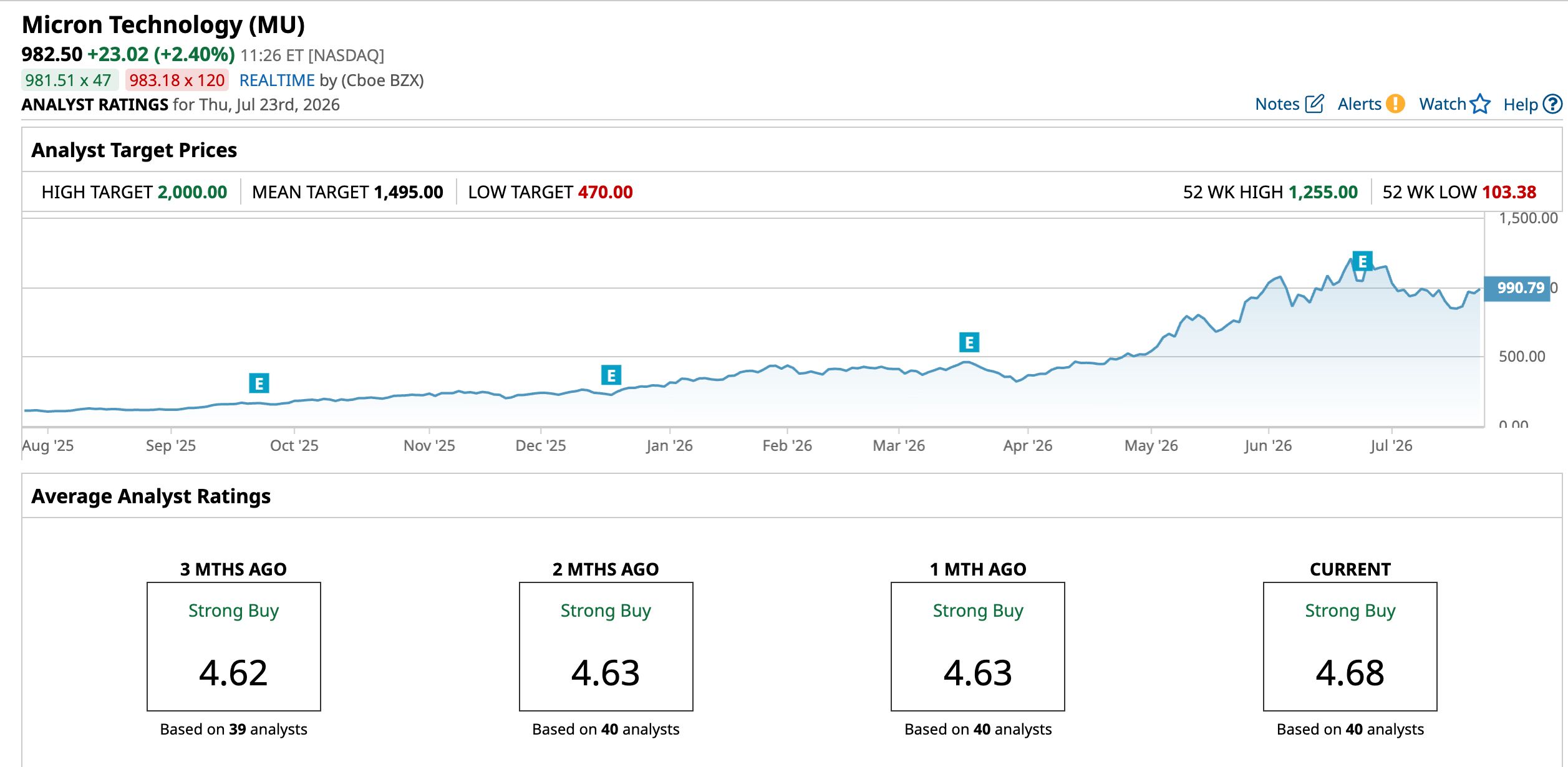
While the average analyst price target of $1,495 suggests an upside of 52.2%, Susquehanna’s Street-high target price of $2,000 suggests that the stock could rally as much as 103.6%.
 www.barchart.com
  www.barchart.com
 On the date of publication, Subhasree Kar did not have (either directly or indirectly) positions in any of the securities mentioned in this article. All information and data in this article is solely for informational purposes. For more information please view the Barchart Disclosure Policy here.
More news from Barchart
AMZN Stock Layoffs: What to Know as Amazon Cuts AI Jobs Oklo Joins Trump’s $200M Nuclear Push for AI. Here’s What It Means for OKLO Stock. Dear SpaceX Stock Fans, Mark Your Calendars for July 23 Why Nvidia (NVDA) Stock Faces Sell-the-News Risk Following Its Q2 Earnings Report