

The AI revolution is evolving. If the first phase was all about training the models on large datasets, inference is at the center of the second one. Here, many analysts believe that Advanced Micro Devices (AMD) has an edge over its much bigger rival, Nvidia (NVDA), and thus has the opportunity to close the gap with the bellwether of the industry.
To that end, reports have surfaced that tech titan Google is looking to collaborate with the Lisa Su-led company to develop the next iteration of its tensor processing unit, or TPU. News about the 10th-generation TPU comes at a time when question marks have been raised again about Google's AI prowess after its Gemini models lag the frontier models of OpenAI's ChatGPT and Anthropic's Claude.
More Top Stocks Daily: Go behind Wall Street’s hottest headlines with Barchart’s Active Investor newsletter.
Matt Bryson of Wedbush Securities reckons that this would be a significant development for AMD if it comes to fruition. In a note to clients, he said, "We would find it noteworthy if Google collaborated with AMD vs. Broadcom, Marvell, or Intel (with the latter seemingly the most often mentioned choice for such aspirational transitional projects of late)."
About AMD
Founded in 1969, AMD is one of the most important semiconductor companies in the world, operating a broad computing platform spanning CPUs, GPUs, networking, adaptive computing, and full AI systems. Also, in July 2026, at its Advancing AI event, AMD launched Helios, its rack-scale AI infrastructure platform that integrates Instinct GPUs, EPYC CPUs, Pensando networking, and ROCm software.
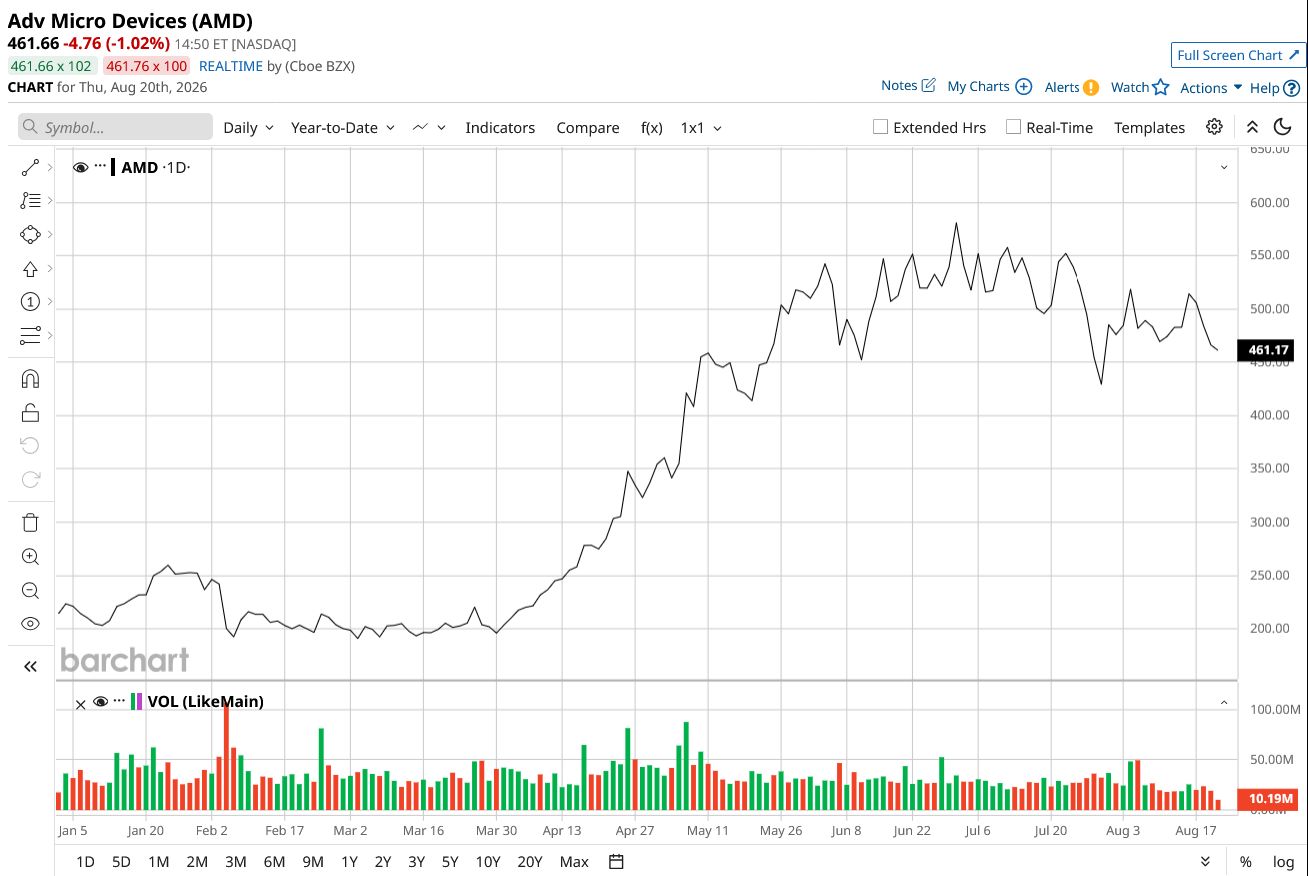
Valued at a market cap of $790.8 billion, AMD has had a roaring 2026 so far, rallying by 116%.
So, what could have possibly tempted Google to go with AMD as its new semiconductor partner instead of Broadcom (AVGO)? Let's find out.
 www.barchart.com
 Inference Powered by Helios
As AI workloads increase in complexity by the day, the demand for inference only grows stronger. Thus, the Helios rack-scale system could not have been debuted at a better time.
CEO Lisa Su elucidated in the latest earnings call how hot the need for Helios is right now when she said, “Across a broad range of inferencing workloads, Helios delivers up to 15% more throughput at the same rack power and up to 30% more tokens per dollar than the competition. Customer pull for Helios is very strong and tracking ahead of our initial forecast.” AMD backs the talk as well with customers like Microsoft (MSFT), Meta (META), Anthropic, and OpenAI already on board. Thus, reliability from leading players in the industry could have nudged Google to opt for AMD, too, apart from the performance and efficiency aspect.
Moreover, Helios provides a mutually beneficial scenario for AMD and its customers. While Helios holds the potential to shift AMD from primarily a supplier of GPUs toward a provider of higher-margin AI infrastructure solutions, it also opens the door to multi-billion-dollar agreements. On the other hand, customers gain the ability to combine hardware and software from multiple vendors within a single rack to lower expenses, tailor configurations for highly specific performance requirements, and independently upgrade GPUs, CPUs, network interface cards, storage, and switches from various suppliers. This approach avoids dependence on any single vendor’s proprietary AI hardware and can help make the overall infrastructure more adaptable over time.
The acquisition of Taalas will also help AMD to augment its inference ambitions. Taalas designs specialized chips that accelerate inference by placing a model's weights and data pathways directly within the transistors themselves instead of retrieving them from memory during every forward pass. AMD intends to integrate this technology into its accelerator product plans with its Instinct graphics processing units. This is especially crucial in an environment where memory prices are soaring, and if AMD can negate even a fraction of these costs, it would provide a boost to its margins.
Double Delight Q2
AMD left little to be desired from its Q2 2026 results. Ignoring the share price fall after the release of the results, it must be noted that AMD reported a double beat (again) on both revenue and earnings.
Revenues were up 50% from the previous year to $11.5 billion, with data center revenues at $6.7 billion, representing a growth of 107% on a year-over-year (YoY) basis. Gross margins saw a significant jump as well, rising to 54% in the quarter from 40% last year. Notably, the company expects Q3 net revenues to be between $12.7 billion and $13.3 billion, much higher than the consensus of $12.5 billion.
Meanwhile, earnings shot up by 246% in the same period to $1.66 per share, coming in ahead of the consensus estimate of $1.62 per share. Overall, this was the seventh consecutive quarter of earnings beats from the company.
Net cash from operating activities continued on its upward trajectory, this time coming in at $2.4 billion in Q2 2026. This was $1.5 billion in the year-ago period. Free cash flow increased by 32% from the year-ago period to $1.6 billion as the company closed the quarter with a cash balance of $13.1 billion. This was much higher than its short-term debt levels of $875 million.
The quarter also saw AMD launching the next generation of its GPUs (AMD Instinct MI400 Series) and CPUs (6th Gen AMD EPYC server CPUs), along with the aforementioned Helios rack-scale systems.
However, AMD's sharp rally has pushed its stock to grossly overvalued levels. Its forward P/E, P/S, and P/CF of 64.06, 15.57, and 100.62 have material gaps with the sector medians of 23.77, 3.41, and 20.07, respectively.
Analyst Opinion of AMD Stock
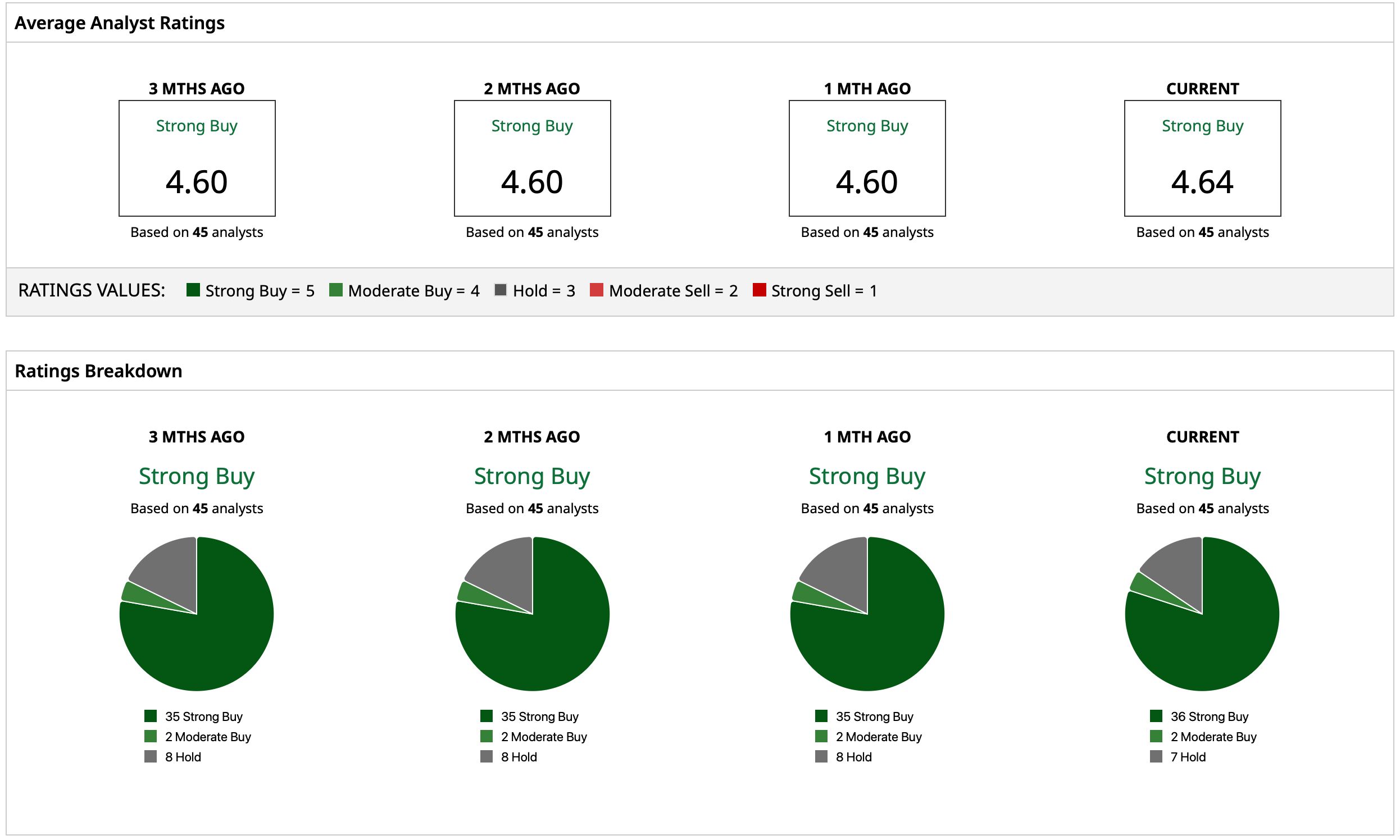
Considering this, analysts have attributed to AMD stock an overall consensus rating of “Strong Buy” with a mean target price of $621.73, which indicates a potential upside of 35% from current levels. Out of 45 analysts covering the stock, 36 have a “Strong Buy” rating, two have a “Moderate Buy” rating, and seven have a “Hold” rating.
 www.barchart.com
 On the date of publication, Pathikrit Bose did not have (either directly or indirectly) positions in any of the securities mentioned in this article. All information and data in this article is solely for informational purposes. For more information please view the Barchart Disclosure Policy here.
More news from Barchart
SMCI Stock Alert: What to Know as Super Micro Computer Wraps Investigation Google Is Reportedly Working with AMD for Its New TPU. What This Means for AMD Stock. Is the VIX Inexpensive Going into the Historically Volatile Fall in 2026? Duquesne Management Just Dumped Its Entire Stake in This Surging AI Stock