

Merck (MRK) was at the center of a major cancer-treatment update in August. Specifically, the drugmaker and Moderna (MRNA) said their personalized mRNA cancer therapy, intismeran autogene, delivered positive results in a Phase 3 study involving 1,137 patients with high-risk melanoma.
Used with Keytruda, the treatment reduced the risk of cancer returning or causing death and improved distant metastasis-free survival compared with Keytruda alone. Merck shares jumped 11% on the news. That was a big move for the stock, which had posted only five single-day gains of more than 5% over the past year.
More Yield, Less Trap: Sign up free to get Barchart’s daily Dividend Investor newsletter straight to your inbox.
The news added to an already strong run for Merck. Currently, MRK stock is up 36% year-to-date (YTD), ahead of the Nasdaq Composite’s ($NASX) 12% gain over the same period. The company is also paying investors to wait for the longer-term potential of its cancer pipeline. Merck declared a quarterly dividend of $0.85 per share, payable on Oct. 7 to shareholders of record on Sept. 15. That works out to about $3.40 per share annually and gives the stock a yield of about 2.36%.
Can Merck keep delivering both share-price gains and dividend income heading into 2027? Let’s take a closer look.
Financial Strength Behind Merck Stock
Merck sells prescription drugs, vaccines, and animal-health products. Its biggest product is Keytruda, a leading cancer treatment that remains the main driver of its oncology business.
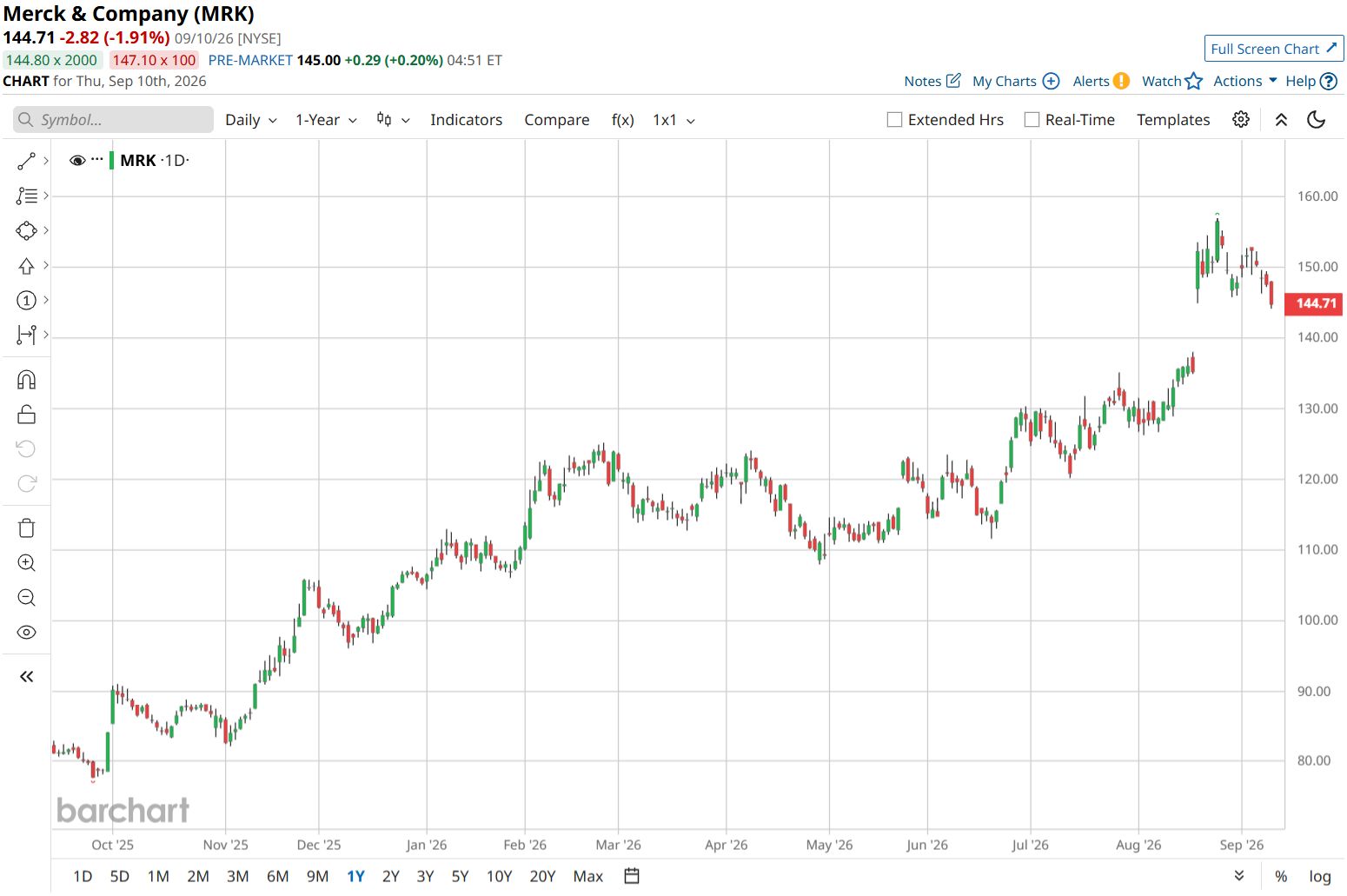
The stock has had a strong run this year. MRK stock is up 77% over the past 52 weeks and has gained 37% so far this year.
 www.barchart.com
 That rally has made the shares more expensive. Merck stock trades at 52 times forward earnings, compared with the healthcare sector average of roughly 18 times.
Merck also gives investors a dividend. The company pays every quarter and has increased its dividend for 15-straight years. Its annual dividend is $3.40 per share. That gives the stock a 2.36% yield, which is above the healthcare sector average of 1.5%. The latest payment was $0.85 per share on July 8. However, the forward payout ratio is 103.5%, meaning expected dividend payments are slightly higher than projected earnings.
Second-quarter sales still moved higher despite the added costs from Merck’s recent deals. Revenue rose 5% year-over-year (YOY) to $16.6 billion. However, GAAP net income swung to a $1.34 billion loss, or a loss per share of $0.54, from net income of $4.43 billion a year earlier, or $1.76 per share. Adjusted earnings also fell to a loss of $0.13 per share from $2.13 per share.
The main reason was $5.7 billion in charges tied to Merck’s acquisition of Terns Pharmaceuticals. Those costs pushed R&D spending to $9.7 billion from $4 billion in Q2 2025. GAAP gross margin fell to 73.5% from 77.5% in Q2 2025, while adjusted gross margin slipped to 81.1% from 82.2%. SG&A expenses also rose 10% to $2.9 billion. However, Merck still raised its 2026 sales forecast to a range of $66.3 billion to $67.3 billion while cutting its adjusted EPS guidance to $2.66 to $2.76 because of one-time charges tied to Cidara Therapeutics and Terns.
Growth Catalysts Taking Shape
On March 25, Merck agreed to buy Terns Pharmaceuticals for $53 per share in cash, valuing the deal at about $6.7 billion. The deal closed on May 5, giving Merck access to TERN-701, an oral drug being tested in Phase 1/2 trials for chronic myeloid leukemia. The drug has received a U.S. Food and Drug Administration (FDA) Breakthrough Therapy Designation, and while TERN-701 is not approved yet, early trial data is promising. TERN-701 could give Merck another cancer drug to build on beyond Keytruda.
Merck is also working with Moderna on intismeran autogene, a personalized mRNA cancer treatment used with Keytruda. On Aug. 19, the companies reported positive Phase 3 results from a study of 1,137 patients with high-risk melanoma that had been surgically removed. The treatment met goals for recurrence-free survival and distant metastasis-free survival. It was the “first positive Phase 3 readout for an individualized neoantigen therapy (INT) and for an mRNA-based cancer therapy.” Merck and Moderna are now studying the drug in nine Phase 2 and Phase 3 trials across melanoma, non-small-cell lung cancer, bladder cancer, and renal cell carcinoma.
Finally, Merck is also spending up to $1 billion on a multiyear deal with Alphabet's (GOOGL) Google Cloud. The agreement will bring Gemini Enterprise and other artificial intelligence (AI) tools into research, manufacturing, sales, and office work. The tools could reach about 75,000 employees and help the company organize data, improve factory planning, cut routine tasks, and speed up drug development.
Analysts Weigh Merck’s Future
Merck is set to report its next quarterly results on Oct. 29. Analysts expect the company to earn $2.27 per share in the September quarter, down 12% from $2.58 per share a year earlier. For full-year 2026, Wall Street expects EPS of $2.76, down 69% from $8.98 in the prior-year period.
Even with those weaker earnings estimates, some analysts are becoming more positive on MRK stock. On Sept. 10, HSBC raised its price target on Merck stock to $172 from $150 and kept a “Buy” rating. A day earlier, Leerink Partners raised its target to $161 from $127 and maintained an “Outperform” rating.
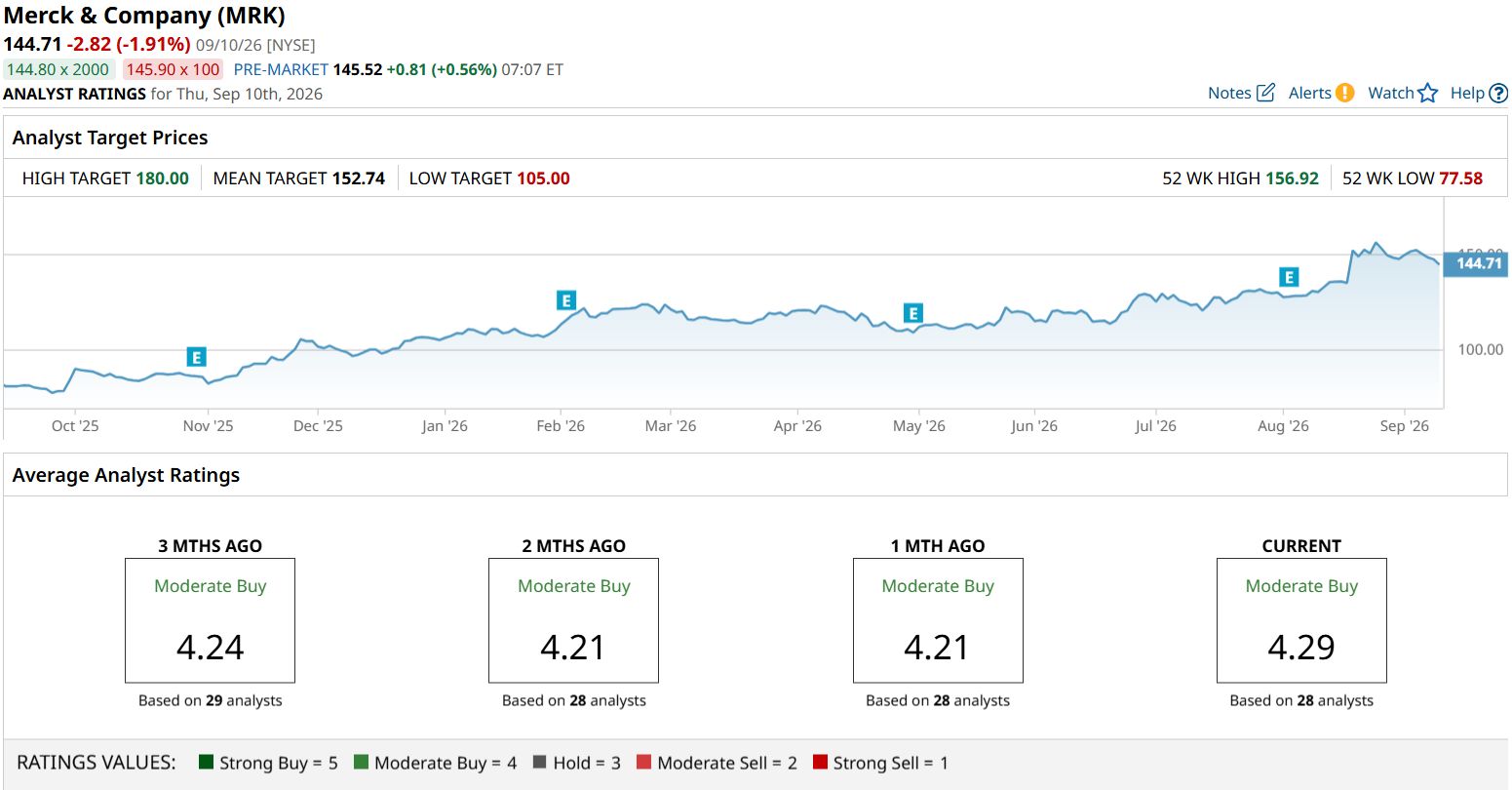
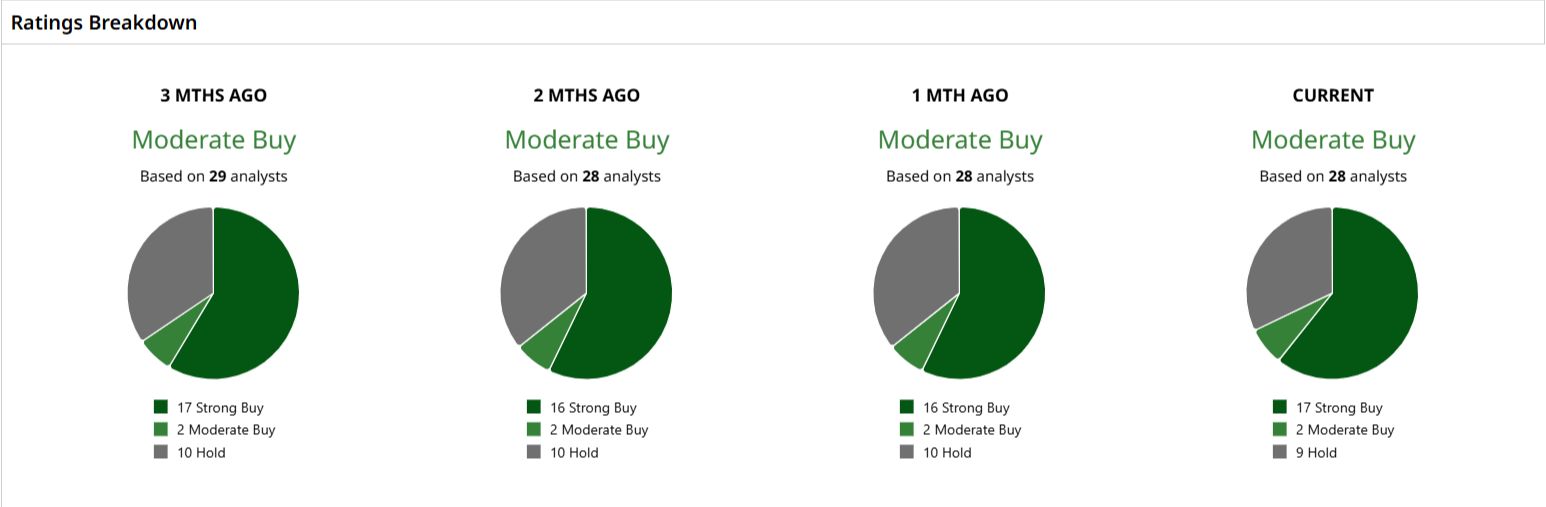
Overall, based on 28 analysts with coverage, Merck has a consensus "Moderate Buy" rating on Wall Street. The average price target of $154.96 points to about 8% potential upside from current levels.
 www.barchart.com
  www.barchart.com
 Conclusion
Merck is shaping up as a credible income-and-growth play heading into 2027, although its premium valuation and elevated payout ratio mean investors should not expect a risk-free ride. The company’s dividend yield above 2.3%, 15-year dividend growth streak, improving sales outlook, and growing oncology pipeline give shareholders several reasons to remain constructive. Given the clinical progress with Moderna and rising analyst confidence, MRK stock appears more likely to trend higher than lower over the next year, although gains may be steadier after the stock’s strong 2026 rally.
On the date of publication, Ebube Jones did not have (either directly or indirectly) positions in any of the securities mentioned in this article. All information and data in this article is solely for informational purposes. For more information please view the Barchart Disclosure Policy here.
More news from Barchart
This Dividend Stock Is Beating the Market in 2026 and Yields 2.36% This High-Yield Construction Stock Just Raised Its Dividend by 40% Dear Intuit Stock Fans, Mark Your Calendars for September 17 1 ‘Strong Buy’ Dividend Stock Offering a 6.3% Yield Right Now