

We all know Nvidia (NVDA), right? Top AI chipmaker in the world, GPU demand stretching forward for years, worth over $5 trillion on a good day - that Nvidia.
Did you know that, even as the top AI chip company, Nvidia doesn’t actually manufacture its chips?
More Top Stocks Daily: Go behind Wall Street’s hottest headlines with Barchart’s Active Investor newsletter.
Nvidia designs Blackwell, Vera Rubin, and all its GPUs, sure; but when it comes to carving up the actual silicon to make them work, it relies on semiconductor foundries, or fabricators.
Semiconductor foundries are specialized factories that turn chip designs into physical silicon chips. They use highly advanced manufacturing processes to etch microscopic circuits onto silicon wafers. I’ve used this analogy before, but I think it fits perfectly: if Nvidia is the picks-and-shovels company, the semiconductor foundries are the ones actually producing the parts needed for those picks and shovels.
Now, to be clear, thousands of semiconductor fabs operate worldwide, mostly serving industry lines like power chips, sensors, LEDs, and other similar products.
But I’m only really focusing on Intel (INTC) and Taiwan Semiconductor (TSM) today - because these are the ones that have a direct line into the AI chip boom. And, more importantly, you can easily invest in two of them through U.S. exchanges. More on that later.
For now, it's worth being clear about why foundries matter so much in the current market. In fact, by some metrics, they're the most important part of the supply chain.
So let’s talk about why.
Why Chip Foundries Are the Real AI Bottleneck
You may already have an inkling why foundries are critical to AI demand. No matter how brilliant Nvidia, AMD (AMD), or Broadcom (AVGO) is at developing chip architectures, none of that matters if they can't manufacture the chips at scale.
Designing a chip is one challenge. Physically producing it - etching billions of transistors onto a piece of silicon smaller than a fingernail, with features measured in nanometers - is an entirely different problem. What’s more, this kind of technology isn’t confined to one level, one type of manufacturing process.
There are chip foundries, and then there are leading-edge chip foundries.
Leading-edge foundries work with the most advanced process nodes currently available. Right now, that's the 2-nanometer class, with 1.6nm-class production expected to begin by the end of 2026.
In the early decades of chipmaking, the nanometer label roughly matched the size of a key feature on each transistor. So a 250-nanometer chip, common in the late 1990s, really did have features around 250 nanometers wide. Today, the names are more like generation labels than literal measurements.
Still, these new transistors are extraordinarily small, with some layers measuring only a few dozen atoms thick.
Now, you might be wondering why chipmakers bother with all this shrinking. Well, the more advanced the node, the more transistors you can cram onto a single chip, and each one uses less power. That means more computing power and better energy efficiency.
According to Nvidia, its new Rubin GPUs pack 336 billion transistors, up from Blackwell's 208 billion. That leap is made possible largely by a move to a more advanced manufacturing node: Rubin is built on TSMC's 3-nanometer-class process, while Blackwell used a 4-nanometer-class one.
But, again, only a handful of silicon foundries out of thousands can actually produce chips at this level. To etch circuits this small, you need extreme ultraviolet, or EUV, lithography. These machines are so precise and so expensive that only one company in the world manufactures them.
On top of that, you need cleanrooms with air purity levels that make hospital operating rooms look dusty, plus the technical know-how to make the operation possible and profitable.
This combination of capital, precision, and expertise is exactly why the leading edge is so exclusive. These companies have spent decades honing their craft and tens of billions to build their infrastructure. That’s why you don’t usually see a silicon foundry startup in the news.
And even when one does appear, as with Japan’s startup Rapidus, you’ll see that it needs massive financial and technological support from its own national government and a consortium of Japan's largest corporations - like Sony (SONY), Toyota (TM), SoftBank (SFTBY), and many more. All that help, just to get off the ground.
And you know what really drives the point home? Rapidus was founded in 2022, and even now, it doesn’t have any semblance of commercial-scale production to show for it. Not for lack of trying, of course; it’s just that difficult.
Long story short: you can’t just buy your way into the leading-edge foundry club. You can’t snap your fingers and build a fab in a few short years.
And that's what turns a manufacturing detail into the industry's hard ceiling.
So when Nvidia, Broadcom, AMD, Marvell (MRVL), and all the other AI chipmakers out there need GPUs and CPUs, they don’t have the privilege of shopping around for a foundry. Realistically, they have two companies capable of producing at the leading edge in meaningful volume today, with a third trying to close the gap.
This is what makes the foundry business so different from almost every other layer of the tech supply chain. In most industries, if demand spikes, new suppliers eventually show up to compete for a slice of the pie. Like ants to honey.
Not here. The barrier to entry is so high, so extreme, that a budding competitor can spend billions and still need years before they can even hope to breach the market.
And that’s exactly the barrier that Intel’s trying to clear.
Intel Foundry Explained: From IDM 2.0 to a Costly Comeback
Now, some of you might be confused by this statement. I mean, Intel’s been a semiconductor manufacturer for as long as it’s been active in the industry. I still remember it being the dominant CPU maker back in the '90s with the Pentium line. The company developed and manufactured those chips itself.
But that’s not the same setup as a modern foundry. Intel historically designed the chips, owned the fabs, and manufactured them at scale - but it was all for its own products.
Modern semiconductor foundries, by contrast, cater to other companies. That means they can manufacture chips for many different customers, each with its own designs, requirements, and timelines. This setup comes with the massive benefit of spreading its manufacturing costs across dozens of customers instead of relying on demand for its own products. A modern foundry can also capitalize on industry trends by offering services to top companies in the space, creating strong growth opportunities like what we’re seeing today.
And in recent years, Intel’s been trying to make that transition, from a company manufacturing its own chips to a foundry that makes it for everyone else. It’s a logical, straightforward shift.
In practice, it’s been anything but.
The company actually began manufacturing services to outside customers in the 2010s, but these efforts remained relatively small compared to its own production. That strategy changed when former CEO Pat Gelsinger, who returned in 2021, announced a major push to build Intel’s Foundry services as a viable competitor to the biggest foundries in operation. The strategy was christened IDM 2.0, and was seen as the company’s attempt to capitalize on the global chip shortage and the growing foundry concentration in Asia.
It was an audacious, aggressive move that many investors welcomed at the time. Intel had been spending years trying to manufacture 10nm and 7nm nodes, and many experts thought it was inevitable that the company would outsource to TSMC or Samsung. This plan called for tens of billions of dollars in new fabs and advanced process technology, including facilities in the U.S. and Europe. Many took the announcement as a sign that Intel had a credible plan to stay in manufacturing.
But then reality hit like a truck.
It became clear that shifting from a first-party manufacturer to a third-party foundry isn't easy. In 2022, Intel began posting quarterly losses as PC demand slumped, foundry spending ramped up, and doubt spread across the market like wildfire. Of course, some analysts had doubted the plan from the start, and the ongoing losses only reinforced their concerns.
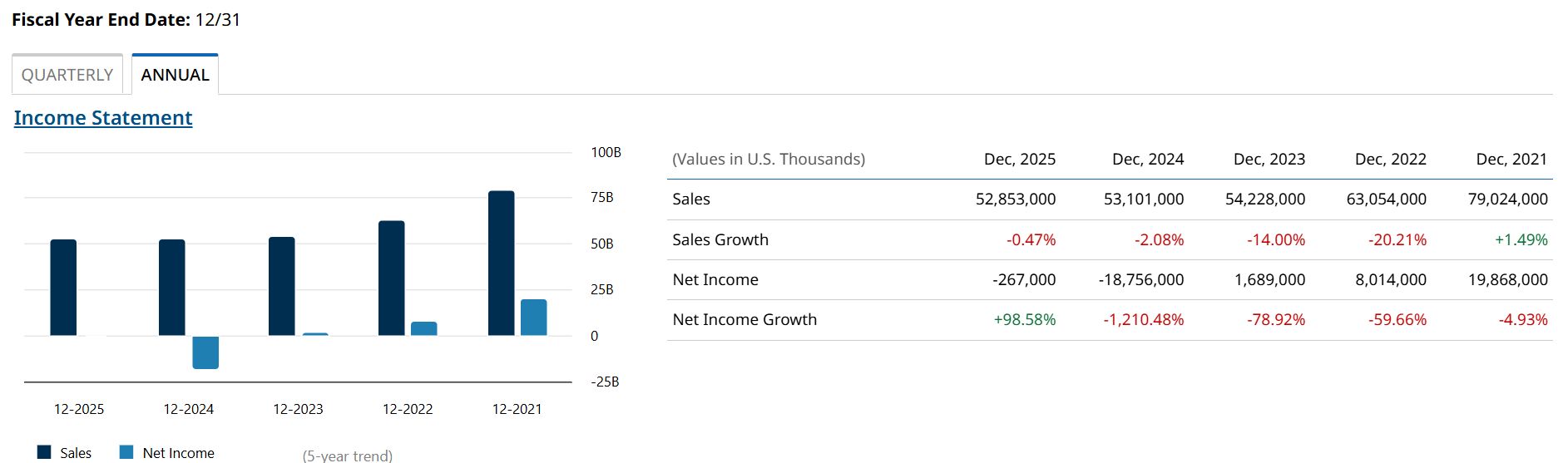
The optimism surrounding IDM 2.0 evaporated, and soon, market experts were all saying the same thing: Intel jumped the gun. It took on an enormous capital burden without a clear path to revenue, and now the mistake was showing on its income statements.
By 2023 end-of-year, Intel’s net income fell 79%. By 2024, it was massively in the red.
 Screenshot courtesy of www.barchart.com
The fallout was, well, as one might expect. Pat Gelsinger, who spearheaded the shift, stepped down as CEO and left Intel’s board in December 2024 amid mounting pressure over the company’s performance. Lip-Bu Tan succeeded him the following year.
He immediately went to work. Tan flattened the management structure, reduced operating expenses, cut capital spending targets, and laid off thousands of employees. He also put Intel Foundry under review, arguing that the company had invested too much, too quickly, without enough customer demand.
Ruthless, some might say, but some argue that it was exactly what Intel needed at the time.
Intel 18A and 14A: Where Intel Foundry Stands Today
Fast forward to today, and the story has changed.
Intel bet its foundry comeback on a process node called Intel 18A. For those unfamiliar, a process node is basically a generation of chip-making technology.
Think of it like a playbook. Intel develops the process node, then gives outside customers a detailed playbook of its rules. These customers design their chips to fit those rules and pay Intel to manufacture them. You might have heard of this process when Intel released its process design kits (PDKs) for 18A. Designers need the PDK before they can start, which is why Intel announces PDK versions (0.5, 0.9, 1.0) as milestones. Each version brings the rules closer to final.
But the playbook is only half of what a customer needs. Most companies don't design every piece of a chip from scratch. They license pre-built components, like memory blocks, interface circuits, or Arm processor cores, that have already been proven on a specific node. The more of these building blocks exist for a given process, the easier it is to adopt.
For Intel, 18A was supposed to be that next big leap. The company needed 18A to work, ramp up successfully, and attract outside customers if Intel Foundry was going to become a serious alternative to TSMC or Samsung.
But here's the difference between Gelsinger and Tan’s strategies.
With Gelsinger, he wanted the foundries put up as fast as possible. Tan wanted proof first that enough customers existed to justify the cost of building additional foundries.
Intel brought 18A to market in 2025. Today, they’re being produced at scale. In the second quarter of 2026, 18A output came in about 25% above target and rose more than 50% from the previous quarter.
The roadmap keeps going from there. Intel 18A-P, the first performance upgrade in the 18A family, has entered risk production, which is the early trial phase before full manufacturing. It offers 9% higher performance at the same power, or 18% lower power at the same performance.
Even better, the overall design is compatible with the previous 18A process node; 18A customers can just jump to the next iteration without too much fuss.
Then there's Intel 14A, the node the foundry's future really depends on. Version 0.5 of its process design kit is complete, with an updated version due in October. Risk production is planned for 2027, and Intel has committed to a high-volume ramp in 2028.
So, with 18A ramping and 18A-P building on the same platform, plus 14A on the horizon, Intel now has a concrete manufacturing technology base around which to grow its external foundry business.
But let’s not get ahead of ourselves. Intel’s Foundry is showing progress, and it’s no longer seen as an enormous money pit that’s not worth the effort.
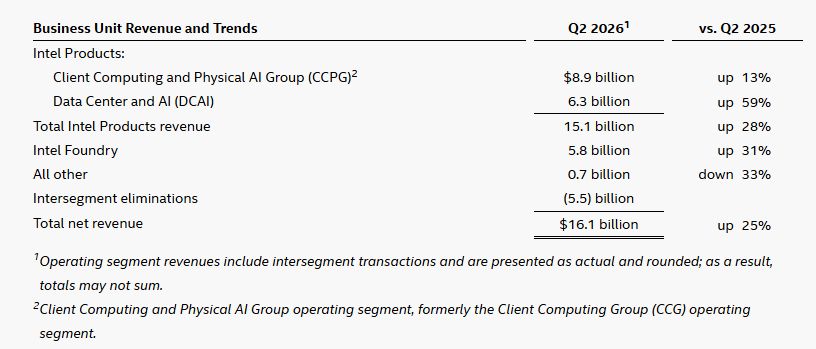
However, the segment is still unprofitable. In Q2 2026, Foundry reported $5.8 billion in revenue, up 31% from last year.
 Screenshot courtesy of www.intc.com
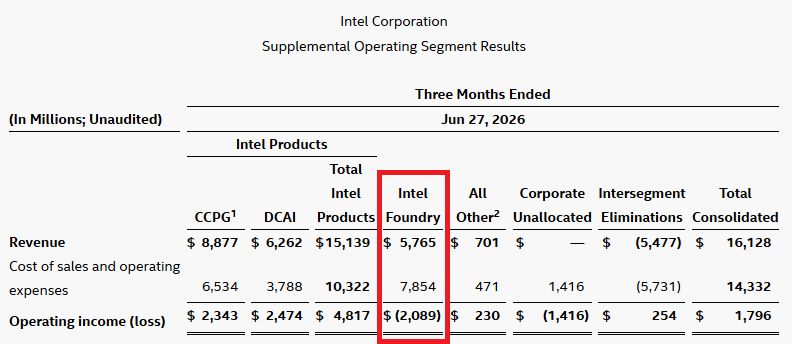
 But of that $5.8 billion, only $293 million came from external customers. The rest was intersegment revenue. And even then, the Foundry segment lost $2.1 billion this quarter.
 Screenshot courtesy of www.intc.com
 It’s still a big hole, but at least the story’s improving.
Customers are also starting to appear. In July, Fortinet (FTNT) signed on to build security chips with Intel, described as the first named foundry customer under Tan. It's not a household name, and the chips aren't high-volume, but it's a start. Earlier deals with Microsoft (MSFT) and Amazon (AMZN) were also for relatively low-volume products.
And that’s really what Intel’s after: a big slice of the hyperscaler pie. Unverified reports suggest companies like Alphabet (GOOG), Apple (AAPL), AMD, and Nvidia could weigh their options this fall as 14A's design kit matures, but none of that is confirmed.
So, in the meantime, the big names are staying with the biggest foundry in the world - which is Intel’s primary target.
Why TSMC Dominates the Global Foundry Market
Taiwan Semiconductor Manufacturing Company, aka TSMC, was founded in 1987, and it pioneered the pure-play foundry model. Unlike Intel, which started as a first-party manufacturer, TSMC was a third-party foundry from the start. This is one of the biggest reasons for its dominance in the industry, and it’s hard to overstate how much it towers above Intel.
Recent reports say that TSMC commands 72.5% of the world’s current foundry business. Nvidia, Google, Apple, AMD, Broadcom, and many more depend on TSMC to manufacture some of their most advanced chips.
But that industry leadership wasn’t just because it pioneered the business model, though it does help. No, the main reason why TSMC is at the top is that it has spent decades refining and perfecting its manufacturing processes, built relationships with both suppliers and chip designers, and developed an ecosystem that makes it easy for new clients to bring complex chips to production.
Remember when I mentioned pre-built components earlier? The more of these available in the market for a specific process node, the easier it is for the customer to have their chips built.
This is where TSMC pulls far, far ahead of Intel. Since launching its Open Innovation Platform in 2008, it has built an ecosystem of over 100 partners, with tens of thousands of intellectual property (IP) blocks for parts that are already proven on its processes. Each of those IPs represents components that customers can use for their designs instead of building from scratch.
It all boils down to this: for customers, choosing TSMC means fewer surprises and a faster path to production. That’s why it's so difficult to leave the company’s production ecosystem. That’s why Nvidia, AMD, Broadcom, and all the other chip designers are willing to fall in line and wait for TSMC’s capacity - sometimes for years at a time - rather than gamble on an unproven alternative.
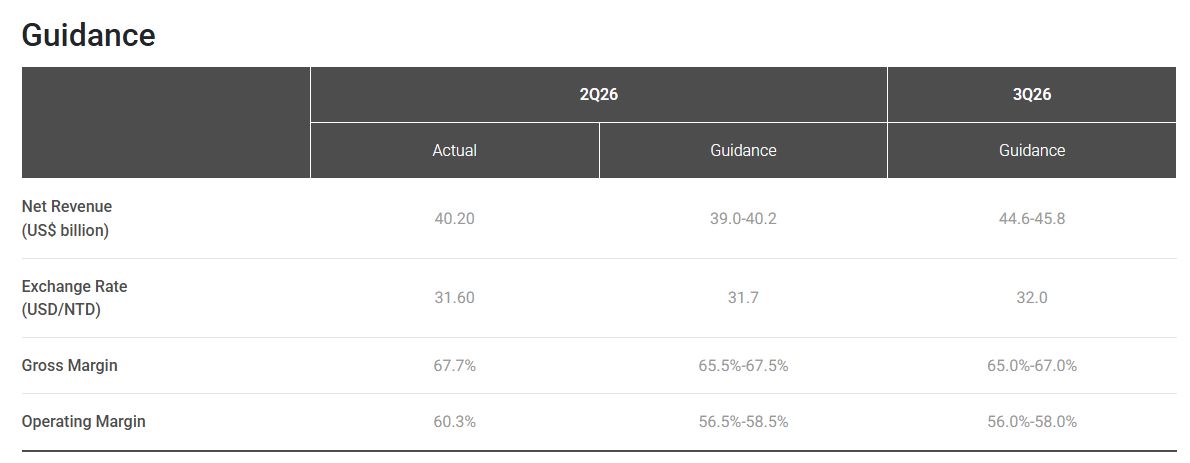
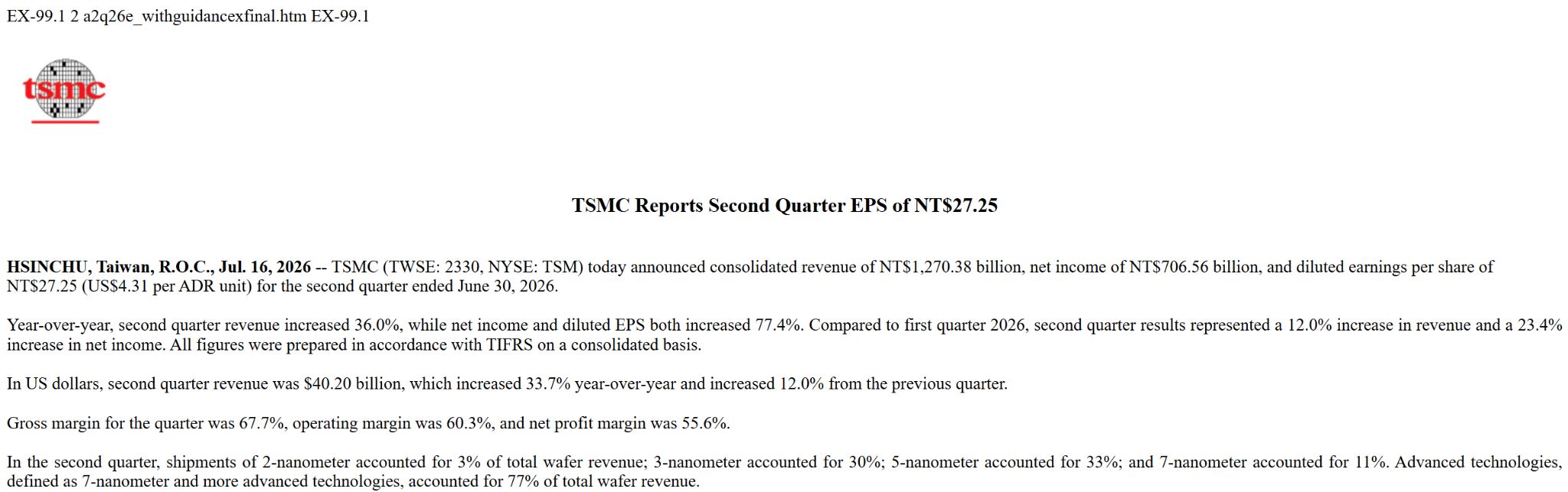
That advantage over Intel shows up clearly in TSMC’s financials. The company reported $40.2 billion in revenue in Q2 2026, along with an impressive 60.3% operating margin. Revenue reached the high end of guidance, while operating margin completely blew past it.
 Screenshot courtesy of www.tsmc.com
 But what’s more interesting is each process node's contribution to that revenue stream. Its 2nm node made up just 3% of wafer revenue that quarter. The bulk came from 3nm at 30% and 5nm at 33%, with 7nm adding another 11%. Together, those older nodes account for the vast majority of TSMC's revenue.
 Screenshot courtesy of www.sec.gov
 Essentially, this shows that TSMC doesn’t really need its customers to jump to its most recent process node. It's still making good money on its older nodes, though customers typically move up that product ladder over time as demand for faster and more efficient chips grows.
And TSMC isn't slowing down. Management expects "steep" growth from its 2nm ramp in the third quarter, with revenue guided to between $44.6 billion and $45.8 billion. That'd be another record quarter on top of a record quarter.
TSMC Stock Risks: Taiwan, Overseas Costs, and Customer Concentration
But for all that dominance, TSMC isn’t without risk.
The biggest concern that many market experts have - including me - is geopolitics. Most of its advanced production sits in Taiwan, and any TSMC investor takes on that geopolitical exposure. It's the core weakness in the company's story.
TSMC knows it, which is why it's spending heavily to diversify. On its latest earnings call, management raised 2026 capital spending to $60-$64 billion and announced another $100 billion investment in its Arizona site.
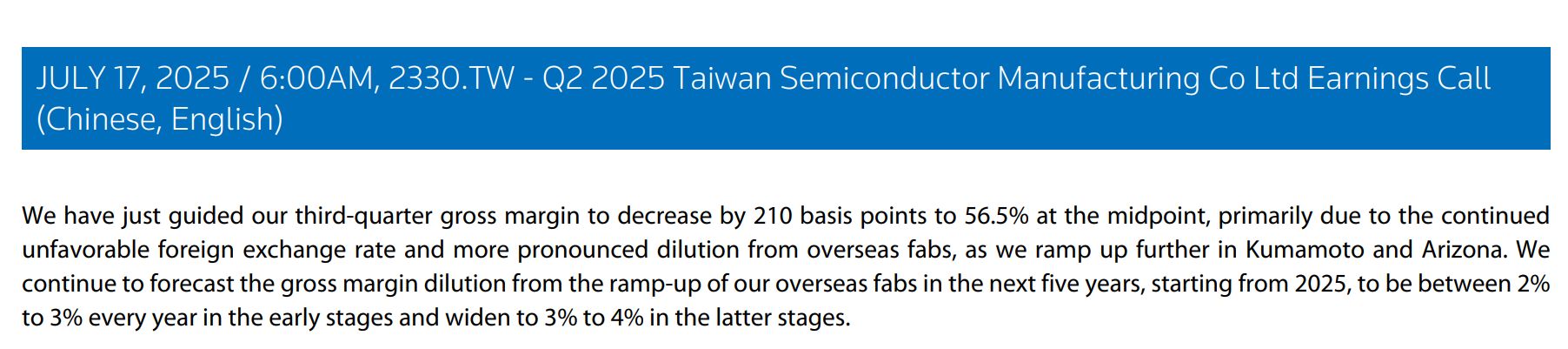
But building overseas isn't cheap. The company expects its overseas fabs to dilute gross margin by 2 to 3 points in the early stages, widening to 3 to 4 points later on. That's a real cost, even for a business earning 67% margins.
 Screenshot courtesy of www.tsmc.com
 The third risk is customer concentration. A small group of AI chip designers now drives much of TSMC's growth, with Nvidia alone estimated at around 22% of its revenue this year. Slower AI spending across the board is likely going to hit TSMC hard.
Why the U.S. Government Is Betting on Intel Foundry
Now, none of these risks come even close to breaking the company’s top-dog narrative. But, it does make Intel’s pitch a little more interesting, which is why customers and the U.S. government care so much.
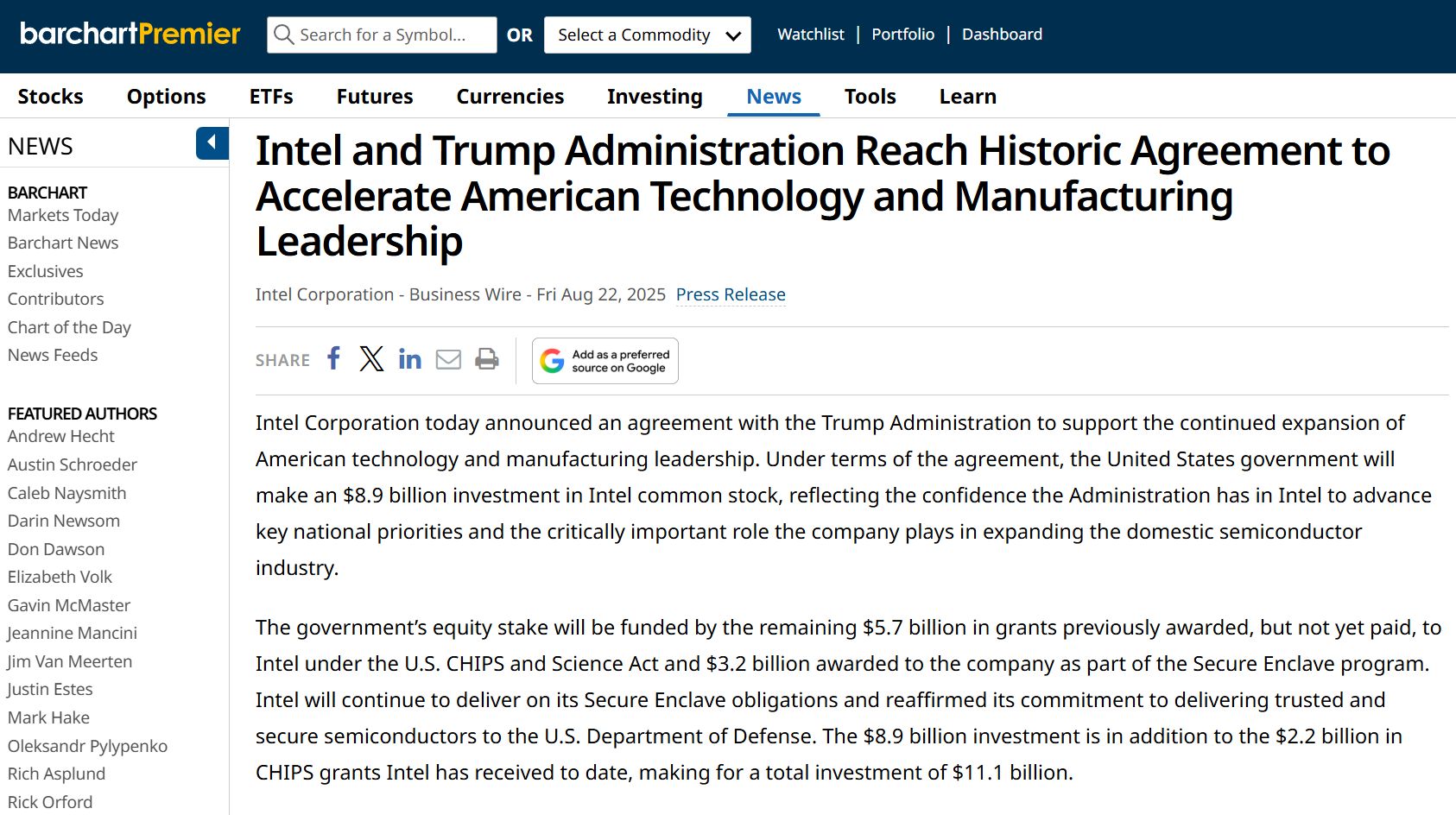
In fact, Washington is now one of Intel's biggest backers. In August 2025, the U.S. government agreed to acquire a 9.9% stake in Intel through an $8.9 billion investment in the company's stock.
 Screenshot courtesy of www.barchart.com
 It was funded by the remaining $5.7 billion in CHIPS Act grants previously awarded but not yet paid, plus $3.2 billion from a separate secure-chips program. Combined with the $2.2 billion Intel had already received, the government's total commitment came to $11.1 billion.
The government also got a warrant to buy an additional 5% of Intel, exercisable only if Intel stops owning at least 51% of its foundry business. So it’s clear that Washington wants Intel’s foundry to stay on American soil.
Intel vs. TSMC: What Each Bet Represents
So what does all this mean for someone looking at these companies as investments?
First and foremost, you can already tell that these are two very different kinds of bets.
TSMC is the undisputed leader. It’s at the top of the food chain, highly profitable, and directly connected to many of the companies driving AI demand today and in the future. The risks are real, from Taiwan's geopolitics to the cost of building overseas, but they sit alongside a foundry business with operating margins over 60%.
When you buy into TSMC, you’re buying proven quality. But that typically means that the potential rewards are more limited. After all, much of its success is already priced in, and Wall Street agrees.
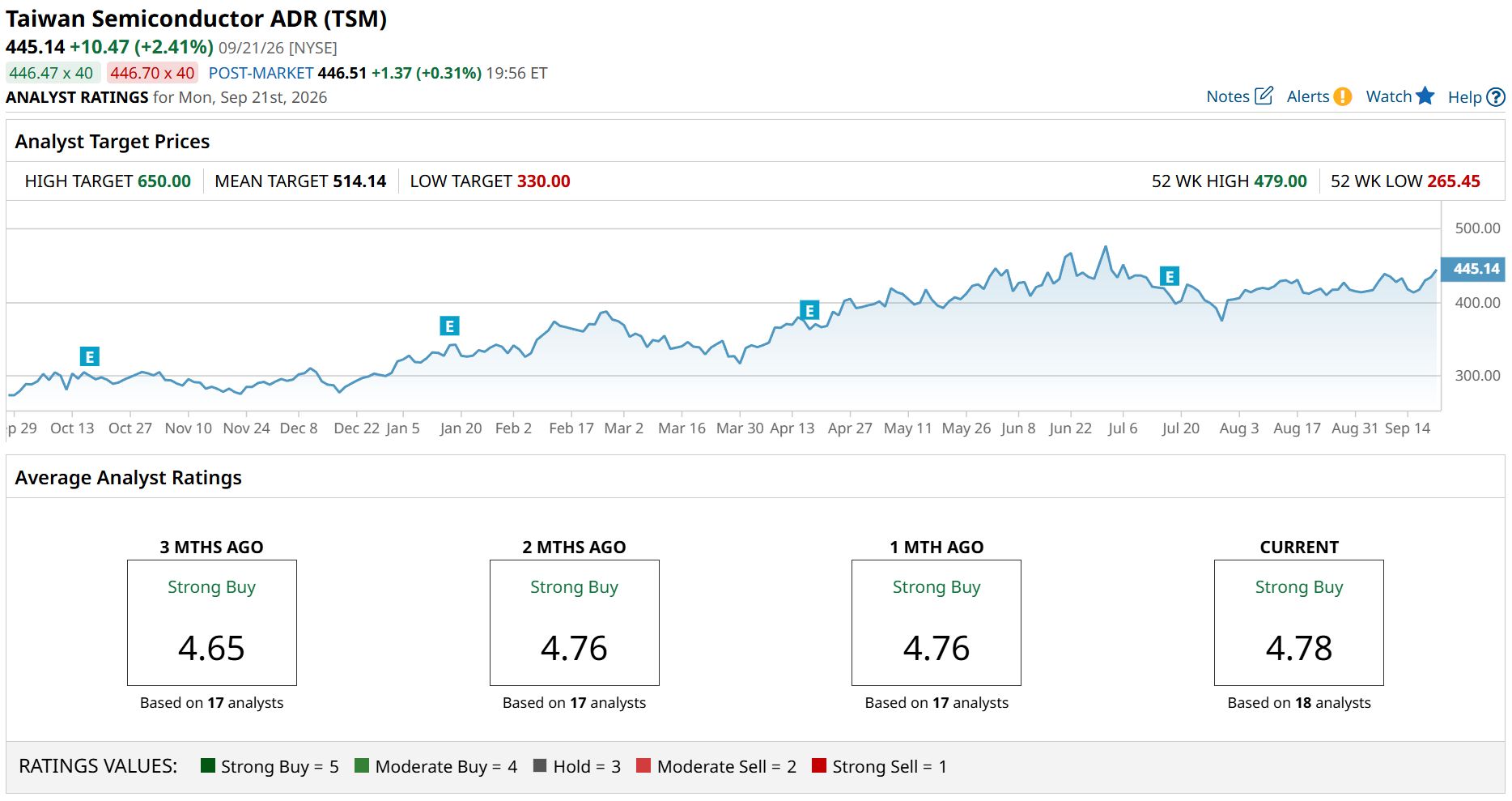 Screenshot courtesy of www.barchart.com
 TSM’s high target price is $650, representing about 46% potential upside.
On the other hand, Intel is the turnaround bet. Much of its “potential” upside is based on things that haven’t materialized yet. It needs to land a major outside customer, make Foundry profitable, grab market share from TSMC, and deliver 14A on schedule.
If Intel pulls it off, the payoff could be bigger.
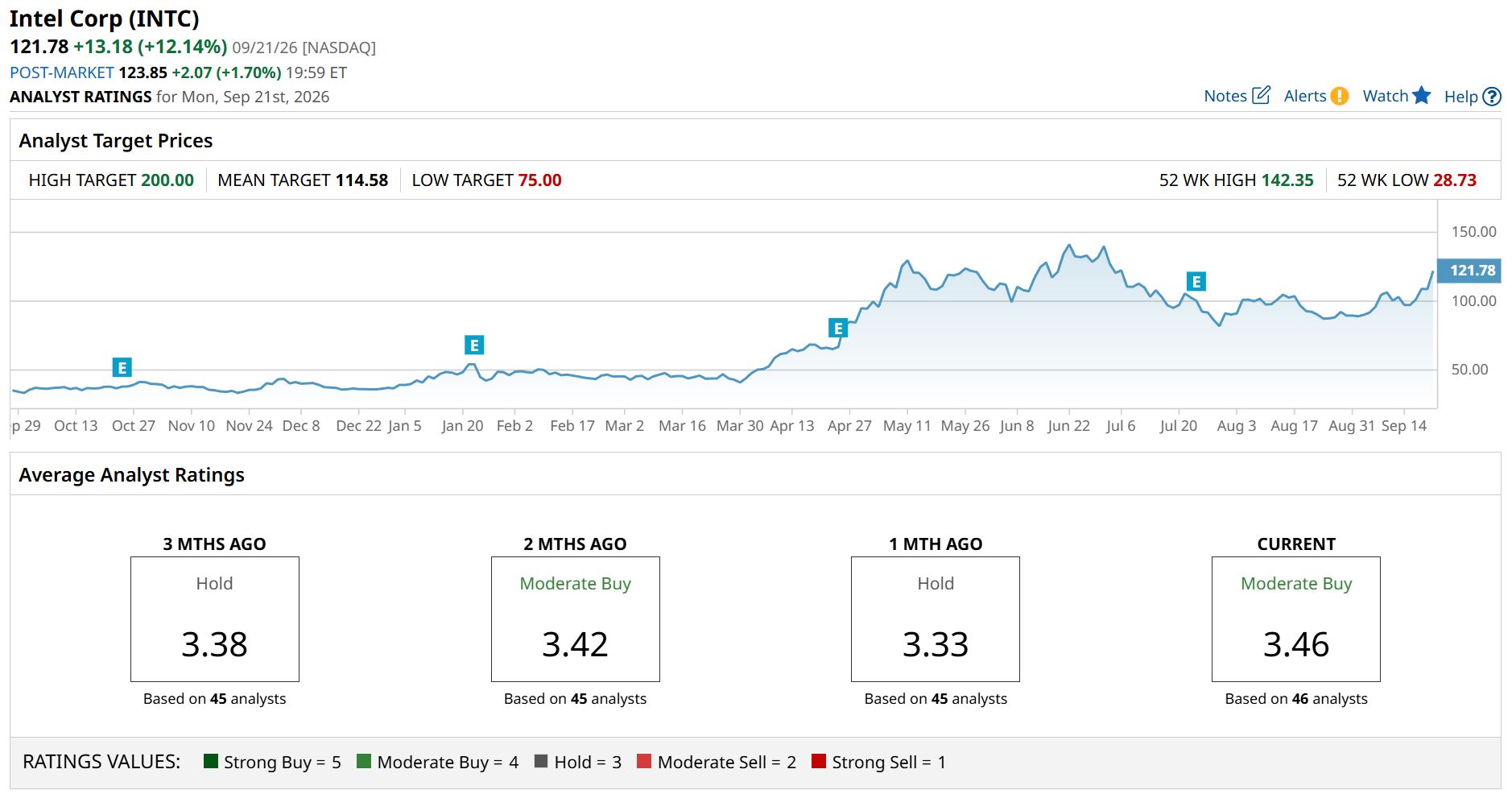 Screenshot courtesy of www.barchart.com
 Even now, with its consensus rating at a “Moderate Buy,” the high target price represents 64% potential upside, already higher than TSMC’s.
So one company is a bet on staying on top, and the other is a bet that a long-shot catch-up is finally working. TSMC offers exposure to a foundry business with enormous scale, a broad customer base, and a mature manufacturing ecosystem. Intel, meanwhile, offers exposure to the turnaround of a company still building out its external foundry business and proving that its newer process technology can attract meaningful customers.
Which one fits depends on how much uncertainty you're willing to hold.
On the date of publication, Rick Orford had a position in: MSFT , AMZN , GOOGL , AAPL . All information and data in this article is solely for informational purposes. For more information please view the Barchart Disclosure Policy here.
More news from Barchart
Intel vs. TSMC: One Chip Stock Controls 72.5% of the Foundry Market. The Other Is Mounting a Comeback. CrowdStrike Stock Rallies as AI Security Fears Create a Major Opportunity. How to Play CRWD Here. Generac Rallies on Power Deal With Amazon. How to Play GNRC Stock Now. A $26 Million Reason Why GameStop Stock Is Up Today