


Diesel Is Telling a Different Inflation Story
The latest Personal Consumption Expenditures Price Index showed inflation rising less than economists expected in August. According to the Bureau of Economic Analysis, the Personal Consumption Expenditures Price Index increased 0.3% for the month, while economists surveyed by Reuters had expected 0.4%.
At the same time, diesel fuel prices have been telling a much different story. U.S. diesel prices recently reached record nominal levels, while inventories remain unusually low.
Don’t Miss a Day: From crude oil to coffee, sign up free for Barchart’s best-in-class commodity analysis.
How can inflation show signs of easing while the fuel that moves much of what we buy is at record prices?
The answer begins with something many people may not realize: diesel fuel and heating oil are closely related.
Heating Oil Is Also a Diesel Story
According to the U.S. Energy Information Administration (EIA), heating oil and diesel are both distillate fuels. No. 2 distillate can be used as either diesel fuel or heating oil.
That relationship is important for futures traders. A heating oil trader isn't watching only how much fuel homeowners may need during a cold winter. The trader is also dealing with many of the same supply forces affecting diesel fuel around the world.
Diesel powers much of the trucking, rail, farming, and construction equipment in the United States. The EIA reports that about 75% of U.S. distillate consumption in 2025 occurred in the transportation sector.
When diesel prices rise, the impact can move through the economy because nearly everything we consume must be transported at some point.
A gallon of diesel is much more than what you buy at a truck stop.
You Can't Make a Barrel of Crude Into a Barrel of Diesel
Another part of this market is easy to overlook.
A 42-gallon barrel of crude oil doesn't produce 42 gallons of diesel.
According to the EIA, U.S. refiners typically produce about 19 to 20 gallons of gasoline and only about 11 to 13 gallons of ultra-low sulfur distillate fuel oil from a 42-gallon barrel of crude. Refiners can adjust those yields as market conditions change, but physical and operating limits remain.
This matters when global diesel supplies tighten.
U.S. refineries have been working hard. The EIA reported refinery utilization reached 97% during the week ending September 11, while U.S. distillate production from January through August averaged 5.1 million barrels per day, the highest since 2019.
Producing more crude oil doesn't automatically solve a diesel shortage. Crude must still be turned into the products consumers need.
America Produces Oil, So Why Do We Import It?
Another misunderstood part of the energy market is why the United States can be a major crude oil producer while importing and exporting crude at the same time.
Not all crude oil is the same.
Much of the crude produced in the United States is light, sweet crude. Many U.S. refineries, particularly along the Gulf Coast and in the Midwest, were built or upgraded to process heavier, higher-sulfur crude oils. According to the EIA, those refineries can often profitably process discounted heavy crude because they already have the equipment required to handle it.
The United States can therefore export domestic light crude while importing heavier crude better suited to some of its refineries.
Refinery capacity is also a factor. The newest U.S. refinery began operating in 2022, but it has a capacity of only 45,000 barrels per day. According to the EIA, the newest U.S. refinery with significant downstream processing capacity is Marathon's Garyville, Louisiana refinery, which began operating in 1977. Existing refineries have expanded considerably since then.
More crude oil production and more refined-product production are not the same thing.
A Global Market Comes Home
Today's diesel problem also shows why U.S. energy markets cannot be viewed in isolation.
The EIA reported in September that global distillate supplies have tightened because of reduced refining activity in Russia, China, and the Middle East. That has increased international prices and demand for U.S. diesel exports.
Russia added another concern last week by extending restrictions on diesel exports through the end of October. Russia has traditionally been one of the world's largest diesel exporters.
Meanwhile, U.S. distillate inventories are tight. The EIA expects inventories to remain below their five-year seasonal low through the end of 2026 and much of 2027.
High global prices encourage U.S. refiners to export fuel into the world market. That is how a supply disruption thousands of miles away can eventually affect the Price paid for diesel in the United States.
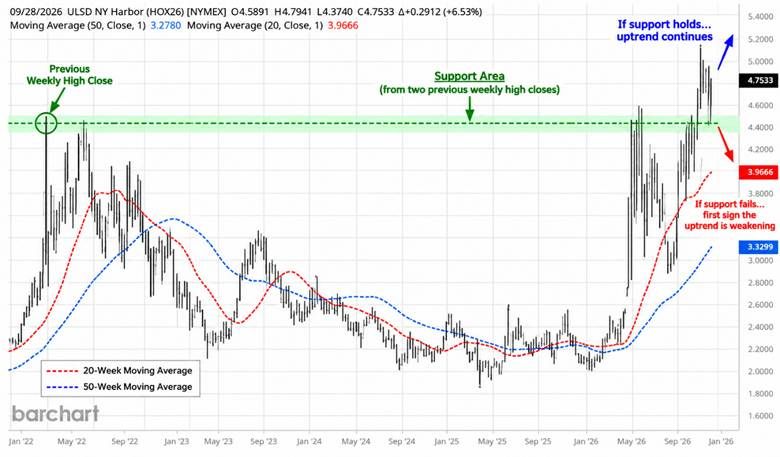
Source: Barchart
The weekly chart illustrates the strength of the current move. I have marked an area created by a previous weekly high close. What was resistance can become support.
As long as that area holds, the longer-term uptrend remains intact. A failure to hold it would be an early indication that the trend may be weakening.
Historical tendencies provide context; current price action provides confirmation.
Follow these markets for confirmation: Heating Oil (HO), Crude Oil (CL), Gasoline (RB), Ten-Year Treasury Yield ($TNX), S&P 500 (SPY), and Gold (GC).
Seasonality Says Something Different
This brings us to an interesting conflict.
Moore Research Center, Inc. (MRCI) data shows a strong 15-year seasonal tendency for heating oil to rally into the early fall before turning lower during October and November.
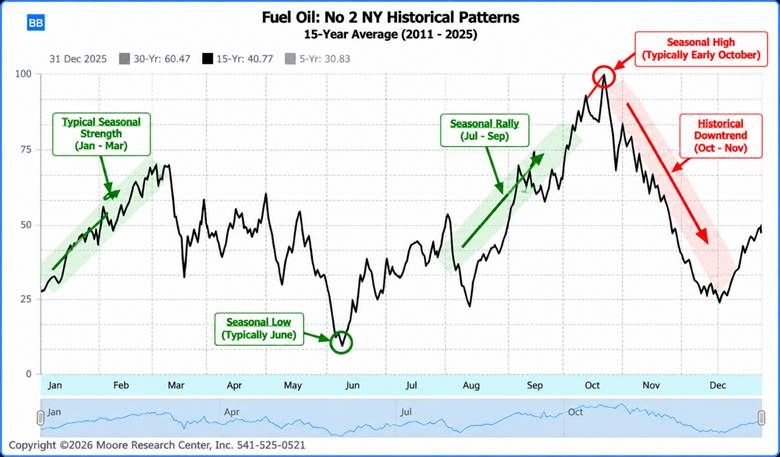
Source: Moore Research Center, Inc. (MRCI)
The seasonal chart makes the historical tendency easy to see. Heating oil typically strengthens from summer into an early-October seasonal high, then declines sharply through much of October and November.
But a seasonal pattern is not a forecast.
This year, the seasonal tendency is meeting low inventories, high diesel prices, strong exports, and geopolitical disruptions to global refining and trade.
That doesn't make the seasonal pattern useless. It makes confirmation more important.
Let Price Have the Final Vote
Seasonality tells us what a market has tended to do during a particular time of year. Fundamentals help explain the forces currently affecting supply and demand.
Neither should replace price action.
If heating oil begins breaking technical support as the historical bearish seasonal window arrives, seasonality and price action would begin telling a similar story.
If support holds and prices continue higher despite the seasonal tendency, traders should respect what the market is actually doing.
The strongest seasonal pattern can be overwhelmed by an unusual fundamental event.
History can tell us where to look, but Price still gets the final vote.
On the date of publication, Don Dawson did not have (either directly or indirectly) positions in any of the securities mentioned in this article. All information and data in this article is solely for informational purposes. For more information please view the Barchart Disclosure Policy here.
More news from Barchart
Micron Generates Massive Free Cash Flow - MU Price Targets Rise What Record Diesel and Heating Oil Prices May Be Telling Other Markets NVO vs. LLY: Novo’s CEO Says Confidence Is Gone. Lilly Is Winning 7 in 10 New Seniors. Nvidia Bull Put Spread Could Return 16%