


Micron Technology’s (MU) artificial intelligence (AI)-fueled rally is showing little sign of slowing down, but the bigger question is whether the stock still has room to run. As one of the world’s three major memory manufacturers, Micron has been a major beneficiary of soaring DRAM (dynamic random-access memory) and NAND flash memory prices, with both markets facing supply constraints as the AI infrastructure build-out accelerates.
The stock has surged a jaw-dropping 473% over the past year, lifting Micron’s market value to around $1.20 trillion and making it one of the most valuable stocks in the U.S. market. While that kind of rally has pushed its valuation significantly higher, Micron’s extraordinary growth means the stock may still not look expensive relative to its earnings. That valuation argument is gaining support from Wall Street.
More Top Stocks Daily: Go behind Wall Street’s hottest headlines with Barchart’s Active Investor newsletter.
Mizuho TMT specialist Jordan Klein believes semiconductor and memory stocks remain attractively valued following Micron’s latest results last month and has advised investors to stay “overweight” the sector. Klein described MU and memory stocks as “dirt cheap,” arguing that free cash flow could accelerate dramatically. More importantly, he sees tight supply conditions becoming even tighter next year, strengthening the case for continued pricing power across the memory market.
Klein’s optimism extends beyond Micron. He said he has become more confident in the durability and upside potential of memory stocks, semiconductor equipment makers, foundries, and parts of the hardware sector, including servers. So, with the bullish case still gaining traction, it might be an opportune time to take a closer look at MU stock.
About Micron Stock
Micron Technology is a leading global semiconductor company founded in 1978 and headquartered in Boise, Idaho. The company is one of the world’s largest memory-chip manufacturers, supplying the technology that helps power everything from smartphones and PCs to cloud data centers and AI systems. As demand for AI workloads explodes, Micron has become a key beneficiary of the growing need for high-performance, high-capacity memory.
Micron’s portfolio spans DRAM, NAND and NOR flash memory, along with SSDs, memory modules and other advanced storage solutions. Its products are used across data centers, AI infrastructure, automotive systems, industrial applications, networking, mobile devices, and consumer electronics. With AI systems requiring increasingly powerful and data-intensive computing, Micron’s memory and storage technologies are becoming an increasingly critical piece of the broader AI hardware ecosystem.
Micron’s stock has been on a blistering run, powered by explosive AI-driven demand for memory chips, tight supply, and stronger pricing power. Those tailwinds have translated into surging revenue and record-high profit margins, sending shares of the storage and memory giant soaring by triple digits over the past year and leaving the broader S&P 500 Index’s ($SPX) 15.7% gain far behind. The momentum has carried into 2026. MU shares have jumped 273% so far this year, once again crushing the broader market’s 13.6% return. The stock hit a record high of $1,255 on June 25 but has since pulled back roughly 15.2% from that peak.
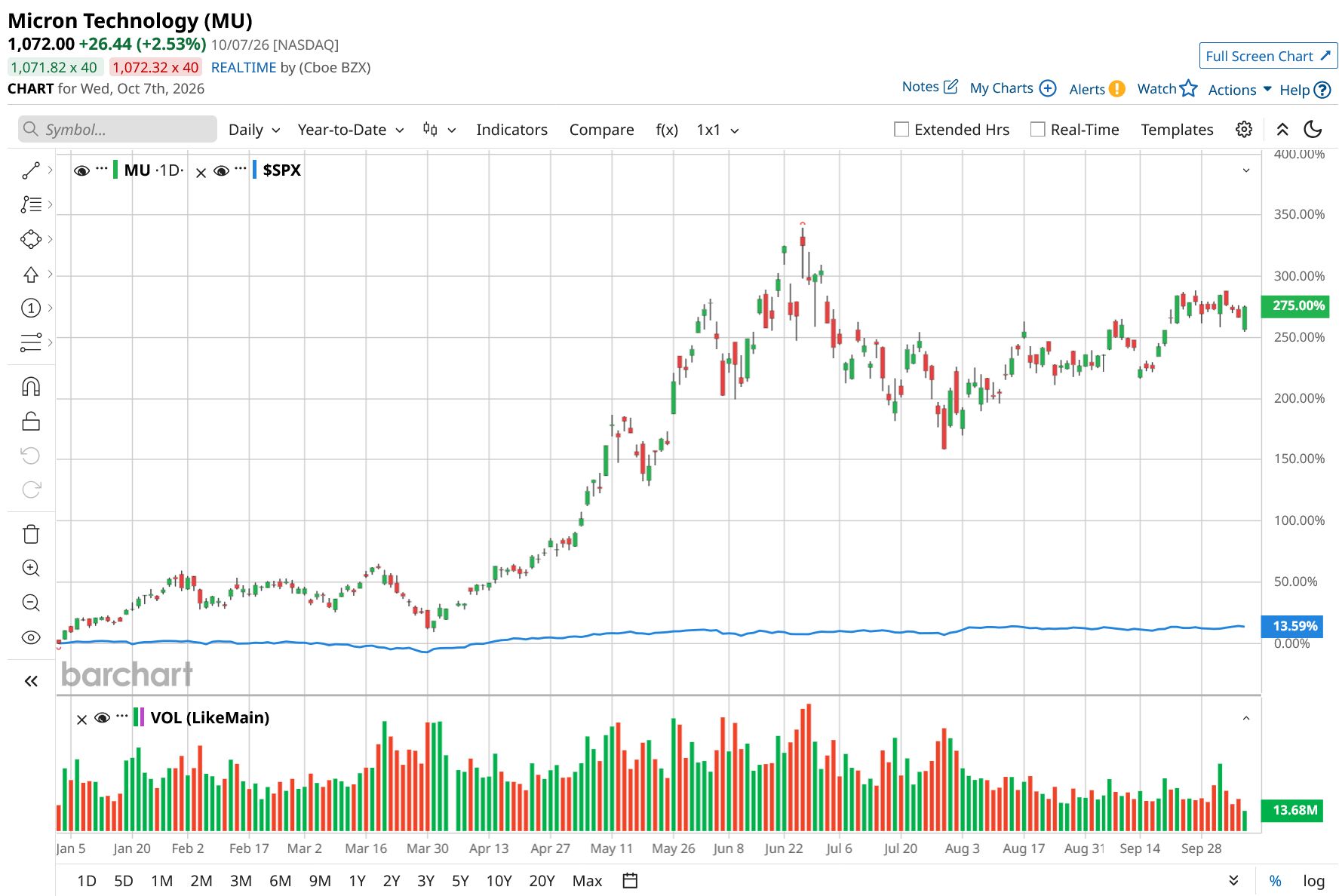 www.barchart.com
 Despite its eye-popping rally, Micron still looks surprisingly inexpensive on a forward-earnings basis. MU currently trades at just 6.84 times forward earnings, a steep discount to the sector median of 23.77 times. That valuation gap suggests investors may be underestimating the strength of Micron’s earnings growth, particularly as AI-driven demand continues to reshape the memory-chip market.
Micron’s Q4 Earnings Snapshot
Micron Technology delivered a blockbuster fiscal 2026 fourth-quarter earnings report on Sept. 30, with results that shattered expectations as explosive, AI-driven demand for advanced memory sent the company’s financial performance soaring. Revenue hit a record $54.23 billion, surging a staggering 379% year-over-year (YoY) and jumping 31% sequentially from the previous quarter. The top line also comfortably cleared Wall Street’s expectations of $51.51 billion, underscoring the sheer strength of demand for Micron’s memory products.
The company’s core memory businesses delivered equally impressive growth. DRAM revenue climbed 27% sequentially to $39.8 billion, accounting for 73% of total revenue in the fourth quarter. Meanwhile, NAND revenue surged 42% sequentially to $14.1 billion, representing 26% of fourth-quarter revenue. Micron’s Cloud Memory Business Unit (CMBU) generated record revenue of $16.3 billion, up 258.4%, while the Mobile and Client Business Unit (MCBU) posted record revenue of $13.1 billion, soaring 248.8% and contributing 24% of total company revenue.
The earnings print was also defined by extraordinary margin expansion, highlighting the enormous pricing power Micron has gained amid industry-wide memory shortages. The company reported a non-GAAP gross margin of roughly 87%, nearly doubling from 45.7% in the year-ago quarter. That margin strength translated into GAAP net income of $37.70 billion. The bottom line was even more eye-popping, with adjusted EPS reaching $33.42, up from just $3.03 a year earlier and comfortably ahead of Wall Street’s expectation of $31.82.
Micron also continued to pour heavily into capacity and future growth. Net capital expenditures totaled $10.77 billion in the fourth quarter of 2026 and $27.37 billion for the full fiscal year. At the same time, operating cash flow surged to $43.97 billion, compared with $25.39 billion in the prior quarter and $5.73 billion in the same period last year. Adjusted free cash flow came in at a massive $33.20 billion for the fourth quarter. Micron ended fiscal 2026 with $73.48 billion in cash, marketable investments, and restricted cash, leaving the company with substantial financial firepower heading into the next fiscal year.
And Micron is showing little sign of taking its foot off the gas. Looking ahead to its fiscal 2027 first-quarter earnings report, management expects revenue to land between $60 billion and $63 billion, while forecasting a non-GAAP gross margin of 86.25%. Adjusted EPS is projected to come in between $37.15 and $39.15, pointing to another quarter of extraordinary profitability as AI-driven memory demand continues to reshape the industry.
What Do Analysts Think About MU Stock?
Wall Street remains firmly in Micron’s corner, with the stock carrying a consensus “Moderate Buy” rating. Among the 42 analysts covering MU stock, 33 rate it “Strong Buy,” five recommend “Moderate Buy,” and just four have a “Hold” rating, highlighting the overwhelming bullish sentiment surrounding MU. And the Street sees plenty of runway left for the stock.
The average price target of $1,537.51 points to a potential 43% upside, while the Street-high target of $2,100 implies MU could surge as much as 96% from current levels, a striking vote of confidence even after the stock’s massive rally.
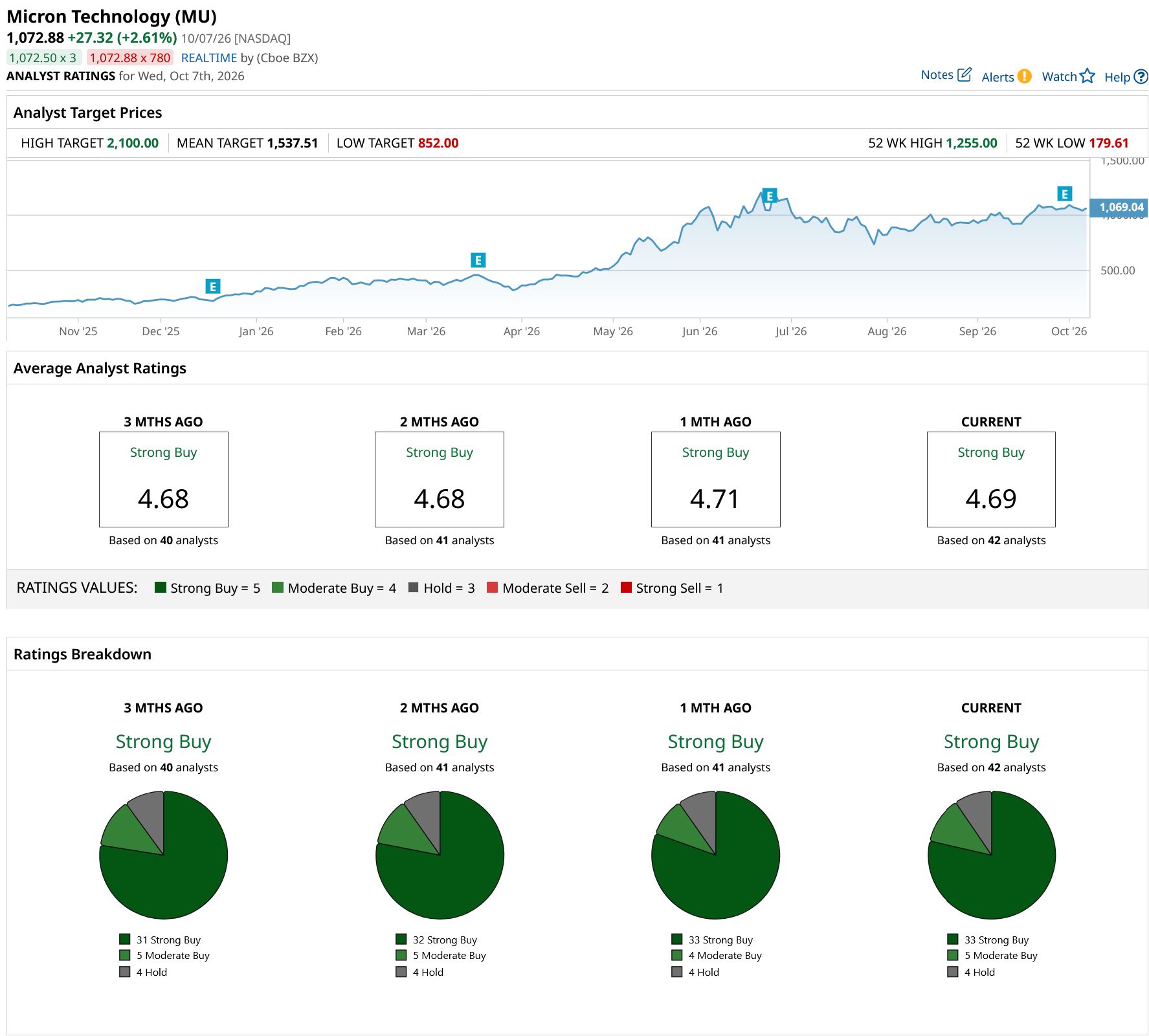 www.barchart.com
 On the date of publication, Anushka Mukherji did not have (either directly or indirectly) positions in any of the securities mentioned in this article. All information and data in this article is solely for informational purposes. For more information please view the Barchart Disclosure Policy here.
More news from Barchart
21.84% of AST SpaceMobile’s Float Is Betting Against It. Here’s What the Convoy Doesn’t Fix. Despite a 473% Rally Over the Past Year, This Analyst Says Micron Stock Is Still ‘Dirt Cheap’ You Likely Haven’t Heard of Arrow Electronics, But Its Stock Is Red Hot at New All-Time Highs Constellation Lands a 3,590 MW Power Deal With Google. AI’s Quietest Winner May Not Stay Quiet for Long.