


Sunrun (RUN) had the two highest Vol/OI (volume-to-open-interest) ratios in Wednesday’s options trading, at 849.68 and 480.66, far above the third-place option, Banco Bradesco (BBD), at 152.19.
I haven’t covered the solar installer and financing provider for many years. I think I might have recommended the small-cap stock in October 2020, when it was heading toward an all-time high of $100.93 in January 2021. It’s lost 92% of its value in the nearly 70 months since. That was one of my better stinkers.
Can’t Get Enough Options?: Join the list for Barchart’s daily unusual options report, delivered free.
Anyway, when I saw that Sunrun held the top two spots for unusually active call and put options -- defined as options with volume of at least 500 contracts, open interest of at least 100 contracts, a Vol/OI ratio of 1.24 or higher and expiring in six days or more -- I absolutely had to take a closer look, especially given RUN is a 100% Strong Sell according to the Barchart Technical Opinion.
I’m not going to spend much time, if at all, talking about the company’s financial situation. I’ll leave that for someone else more in tune with the solar industry.
Instead, I am going to study the options strategy behind Sunrun’s unusual options activity from yesterday. I think it provides retail investors with a teachable moment.
Let’s dig into it.
The RUN Options in Play

Volume in both the May 21/2027 $6 put and May 21/2027 $12 call (shown above) was significant. The combined volume of 248,074 was 97.7% of the day's total, nearly 10 times the 30-day average. It was RUN's highest daily volume in the past 12 months. Interestingly, yesterday's put/call volume ratio was 0.81, suggesting options investors were moderately bullish but not overenthusiastic.
However, you can’t take too much stock from the P/C volume ratio because the two trades accounted for most of the day’s volume. A closer look at the options flow can tell us more about the bullish or bearish nature of the trades.
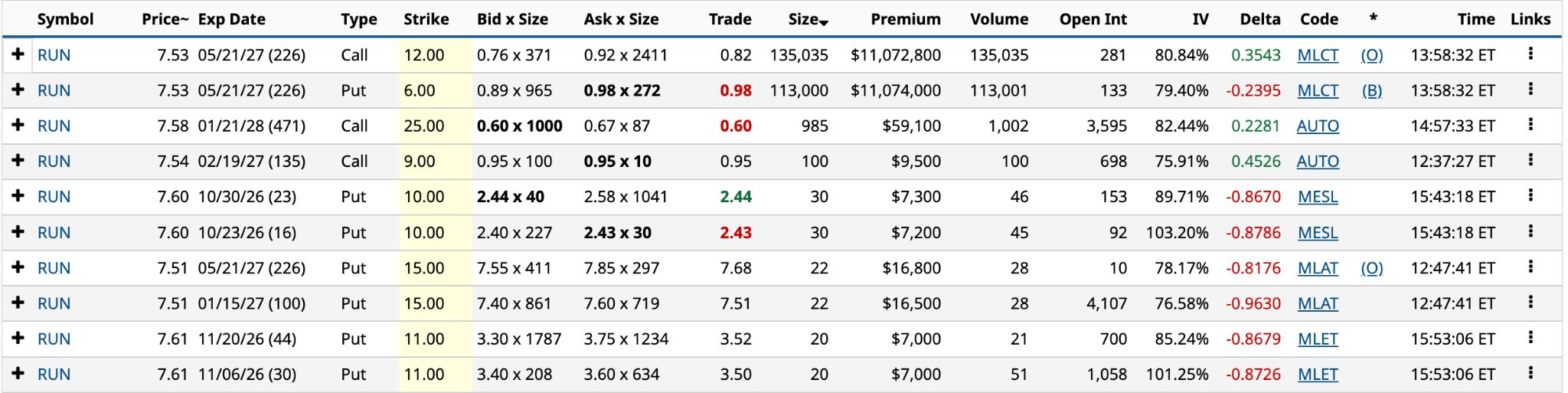
Yesterday, there were 10 trades (shown above) of 10 or more contracts for RUN. The two unusually active call options are the top two, with trade sizes of 135,035 and 113,001 contracts. They occurred at the same time, suggesting they were the two legs of a large institutional bet.
The question for retail investors is which options strategy is at play. I have three possible ideas, from least likely to most likely.
The RUN Long Strangle
The Long Strangle is a bet that the stock’s volatility will increase, leading to a significant move up or down. It is neither a bullish nor a bearish bet.
In this case, the institution would have bought 135,035 May 21/2027 $12 calls and 113,000 May 21/2027 $6 puts for a net debit of $22,146,800. That is also the maximum loss.

Here’s how the long strangle looked Thursday morning. In the example above, the net debit per contract is $1.86. Using yesterday's trade prices, the net debit at a 1:1 ratio would have been $1.80. The institution makes money if the share price is above $13.64 or below $4.04 at expiration.
Calculation (Upside): $12 strike price + ($22,146,800 net debit / 135,035 call contracts * 100) = $13.64
(Downside): $6 strike price - ($22,146,800 net debit / 113,000 put contracts * 100) = $4.04
However, because the call-to-put ratio was 1.2:1, the options strategy is a Ratio Strangle.
The maximum profit for this strategy on the upside is unlimited, as the share price could go to $100 (unlikely). On the downside, the maximum profit is capped at $45.7 million if the share price falls to $0 (more likely) by next May.
Calculation: $6 strike price - $0 share price * (113,000 put contracts * 100) - $22,146,800 net debit
Let’s say the share price is $20 at expiration. The institution’s profit would be $85,881,200.
Calculation: ($20 share price - $12 strike price) * 100 * 135,035 call contracts - $22,146,800 net debit
An institution could make this unhedged bet, assuming implied volatility rises significantly over the next 2-3 months, which would increase the value of the calls and puts without a big move in the share price, allowing it to exit the positions early.
However, with both options OTM (out of the money), they have no intrinsic value, only extrinsic (time) value, which shrinks as the trade approaches expiration.
The RUN Risk Bearish Reversal
The bearish risk reversal acts as a synthetic short stock position. You don’t actually own the stock, but you believe the shares will fall in the future.
In yesterday's two trades, the 113,000 long put contracts traded at $98 per contract, right at the ask, suggesting the buyer was less concerned about price than about filling the position. The “B” code, or buy-to-open, helps confirm this. At the same time, it opened a new short call position for 135,035 contracts and received $82 per contract in premium to offset the puts' cost.
So, it paid $11,074,000 for the long $6 puts and received $11,072,800 for the 135,035 short $12 calls, for a net debit of $1,200. That’s a low-cost bet that Sunrun’s shares will keep falling. They’re down nearly 60% in 2026.
Let’s assume the shares fall to $4 by expiration next May. The short calls would expire worthless, while the 113,000 $6 puts would be worth $22,600,000 for a profit of $22,598,800.
Calculation: $6 strike price - $4 share price * 100 * 113,000 put contracts - $1,200 net debit.
The downside of this bet is that the maximum loss on the upside is significant, above the $12 call strike price, because you would have 22,035 uncovered short calls. That’s a big risk for a relatively low chance of profit on the bearish risk reversal.
The RUN Zero-Cost Collar
The most likely of the three options strategies is the Zero-Cost Collar. It works like the risk reversal, except the institution has an underlying position in Sunrun that it’s trying to hedge against downside losses or protect profits.
With shares trading at or near a 52-week low and close to its June 2025 five-year low of $5.38, I’d say the institution recently took a new position in RUN and wants to ensure it has a chance to move higher over the next eight months or so.
Let’s assume the institution paid $7.53 per share (the share price at the time of the two option trades) for about 11.3 million shares of Sunrun. That’s an outlay of $85.1 million outlay for the position, or about 4.6% of its market cap.
That’s a big bet. One where insurance protection makes total sense. For that protection, they’re capping profits at $12 a share.
If the shares hit exactly $12 between now and next May, are assigned to the buyer, and then sold, the institution cashes out for a $50,509,800 profit. That’s a 59% return over 7.5 months, or 95% annualized. However, above $12, the 22,035 uncovered call contracts would lose $2.2 million per $1 increase in the share price.
Calculation: $12 share price - $7.53 purchase price * 11.3 million shares - $1,200 net debit
On the date of publication, Will Ashworth did not have (either directly or indirectly) positions in any of the securities mentioned in this article. All information and data in this article is solely for informational purposes. For more information please view the Barchart Disclosure Policy here.
More news from Barchart
Sunrun’s Unusual Options Activity Points to 3 Possible Multimillion-Dollar Bets Why Traders Are Watching Bull Call Spreads on ANET Huge Unusual Call Option Volume in Mattel as Investor Pressures For a Sale of the Company Volatility Alert: 15 Stocks Showing a High IV Rank