

Meta Platforms (META) is introducing non-voting Class C shares to widen its options for raising capital, rewarding employees, and financing acquisitions without weakening CEO Mark Zuckerberg’s voting control. On Wednesday, Oct. 21, the board approved the charter amendment alongside its Q3 results, with a revised certificate of incorporation scheduled to take effect on Tuesday, Jan. 19, 2027.
Under the new arrangement, existing shareholders will receive one Class C share for every outstanding Class A or Class B share they own. Meta expects its Class A share price to reflect a two-for-one stock split following the distribution, while the board will determine the record date and payment date for shareholders.
More Top Stocks Daily: Go behind Wall Street’s hottest headlines with Barchart’s Active Investor newsletter.
Beyond giving Meta greater financial flexibility, the arrangement also supports Zuckerberg’s continued leadership amid concerns over California’s proposed wealth tax, Proposition 40.
Under a Founder Alignment Agreement, he would receive non-voting Class C shares that could provide liquidity to cover a potential multibillion-dollar tax liability, in exchange for committing to remain a California resident or live wherever Meta maintains its headquarters for eight years, subject to limited exceptions.
The initial distribution resembles a stock split, but the broader framework has longer-term implications. By creating another avenue for capital raising, employee compensation, and strategic acquisitions, Meta would be able to finance its expansion with greater flexibility while preserving its existing governance structure.
About Meta Stock
Meta Platforms has evolved well beyond its social media beginnings. Based in Menlo Park, California, the company connects users through Facebook, Instagram, Messenger, WhatsApp, Threads, and Meta AI. Its Reality Labs division extends that reach into Quest headsets, artificial intelligence (AI) glasses, and related technologies, alongside virtual and augmented reality.
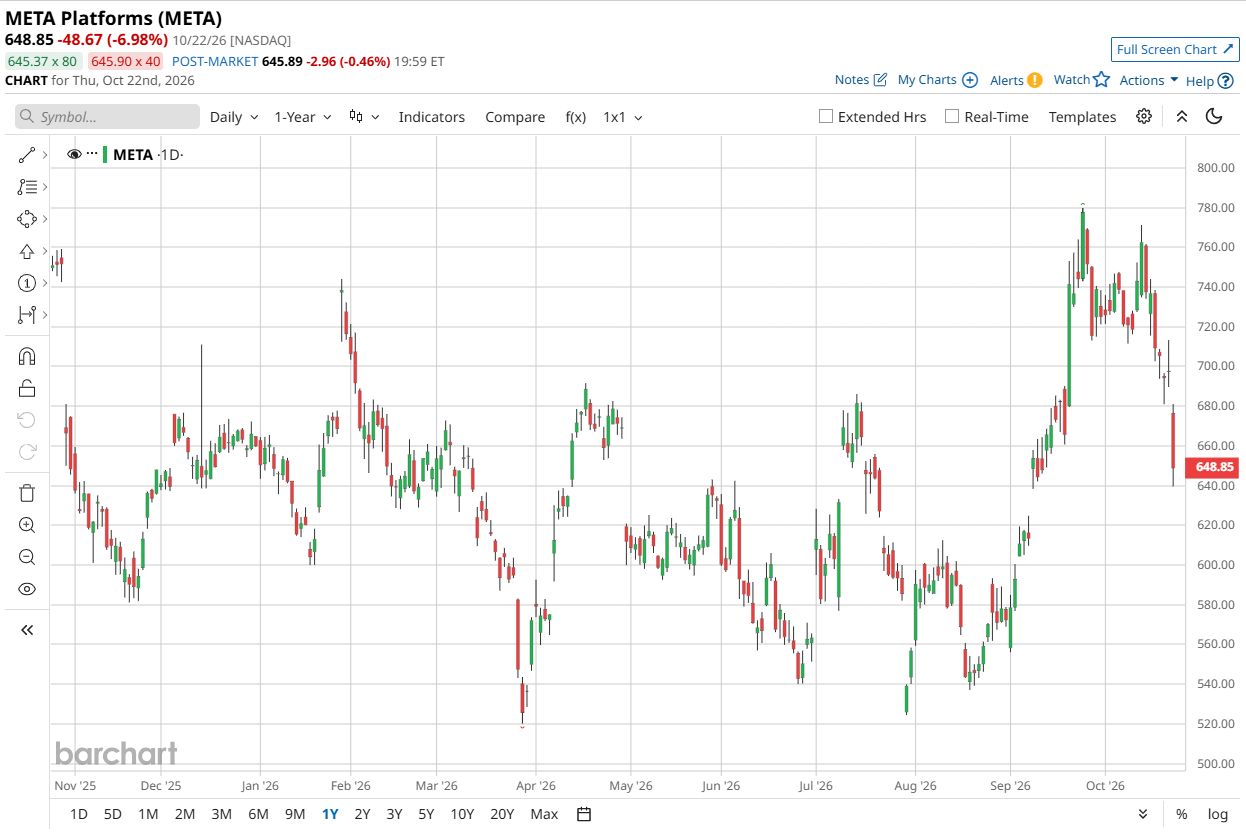
That breadth has helped Meta become one of the technology sector’s biggest players, with a market cap of about $1.8 trillion. Its share-price performance, however, has been far less convincing. META stock has fallen 11.5% over the past 52 weeks and declined 1.7% year-to-date (YTD). The recent slide has been sharper, with shares dropping 11.9% over the past month.
 www.barchart.com
The declines, however, have not erased Meta’s premium valuation. The stock is currently trading at 22.97 times forward adjusted earnings and 6.99 times sales, with both multiples exceeding industry averages and Meta’s own five-year average multiples.
Moreover, Meta pays a $2.10 per share dividend annually, translating into a yield of 0.30%. Its latest dividend payment was $0.53 per share, paid on Sept. 28, to shareholders of record as of Sep. 21.
A Closer Look at Meta’s Q3 Earnings
On Oct. 21, the company reported Q3 FY2026 revenue of $64.60 billion, up 26.1% year over year (YOY) and ahead of analyst expectations of $63.35 billion. Advertising did most of the heavy lifting, with ad impressions rising 10% YOY and the average price per ad climbing 14% YOY.
Meanwhile, daily active people across Meta’s Family of apps reached 3.64 billion, up 3% from last year. Revenue growth also outpaced audience expansion, pointing to stronger monetization rather than a dramatic surge in users.
The revenue gains, however, came with a substantial profitability setback. Rising AI infrastructure spending and a major legal charge pushed costs and expenses up 68.1% from the prior year’s quarter to $51.6 billion. Included in that total was a $9.89 billion legal charge related to an agreement with U.S. state attorneys general, which significantly affected the quarter’s reported results.
Operating income fell 36.8% from the year-ago value to $13 billion, driving the operating margin down to 20% from 40%. The legal expense explains a significant portion of the decline. Without that charge, operating income would have reached $22.88 billion, presenting a considerably stronger picture of underlying operations.
Net income grew 264% YOY to $9.9 billion. EPS also rose 264.8% from the previous year’s period to $3.83, although the bottom line missed analyst expectations of $5.46. However, it would have increased by $3.57 to $7.40 if not for the legal issue.
Looking ahead, management expects Q4 total revenue to range from $73 billion-$76 billion and has raised its expense outlook to incorporate the $9.9 billion legal charge recognized in Q3.
Full-year 2026 total expenses are now expected to fall between $175 billion-$179 billion. Meta also anticipates 2026 capital expenditures, including principal payments on finance leases, of $135 billion-$145 billion, narrowing its previous outlook of $130 billion-$145 billion.
Analysts expect these investments and expenses to weigh on earnings in the near term before growth gathers pace again. For Q4, EPS is projected to decline 7.9% YOY to $8.18, while FY2026 EPS is expected to fall 11.5% to $26.28. The outlook improves in FY2027, when EPS is forecast to rebound 28.7% YOY to $33.83.
What Do Analysts Expect for Meta Stock?
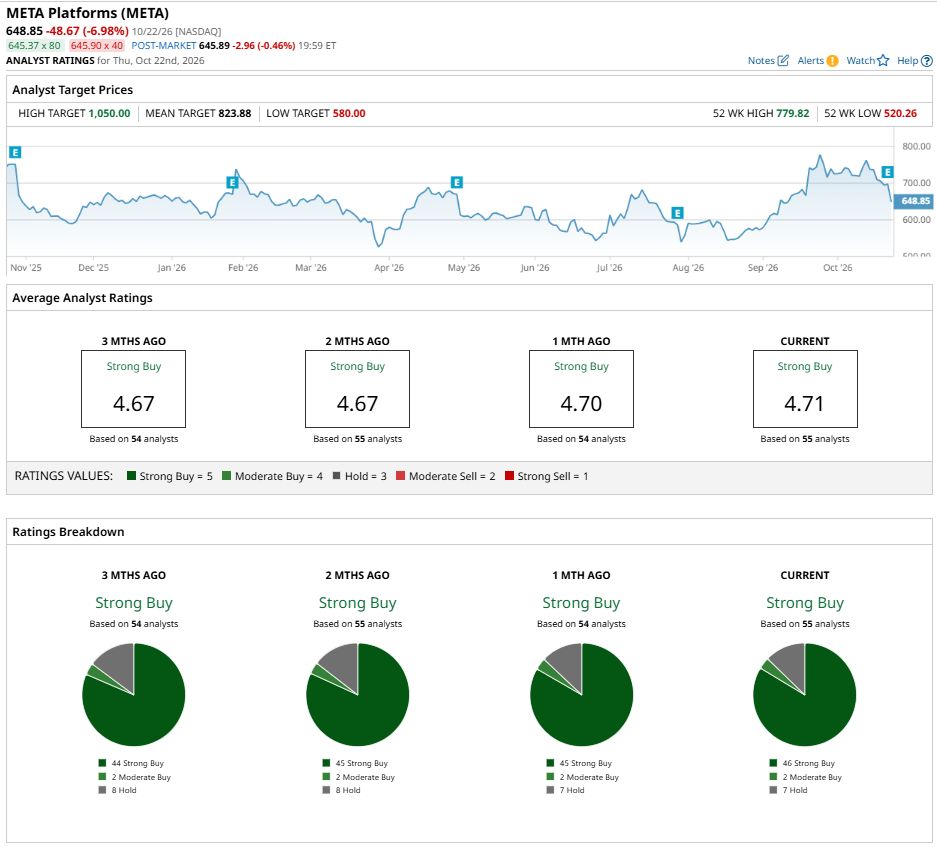
Despite the recent share-price weakness and pressure on reported earnings, Wall Street remains broadly optimistic about Meta. Among 55 analysts covering the stock, 46 assign it a “Strong Buy” rating, another two recommend a “Moderate Buy,” while seven advise investors to “Hold” their positions.
Price targets reinforce that positive outlook. The average price target stands at $823.88, representing potential upside of 27%, while the Street-high target of $1,050 implies a 61.8% gain from current levels.
 www.barchart.com
On the date of publication, Aanchal Sugandh did not have (either directly or indirectly) positions in any of the securities mentioned in this article. All information and data in this article is solely for informational purposes. For more information please view the Barchart Disclosure Policy here.
More news from Barchart
Micron’s Taiwan Unit Reached a Deal With the Taichung Union. Here’s What to Know. IBM’s CEO Just Issued a Warning Message on AI Spending. He Ended Up Hurting His Own Stock. What the New Class C Share Structure Actually Means for Meta Platforms Stock Investors Lockheed Vs. RTX: The Cheaper Defense Giant Is The Clear Value Win