

Earnings season is when companies do more than just put numbers on the table. They give investors a peek into what lies ahead. And sometimes, management’s commentary matters just as much as the actual results. For Home Depot (HD), Nov. 17 is the date to watch. That’s when the home improvement giant is set to report its fiscal Q3 2026 results before the opening bell, with Wall Street looking for clues on whether consumers are finally ready to loosen their purse strings.
The retailer had a decent Q2, with smaller projects and professional customers helping keep sales growing despite a sluggish housing market. Tariff refunds also provided some welcome breathing room against rising input costs. Its dividend story remains another bright spot, giving long-term investors a reason to stick around even when the broader housing market refuses to cooperate.
More Top Stocks Daily: Go behind Wall Street’s hottest headlines with Barchart’s Active Investor newsletter.
But let’s not get carried away just yet. High borrowing costs, cautious shoppers, and weaker demand for larger renovation projects continue to complicate the growth story. Meanwhile, rising fuel, energy, and product costs are putting margins under pressure, even as tariff refunds offer some relief.
Analysts are still looking for growth in both revenue and earnings in the third quarter. The bigger question, however, is whether Home Depot can deliver that growth without sacrificing profitability.
So, before the Nov. 17 report drops, let’s look at what analysts expect and the key numbers investors should watch.
About Home Depot Stock
Home Depot, founded in 1978 and headquartered in Atlanta, is the world's largest home improvement specialty retailer. The company operates 2,364 retail stores and more than 1,340 SRS locations across the U.S., Canada, and Mexico, serving a diverse customer base that includes individual homeowners, DIY enthusiasts, professional contractors, and builders. Its extensive product portfolio spans building materials, home improvement supplies, tools, flooring, cabinets, home décor, and lawn and garden products.
Beyond merchandise sales, Home Depot offers installation services, tool and equipment rentals, and maintenance and repair solutions, catering to a wide range of residential and professional requirements. The retailer also operates through multiple digital platforms, websites, and mobile applications, supported by an extensive distribution and fulfillment network. With a market capitalization of approximately $350.5 billion, Home Depot maintains a leading position in the North American home improvement retail industry.
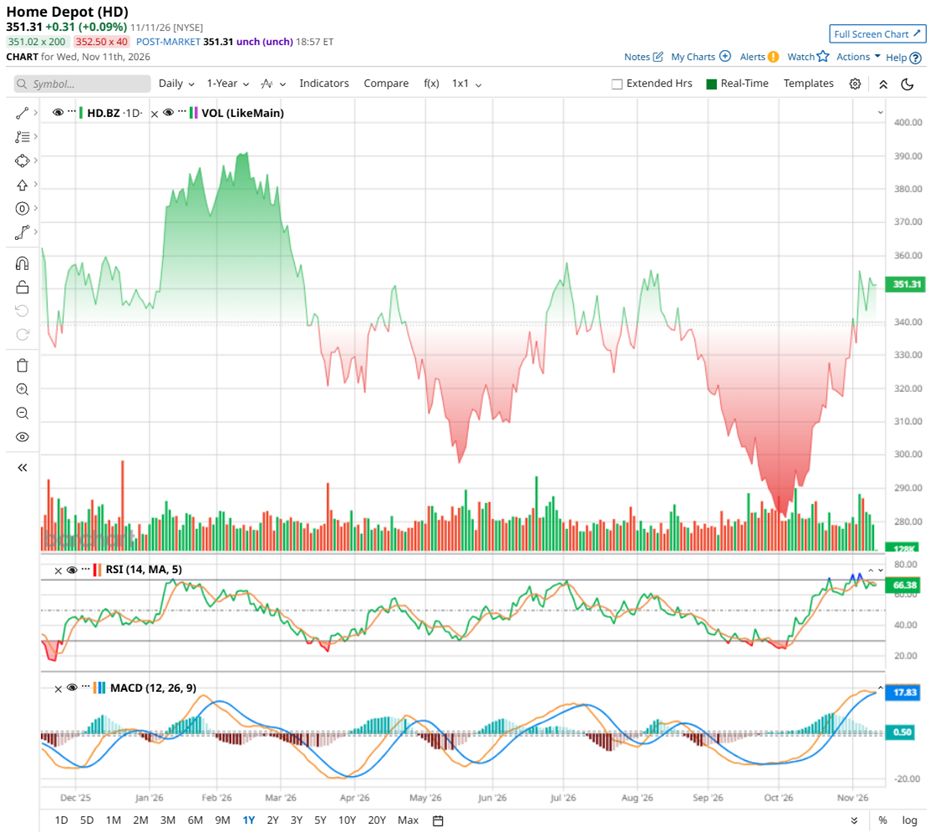
And while Home Depot continues to hold its ground in the home improvement market, its stock has had a few ups and downs of its own. Over the past 52 weeks, shares have slipped around 6.1%, although the stock is showing signs of finding its footing. After hitting a 52-week low of $277.15 in January, shares have staged an impressive comeback, climbing nearly 27%. At the current price of $351.31, the stock is still about 12% below its February high of $397.63, so there is some ground left to cover.
However, the recent momentum suggests the bulls are slowly getting back in the driver’s seat. HD stock has gained 20.8% over the past month alone, pushing its year-to-date (YTD) returns into positive territory at 2.1%.
The technical picture is also improving. The 14-day RSI, which slipped into oversold territory in October, has rebounded to 66. That’s a notable turnaround, suggesting buying interest has picked up considerably. So, after spending some time in the repair aisle, Home Depot stock appears to be putting itself back together.
 www.barchart.com
When it comes to valuation, Home Depot is not trading at bargain-bin prices, but its numbers offer a reasonably balanced picture. The stock trades at 23.39 times forward adjusted earnings, above both its sector and historical averages, suggesting investors are willing to pay a premium for its established market position and stability. However, its price-to-sales multiple of 2.04x remains below historical levels, indicating that the valuation may not be as stretched as the earnings multiple suggests.
Dividends add another reason for long-term investors to keep HD on their radar. Home Depot has maintained dividend payments for nearly four decades, with 16 consecutive years of increases. Currently, it offers a forward annual dividend of $9.32 per share, translating into a yield of approximately 2.65%, comfortably above the State Street SPDR S&P 500 ETF Trust’s (SPY) 1% yield.
A Snapshot of Home Depot’s Q2 Earnings Report
Home Depot delivered solid second-quarter numbers, reported in August, with sales growing 5.7% year over year (YOY) to $47.9 billion, comfortably beating Wall Street’s expectations. Comparable sales (comps) rose 1.7%, while U.S. comps increased 1.3%. The interesting part is that the customers were still spending, just a little more selectively. Comparable transactions declined 1%, with total transactions falling 0.8% to 443.2 million. However, the average ticket climbed 2.8% to $92.50 from $90.01 a year ago, suggesting shoppers were spending more each time they visited. Smaller home improvement projects also remained a source of strength, helping offset softer customer traffic.
Meanwhile, net income increased approximately 5% to $4.8 billion, while adjusted EPS rose 5.1% YOY to $4.92, ahead of forecasts. Margins, meanwhile, faced pressure from rising costs, but operational efficiencies, new-store leverage, better-than-expected consumer spending, and IEEPA tariff refunds helped cushion the impact.
Cash generation also improved. Operating cash flow for the first six months of fiscal 2026 reached $11.4 billion, compared with $9 billion a year earlier. Capital expenditures totaled $1.7 billion, alongside $1.3 billion in payments for acquired businesses. Home Depot ended Q2 with $2.1 billion in cash. It also returned $4.64 billion through dividends and repaid $3.04 billion in long-term debt, contributing to $7.7 billion in net cash used for financing activities. Inventory stood at $26.9 billion, receivables at $7 billion, and long-term debt at $43.95 billion.
Looking ahead, management reaffirmed its fiscal 2026 guidance, expecting total sales growth of 2.5% to 4.5% and comparable sales ranging from flat to up 2%. The retailer plans to open 15 new stores and invest 2.5% of sales in capital expenditures. Gross margin is expected at 33.1%, with adjusted operating margin of 12.8% to 13%.
Home Depot expects both reported and adjusted EPS to remain flat to increase 4% from their respective year-ago levels of $14.23 and $14.69. Importantly, guidance factors in IEEPA tariff refunds, which should partially offset higher fuel, energy, and product input costs.
For the upcoming Q3 report on Tuesday, analysts tracking Home Depot anticipate its Q3 revenue to rise to $42.8 billion, with adjusted EPS rising 3.5% YOY to $3.87. Looking further ahead, fiscal 2026 EPS is expected to rise by 2.2% YOY to $15.01, and then surge by another 6.3% annually to $15.95 in fiscal 2027.
What Do Analysts Expect for Home Depot Stock?
Analysts remain cautiously optimistic but see limited room for upside. Bernstein recently raised its price target on HD to $357 from $344, maintaining a “Market Perform” rating. While the firm expects HD to outperform Lowe’s (LOW) in Q3, muted home improvement demand and affordability concerns could limit further gains.
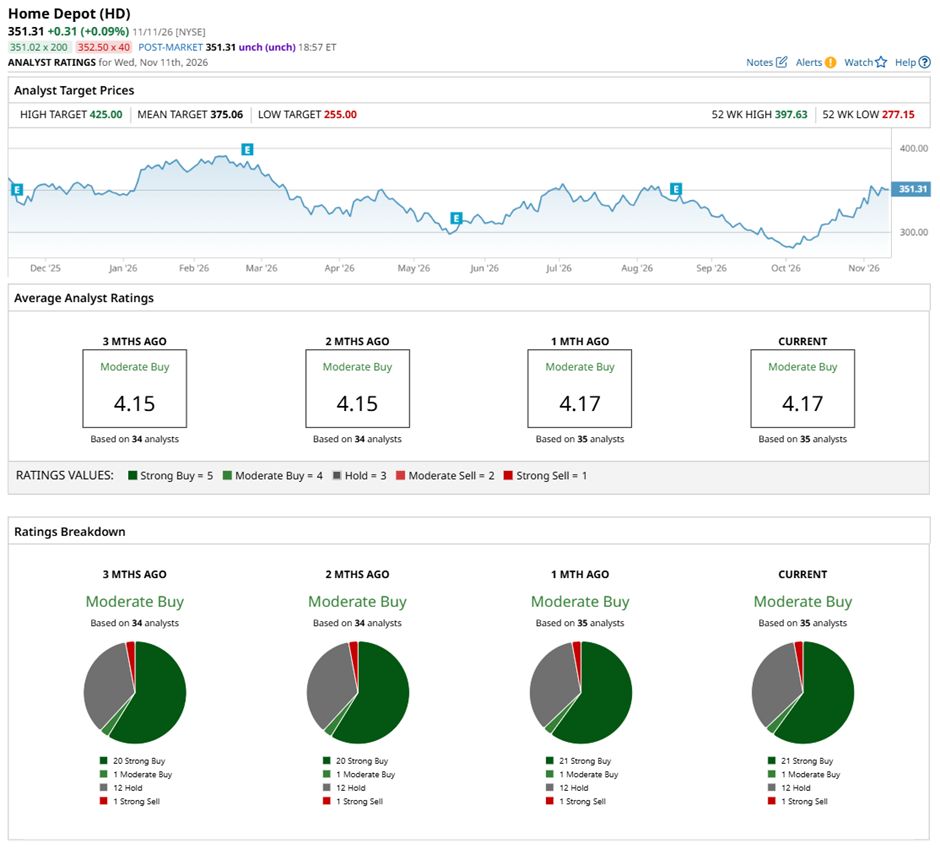
Analysts are upbeat with a dash of caution about this home improvement stock’s potential. Of the 35 analysts covering the stock, the overall rating is a “Moderate Buy.” The current bullish rating is based on the confident 21 analysts advising a “Strong Buy,” while one sticks to “Moderate Buy.” 12 are staying on the sidelines with a “Hold” rating, and the remaining one is waving a red flag with a “Strong Sell.”
HD stock’s mean price target of $375.06 hints at a 6.8% rebound potential from where it’s trading now. The Street-high target of $425 implies the stock could rally as much as 21%.
 www.barchart.com
On the date of publication, Sristi Suman Jayaswal did not directly have a position in any of the securities mentioned in this article. All information and data in this article is solely for informational purposes. For more information please view the Barchart Disclosure Policy here.
More news from Barchart
Novo Nordisk vs. Amgen: 1 Has the Blockbuster Weight-Loss Drugs, the Other Has a Promising Rival Cathie Wood and Jim Cramer Disagree on Nvidia Stock Without Jensen Huang. Earnings Could Decide Who's Right A $1.3 Billion Reason to Buy Firefly Aerospace Stock Here Why at Least 1 Analyst Says Nvidia Stock Has Already Bottomed – Or Is Very Close