

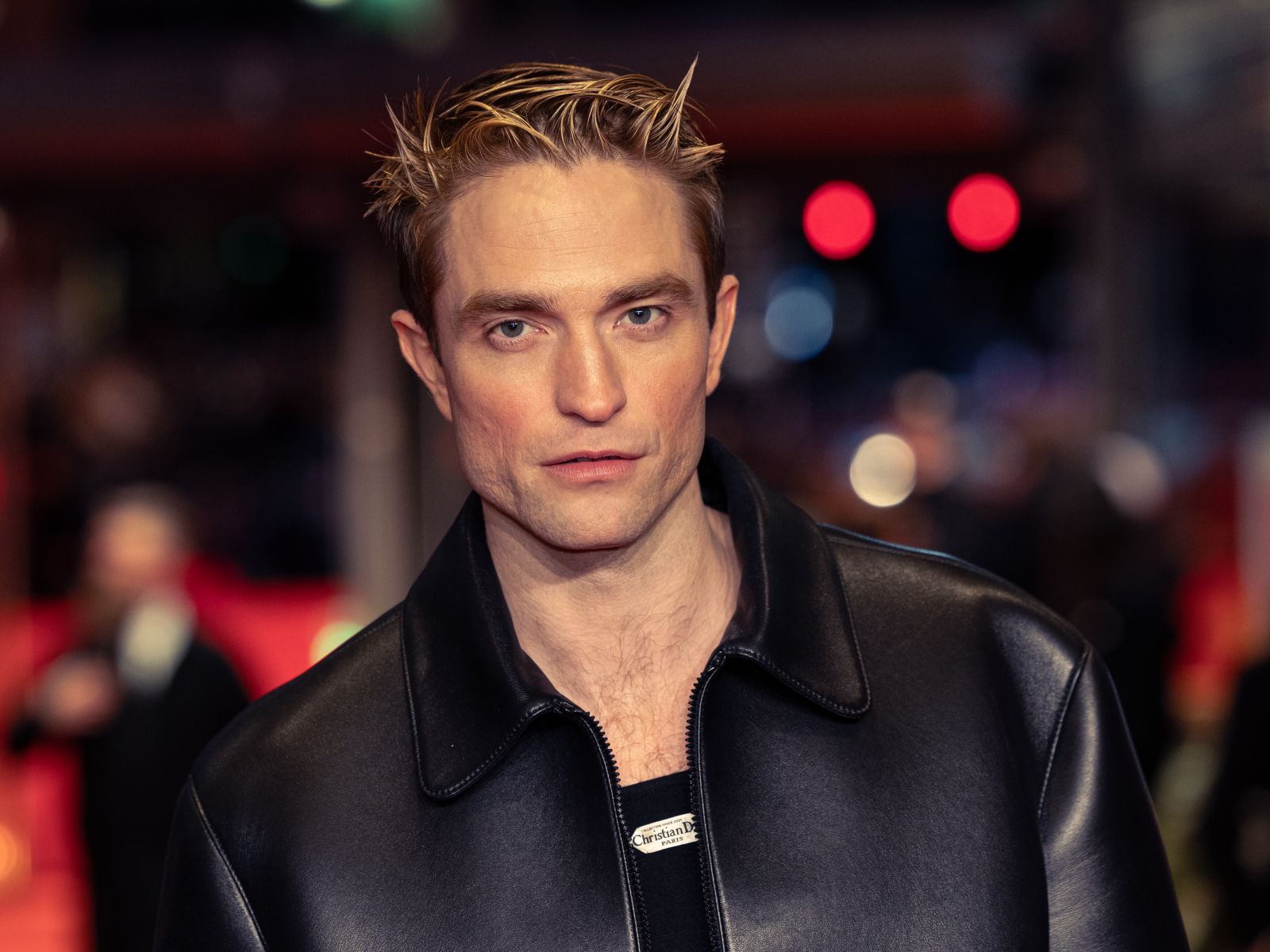
After years of speculation, Amazon (AMZN) has chosen Robert Pattinson as its next James Bond. Amazon MGM Studios announced the casting on Monday, making Pattinson the seventh 007 and the first since Amazon took over the franchise.
I see this as a return to form: another major studio committing to a long-term, intellectual property-led project by casting a well-known, A-list actor in its biggest franchise. This news puts Amazon following peers like Disney (DIS), which is making fewer, better Star Wars films and somewhat retconning the Marvel Cinematic Universe with the Russo brothers on “Avengers: Doomsday.”
More Top Stocks Daily: Go behind Wall Street’s hottest headlines with Barchart’s Active Investor newsletter.
On the other hand, it is bad news for Skydance (SKYD) investors and fans. The recent Warner-Bros merger just closed, the company has a mountain of debt, and for better or worse, it has decided to reset the DC Universe again. That creates a more fractured experience for fans and moviegoers, which I am sure will hurt Skydance’s ticket sales over the next several quarters.
Sponsored Content: This AI Company Has Signed 200+ Contracts in 2026, Completed Its First Acquisition, and Is Building a Portfolio of AI-Powered Businesses.
In Hindsight, Pattinson Was the Obvious Choice for Bond
Many actors who become James Bond first had an audition movie, one that has them playing a suave, spy-esque character. For Daniel Craig, many believe that was “Layer Cake,” a movie about a drug dealer navigating the London underworld.
For Pattinson, it was likely “Tenet.” In Christopher Nolan’s time-travel film, he played Neil. His character was the protagonist’s consistent ally, friend, and confidant. More importantly, he was always in nice tailored suits, great with weapons and combat, and had a very classically British espionage vibe about him throughout the film.
I’m sure working closely with Denis Villeneuve on “Dune: Part Three” probably boosted his chances, as he is directing Amazon’s first Bond film. But I also think he read the writing on the wall with Skydance.
Filming for his Batman kept getting pushed back, with “The Batman Part II” moving from October 2025 to October 2027, and instead of waiting around, he auditioned for Bond, as reported at the end of October.
Pattinson’s proactive auditioning decision should matter to investors because it reflects a leading actor’s perception of a major studio’s financial health. Investors want consistency and returns. So they look to companies with a solid plan, and I see Pattinson as a proxy for where the winds are shifting at Amazon, Apple (AAPL), Skydance, Disney, and Netflix (NFLX).
Megacap Tech Is Finding Blockbuster Success
Amazon and Apple are both megacap tech companies that have been investing heavily in video entertainment through Prime Video and Apple TV, and even more directly with Amazon buying MGM.
Amazon (AMZN)
 www.barchart.com
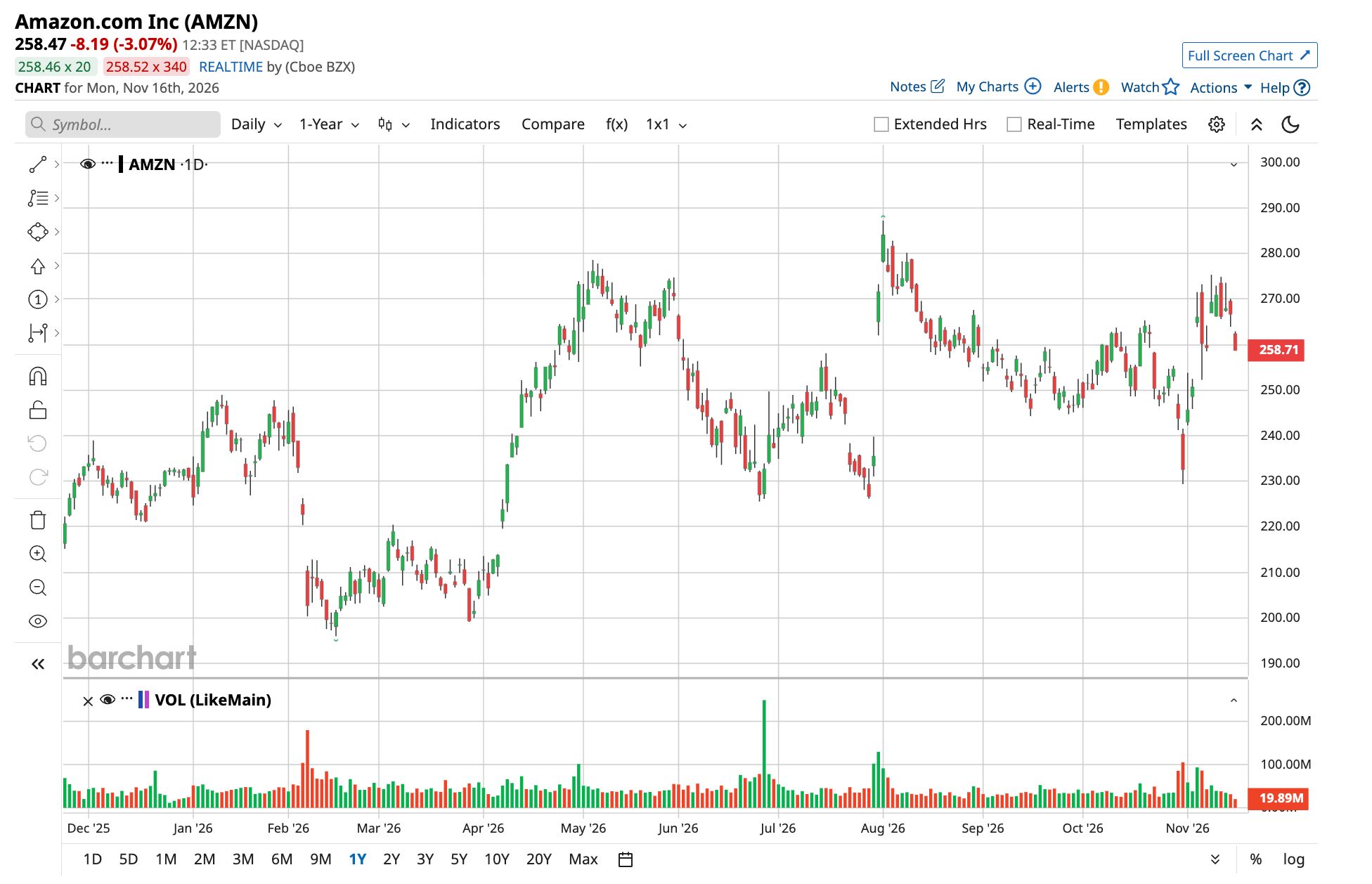
Movies are not a material component of Amazon’s income statement, but its foray into theatrical blockbusters is growing, and “Project Hail Mary” was a really big win. Finally releasing a new James Bond gives Amazon a franchise it can build on in a secure, strong way.
Amazon reported $201.9 billion in third-quarter net sales, up 12%. Amazon MGM Studios has exceeded $1.2 billion in global box office so far in 2026. The Barchart Technical Opinion on AMZN is an 88% Buy, and shares are up 11.5% over the past year. Third-quarter earnings of $1.89 per share missed the $2.01 estimate. Analysts carry a mean price target of $328.33. Pattinson’s deal reportedly covers three films. Production is expected to start in 2027, with a release in 2028 at the earliest.Apple (AAPL)
 www.barchart.com
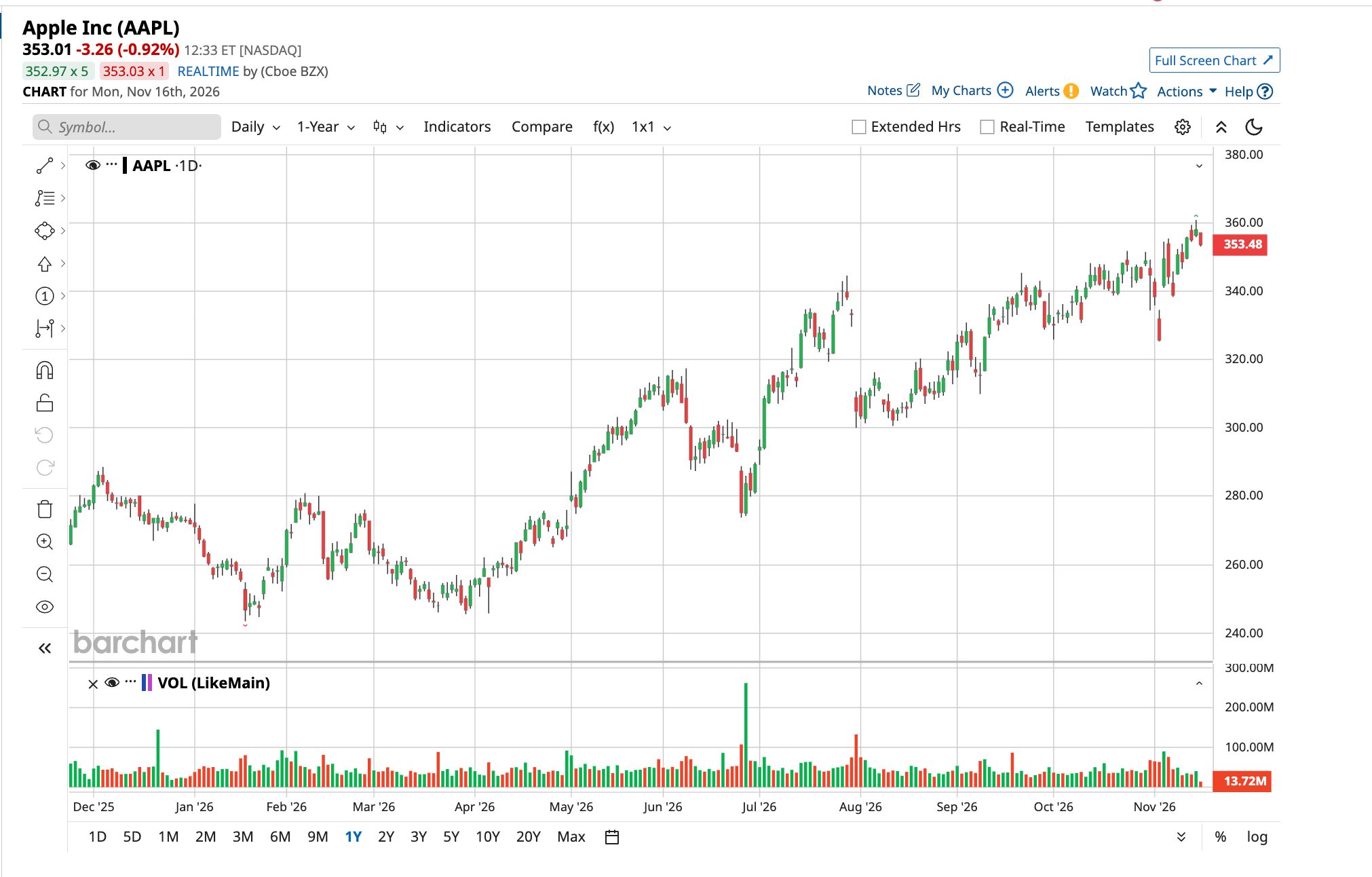
Following Amazon’s lead, Apple is another megacap that continues to reinvest and double down on strong IP. “F1” was a runaway blockbuster hit with Brad Pitt, and Apple is already looking to bring it back with a sequel. Like Amazon, Apple can take lots of creative risks and liberties by experimenting with different shows and movie concepts, because it is backed by the iPhone rather than ticket sales.
Apple reported record September-quarter revenue of $114.5 billion, up 12%, and fiscal 2026 revenue of $479 billion. “F1” grossed more than $634 million worldwide, and Apple executive Eddy Cue told Reuters that writers are working on the sequel. The Barchart Technical Opinion on AAPL is a 100% Buy. Shares are up 30.5% over the past year, for a market cap of about $5.2 trillion. Earnings of $2.05 per share beat the $1.98 estimate.Debt-Laden Studios Are Resetting Their Biggest Franchises, Which Alienates Fans and Investors
Many large studios are debt-laden and carry immense production costs. As investors continue to demand a safe, strong, and predictable strategy, several are restructuring to get one.
Skydance (SKYD)
 www.barchart.com
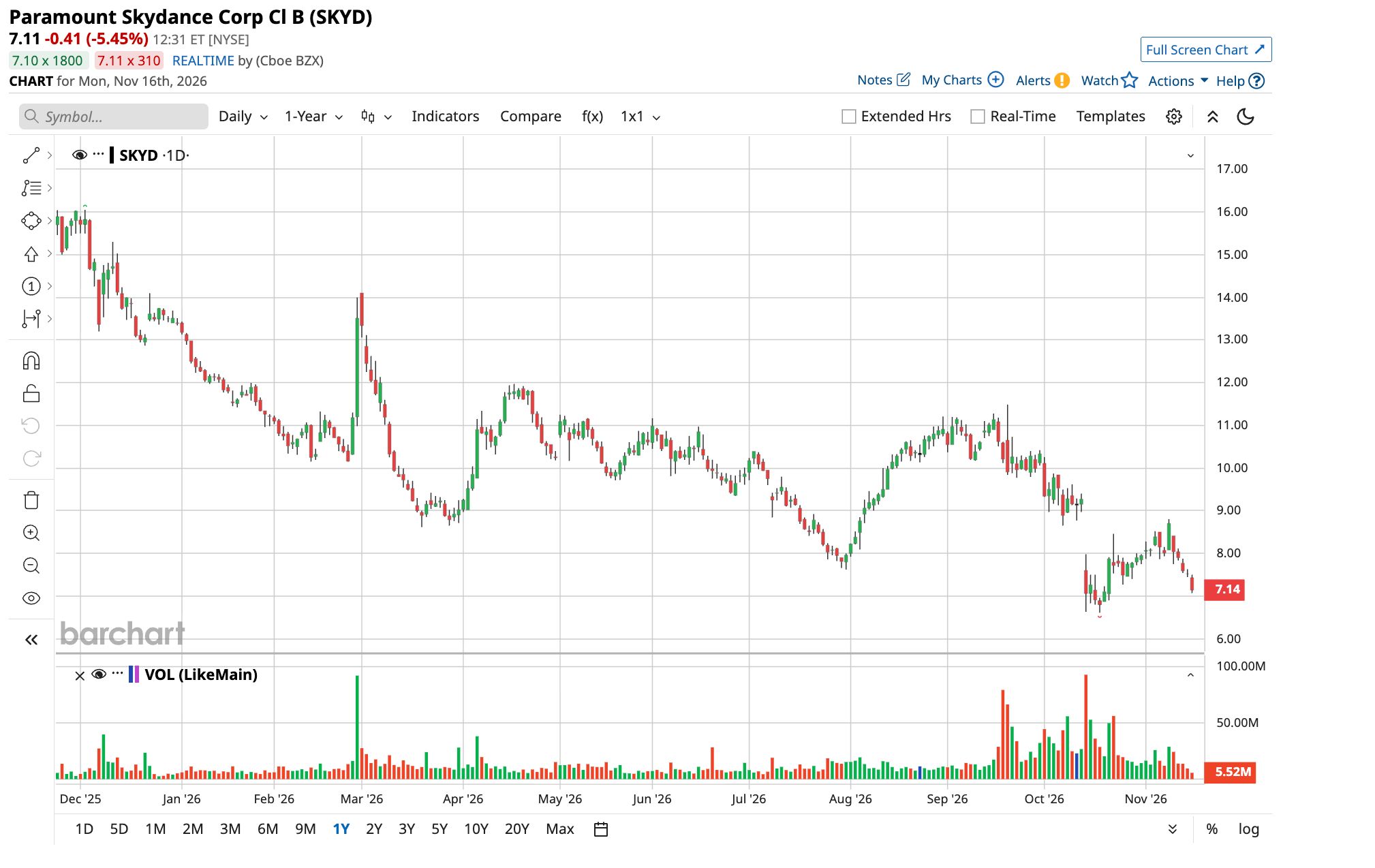
Pattinson’s casting as Bond is bad for Skydance in two ways. First, it increases speculation that his Batman universe is ending, at a studio that already has plenty of tumult: Matt Reeves stepped away from “The Batman Part II,” Steven Soderbergh is filling in, and the DC Universe has been shaken up yet again as James Gunn and Peter Safran “stepped down” (read: were fired).
Second, Batman is the backbone of DC. From an investor perspective, seeing your quarterback sign a long-term deal with a competing studio can read as bearish sentiment on Skydance stock and the DC Universe. As a DC fan myself, it is a little bit discouraging, because I thought James Gunn was doing a good job.
SKYD shares traded at $7.15 midday Monday, down 19.1% over five days and 55.1% over the past 52 weeks. The Barchart Technical Opinion is a 100% Sell. Skydance had $87 billion in gross debt and about $10 billion in cash after closing its Warner Bros. Discovery acquisition. Its market cap is about $8.4 billion. Management expects the Warner Bros. film slate to reduce fourth-quarter profit by up to $200 million. Analysts expect a fourth-quarter loss of $0.19 per share. The consensus rating is Hold with a mean price target of $9.20.Disney (DIS)
 www.barchart.com
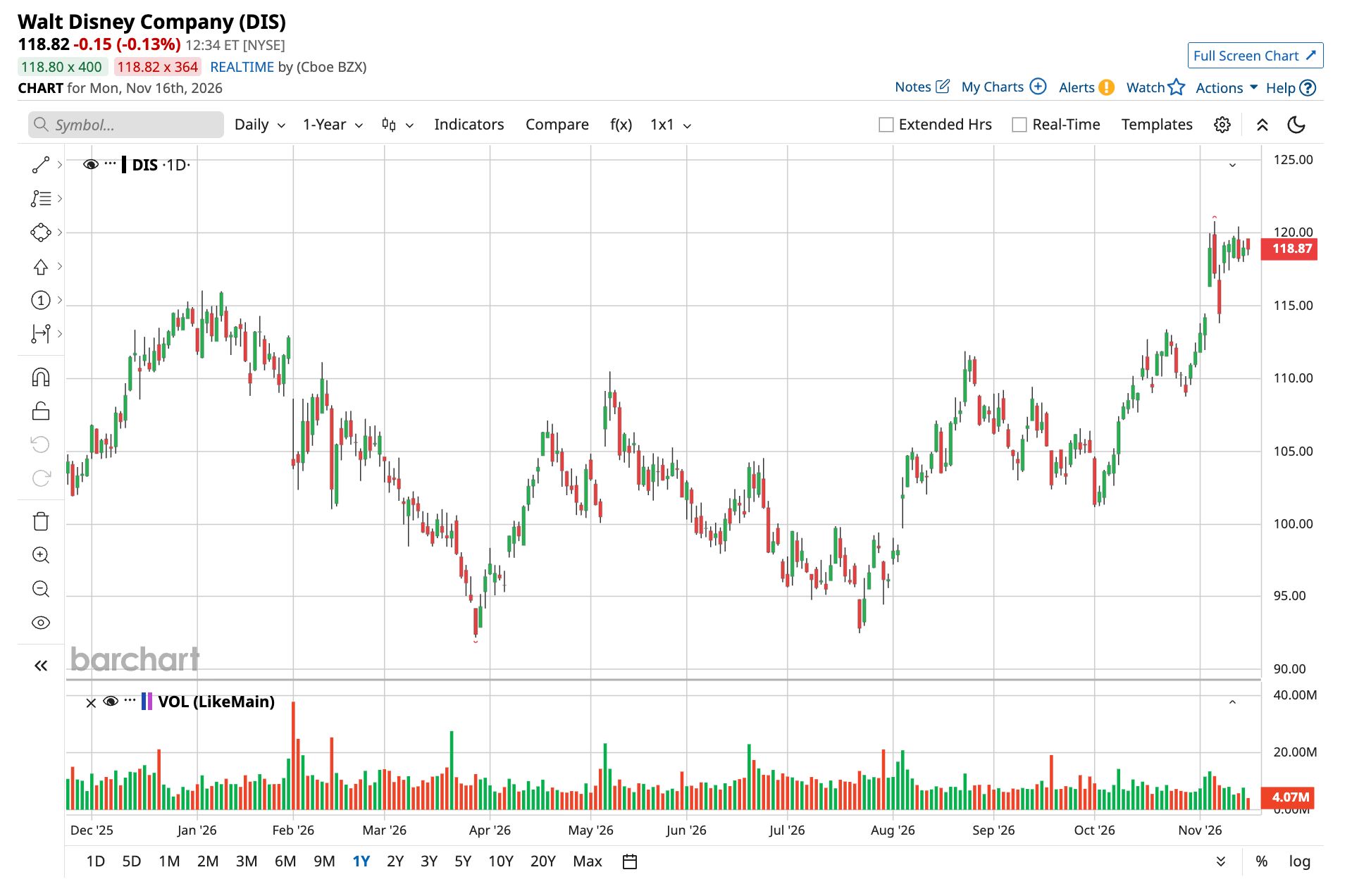
Disney has a lot riding on “Avengers: Doomsday.” Execs have admitted the company went too broad, and the studio is now doing fewer Star Wars and Marvel releases while being more intentional with storylines and writing.
Disney reports fiscal fourth-quarter earnings before the open on Nov. 17. Analysts expect $1.67 per share, up 50% from a year ago, and Disney has beaten estimates in each of the last four quarters. The Barchart Technical Opinion on DIS is a 100% Buy. Shares are up 12.2% over the past year and trading near their 52-week high of $120.80. “Avengers: Doomsday” opens Dec. 18 and is tracking for a $340 million to $369 million domestic debut. “Toy Story 5” surpassed $1 billion in global box office, while Disney said “The Mandalorian and Grogu” underperformed expectations.Netflix (NFLX)
 www.barchart.com
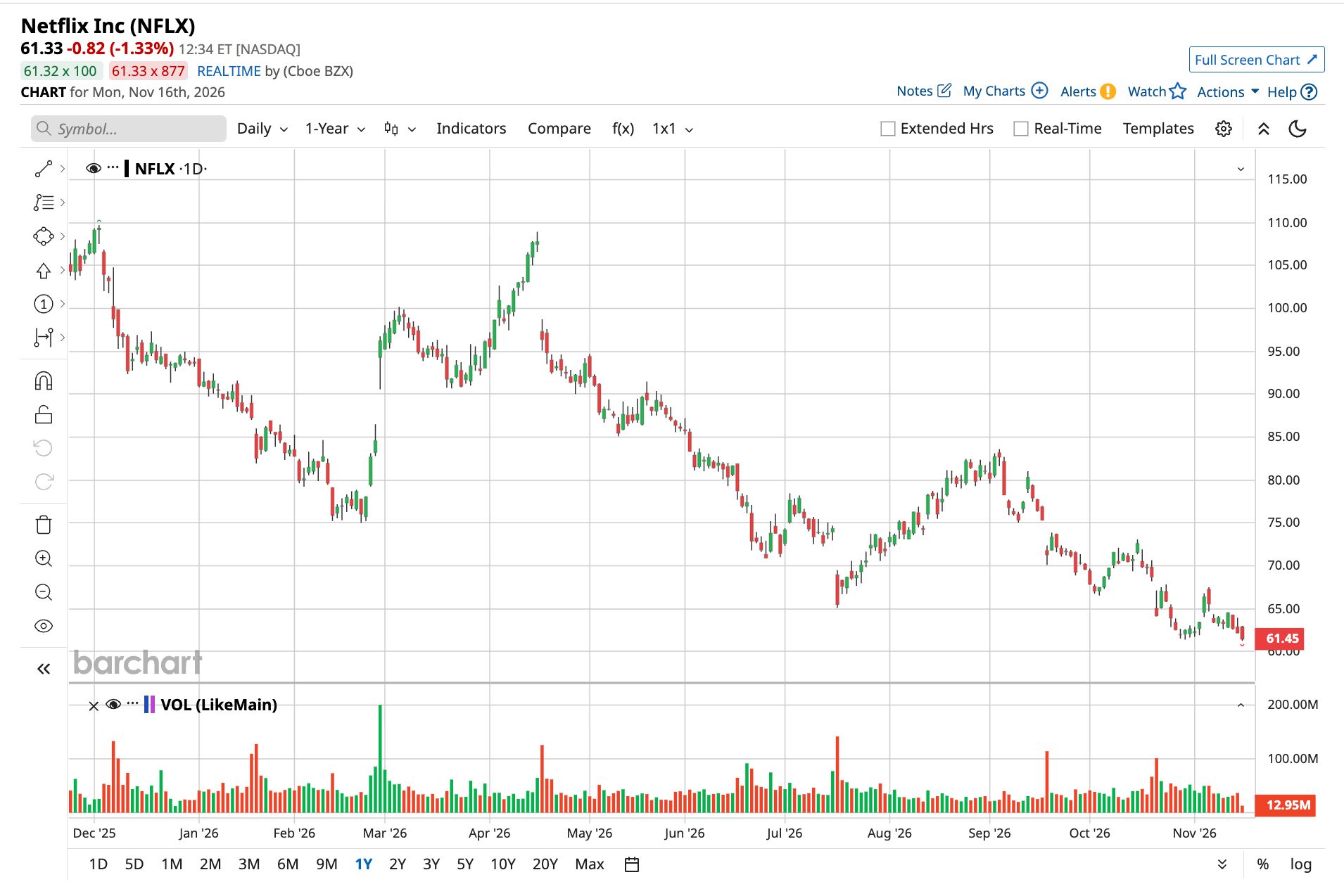
Netflix, I would say, has its back against the wall because competition is increasing across the board. Studios like Amazon and Apple are hitting home runs both in theaters and at home, so Netflix is losing some of its moat, though it’s still in a better position than Skydance.
The Barchart Technical Opinion on NFLX is a 100% Sell. Shares are down 45.38% over the past year and trading near their 52-week low of $61.24. Third-quarter earnings of $0.87 per share beat the $0.82 estimate, and revenue grew 12%. Netflix still carries a 24.3% profit margin. Netflix cut its 2026 advertising revenue forecast to $2.7 billion from $3 billion and is cutting 1,000 jobs, about 6% of its workforce. Netflix had agreed to acquire Warner Bros.’ studio and streaming businesses before Paramount’s bid won out.The Way Forward for Studios Is a Profitable Franchise First, Creative Risks Second
As an avid moviegoer, it is nice to see a movie like “Wildwood” get made. The stop-motion epic comes from Laika, the studio run by Travis Knight, son of Nike co-founder Phil Knight. The art is there. The film has passed $60 million worldwide against a reported $100 million budget.
On the flip side is “Digger.” The Tom Cruise film opened to $8 million domestically and is tracking to lose $245 million for Warner Bros., now part of Skydance.
To take risks, studios need either profits from elsewhere or a consistent IP that generates a lot of revenue. Amazon and Apple have the profits, and Disney has the IP, while Skydance is trying to rebuild its biggest IP with $87 billion in debt.
Pattinson’s Bond Casting Ushers in a New Era for Film Studios
As I gathered my research for this article, it became clear to me that Robert Pattinson is, physically and philosophically, an embodiment of the strategic crossroads facing the broader entertainment industry.
The companies pivoting towards structure and grounded predictability are the ones the market is rewarding. Apple is doubling down with an “F1” sequel, and even Disney, which admitted it went too broad with its sheer volume of new shows and movies, is being more intentional with Star Wars and Marvel.
As both an investor and a moviegoer, I am excited to see where it goes.
On the date of publication, Justin Estes did not directly have a position in any of the securities mentioned in this article. All information and data in this article is solely for informational purposes. For more information please view the Barchart Disclosure Policy here.
More news from Barchart
Dear Klarna Stock Fans, Mark Your Calendars for November 17 Dear Starbucks Stock Fans, Mark Your Calendars for November 17 Robert Pattinson Is the New 007. That’s Bad News for Skydance Stock and Good News for the Film Industry. Don’t Buy the Dip in Nvidia Without This Safety Net. How I’m Playing NVDA Stock After the Jensen Huang Fiasco