


Earlier this month, I introduced a custom Barchart watchlist that I affectionately call "The Short List." It is a curated basket (by me) of high-beta stocks and ETFs that were flashing early warning signs of technical exhaustion last summer.
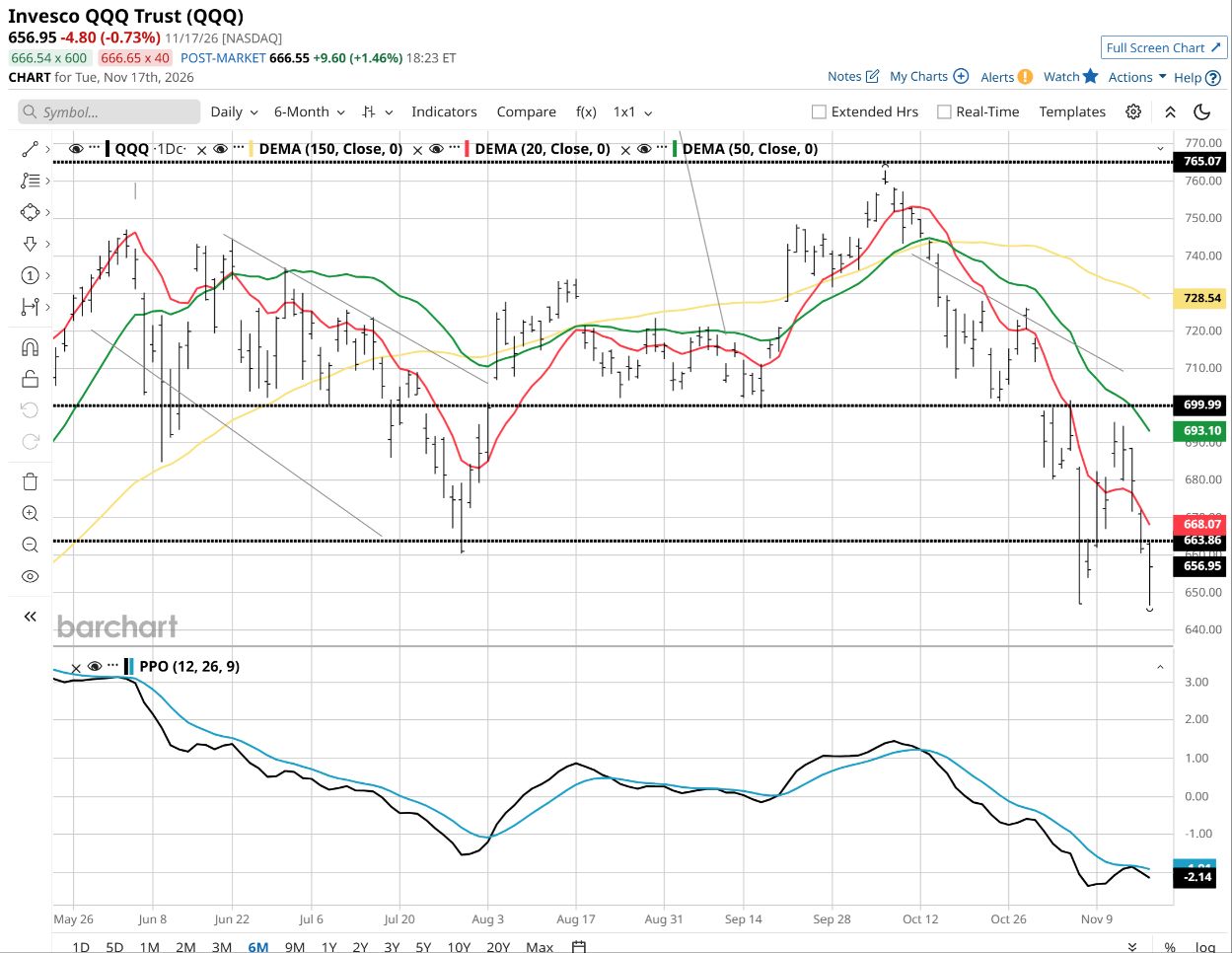
That was around the time when the Invesco QQQ Trust (QQQ) topped out on June 2, following a vicious spring rally. However, rather than creating the old upside-down V formation and plunging back down, it traded in a volatile range for four months.
More Top Stocks Daily: Go behind Wall Street’s hottest headlines with Barchart’s Active Investor newsletter.
Then it broke down around Oct. 6, and as of Tuesday night, it was still breaking down. During the six months ended Nov. 17, QQQ is down 7.7%. And has fallen nearly 14% from the all-time high it set earlier in the month.
 www.barchart.com
That’s all very nice accounting. But what can we learn from what just happened? For that, I refer back to that Short List. Back in June, I determined they were the most likely canaries in a coal mine for the stock market's future path.
Not so much the next few wiggles up and down, as we’ve seen. I’m talking about whether there’s another 20-30% move higher before the bull cycle ends, or if it could head sharply downward instead.
At the time, the group had averaged a roughly 20% pullback, right on the doorstep of a bear market. Since then, those cracks have widened into full-blown potholes and much worse.
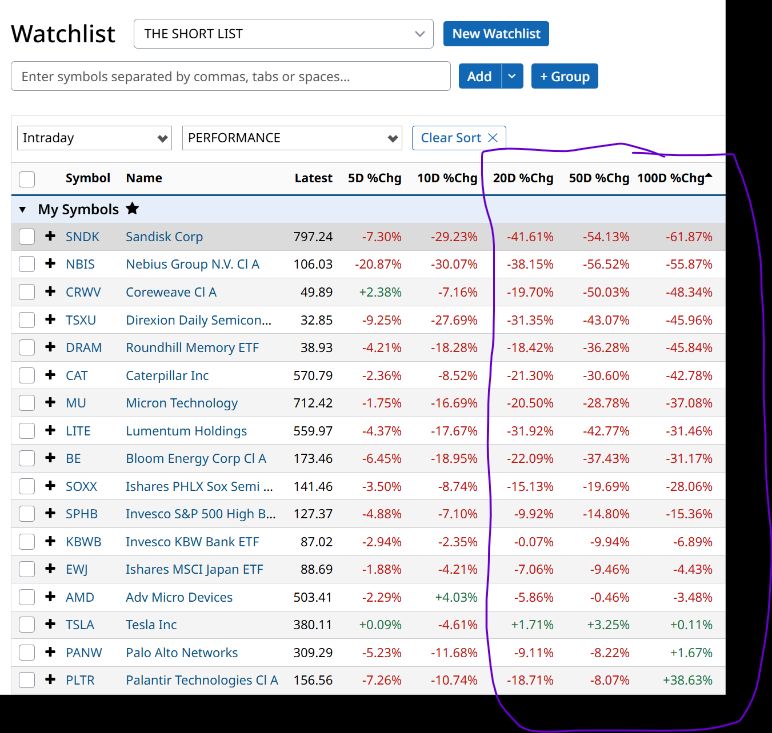
When I sort that same watchlist by 100-day performance and track the progression across the 20-day, 50-day, and 100-day columns, the message is quite clear: forced liquidation in speculative market leaders is accelerating, not ending.
 www.barchart.com
Look closely at the breadth of that damage. It is no longer confined to a couple of fringe cloud plays. In fact, if I showed you the charts of ETFs like CLOU, IGV, and CIBR, you’d see that this is a pan-tech issue.
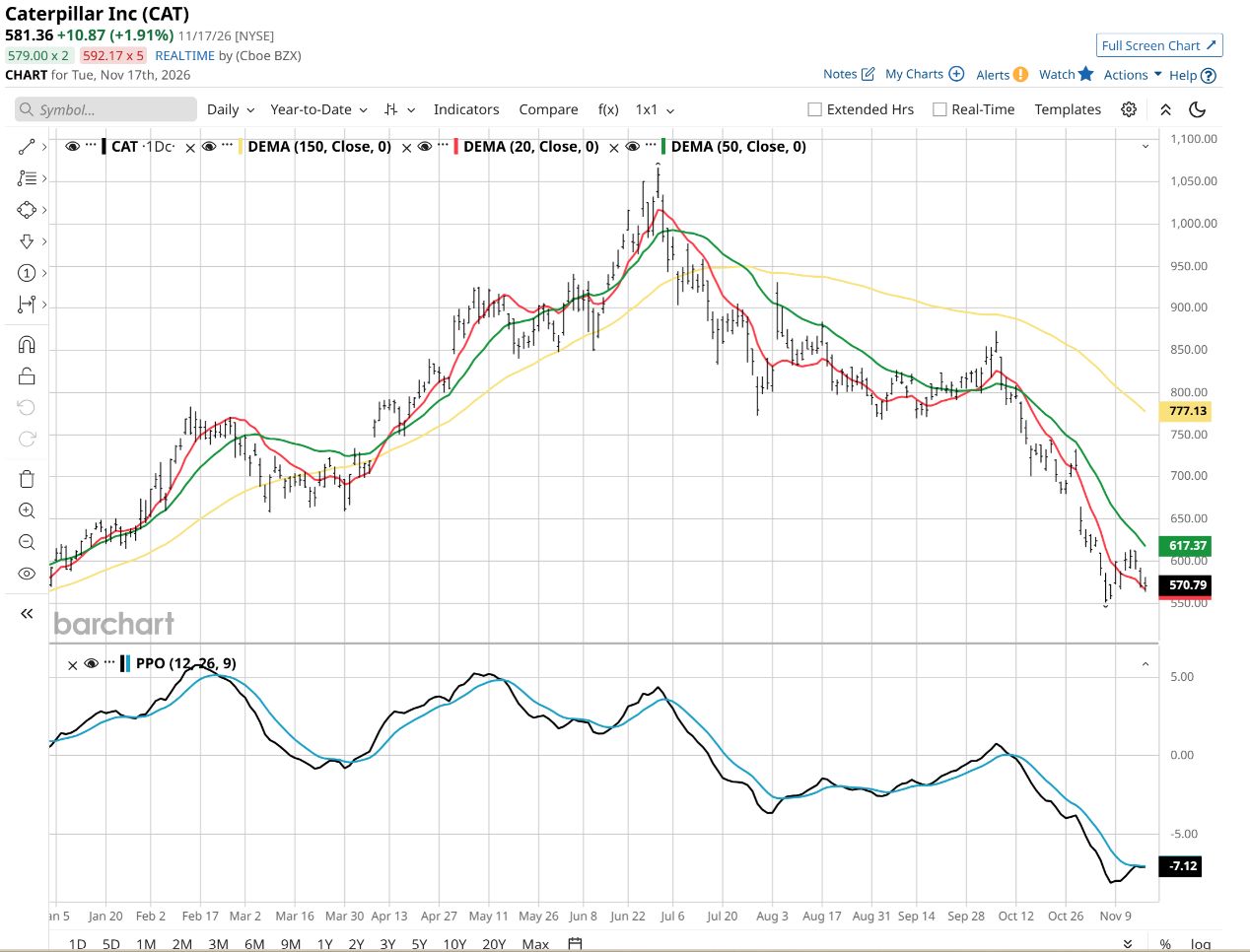
Memory and storage stocks like Sandisk (SNDK) and Micron (MU) have sold off hard during the past 100 trading days, dragging down the Roundhill Memory ETF (DRAM) and the broader iShares Semiconductor ETF (SOXX) right alongside them. Even industrial and power-infrastructure darlings tied to the data-center buildout, such as Caterpillar (CAT) and Bloom Energy (BE), have shed more than 40% — another reminder to beware of “rebirths” like CAT, which suddenly became an AI darling.
See this chart? If I didn’t know better, I would think it was QQQ in 1999 and 2000. In fact, percentage-wise, it is nearly identical: up 75%, then giving it all back. But it took longer with QQQ back then!
 www.barchart.com
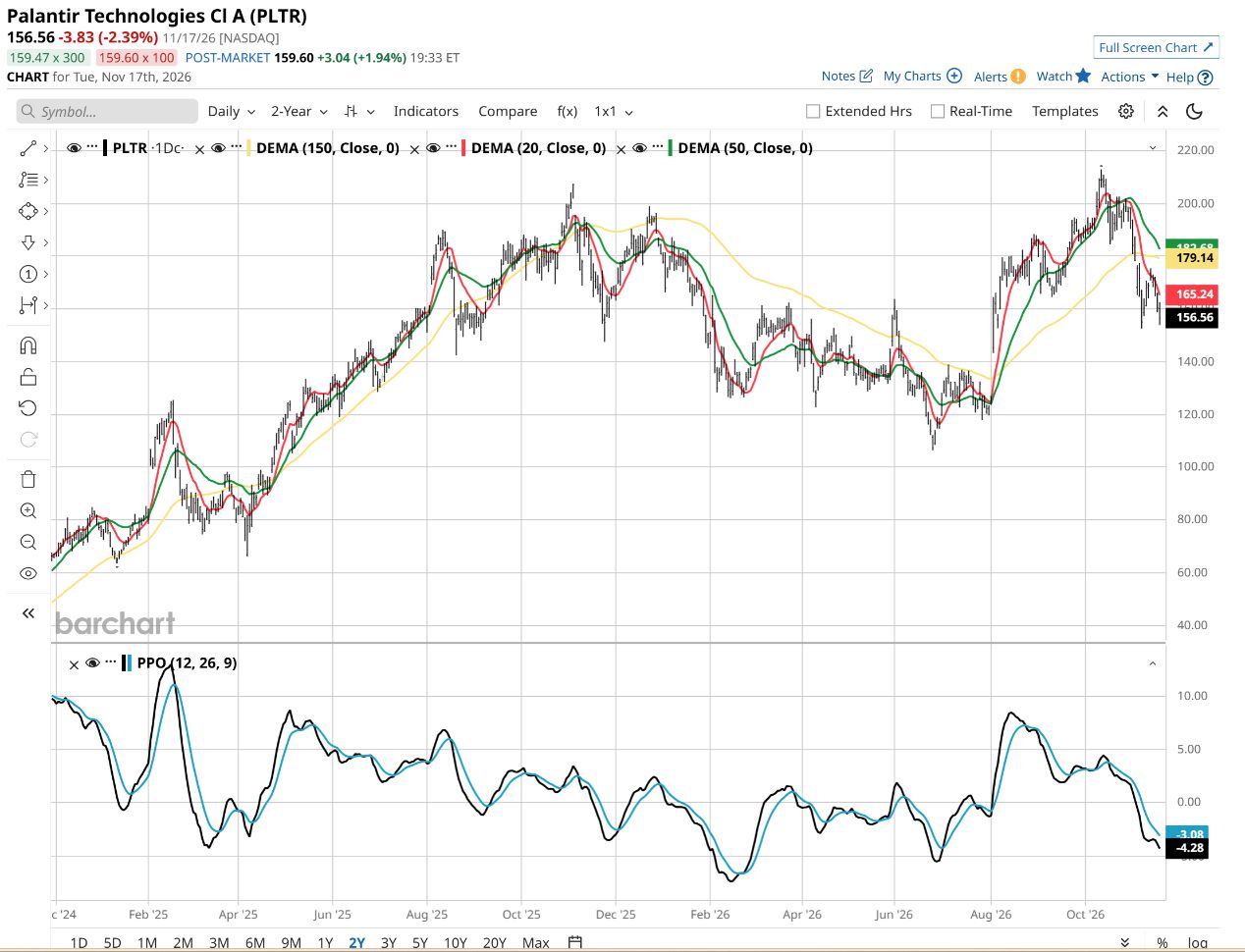
Meanwhile, the few holdouts near the bottom of the list are starting to buckle. Palantir (PLTR) is still clinging to a nearly 50% gain over 100 days. But the chart below points to $120 or lower, which could reverse the progress made, as it did with the others.
 www.barchart.com
I took an honest look through that watchlist to see if any of them deserved to be removed. Sort of like when a prisoner is let out early for good behavior. No such luck.
Tesla (TSLA) looks flat, and the Invesco KBW Bank ETF (KBWB) isn't in full-blown bear mode yet. But let’s not grade on a curve here. Nothing on the list is anything more than a speculative trading buy. And even that’s a stretch.
The most dangerous mistake retail investors make during a market transition is assuming that carnage in high-beta stocks stays neatly contained.
In every major market unwind I have charted over the past 40 years, the speculative perimeter breaks first. Traders who bought high-flyers on margin get hit with capital calls, forcing brokers to liquidate positions at market prices.
Once liquidity drains out of the secondary leaders, institutional desks are forced to sell their liquid mega-cap holdings in the S&P 500 and Nasdaq 100 to raise cash. I think we’re rapidly approaching that phase.
Wall Street pundits love to call a 30% to 50% drop in former leaders a "healthy reset" or a "buying opportunity." In reality, stocks down by that much carry massive overhead supply in the form of millions of trapped buyers waiting to sell into every minor bounce just to break even.
Despite the name of this watchlist, I follow a strict rule after four decades as a fiduciary risk manager: I never short stocks directly. Direct short selling exposes your account to unlimited theoretical losses, steep borrow fees, and catastrophic overnight gaps.
Instead, treat a deteriorating watchlist like this as an early-warning radar and deploy defined-risk tools to play offense and defense at the same time: Ultra-short Treasury bill ETFs like the SPDR Bloomberg 1-3 Month T-Bill ETF (BIL), so your worst-case portfolio loss is strictly capped before volatility hits. And unique ETFs like the AGF U.S. Market Neutral Anti-Beta Fund (BTAL) systematically short high-beta stocks while holding low-beta stability — turning the exact unwind shown in the table above into positive portfolio returns.
Of course, there’s also the options market. If you insist on holding volatile growth names or index ETFs, consider wrapping them in married puts or an options collar rather than relying on stop-loss orders that fail during overnight gaps.
I know, I know. I’ve been breaking records here for months warning about the importance of managing risk.
But in the daily chaos of managing money in these markets, hopefully it provides a running “training course” on that often-overlooked art and science of not turning your 401(k) into a proverbial 201(k).
Rob Isbitts is a semi-retired CIO, former fiduciary investment advisor, Barchart columnist, and straight-talker. Download his new free e-book on hedged bond investing for retirement at ETFYourself.com. His research and model portfolios are at ROAR.PiTrade.com.
On the date of publication, Rob Isbitts did not directly have a position in any of the securities mentioned in this article. All information and data in this article is solely for informational purposes. For more information please view the Barchart Disclosure Policy here.
More news from Barchart
The Downside Risk in Stocks Is Still High, According to My 'Short List' CRM Stock Layoffs: What to Know as Salesforce Reportedly Begins More Job Cuts Dear SpaceX Stock Fans, Mark Your Calendars for November 19 INTC Stock Layoffs: What to Know as Intel Reportedly Conducts Another Round of Job Cuts