


Prediction markets are quickly becoming Wall Street’s latest obsession, letting people trade on the outcomes of real-world events, from election results and economic decisions to whether Bitcoin (BTCUSD) will hit a certain price. With prominent players like Kalshi and Polymarket already competing for a slice of this growing market, Coinbase Global (COIN) clearly does not want to sit on the sidelines.
The crypto exchange is now preparing to launch its own U.S. prediction markets platform in the first half of 2027, according to Bloomberg Law. Coinbase already offers event contracts through a partnership with Kalshi, but building its own platform would give it greater control over which events customers can trade and, more importantly, allow it to keep a bigger share of the revenue. The move also follows its acquisition of prediction markets startup The Clearing Company last December, as Coinbase looks to expand beyond traditional crypto trading.
Join 200K+ Subscribers: Find out why the midday Barchart Brief newsletter is a must-read for thousands daily.
There is already some money coming in as well. Coinbase's Kalshi partnership generated more than $200 million in annualized net revenue in the third quarter, while daily prediction traders jumped more than 60% sequentially. That’s encouraging, especially as slowing crypto activity weighs on its core business.
However, competition is heating up, and COIN stock recently sank to a 52-week low of $94.88 amid a broader crypto selloff, weaker trading activity, risk aversion, and regulatory uncertainty.
So, is this an attractive entry point? Or another falling knife that investors should avoid? Let’s take a closer look at how to play COIN stock.
About Coinbase Stock
Founded in 2012, Coinbase has grown from a simple crypto exchange into one of the biggest names in digital finance. With a market capitalization of roughly $27 billion, the company serves millions of retail and institutional customers worldwide.
But buying and selling Bitcoin is no longer its only game. Coinbase is expanding into stablecoin payments, crypto-backed cards, subscriptions, derivatives, and blockchain infrastructure, hoping to build a broader digital financial ecosystem and reduce its dependence on unpredictable crypto trading cycles.
Unfortunately, Wall Street does not always reward ambition, especially when the crypto market decides to throw a tantrum. Coinbase shares have historically moved closely with Bitcoin and broader crypto sentiment. When digital assets rally, COIN stock tends to catch the wave. When prices tumble and trading activity dries up, the stock rarely gets a free pass.
That relationship was on full display last year. As Bitcoin surged past $120,000 in July 2025, Coinbase shares climbed to a high of $444.65. Investors were betting that rising crypto prices would bring more trading activity and fatter profits. But the momentum did not last. Bitcoin lost momentum, trading volumes cooled, and regulatory concerns resurfaced. COIN stock has since surrendered much of those gains and now trades roughly 77% below its peak.
The recent selloff has been particularly brutal. Shares have plunged 44% over the past six months, 45% in the past three months, and 37% over the past month. In the last five trading sessions, the stock has lost 7%.
Adding to the uncertainty is the growing regulatory battle over prediction markets. Coinbase recently urged the U.S. Commodity Futures Trading Commission (CFTC) to classify sports and election event contracts as swaps under federal commodities law, arguing that clearer federal rules would prevent conflicting state-level decisions. Several states, including Utah, Arkansas, Maryland, and Connecticut, have challenged the legality of sports-related contracts. The CFTC has also sued Arkansas and other states to defend its regulatory authority. Coinbase wants the agency to maintain an open-ended list of eligible event categories rather than restrict future products to a fixed list. The firm argues that inconsistent rules create confusion, fragment liquidity, and make hedging harder.
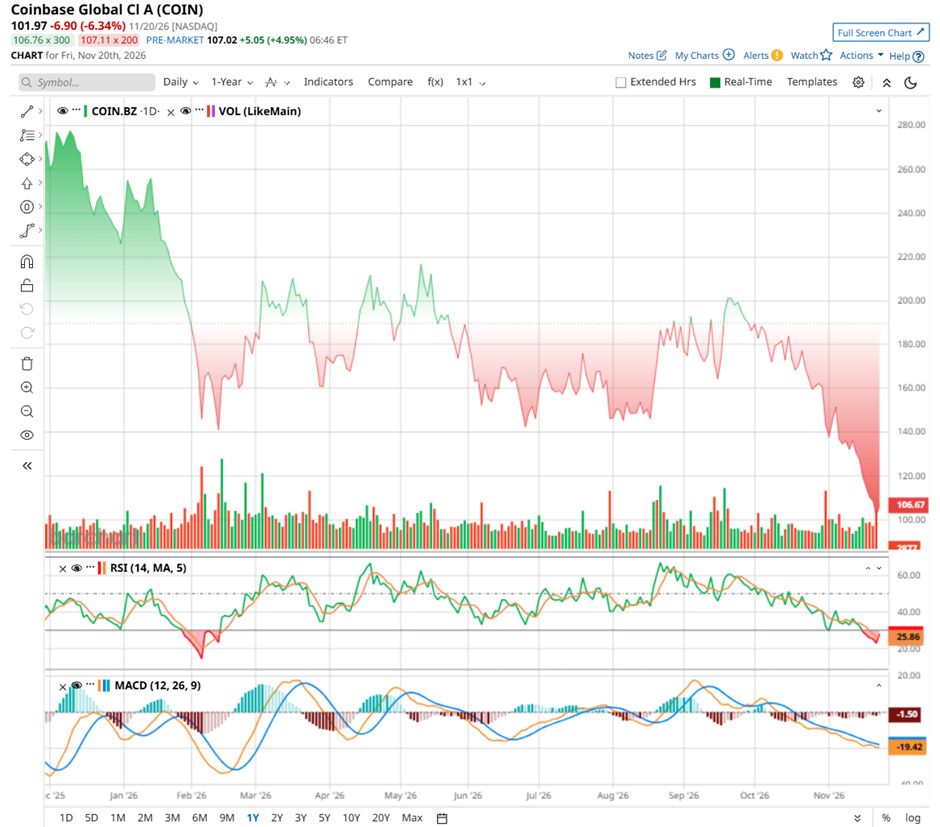
COIN stock’s technical indicators are not exactly cheering investors up, either. The 14-day RSI has slipped to around 29, firmly in oversold territory, signaling intensifying selling pressure. The MACD oscillator isn’t looking any healthier, with the MACD line below the signal line and the histogram staying negative since October. Together, these indicators suggest bearish momentum remains firmly in control, even if the stock’s steep decline raises hopes of a potential rebound.
 www.barchart.com
A steep selloff doesn’t automatically make COIN stock a bargain, and its valuation makes that pretty clear. COIN stock trades at 4 times sales, a premium to most of its industry peers, suggesting investors have not completely given up on its long-term growth story. Sure, the multiple is below its five-year average, but that’s hardly cheap. Investors are still paying a premium for Coinbase’s expansion plans, and the company will need to deliver to justify it.
Coinbase Reports Mixed Q3 Results
Released in October, Coinbase’s Q3 2026 earnings report was a mixed bag. Revenue fell 35% year-over-year (YOY) to $1.216 billion and missed Wall Street’s expectations. Adjusted EPS of $0.28 topped analysts’ estimates. While slower crypto trading weighed on results, prediction markets, stablecoins, and lower expenses helped soften the blow. Even amid a softer crypto market, Coinbase posted its 15th-straight quarter of positive adjusted EBITDA, with the figure jumping 60% sequentially to $333 million.
Transaction revenue tumbled 44% YOY to $590.2 million. Overall crypto market trading volume fell 10% sequentially, while asset volatility dropped 15% to multiyear lows. Consumer spot trading volume declined 9%, and derivatives volume slipped 6%. Consumer transaction revenue held relatively steady at $450 million.
Institutional transaction revenue fell 8% sequentially to $92 million. One bright spot was Coinbase’s crypto trading volume market share, which climbed to 10.7% from 5.6% a year earlier.
Meanwhile, its subscription and services business is becoming an increasingly important growth driver. Revenue from this segment totaled $570.2 million, down 20% YOY but up 3% sequentially, accounting for roughly 49% of net revenue. Stablecoin revenue rose 5% sequentially to $307 million, supported by record average USDC (USDCUSD) holdings of $22 billion across Coinbase products. Blockchain rewards increased 3% to $86 million, while interest and finance fee income grew 4% to $69 million.
Prediction markets offered another bright spot. Annualized revenue crossed $200 million, following 82% quarterly compound growth since launch, while daily traders jumped more than 60% sequentially. Management said these products were generating incremental activity rather than replacing existing spot trades. Paid Coinbase One subscribers also reached a record, growing 24% YOY, with subscribers generating 3.5 times the average revenue of non-subscribers.
“Prediction markets are adding another revenue stream and are less correlated to crypto volatility," said CFO Alesia Haas.
Coinbase is also expanding beyond traditional crypto trading. It completed its international exchange integration with Deribit in October, plans to relaunch Coinbase Pro in Q4, and continues growing its Base network. Tokenized stock trading volume on Base has surpassed $1 billion since launch.
Financially, Coinbase ended September with $8.6 billion in cash and cash equivalents against $5.95 billion in long-term debt. Operating cash flow for the first nine months fell 56% YOY to $785.5 million. The company also returned over $2 billion through share repurchases, with roughly $2 billion in authorization remaining.
Looking ahead, Q4 subscription and services revenue is expected to be between $550 million and $630 million. Transaction revenue reached approximately $165 million through Oct. 25, although management cautioned against extrapolating this partial-quarter figure. Coinbase also lowered its full-year adjusted expense outlook to $4.15 billion to $4.3 billion from the prior $4.2 billion to $4.45 billion range.
Analysts monitoring Coinbase expect the company to post a loss per share of $0.43 in fiscal 2026. But the tide could turn quickly by the next fiscal year. Losses are expected to narrow, with the company expected to generate adjusted EPS of $2.33 in fiscal 2027.
What Do Analysts Expect for Coinbase Stock?
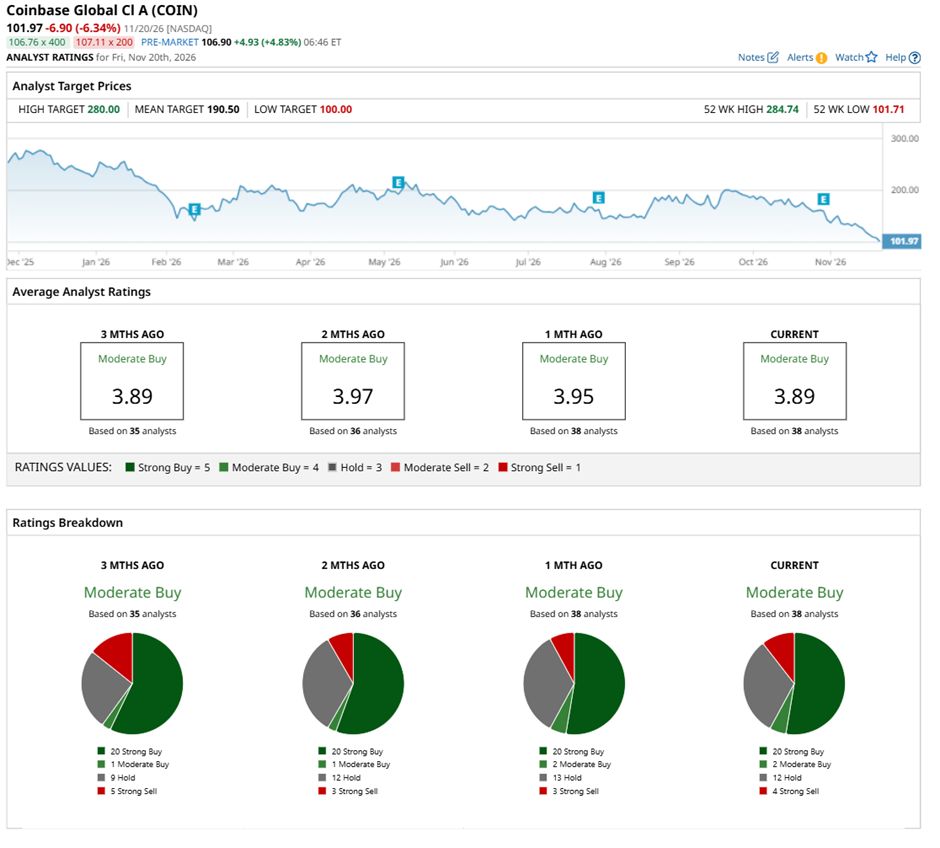
Overall, COIN stock has a consensus “Moderate Buy” rating on Wall Street. Of the 38 analysts covering the stock, 20 have a “Strong Buy,” two have a “Moderate Buy” rating, 12 analysts have a “Hold,” and four analysts are outright bearish with a “Strong Sell” rating.
Wall Street has not completely given up on COIN stock yet. Analysts still see plenty of room for a recovery, with the mean price target of $189.65 suggesting potential upside of approximately 83% from current levels. The most optimistic analyst is even more bullish, setting a target of $280, which points to a potential 170% gain from here.
 www.barchart.com
Final Thoughts on COIN Stock
Coinbase’s push into prediction markets could be a much-needed growth catalyst, especially as traditional crypto trading loses some steam. With more than $200 million in annualized revenue already coming from its Kalshi partnership, building its own platform could give the company greater control and a bigger slice of the pie. But competition from Kalshi, Polymarket, and regulatory roadblocks won’t make the ride easy. At current levels, COIN stock may look tempting, but investors should watch whether prediction markets can deliver meaningful growth before betting on a full-blown comeback.
On the date of publication, Sristi Suman Jayaswal did not directly have a position in any of the securities mentioned in this article. All information and data in this article is solely for informational purposes. For more information please view the Barchart Disclosure Policy here.
More news from Barchart
How to Play Coinbase Stock Ahead of Its Prediction Markets Launch Billionaire Mark Cuban Said ‘Chips As An Asset Class Will Be The New Crypto’ but Since He Posted It, Bitcoin Is Up 20% And Chip Stocks Are Down 24% Dear MicroStrategy Stock Fans, Mark Your Calendars for November 30 Mark Cuban Said He Wanted Bitcoin, Not Gold, ‘In The Event Of The Economy Going Down Or Something Bad Happening’