


Amazon AMZN and Microsoft MSFT sit atop the global cloud computing hierarchy, each channeling record capital into artificial intelligence infrastructure to capture enterprise workloads shifting to the cloud. Amazon Web Services and Microsoft Azure remain the two largest cloud platforms worldwide, and both companies have used recent product launches to reinforce their positions as the default infrastructure layer for generative and agentic AI.
The two stocks warrant a side-by-side look right now because both are entering a pivotal stretch of AI monetization, backed by aggressive infrastructure spending, expanding model partnerships and enterprise demand that continues to outstrip available capacity. Yet each company is approaching the opportunity from a different starting point, with distinct guidance, cost structures and growth trajectories.
Let's delve deep and closely compare the fundamentals of the two stocks to determine which one is a better investment now.
The Case for AMZN Stock
Amazon's cloud arm continues to demonstrate that scale and innovation can move together. In the first quarter of 2026, AWS delivered operating income of $14.2 billion, with management attributing the strength to broad customer demand alongside efficiency gains from custom Trainium chips, which now underpin the majority of Amazon Bedrock workloads. This combination lets Amazon absorb rising component costs while still expanding margins, a favorable setup few cloud rivals can match at similar scale.
Amazon's roadmap reinforces this momentum. At recent AWS Summit events, the company introduced Amazon Bedrock's fully managed Knowledge Bases, an Agentic Retriever for complex enterprise queries, and Web Search on Bedrock AgentCore, extending its agentic AI stack well beyond simple model hosting. AWS also deepened its partnership with OpenAI, bringing GPT-5.5 and Codex to Bedrock, giving customers more model choice without leaving Amazon's ecosystem. New EC2 G7 instances powered by Blackwell GPUs further strengthen AWS' AI compute lineup.
Management has been candid about near-term pressure points, including elevated memory costs and cash capital expenditures of $43.2 billion in the first quarter, mostly directed toward AWS and generative AI capacity. Executives acknowledge a lag of 6 to 24 months between infrastructure spending and revenue monetization, tempering the timeline for payback.
Even so, Amazon's diversified base of retail, advertising and cloud earnings gives it more levers to fund this AI buildout than a single-segment cloud peer, positioning AWS to keep converting capacity investment into durable, long-term growth as enterprise AI adoption widens steadily across its global customer base.
The Zacks Consensus Estimate for AMZN’s 2026 earnings is pegged at $8.93 per share, indicating a 24.55% increase from the figure reported in the year-ago quarter.
Amazon.com, Inc. Price and Consensus
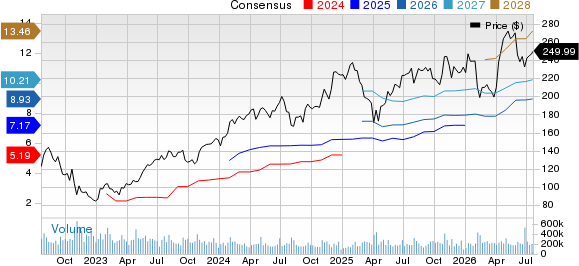
Amazon.com, Inc. price-consensus-chart | Amazon.com, Inc. Quote
The Case for MSFT Stock
Microsoft's cloud business remains a formidable growth engine, though its economics look different from Amazon's. In its third quarter of fiscal 2026, Azure and other cloud services revenues grew 40%, with management guiding to 39% to 40% constant-currency growth for the fiscal fourth quarter, citing broad customer demand that continues to exceed available supply. Microsoft's commercial remaining performance obligations reached $627 billion, underscoring a substantial multiyear revenue backlog.
Recent announcements show Microsoft widening its AI platform ambitions. The company confirmed that Anthropic's Claude models now sit alongside OpenAI's GPT models within Microsoft Foundry, giving enterprise customers added model flexibility. Microsoft also committed $2.5 billion and thousands of employees to a new AI implementation unit designed to help customers deploy agentic AI faster, following a similar move by AWS.
That expansion carries a real cost. Fiscal third-quarter capital expenditures and finance leases rose 49% year over year to $31.9 billion, and management has guided to roughly $190 billion in 2026 capital spending, up sharply from the prior year. Gross margin narrowed to its lowest level since 2022 as depreciation from data center buildouts weighed on profitability, and Microsoft Cloud gross margin is guided to soften further next quarter.
Copilot adoption offers a genuine bright spot, with paid seats climbing sharply and usage trends improving across coding, productivity and security workloads. Still, questions persist around whether that momentum, alongside Azure's capacity-constrained growth, can offset mounting depreciation and infrastructure costs quickly enough to preserve Microsoft's historically wide operating margins over the next several quarters.
The Zacks Consensus Estimate for MSFT’s fiscal 2026 earnings is pegged at $17.33 per share. The estimate indicates 27.05% year-over-year growth.
Microsoft Corporation Price and Consensus
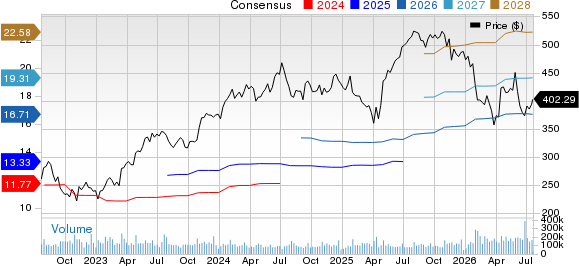
Microsoft Corporation price-consensus-chart | Microsoft Corporation Quote
Valuation and Price Performance Comparison
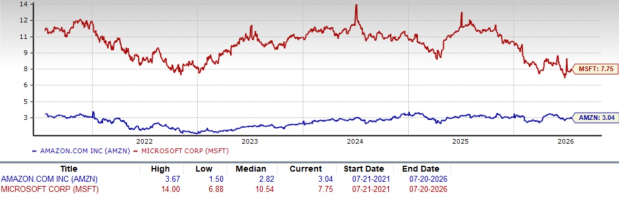
On valuation, AMZN stock is currently trading at a forward 12-month price-to-sales ratio of 3.04, well below MSFT's 7.75, even as both companies carry premium multiples relative to the broader market. Amazon's comparatively lower premium looks better justified given its diversified retail, advertising and AWS earnings base funding its AI buildout versus Microsoft's steeper multiple resting more heavily on cloud and Copilot monetization.
AMZN vs. MSFT P/S Ratio
Image Source: Zacks Investment Research
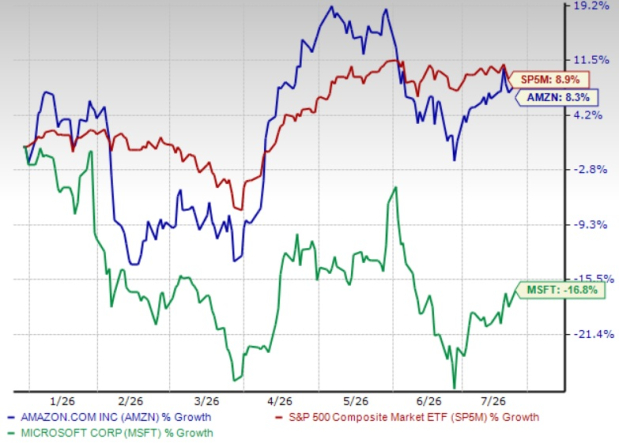
Price performance also favors Amazon. Microsoft shares have lost 16.8% year to date, underperforming Amazon's 8.3% gain over the same stretch, reflecting relatively stronger investor confidence in Amazon's near-term execution and its broader AI-driven growth trajectory.
AMZN Outperforms MSFT In 6 Months
Image Source: Zacks Investment Research
Conclusion
Weighing both companies together, Amazon holds a modest edge. Its efficient Trainium-powered infrastructure, expanding agentic AI stack, diversified earnings base, and comparatively reasonable valuation offer a more balanced risk-reward setup than Microsoft, whose steep capital spending and narrowing cloud margins introduce near-term uncertainty despite strong Azure growth. Amazon's stronger year-to-date price performance further reflects this relative confidence. Investors would do well to track Amazon stock closely and consider holding it as AWS scales its AI monetization, while staying patient on Microsoft and watching for a more attractive entry point before committing fresh capital, given its currently elevated near-term cost pressures. AMZN currently carries a Zacks Rank #2 (Buy), whereas MSFT has a Zacks Rank #3 (Hold). You can see the complete list of today’s Zacks #1 Rank (Strong Buy) stocks here.
Zacks' Research Chief Names "Stock Most Likely to Double"
Our team of experts has just released the 5 stocks with the greatest probability of gaining +100% or more in the coming months. Of those 5, Director of Research Sheraz Mian highlights the one stock set to climb highest.
This top pick is a little-known satellite-based communications firm. Space is projected to become a trillion dollar industry, and this company's customer base is growing fast. Analysts have forecasted a major revenue breakout in 2025. Of course, all our elite picks aren't winners but this one could far surpass earlier Zacks' Stocks Set to Double like Hims & Hers Health, which shot up +209%.
Free: See Our Top Stock And 4 Runners UpWant the latest recommendations from Zacks Investment Research? Today, you can download 7 Best Stocks for the Next 30 Days. Click to get this free report
Amazon.com, Inc. (AMZN): Free Stock Analysis Report
Microsoft Corporation (MSFT): Free Stock Analysis Report
This article originally published on Zacks Investment Research (zacks.com).