

Bank of America’s BAC capital return story is supported by a combination of improving earnings power, a healthy capital cushion and disciplined balance-sheet management. After generating $30.5 billion in net income in 2025, the banking giant carried solid momentum into 2026. In the second quarter alone, net income reached $9.1 billion, while revenues rose 15% year over year to $31.6 billion. Net interest income (NII) rose 9%, while growth in trading, asset-management and investment banking (IB) fees further strengthened the company’s earnings base.
BAC’s capital position provides another important pillar for its shareholder-return strategy. At the end of June 2026, the company had $202 billion in CET1 capital, with its CET1 ratio holding at 11.2%. This remained comfortably above the 10% regulatory minimum. Further, the Federal Reserve’s 2026 stress-test results left BAC’s stress capital buffer at 2.5% through September 2027. This sizeable capital cushion gives management considerable flexibility to return excess capital while maintaining adequate buffers against potential economic and market volatility.
Share repurchases remain a central component of BAC’s capital deployment strategy. The company’s board authorized a $40-billion share repurchase program, effective Aug. 1, 2025. As of June 30, 2026, roughly $17 billion remained available under the program. This substantial capacity provides Bank of America with room to continue reducing its share count, which could support earnings over time.
Dividends complement these sizeable buybacks. Following the 2026 stress test, Bank of America raised its quarterly common stock dividend 14.3% to 32 cents per share, marking its sixth consecutive annual dividend hike. The increase underscores management’s confidence in the company’s earnings durability and capital-generation ability. More importantly, BAC has been able to increase shareholder payouts while continuing to invest across its businesses, demonstrating a balanced approach to growth and capital returns.
Overall, Bank of America appears well-positioned to sustain healthy capital distributions. Strong profitability, excess CET1 capital and considerable remaining buyback capacity provide a solid foundation for continued dividends and repurchases. While a higher G-SIB surcharge expected from January 2027 could modestly increase future capital requirements, continued NII growth, improving fee revenues and disciplined capital management should help offset some of that pressure.
Current Capital Distribution Plans of BAC’s Peers
Bank of America’s two close peers are JPMorgan JPM and Morgan Stanley MS.
JPMorgan's capital distribution capacity is also supported by strong earnings and regulatory capital. After clearing this year’s stress test, the company intends to announce a 10% increase in its quarterly dividend to $1.65 per share. Over the past five years, JPM has hiked its dividend six times, with an annualized growth rate of 11.3%.
JPMorgan has authorized a $50-billion share repurchase program, which became effective July 1, 2026.
Likewise, Morgan Stanley has increased its quarterly dividend by 15% to $1.15 per share in the third quarter of this year. Before this, the company had hiked its quarterly dividend 8% in 2025.
Also, Morgan Stanley’s board of directors has reauthorized a multi-year share repurchase program of up to $20 billion, without an expiration date. Management continues to emphasize disciplined capital allocation, with a preference for organic investment, capital returns and selective bolt-on acquisitions only where strategic and cultural fit are strong.
BAC’s Price Performance, Valuation & Estimates
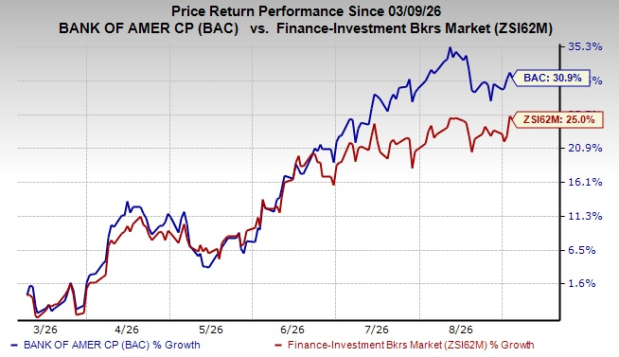
In the past six months, shares of Bank of America have gained 30.9% compared with the industry’s 25% growth.
Image Source: Zacks Investment Research
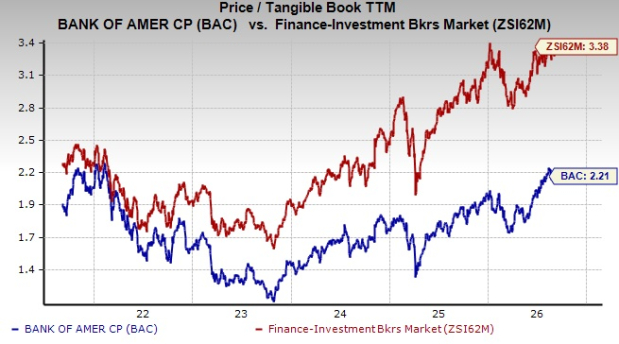
From a valuation standpoint, BAC trades at a trailing 12-month price-to-tangible book ratio of 2.21, well below the industry average of 3.38.
Image Source: Zacks Investment Research
The Zacks Consensus Estimate for BAC’s 2026 and 2027 earnings indicates year-over-year growth rates of 22.8% and 12.6%, respectively. Earnings estimates for both years have been unchanged over the past 30 days.
Image Source: Zacks Investment Research

Currently, Bank of America carries a Zacks Rank #3 (Hold). You can see the complete list of today’s Zacks #1 Rank (Strong Buy) stocks here.
Radical New Technology Could Hand Investors Huge Gains
Quantum Computing is the next technological revolution, and it could be even more advanced than AI.
While some believed the technology was years away, it is already present and moving fast. Large hyperscalers, such as Microsoft, Google, Amazon, Oracle, and even Meta and Tesla, are scrambling to integrate quantum computing into their infrastructure.
Senior Stock Strategist Kevin Cook reveals 7 carefully selected stocks poised to dominate the quantum computing landscape in his report, Beyond AI: The Quantum Leap in Computing Power .
Kevin was among the early experts who recognized NVIDIA's enormous potential back in 2016. Now, he has keyed in on what could be "the next big thing" in quantum computing supremacy. Today, you have a rare chance to position your portfolio at the forefront of this opportunity.
See Top Quantum Stocks Now >>Want the latest recommendations from Zacks Investment Research? Today, you can download 7 Best Stocks for the Next 30 Days. Click to get this free report
Bank of America Corporation (BAC): Free Stock Analysis Report
JPMorgan Chase & Co. (JPM): Free Stock Analysis Report
Morgan Stanley (MS): Free Stock Analysis Report
This article originally published on Zacks Investment Research (zacks.com).