


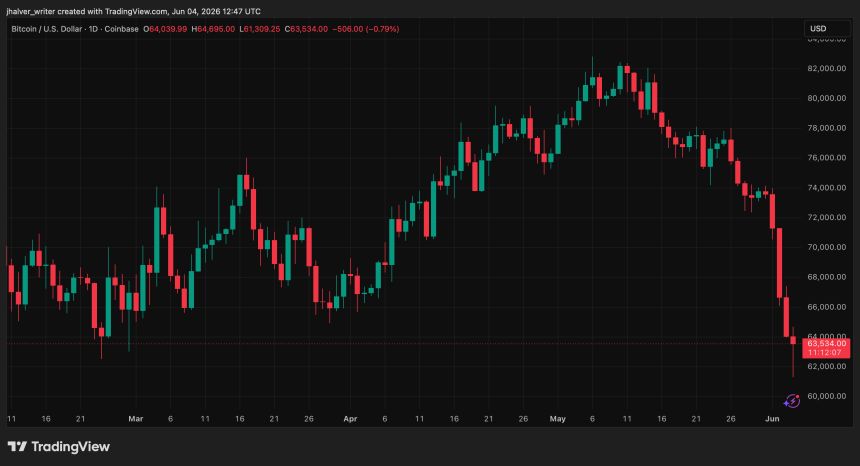
Standard Chartered’s head of digital assets research, Geoff Kendrick, has outlined three specific scenarios that stand between Bitcoin and a new market low — a sobering analysis arriving as Bitcoin trades near $62,562, its lowest level since the February lows, and ETF outflows reach historically severe levels, according to a CoinDesk report .
The analysis from one of the most closely watched institutional voices in crypto arrives as the broader market absorbs a brutal string of data points. US spot Bitcoin ETFs recorded $1.42 billion in outflows for the week ending May 29 — the third-worst weekly result in history — with total outflows over the preceding three weeks exceeding $4.21 billion, per Bitcoin Foundation’s tracking of ETF flow data.
Bitcoin has simultaneously fallen to the lower boundary of the Power Law corridor, a long-term valuation model that plots price against time on a logarithmic scale, with the Power Law Oscillator dropping to 4.4% — meaning Bitcoin is priced cheaper than 95.6% of historical readings relative to its long-term trend.
The Three Conditions For The Bitcoin Price
According to CoinDesk’s report of Kendrick’s analysis, the three “ifs” that could tip Bitcoin toward a new market low center on the intersection of macro forces, institutional flows, and market structure — rather than any crypto-specific catalyst. The first is whether ETF outflows continue accelerating beyond current levels, removing the institutional demand layer that has been the primary structural support for Bitcoin since January 2024.
The second is whether the Federal Reserve’s June and July meetings deliver a hawkish surprise — specifically if the dot plot fails to signal rate cuts, removing a key tailwind the market has been pricing in. The third is whether Bitcoin dominance — currently above 60% — breaks below the 52–54% range, a level that historically signals broad-based crypto selling rather than Bitcoin-specific rotation, per Standard Chartered’s prior framework as reported by CoinDesk.
The Contrarian Signal Inside The Warning
Kendrick’s three-ifs framework is not a straightforward bear call — it is a risk-mapping exercise from an analyst who remains constructive on Bitcoin’s year-end trajectory. According to CoinDesk’s report, Kendrick told clients directly: “I think when we look back at the end of 2026 with BTC at $100k and ETH at $4k we will say this was the buying zone we all wanted.” The bank’s year-end Bitcoin target remains $100,000, per its February 2026 revised forecast — a level that would require a 60% recovery from current prices.
The observation that Bitcoin is trading near its 200-week simple moving average is central to Standard Chartered’s framing. Previous bear markets ended around the same moving average, per CoinDesk’s chart analysis — a historical pattern that, while not a guarantee, supports Kendrick’s view that the market may be closer to a bottom than a breakdown.
This development marks a critical juncture for Bitcoin in the current cycle. Standard Chartered’s three-condition framework offers both a warning and a map — and the next few weeks of ETF flow data, Fed signaling, and dominance metrics will determine which scenario actually plays out.
As of this writing, Bitcoin trades at around $62,562, testing levels that have historically preceded either a sustained recovery or a final capitulation flush.
Cover image from Grok, BTCUSD chart from Tradingview