

If you want to witness a pure psychological asset war, look no further than the 30-stock Dow Jones Industrial Average ($DOWI) and its primary tracking vehicle, the SPDR Dow Jones Industrial Average ETF Trust (DIA). As we advance through this year, the oldest stock index in the world is suffering from a severe case of split personality.
On any given day, you can look at the tape and see a set of stocks flashing bright green, looking technically sound and ready to break out, while the other half look absolutely atrocious, bleeding capital and carving out multi-month lows. I am heartened by any sign that the market is starting to distinguish between stocks, as high correlation has been a theme of my views here for a while.
More Yield, Less Trap: Sign up free to get Barchart’s daily Dividend Investor newsletter straight to your inbox.
However, the lack of follow-through in many Dow names might be a sign that these surges in value are more a sign of faint hope. That is, traders aggressively hop into something that is both blue-chip and down on its luck. But they tend to be renters, not owners. So the moves are fleeting. That’s sure what it looks like to me.
This internal friction has triggered a mechanical phenomenon, the likes of which I cannot recall, at least to this degree. Specifically, the Dow is staging sudden, explosive, single-day spikes on days when the tech-heavy Nasdaq ($NASX) is flattening out or sliding down. Financial media pundits immediately scream that the great rotation into value has finally arrived.
To me, it looks more like the Great Pumpkin of “Peanuts” fame.
But don’t fall for the headline trap. When you pan out and look at the actual long-term data, these short-term spikes are nothing more than tactical head-fakes. So far at least. Over time, the Dow has been unable to keep up with the S&P 500 ($SPX) or Nasdaq.
That said, its structure, which is more diversified, less tech-laden, and lacks the huge overweight in Magnificent-7-type stocks, is giving DIA investors some hope. In the aggregate, that is.
A Closer Look at DIA
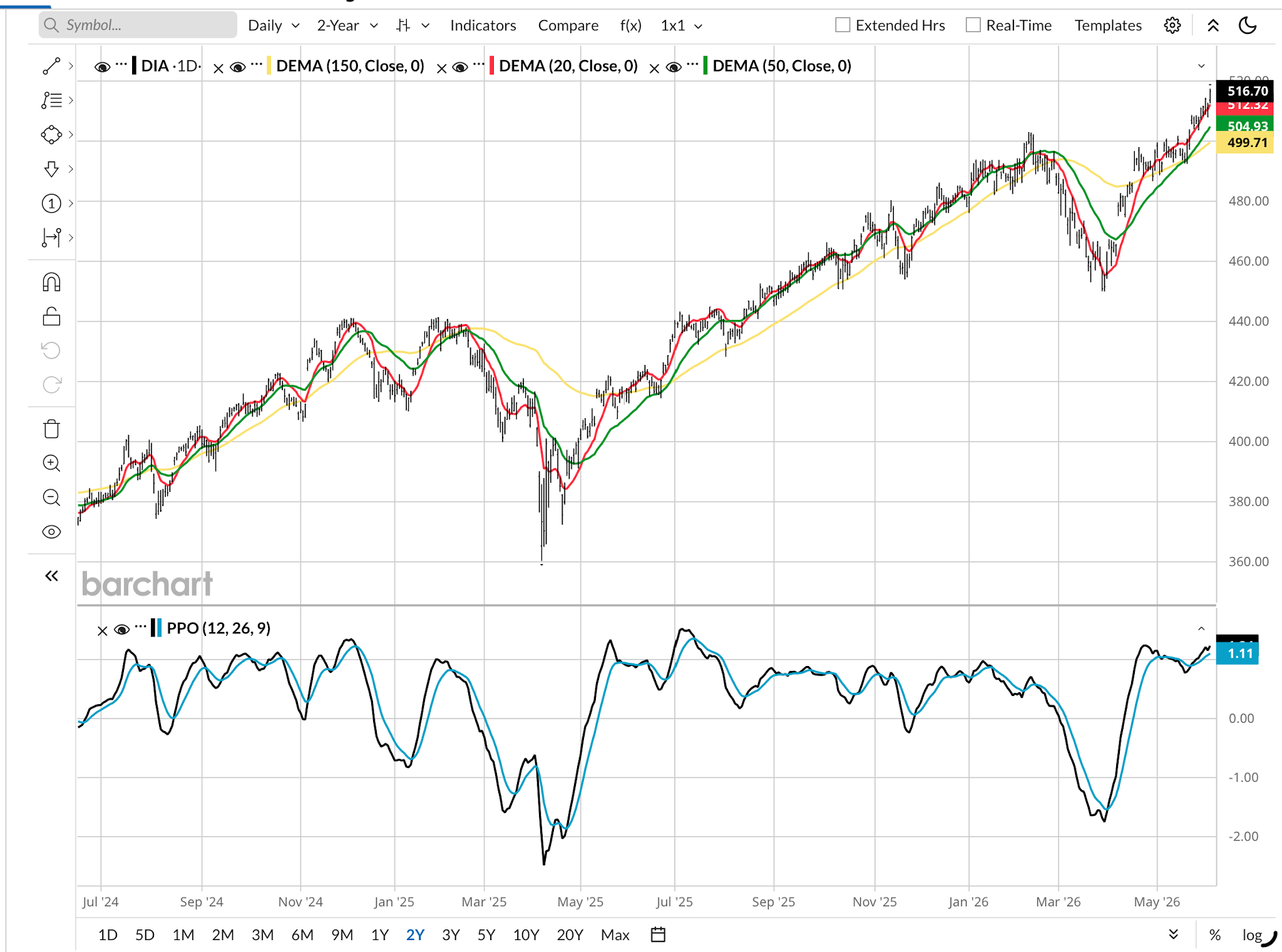
Here’s the DIA chart. This daily look shows what appears to be a true breakout. But breakouts ain’t what they used to be. So I’m holding tight on declaring a new era for Dow 30 investors. Frankly, I’d like to announce that, as I’ve grown tired of what I think is a second coming of the dot-com bubble, which I think will certainly end with a lot of disillusioned investors. I do not use the word “certainly” often.
 www.barchart.com
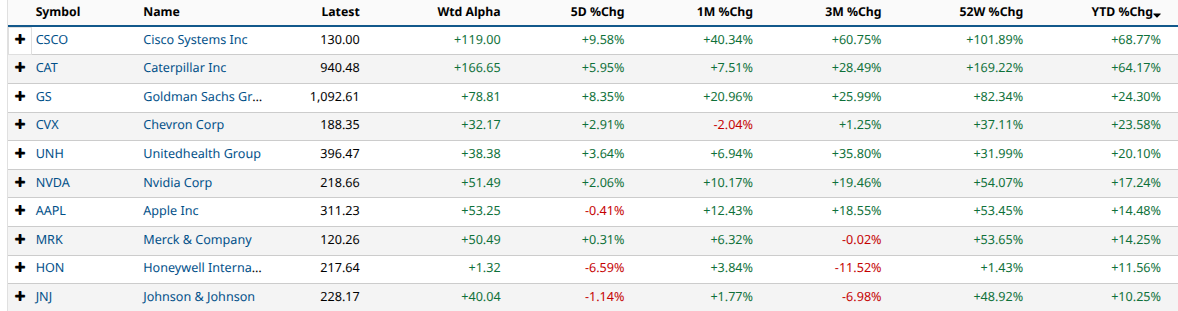
 Let’s examine the best of DIA so far this year. Apple (AAPL) and Nvidia (NVDA) were the leaders coming into this year, along with Amazon (AMZN) and Microsoft (MSFT), the other two Mag 7 names in the Dow. But this year, the revival of Cisco (CSCO), the impressive run of Caterpillar (CAT), and the successful banking fee rush that has accrued to Goldman Sachs (GS), have them at the top. And Chevron (CVX), of course, thanks to the Iran war breaking out. I’m looking primarily at the far right column here, the YTD change.
 www.barchart.com
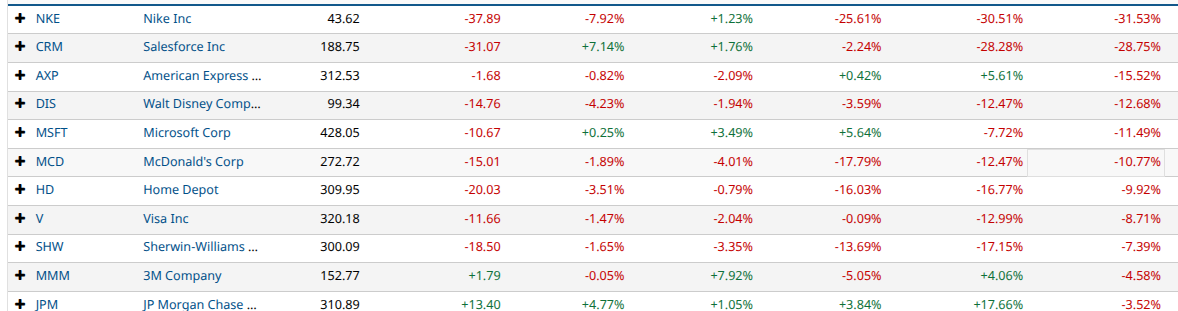
 The losers' bracket is dominated by fallen angels, if you will. Again, in the far-right YTD column, there’s Nike (NKE) and Salesforce (CRM), well-known case studies in how the market can take a former leader out back and mess them up. And American Express (AXP), the other Dow name in the 15%-plus YTD loss category, has faced the threat of higher-end consumers finally feeling the squeeze.
 www.barchart.com
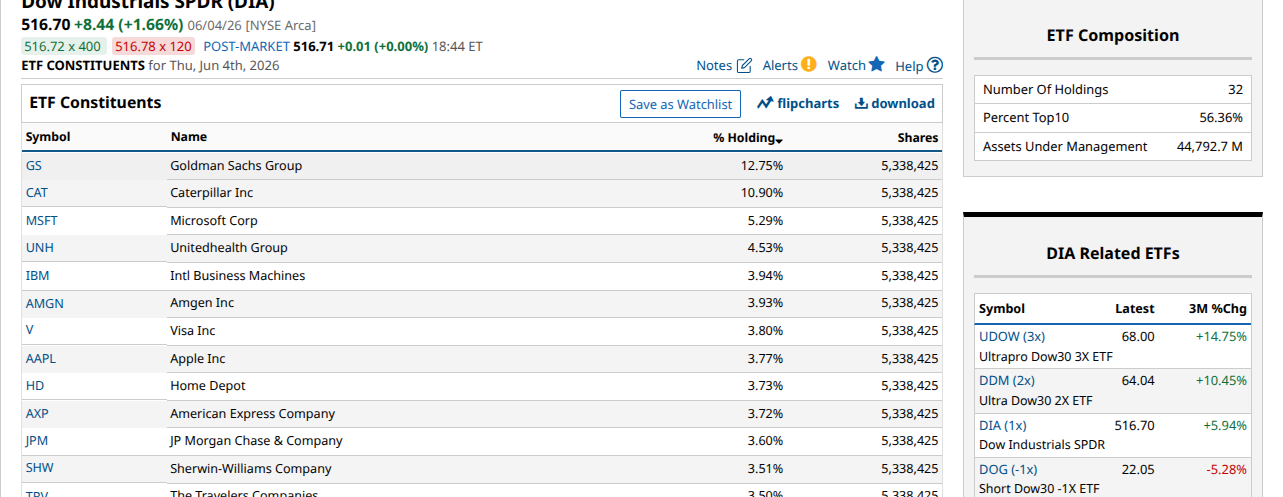
 The Dow is a collection of only 30 massive blue-chip companies. Because the index is famously price-weighted, meaning companies with a higher nominal stock price dictate the index's score regardless of their actual market cap size, the performance gap between the winners and the losers creates massive, violent tugs-of-war.
When institutional liquidity flees extreme tech valuations, it treats some of those specific high-priced Dow pillars as temporary safe havens. But as shown here, DIA is top-heavy in its own way, just one that favors financials and industrials. So on days like this past Thursday, where financial company stocks lead, DIA steals the show.
 www.barchart.com
 The Other Side of the Coin
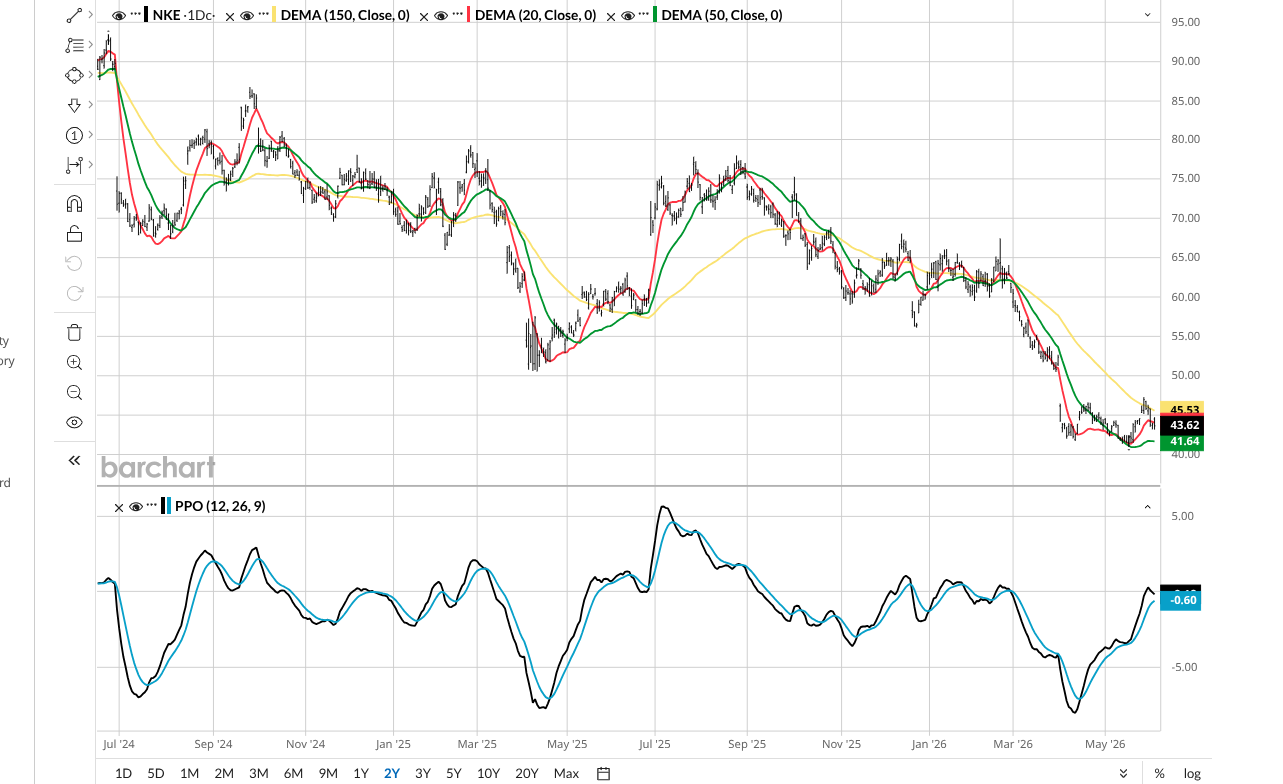
But look at the other side of the ledger. The bottom half of the Dow looks like a corporate graveyard. Yet some legacy giants are getting absolutely dismantled. It is hard to look at a chart like NKE here and be optimistic. Even being a contrarian as I am.
 www.barchart.com
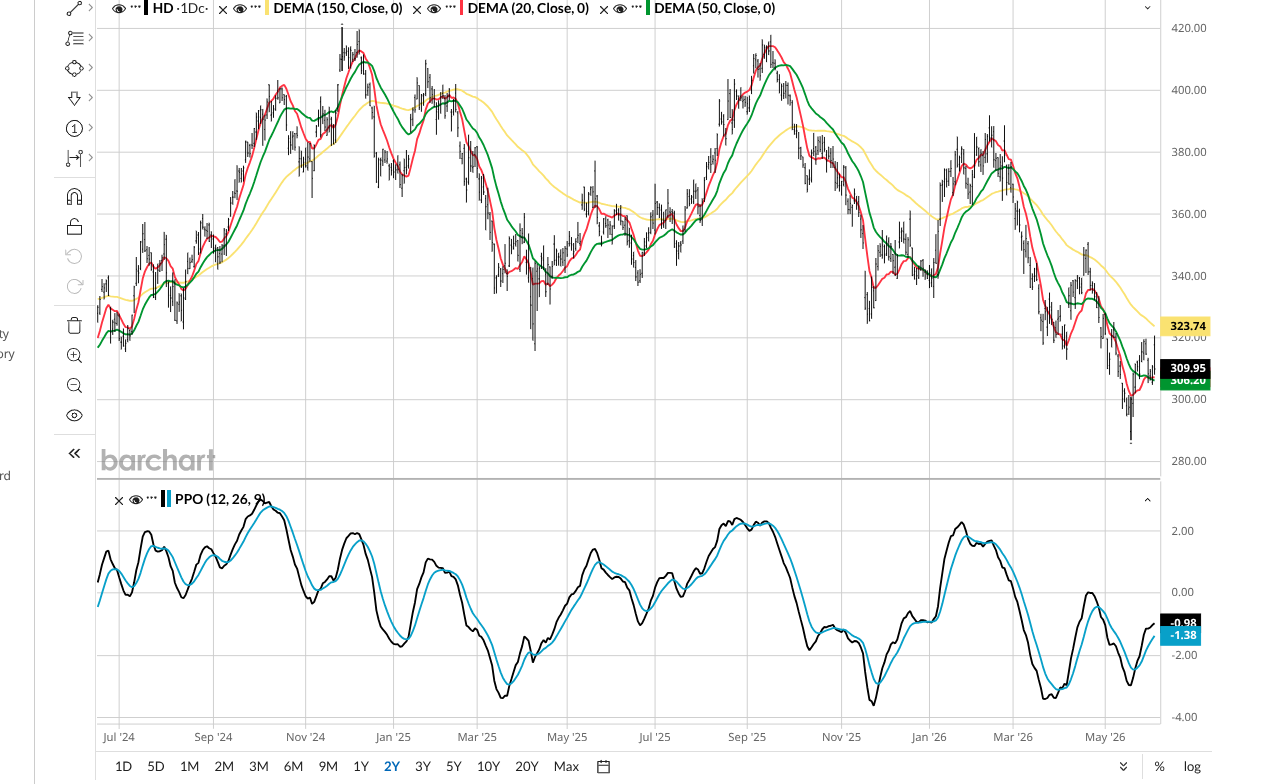
 There are many other weak charts within DIA’s holdings, including Home Depot (HD), another true blue-chip. But the other chip is more of a dent. The one in its stock price.
 www.barchart.com
 This brings us to those occasional, aggressive green days where the Dow surges 400 points while QQQ falls 1.5%. This is not a sustainable trend. It is a mechanical artifact of algorithmic hedging and programmatic risk-off rotation. When a mega-cap tech flyer like Nvidia or Apple hits a technical speed bump, macro hedge funds don't immediately retreat to cash.
Instead, automated programs instantly sell tech and buy the highest-priced, liquid components of the Dow to neutralize their net-long market exposure for the day. If your bull case is “the hedge funds will use us to hedge, and our stock prices will go up,” you need to find something that will not be forgotten headlines a week from now.
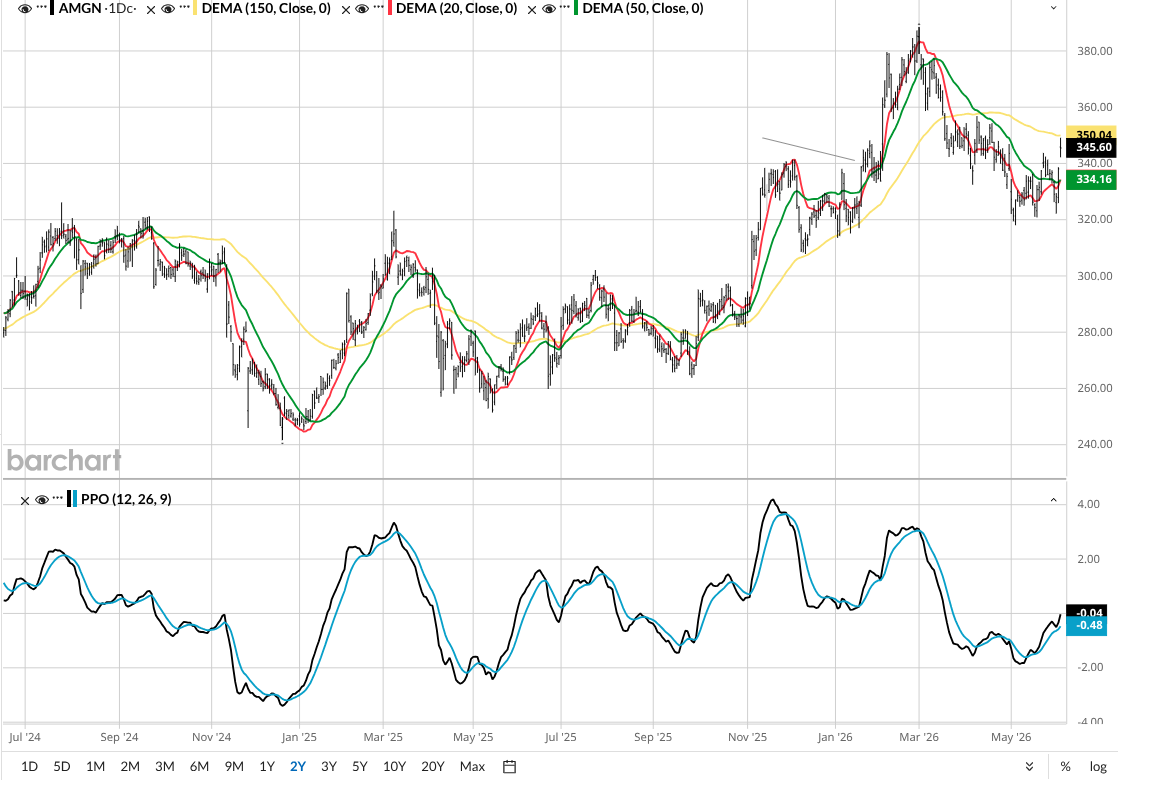
Yet there is some joy in Dow-ville. Amgen (AMGN) is one of the stocks in DIA that looks ready to rally. But there are not enough of these to convince me yet that there’s too much weight dragging on this venerable index.
 www.barchart.com
 For now, DIA can provide a minor dividend-yield cushion and brief relative stability during a massive tech-led liquidity flush. But it is not yet ready to rescue the stock market from a potential AI-mageddon situation.
Rob Isbitts created the ROAR Score, based on his 40+ years of technical analysis experience. ROAR helps DIY investors manage risk and create their own portfolios. For Rob's written research, check out ETFYourself.com.
On the date of publication, Rob Isbitts did not have (either directly or indirectly) positions in any of the securities mentioned in this article. All information and data in this article is solely for informational purposes. For more information please view the Barchart Disclosure Policy here.
More news from Barchart
The Dow's Split Personality: Why Some Winners Soar While Others Drag Down the Dow Greg Abel is Writing Checks for Berkshire Hathaway in a Hurry. You Should Write One for BRK.B Stock. Retail Investors Are Beating Wall Street Benchmarks With AI Stocks. Why That Could Change Soon. Hunting for the Next Nvidia Is No Easy Feat. Small-Cap Tech Stocks Promise Riches but Really Are Just Rags.