


Stride, Inc. LRN is taking a measured approach toward enrollment after recent operational disruptions. The company is deliberately avoiding aggressive expansion and is instead concentrating on stabilizing its platform, improving execution and restoring consistency across its programs. Despite healthy demand for alternative education offerings, the company believes a stability-first strategy is more appropriate at this stage.
In the fiscal second quarter of 2026, total enrollments reached about 248,500, up 7.8% from last year and up slightly from the first quarter. Enrollment remained steady as strong application volumes allowed the company to backfill much of the attrition during the quarter. The company also indicated that second-semester withdrawal trends returned to historical norms, which reduced pressure on enrollment levels. This supported the decision to keep enrollment growth restrained for the year.
Demand indicators remained encouraging. Application volumes stayed near record levels, even as marketing activity was reduced. This showed that interest in the company’s programs remained intact despite earlier platform challenges. However, the company chose not to push enrollment growth to give operations time to settle.
Enrollment trends also reflected a shift in mix. In the fiscal second quarter of 2026, Career Learning programs continued to see stronger enrollment growth, while General Education faced modest pressure. This dynamic mix influenced overall enrollment performance.
The company’s enrollment stability appears closely tied to its decision to limit expansion despite strong demand. By prioritizing normalized withdrawals, controlled intake and platform reliability, the company is reducing the risk of renewed enrollment volatility.
While this approach may cap near-term growth, it lowers execution risk and supports a more predictable enrollment base. If application trends remain strong and withdrawal patterns stay within historical ranges, the company’s stability-first strategy could provide a steadier foundation for future enrollment growth once expansion resumes.
Stride’s Competition in Education Market
Stride operates in a competitive online education space, where peers like Coursera, Inc. COUR and Strategic Education, Inc. STRA continue to expand their presence. Coursera has gained recognition for its flexible programs and global reach, while Strategic Education leverages its Capella and Strayer brands to focus on affordability and career-oriented degrees for adult learners.
Stride has carved out an edge by combining academic programs with tutoring and support services, helping drive more consistent enrollment in its career-focused pathways. Coursera is advancing with AI-powered course recommendations and enterprise partnerships. Strategic Education is applying AI in student advising and skills evaluation.
Stride is moving in a similar direction, deploying AI not only to personalize learning but also improve tutoring and streamline administrative processes, supporting efficiency and scalability.
Stride Stock’s Price Performance & Valuation Trend
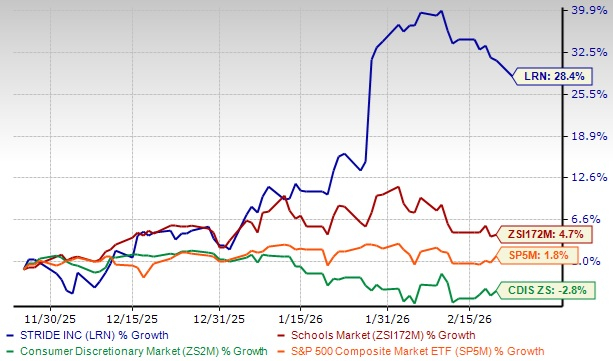
Shares of this Virginia-based education company have gained 28.4% in the past three months, significantly outperforming the Zacks Schools industry, the broader Zacks Consumer Discretionary sector and the S&P 500 Index.
Image Source: Zacks Investment Research
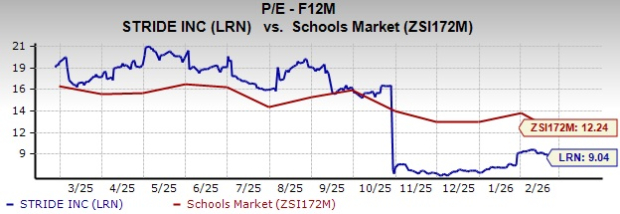
LRN stock is currently trading at a discount compared with its industry peers, with a forward 12-month price-to-earnings (P/E) ratio of 9.04, as shown in the chart below.
Image Source: Zacks Investment Research
Earnings Estimate Revision of LRN
Estimates for LRN’s fiscal 2026 and fiscal 2027 earnings have moved north in the past 30 days. The estimated figures for fiscal 2026 and fiscal 2027 imply year-over-year improvements of 3.2% and 10.7%, respectively.
Image Source: Zacks Investment Research

Stride stock currently carries a Zacks Rank #3 (Hold). You can see the complete list of today’s Zacks #1 Rank (Strong Buy) stocks here.
Radical New Technology Could Hand Investors Huge Gains
Quantum Computing is the next technological revolution, and it could be even more advanced than AI.
While some believed the technology was years away, it is already present and moving fast. Large hyperscalers, such as Microsoft, Google, Amazon, Oracle, and even Meta and Tesla, are scrambling to integrate quantum computing into their infrastructure.
Senior Stock Strategist Kevin Cook reveals 7 carefully selected stocks poised to dominate the quantum computing landscape in his report, Beyond AI: The Quantum Leap in Computing Power .
Kevin was among the early experts who recognized NVIDIA's enormous potential back in 2016. Now, he has keyed in on what could be "the next big thing" in quantum computing supremacy. Today, you have a rare chance to position your portfolio at the forefront of this opportunity.
See Top Quantum Stocks Now >>Want the latest recommendations from Zacks Investment Research? Today, you can download 7 Best Stocks for the Next 30 Days. Click to get this free report
Strategic Education Inc. (STRA): Free Stock Analysis Report
Stride, Inc. (LRN): Free Stock Analysis Report
Coursera, Inc. (COUR): Free Stock Analysis Report
This article originally published on Zacks Investment Research (zacks.com).