


Globalstar, Inc. GSAT is stepping into a transformative phase following its definitive agreement to be acquired by Amazon.com, Inc. AMZN, a move that positions the satellite communications provider at the center of the next wave of global connectivity. Long known for its mobile satellite services and early leadership in low Earth orbit (LEO) systems, Globalstar now stands to significantly expand its technological reach and commercial relevance through integration with Amazon’s ambitious Amazon Leo initiative.
The deal represents a powerful validation of its decades-long investment in spectrum assets, satellite infrastructure and direct-to-device (D2D) capabilities. Globalstar’s globally licensed mobile satellite spectrum is a scarce and strategic asset, and its inclusion in Amazon Leo provides a foundational layer for building a scalable, high-performance satellite-to-phone ecosystem.
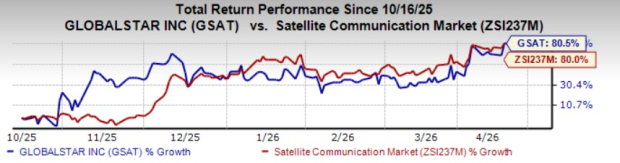
Notably, shares of Globalstar have gained approximately 10% in the trading session yesterday. Its shares have gained 80.5% in the past six months compared with the Zacks Satellite and Communication industry's growth of 80%.
Image Source: Zacks Investment Research
What Does This Acquisition Offer?
The addition of Globalstar’s infrastructure allows Amazon Leo to accelerate its roadmap toward D2D services, expected to roll out beginning in 2028. For Globalstar, this means its existing satellite fleet and next-generation assets will not only remain relevant but become integral to a much larger, unified network. This integration enhances utilization rates, extends asset lifecycles and unlocks new monetization avenues across consumer, enterprise and government segments. Instead of operating as a niche satellite provider, Globalstar is effectively being scaled into a global connectivity backbone.
The transaction shifts Globalstar from a capital-constrained operator to part of a well-funded ecosystem backed by Amazon’s scale, engineering depth and cloud infrastructure. This dramatically reduces execution risk associated with satellite launches, network expansion and technology upgrades. It also positions GSAT to benefit from Amazon’s broader partnerships with mobile network operators, enabling hybrid connectivity solutions that extend coverage to remote and underserved regions worldwide.
The acquisition strengthens Globalstar’s competitive positioning against other satellite players pursuing direct-to-device connectivity. With Amazon’s backing, GSAT gains the ability to compete not just on technology, but on scale, integration and service reliability. This is especially important as satellite connectivity becomes a critical layer in global telecom infrastructure, supporting everything from disaster response to IoT and remote enterprise operations.
Globalstar, Inc. Price and Consensus
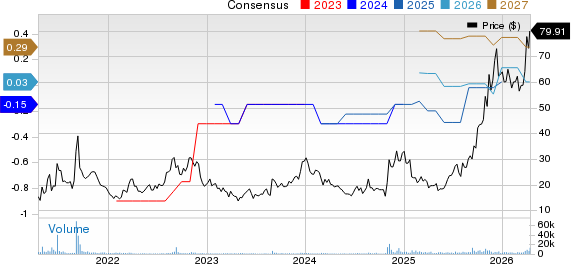
Globalstar, Inc. price-consensus-chart | Globalstar, Inc. Quote
The deal offers Globalstar shareholders a structured exit with upside participation through Amazon equity, while also reflecting the strategic premium attached to its assets. More importantly, it underscores the growing value of spectrum ownership and LEO capabilities in an increasingly connected world.
GSAT operates a LEO satellite constellation providing mobile satellite services (MSS) and voice/data communications to retail, enterprise and government customers. Its terrestrial assets include Band 53 spectrum, the 5G n53 variant and XCOM RAN. Recently, Globalstar introduced XCOM RAN, a next-generation private 5G solution designed to accelerate the adoption of “physical AI” across industries. The company is preparing to launch replacement and next-generation satellites, expand network infrastructure, roll out two-way IoT services and grow its XCOM RAN business, positioning 2026 as a growth phase.
For 2026, the company expects total revenues to be in the range of $280-$305 million, along with an adjusted EBITDA margin of approximately 50%.
However, Globalstar faces stiff competition from other companies such as AST SpaceMobile, Inc. ASTS and Iridium Communications Inc. IRDM. AST SpaceMobile has strategically partnered with leading telecom companies to grant customers easy access to their technology. The acquisition of Ligado Networks has enabled it to gain the spectrum rights to a 45MHz block of Ligado’s L-band spectrum in the United States and Canadian markets for more than 80 years. With the successful completion of the transaction, ASTS will be able to offer its cellular satellite services independently, reducing its reliance on carrier partners.
IRDM benefits from strong growth prospects in the satellite communications space, supported by its enhanced mesh architecture, strategic government relationships and a solid subscriber base, positioning it to generate higher revenues. In 2026, Iridium plans to roll out new offerings with $200 million in revenue potential by 2030.
Globalstar currently has a Zacks Rank #3 (Hold). You can see the complete list of today’s Zacks #1 Rank (Strong Buy) stocks here.
5 Stocks Set to Double
Each was handpicked by a Zacks expert as the #1 favorite stock to gain +100% or more in the coming year. While not all picks can be winners, previous recommendations have soared +112%, +171%, +209% and +232%.
Most of the stocks in this report are flying under Wall Street radar, which provides a great opportunity to get in on the ground floor.
Today, See These 5 Potential Home Runs >>Want the latest recommendations from Zacks Investment Research? Today, you can download 7 Best Stocks for the Next 30 Days. Click to get this free report
Amazon.com, Inc. (AMZN): Free Stock Analysis Report
Iridium Communications Inc (IRDM): Free Stock Analysis Report
Globalstar, Inc. (GSAT): Free Stock Analysis Report
AST SpaceMobile, Inc. (ASTS): Free Stock Analysis Report
This article originally published on Zacks Investment Research (zacks.com).