


Retail juggernaut Walmart (WMT) is badly overpriced, at least according to contemporary analyses. Certainly, no one questions the viability and relevance of the big-box retailer. However, with a market capitalization of over $1 trillion, it’s reasonable for investors to wonder whether or not the party in WMT stock is about to collapse — and that’s a bill nobody wants to pay.
Again, it’s not that Walmart is a bad business; quite the opposite. However, a giant brick-and-mortar — which is a yesteryear business model — isn’t supposed to compete with the latest innovators in artificial intelligence and other exciting technologies. Plus, WMT stock must deal with the practically omnipresent Amazon (AMZN) threat. So, it would appear that a negative rerating is in order.
Can’t Get Enough Options?: Join the list for Barchart’s daily unusual options report, delivered free.
Interestingly, I came across a recent post from a competing financial outlet that suggested that WMT stock was (highly) overpriced due to the security featuring a fair value of only $72.50. Given that WMT closed at just under $130 on Tuesday, we may be looking at a 44% drop from the present rate. That would be bubble territory in most people’s books.
Based on the article’s content, we’re basically left to assume three main factors that caused the analysis to arrive at a fair value of $72.50:
Revenue compression, with the model assuming a sort of “dis-economy of scale” where every new dollar of revenue costs more than a buck to acquire. Net margin ceiling, with investors overpaying the net margin percentage that’s driven by high-margin ad revenue (Walmart Connect). An increased discount rate (Weighted Average Cost of Capital or WACC) to effectively penalize Walmart’s future earnings due to underlying skepticism.In many ways, the article that I read — and there are plenty like it — utilizes a black box DCF, providing the output without much justification for the input. That’s understandable from a practical perspective because explaining the input can be messy.
Still, much of the analysis centers on assumed premises, particularly the presupposition of staticity, or the idea that market regimes are stable in nature. In contrast, I believe that the market has a Markovian composition, where the probability of an event occurring depends largely on its current state, not a linear aggregation of long historical trends.
WMT Stock Flashes a Rare Market Signal
Let’s get right into it. When the market closed on Tuesday, WMT stock flashed a rare market signal: in the past 10 weeks, the security printed seven up weeks (adding fuel to the bubble argument) but, in an odd twist, the overall slope during this period (from the opening volley to the closing price) was negative.
In other words, when we look at the frequency of weekly candlesticks, we would assume that the return profile of Walmart stock is in an uptrend. But the opposite is true: WMT is actually in a downtrend, which creates an unusual contrarian vibe.
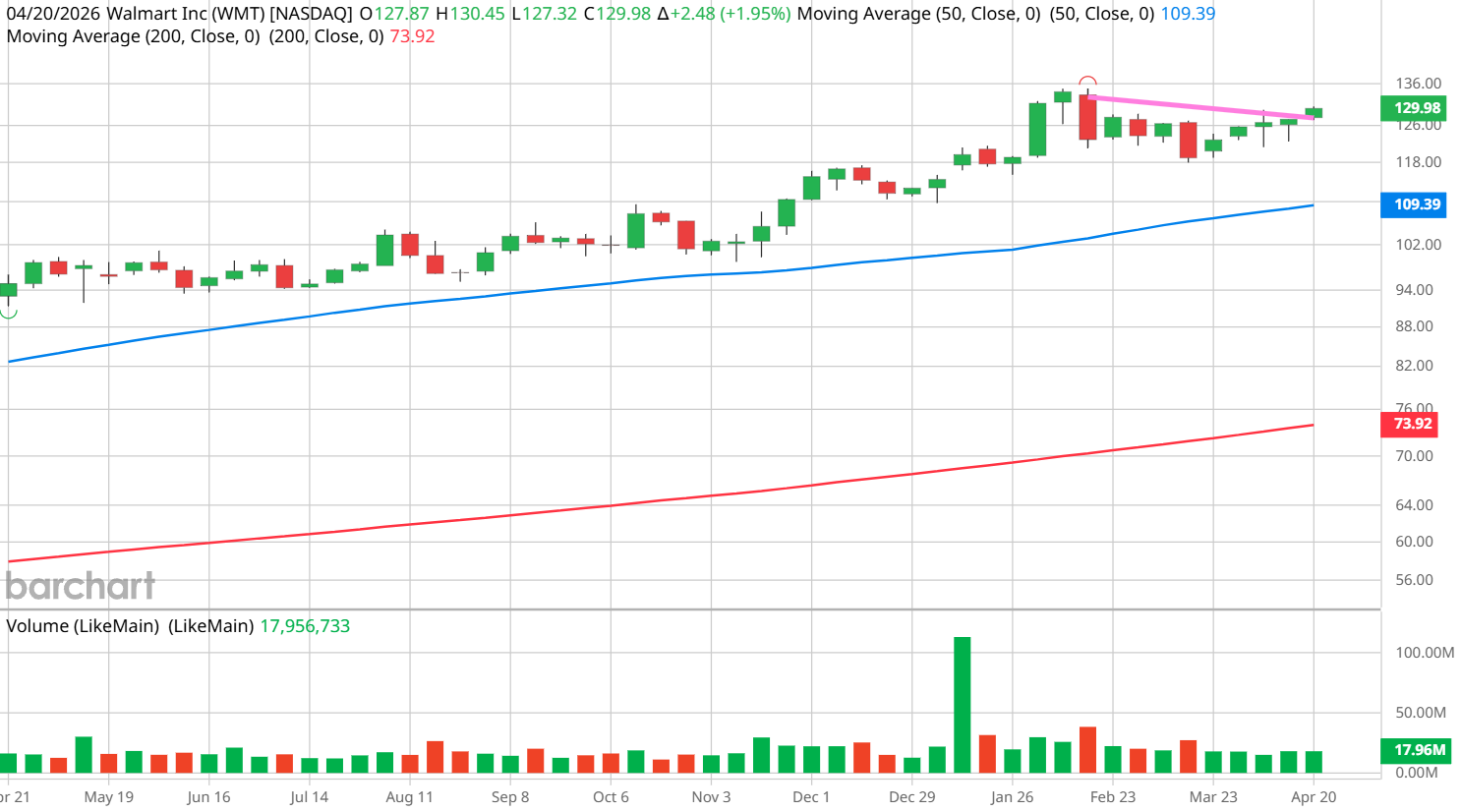
Beyond the aesthetic oddity, what makes this market signal stand out? The answer comes in the form of a discretized inductive analysis.
In any given 10-week where WMT stock is held long randomly, a dataset going back to January 2019 reveals that bullish traders enjoy an extraordinarily upward bias. Out of 362 rolling 10-week sequences, 265 of them landed above the starting price. To use mathematical lexicon, the exceedance ratio of holding WMT randomly for 10 weeks lands at 73.2%.
Simply put, if you bet on Walmart stock 100 times, you’ll statistically come out in the black 73 times. This calculation is based on induction, which relies on the uniformity of nature; basically, that the future will resemble the past.
All forecasts of the unknown future are necessarily inductive — and that makes every future projection subject to the black swan risk. However, we can attempt to minimize this variance risk by conditioning our probabilistic assumptions.
That’s where the aforementioned market signal comes to mind. This rare sequence has only flashed a handful of times since January 2019. Over a full 10-week period, Walmart stock has come out ahead of the starting point without fail. Under this condition, the theoretical distribution of outcomes would likely land WMT between $125 and $145.
However, from the actual data itself (since 2019), there has never been a time when WMT stock did not result in a positive return for bullish speculators.
Tempted by a Bull Spread
To be crystal clear, I am not making a mathematical argument, per se, about WMT stock. Unfortunately, the sample size of the rare market signal is far too small and insignificant to frame this as a statistically justified proposition. Instead, using induction, I’m pointing out a market signal that very few people — if any — have picked up on and running a Markov simulation.
Based on the results of the simulation, I’m tempted by a specific debit-based options strategy: the 135/140 bull call spread expiring June 18.
This trade requires WMT stock to rise through the $140 strike to trigger the maximum payout of 189%. Given the theoretical distribution of outcomes and WMT’s actual price history, I believe the $140 is within the realm of plausibility. In addition, the spread’s breakeven price of $136.73 roughly coincides with the market signal’s projected peak probability density.
Now, I have to warn readers that just because you see a thousand white swans does not mean all swans are white. Further, the extremely limited sample size prevents pounding-on-the-table confidence. But if you’re a fan of speculative contrarian bets, Walmart stock deserves close attention.
On the date of publication, Josh Enomoto did not have (either directly or indirectly) positions in any of the securities mentioned in this article. All information and data in this article is solely for informational purposes. For more information please view the Barchart Disclosure Policy here.
More news from Barchart
Is Walmart Stock in a Bubble? 1 Weird Signal Answers a Contrarian ‘No.’ Super Micro Computer Stock Plunges on Lost Oracle Contract, but Supply Chain Excesses Could Be the Bigger Problem for SMCI Long Straddle Screener Results for April 23 Marvell Technology Surges Again on AI News, With Heavy, Unusual Call Options Activity