

Taiwan Semiconductor (TSM) is set to extend its node leadership well into the next decade, increasing pressure on rivals like Intel (INTC) and Samsung. The Taiwan-based chipmaker recently announced its latest generation of AI chip techonologies. Smaller and faster than previous generations, one of the company's announcements was the new A13 process while another was N2U, a 2-nanometer (2nm) process offering a “balanced option for AI, HPC, and mobile applications.”
The fact that these chip technologies are smaller and faster may sound obvious — after all, that’s what every new generation does. But there’s something that makes this development different. Every new generation of chips that claims to pack more transistors than the previous one does so by using a better manufacturing technology. This tech has become so advanced now that there’s just one company in the world that makes it: ASML Holdings (ASML).
More Top Stocks Daily: Go behind Wall Street’s hottest headlines with Barchart’s Active Investor newsletter.
ASML’s new High-NA machines, which cost $400 million each, are the only ones that currently allow scalable production of 2nm chips. However, this superior position has just been challenged by Taiwan Semiconductor, causing ASML shareholders to wonder if the company’s moat is as strong as many make it out to be. Let's take a closer look.
Taiwan Semiconductor's Latest Breakthrough Could Rock ASML
Taiwan Semiconductor claims that it can manufacture the latest nodes without ASML's High-NA machines by leveraging existing extreme ultraviolet (EUV) machines and combining multiple patterning. While this concept is nothing new, what comes as a surprise to many is that it's now possible to do at scale for modern AI chips.
This development changes the semiconductor landscape significantly. It allows companies to delay the deployment of capital-intensive modern chipmaking equipment, and consequently enables capital-light chip manufacturing, lowering the capex requirement for hyperscalers. This capital efficiency could also help AI progress even faster, as capital can instead be deployed to improve the other aspects of artificial intelligence, such as packaging, memory, and everything else around GPUs. For ASML, this doesn’t necessarily mean its High-NA machines are useless. But it does push High-NA deployment further into the future, delaying cash flow.
Another aspect of this development that could have much bigger implications is that semiconductor development may move to relying on better know-how rather than access to better technologies. This could potentially bridge the gap between the West and China, as China could leverage its local knowledge base and existing manufacturing equipment much like Taiwan Semiconductor. If that happens, the existing ban on the export of High-NA EUV lithography machines to China would effectively be rendered useless.
About ASML Stock
ASML focuses on providing solutions for the semiconductor industry, supporting everything from development and production to upgrades, sales, and servicing of advanced chip manufacturing equipment systems. The company’s portfolio includes metrology, lithography, and inspection systems. ASML offers EUV lithography systems and deep ultraviolet lithography systems, including both dry and immersion technologies.
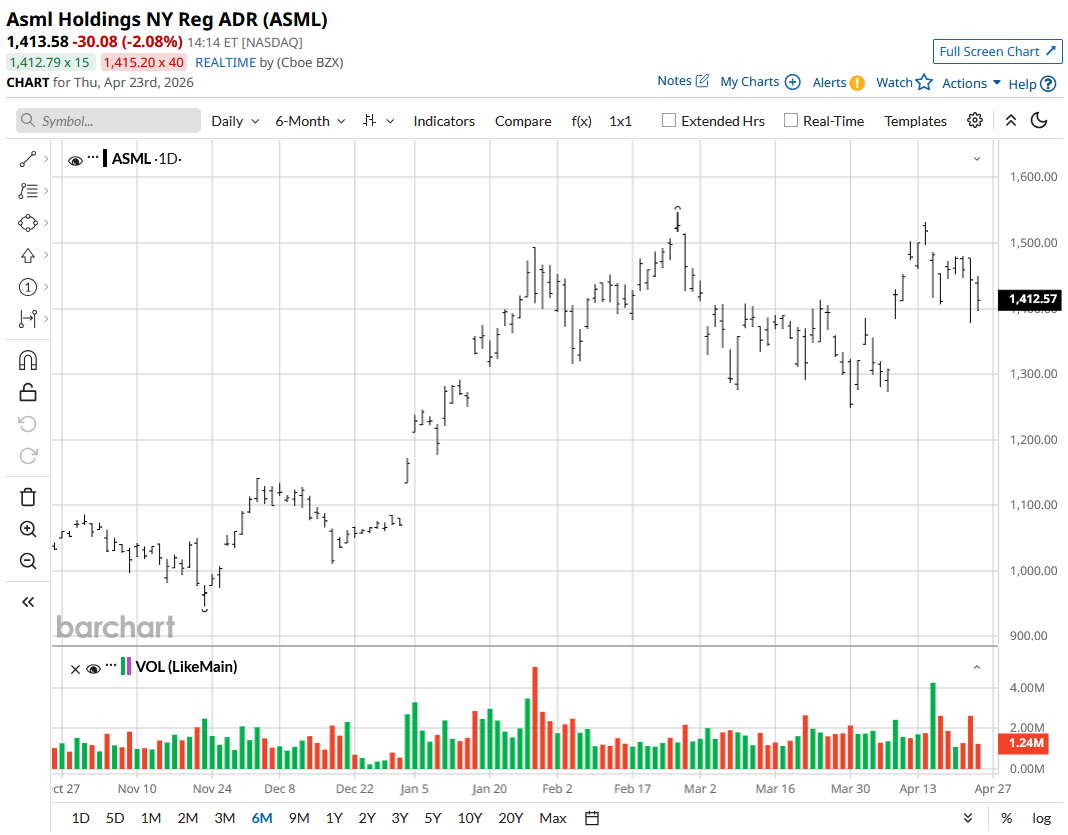
ASML has significantly outperformed the S&P 500 ($SPX) over the past year. While the broader market has delivered returns of around 30%, ASML stock has surged by approximately 110% during the same period. Despite geopolitical uncertainty, ASML stock has also maintained its upward momentum so far this year, rising 33% year-to-date (YTD) compared to the S&P 500’s gain of about 5%.
 www.barchart.com
 Recent developments seem to have put a stop to the rally, although the iShares Semiconductor ETF (SOXX) continues on its merry way, having registered 40% gains over the past month alone. ASML has been relatively subdued in comparison, but not enough to give any meaningful discount on the valuation front. This could change in the coming days as analysts absorb the news coming out of Taiwan. For now, investors are likely going to step back rather than pay 38.8 times for forward earnings.
EUV System Sales Dominate ASML’s Revenue
ASML posted its first-quarter fiscal 2026 earnings on April 15. The company reported net system sales of €6.3 billion for the period, of which more than €4.1 billion came from EUV system sales. This included contributions from two High-NA systems, while over €2.1 billion was generated from non-EUV system sales. Installed Base Management sales for the quarter reached €2.5 billion. On the cost side, R&D expenses came in at around €1.2 billion, with SG&A expenses at €300 million.
For the second quarter, ASML guided total net sales in a range from €8.4 billion to €9 billion. Within this, installed base management sales are projected to be around €2.5 billion, with gross margin expected in the range of 51% to 52%. Management also updated the company’s 2026 outlook with a revenue range of €36 billion to €40 billion.
What Are Analysts Saying About ASML Stock?
Following the company’s earnings report, Wells Fargo raised its price target on ASML stock from $1,650 to $1,750 while keeping an “Overweight” rating. The firm remains bullish on the stock, citing an improved outlook supported by non-China demand. It also highlights the rising low-NA EUV capacity and improving visibility into 2027 growth potential. This month, RBC Capital also increased its price target on ASML from $1,625 to $1,700.
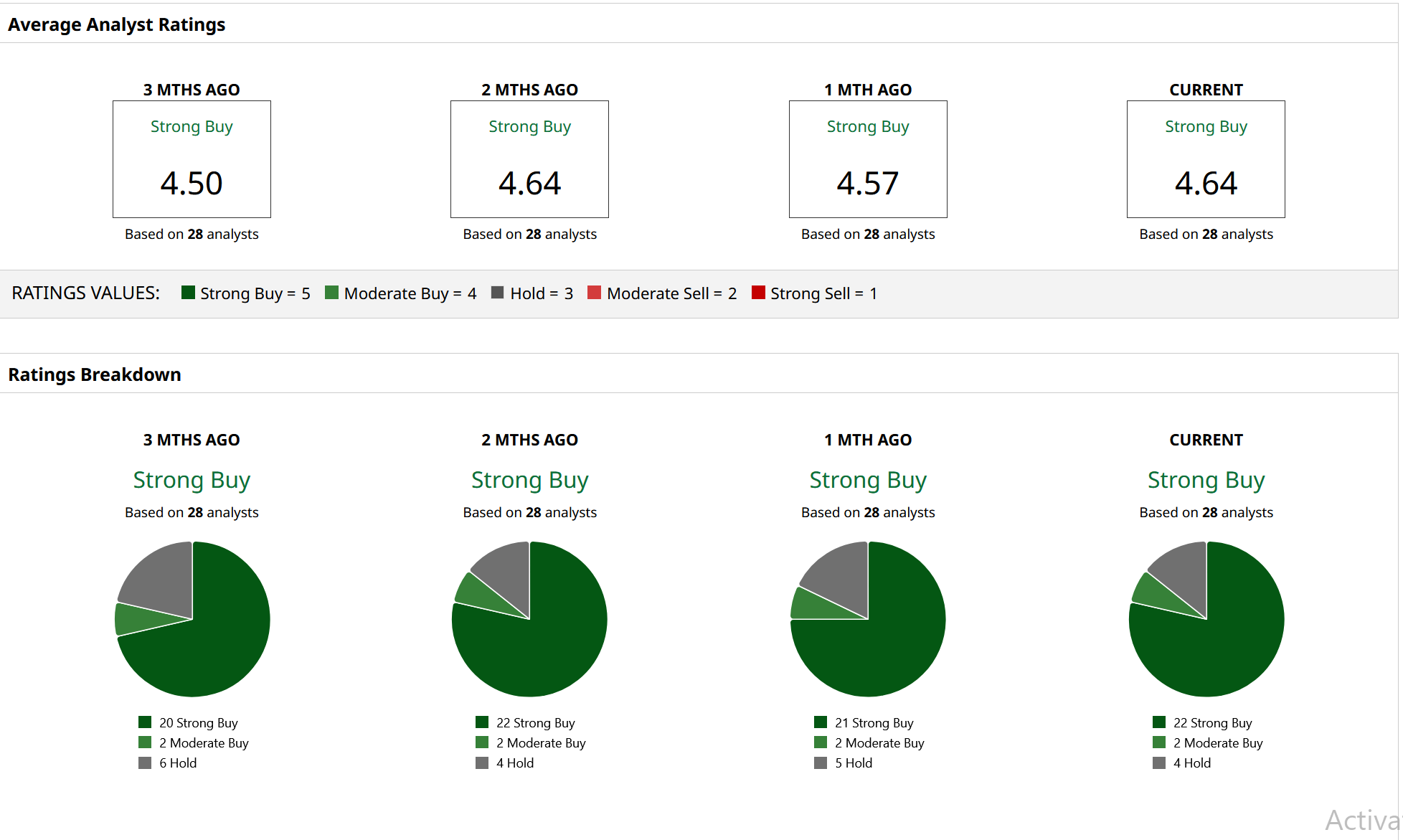
ASML stock holds a consensus “Strong Buy” rating from 28 Wall Street analysts with coverahe. The mean price target of $1,680 reflects 18% potential upside from current levels.
 www.barchart.com
 On the date of publication, Jabran Kundi did not have (either directly or indirectly) positions in any of the securities mentioned in this article. All information and data in this article is solely for informational purposes. For more information please view the Barchart Disclosure Policy here.
More news from Barchart
Taiwan Semi’s Latest Breakthrough Isn’t Just Bad for ASML Stock, It Could Disrupt the Entire Chip Industry Dear Spotify Stock Fans, Mark Your Calendars for April 28 As Intel Triggers a Major Rally in Semiconductor Companies, DA Davidson Hikes Its AMD Stock Price Target by More Than 70% How Nvidia Stock Could Be the Biggest Loser From the SpaceX IPO