


If you hadn’t noticed, Wall Street is very busy making lots of money, and occasionally losing lots of money, and just generally moving lots of money from one column to another, sometimes at a very frenetic pace. So, like the rest of the world, Wall Street prefers to operate along a binary system of organization.
You can be either bullish or bearish, which is roughly the same (but not exactly) as being long or short. And if that all feels a little too game-y, you can instead be hawkish or dovish — but usually only in a convincing way if you’ve done some postgraduate work, candidly.
Can’t Get Enough Options?: Join the list for Barchart’s daily unusual options report, delivered free.
If none of that feels quite right, there’s also growth vs. value, small-cap vs. large-cap, and technical vs. fundamental analysis, but now we’re really starting to pigeonhole ourselves.
It’s not entirely unlike the gender binary — which we’ll get to soon, believe it or not, and in a way that’s surprisingly organic to the text.
But one of the greatest rivalries simmering at the intersection of Wall and Broad, with both sides narrowing their eyes at each other across the sizzling hot pavement like so many Sharks and Jets, might be traders vs. investors.
In this deep dive, let’s talk about what the real difference is, whether it matters, where you belong on the spectrum, and how to use our Barchart tools to find the best stocks for whatever type of market participant you want to be.
Gekko vs. Buffett
If we think about the archetypal “trader” here, it’s useful to reference Gordon Gekko, who, of course, is not a real person.
Instead, the main character of Wall Street is a composite based on the actual financiers Carl Icahn and Asher Edelman (both corporate raiders); “Junk Bond King” Michael Milken (convicted of securities fraud); and arbitrage savant Ivan Boesky (who was trading on insider tips and rolled on Milken).
It was Boesky who told a UC Berkeley business class in 1986, “I think greed is healthy. You can be greedy and still feel good about yourself,” which gives us a pretty straight line to Gekko’s most famous piece of dialogue.
It’s also a glide path from there to guys like Jordan “The Wolf of Wall Street” Belfort, who has become a modern-day trading folk hero after Leonardo DiCaprio and Margot Robbie dramatized the story of his conviction for securities fraud over a penny-stock pump-and-dump scheme. (Yes, it’s kind of weird, unless you don’t think about it too hard, which I suppose is the point of most Leo memes.)
My point here is not that all traders are criminals — although there are certainly a few in the mix, as you might expect. Instead, it’s that this particular slicked-back huckster is the “central casting” image that comes to mind even when I think of a trader, and I’m someone who counts a few traders among my good friends.
On the other hand, if I think of an investor, I immediately think of Warren Buffett, and also a little bit of Peter Lynch. The investor is an older guy in a slightly out-of-fashion suit with a completely spotless criminal record, and his top three hobbies are reading, crossword puzzles, and then something train-related.
An “investor” is someone very close to the idealized version of my dad, which is: he still reads the Wall Street Journal every morning and wears ties to work and has the same haircut for 55 years and tells me to start a 401(k) at age 21, but crucially, he never once embarrassed me at the mall when I was 13.
The difference in perception here has a lot to do with intent, stated or otherwise.
As a trader, your primary purpose in engaging with markets is to separate other participants from their capital. The idea is to walk into the market, remove their cash, and walk out — like a bank job, but totally above-board, and with a lot more steps and intermediaries. As an activity, trading requires a certain dexterity and focus, and a degree of nihilism that doesn’t suit everyone. As an investor, your primary purpose is something more akin to joint ownership in a corporation for the purpose of long-term wealth-building. You’re purchasing a small stake in a company with the intent of participating in its anticipated growth over time, and potentially growing your own stake, as well. Investing requires a certain degree of research and a tolerance for patience, which can be disqualifying for some.Now, if we’re being honest, the investor is doing the exact same thing as the trader, in terms of the ol’ smash & grab. The extraction of capital is simply taking place over years and decades, instead of hours and days. So a useful metaphor here in terms of the “investment” aspect might be to think about a Grindr hookup versus a longtime domestic partner.
By the way, if you look closely enough at this Grindr chart, you might actually be able to see the 10 or so shares’ worth of volume I traded back in June 2023.
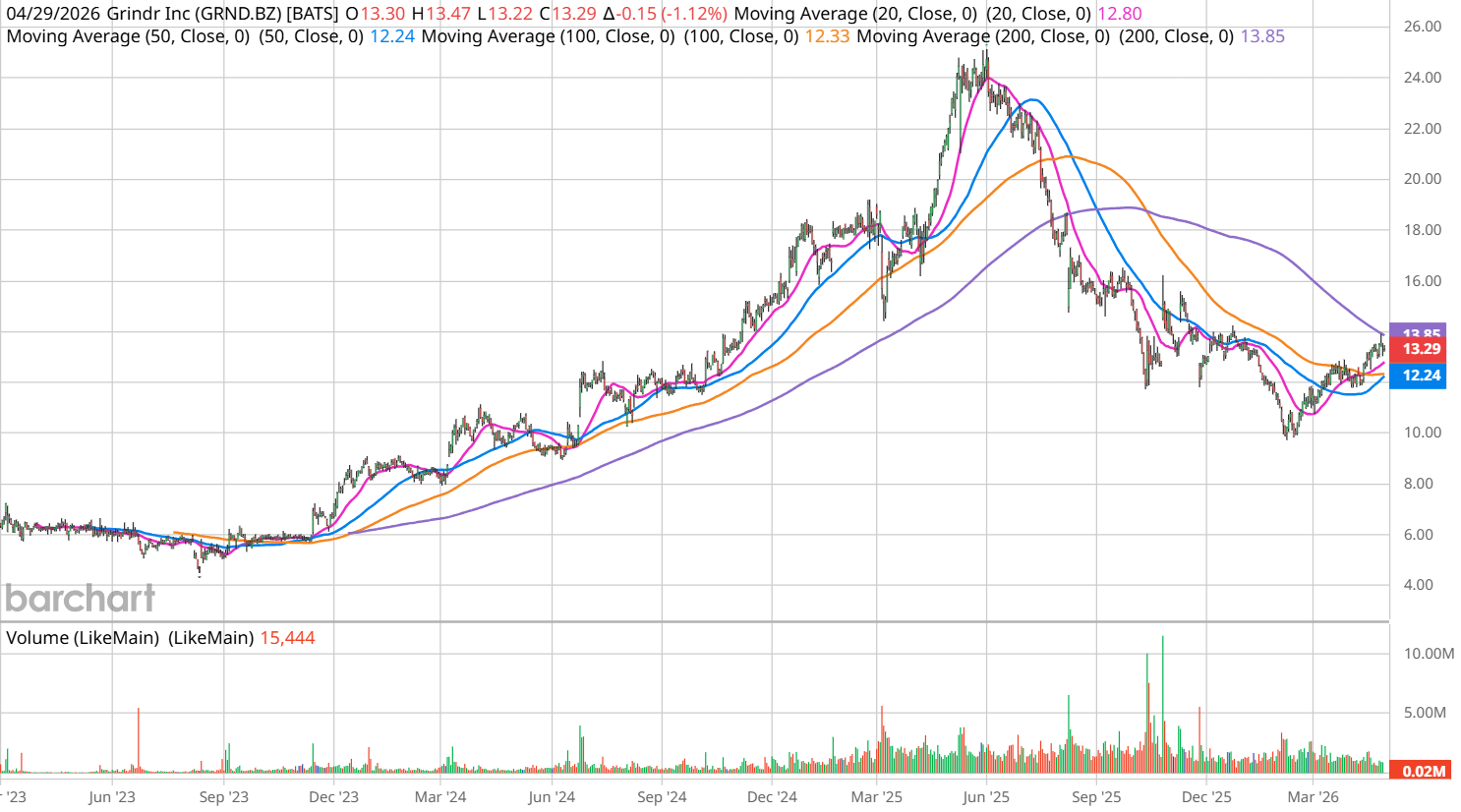 That's me, not too long before the ~5M institutional trade.
 We’ll talk about why that’s a dealbreaker for this hookup later on.
How I Learned Absolutely Everything About Stocks
Of course, like all forced binaries — Pepsi vs. Coke, Sam Altman vs. Elon Musk, Betty vs. Veronica — the truth is that most of us exist somewhere in the hazy gray middle of the spectrum, neither fully investors nor fully traders.
As for me, I became a generalist by necessity, largely due to my years spent presenting as a man in the course of my work as a writer.
Being a proud graduate of NYU’s Tisch School of the Arts, I’m largely self-taught on the broad strokes of the stock market. But as a writer covering stocks, options, and commodity markets, I’ve also spent a significant amount of time working closely, and very directly, with a smart and diverse group of analysts — some of whom you might know, like our Senior Market Strategist John Rowland, CMT, and Senior Market Analyst Darin Newsom.
As you can imagine, this kind of close collaboration is an excellent way to learn the subject matter; it’s like a full-time paid apprenticeship, with benefits.
For example, I spent several years early in my career sharing a daily newsletter byline with someone who is now a regular CNBC contributor, which I would recommend to anyone starting out, especially if you find someone who’s still willing to put up with your childish midday prank text threads all these years later, as I did.
And one of my favorite accounts on Substack is written by a brilliant macroeconomist and analyst who I used to work with so closely that he once woke up, panicked, at 7:30 AM, and started messaging everyone else on our team to ask why he hadn’t heard from me yet. (No one answered, but it’s because he had briefly forgotten that he was in Germany, and I was not.)
You get the idea. But as part of this work, for years before I started in my role here at Barchart — I’m talking probably a good decade or so — I wrote, under a broad portfolio of men’s bylines, an incredibly wide variety of market analyses for public consumption, based on a varied and esoteric set of disciplines they never taught me at playwriting school.
I’m Him
It didn’t matter if the guy was a gunslinging speculator from Texas or a by-the-book options scholar from Chicago. He could be a quiet biotech nerd who refused to post on his own Twitter, or a brash technical analyst with strong social media takes on wine pairings. Whatever the methodology, the time frame, the specific set of technical indicators, the fundamental “tells,” the unique vocabulary — I was him.
On behalf of the reclusive industry legend who usually forgot to approve my drafts, I learned most of what I know about exchange-traded funds (ETFs), fund flows, and how to weave it all together into a coherent broad-market analysis that he wouldn’t get annoyed about three weeks later.
For the wunderkind who transformed his life after learning to trade, I would sit in silence for hours, listening intently to the livestream in hopes he would say something, anything, as he watched the screen. Then I would take the two or three scraps of quotes my time had yielded, turn them into a 500-word lesson on the fine art of following big-money options volume, and send it out as an email.
For the crypto expert who insisted he was working under an alias not to dodge the obvious SEO links with his prior rugpull endeavor, but simply because he was former CIA, I obligingly learned more than any gainfully employed playwright ever has about altcoins, Layer 1 vs. Layer 2, and even non-fungible tokens (NFTs).
And that Instagram-famous trader with the options scanner, the one who usually spoke primarily in onomatopoeia? When his newsletter suddenly became self-aware, and with real call-buying fundamentals woven into the copy, that was me, too.
Based on some quick back-of-the-napkin math, I would estimate that over a stretch of time from roughly 2012 to 2024, I regularly wrote original content under the bylines of no fewer than 10 men, including additional uncredited scriptwriting for perhaps dozens more, across the financial publishing industry. Whatever they knew, I knew. Whatever I said, they said.
This was a tremendous learning experience for me on many levels.
First of all, gender is absolutely a social construct. In all my years of cosplaying as a man with a brokerage account, we never had one customer write in and say, “Hey, are you sure about this analysis? Because it says ‘by Chauncey Brotherington,’ but I could swear it was written by someone with a scorching case of postpartum anxiety who has attended at least one live Tori Amos performance.”
Not one.
Second, there is no magic trick to navigating the stock market. There is only you, and the charts, and the linear progression of time, and it’s up to you to spend that time however you choose.
The Fallacy of Choice
I’m not in the recommendations business anymore, under my own name or anyone else’s. But I do suggest, gently, that you think less about binary questions like, “Am I a trader or an investor?” and more about open-ended questions like, “How much time do I have in my life to think about stocks?”
And then maybe it becomes a little more refined: “How often do I want to have to think about stocks?”
This answer will be a little different for everyone, in theory. And it should help guide you toward the best approach for you to extract capital from the markets, whether you prefer to do so in the style of a Gordon Gekko or a Warren Buffett or — more likely — some kind of vigorous hybrid.
Because another thing I learned, in the course of becoming some of the most charmingly written personalities that the financial publishing world of the 2010s and early 2020s had to offer, is that the investor-trader dichotomy is a myth.
Everybody — even the guy who told me that investments are just failed day trades — does a little bit of both.
What generally works for me, I’ve learned, is one of two extremes:
Quick day trades that I can forget about forever after 4:00 PM Eastern. Long-term investments that I plan to buy and hold and then forget about for at least several months, then manage maybe once a quarter when I think about it.Despite the wide gulf in my preferred time frames, you can see that the unifying thread is my complete lack of interest in active trade management. I certainly have the utmost respect for people who actively manage their trades on a regular basis; that’s just not me, man. And if I try to pretend it is, who wins? Nobody.
If you are someone who’s willing to manage your trades like an adult, several experts I have worked with operate largely in a time frame known as swing trading, where trades unfold over a few days to a few months. When day trading feels too frenetic and buy-and-hold is too boring, swing trading typically resonates. For some of the best technical and momentum indicators to use here, I would nod again to our own John Rowland as a top resource.
But for day traders, buy-and-hold investors, and swingers alike, there is a relatively small handful of easy-to-understand criteria that we can use to help find the very best candidates for our money-extraction operations, all the way across the board.
Finding the Best Stocks to Trade and Invest
You may have heard that markets are irrational, and that probably goes double when it comes to day trading.
For that long, shimmering stretch of regular business hours between 9:30 AM and 4:00 PM Eastern, just about any publicly listed company can turn into a star, for almost any reason. A Taylor Swift engagement; a pivot to AI; something something Sydney Sweeney; and it’s load the boat, Cathie, because we’re all bulls now.
So, in all fairness, if you’re just chasing the nonsensical breakout move of the moment, the last three criteria on this list might be fully disposable.
But if you’re looking to build a go-to roster of dependable names whose charts you can learn like the back of your hand, a lineup of stocks that you can trade even on a slow day, a list of symbols that you can play short as comfortably as you can go long — these are good qualifiers to add, even as a day trader.
Over on the investing side, you can refine your search further than I did here by adding filters for dividend payouts, earnings and revenue growth, and any other fundamental data you want to include on the list. On our free Stock Screener, be sure to check the drop-down Filter menu for Financial Ratios, Balance Sheet, and Per Share Info to find all of your go-to metrics.
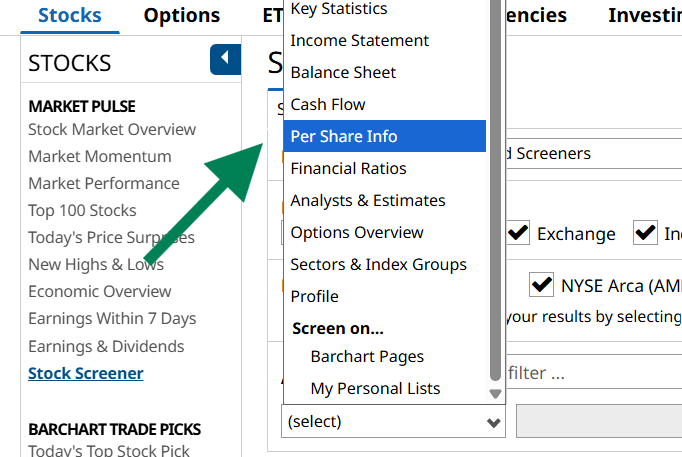 I honestly didn't use any Per Share Info, but live your own life.
 But these four are what I would consider the very bare essentials.
#1. Volume
Volume is the lifeblood of markets, in a very non-hyperbolic way. I truly believe that the worst mistake any trader or investor can make is to wander blithely into a low-volume stock, and then wind up stuck there, trapped in the airless vestibule of a wide bid-ask spread.
At its most basic level, “volume” refers to the number of shares (or option contracts, depending) that are being traded over the course of any given time frame. The more popular an asset is, the higher the volume. We discuss volume in terms of liquidity — high-volume stocks are liquid; low-volume stocks are illiquid.
That’s reflected for practical purposes in the bid-ask spread, which reflects the real-time difference throughout the session between the price sellers are willing to accept (the ask) and the price buyers are willing to pay (the bid) for an asset.
On very liquid, high-volume stocks, this bid-ask spread can be as narrow as a penny. That means orders are likely to be filled quickly, and it’s possible to enter and exit trades with minimal “slippage” — a term that refers to trade orders getting filled at unexpected prices.
For illiquid stocks, like our friend Grindr, you can have the wild good fortune to enter a low-stakes lark of a trade right before a big-money whale saunters up to the table, as I did — and then still find yourself frustrated by low daily volume and wide spreads when it’s time to take profits.
Even as a long-term investor, you will occasionally want to manage your position — add, reduce, take profits — and the ability to do this on your own schedule, not the market’s, is invaluable.
So for ease and speed of entry and exit, plus the absolute best pricing and fills on all of your orders, healthy daily volume is the number one qualifying metric I want to see for any stock I’m trading or buying for the long haul.
For this screener, I’m doubling down by focusing on (1) stocks with volume exceeding their own 50-day moving average, which is a relative measure, and (2) volume exceeding 500,000 shares on an absolute basis.
#2. Options
This is effectively another way to screen for Wall Street’s most actively traded and popular stocks, since low-volume/low-interest names will typically not have options listed. That said, it’s also a filter with a lot of utility.
For short-term traders, buying puts or calls instead of shares can provide leverage on a directional move, allowing you to generate the greatest possible return for your brief time in the market. Yes, there’s a possibility of a 100% loss, but it’s a clearly defined loss, and if you’re allocating responsibly (no more than about 2% to 5% of your total available capital per trade, usually), the risk should stay manageable.
For investors, options can be a flexible position-management tool if you happen to need one. Strategies like covered calls, protective puts, and collars can all be pulled into service for hedging and income-generation purposes, and cash-secured puts or the wheel strategy can be implemented to accumulate additional shares.
Here, I screened for optionable stocks and drilled down further to include only those with weekly options, which narrows our list to the most popular names among options traders.
#3. Index membership
As our dear friend John Rowland once said in reference to Broadcom (AVGO), which I happen to own:
“I don’t care what Broadcom’s results are, because passive investing tells me that every month, money is going to flow into Broadcom.”
He was referring here to the market mechanics underpinning the ETF industry, which has become a dominant force on Wall Street.
When investing dollars flow into market-cap-weighted proxy funds that benchmark the S&P 500 Index (SPY) or Nasdaq-100 Index (QQQ), the capital isn’t distributed evenly among the index components. Instead, it’s heavily concentrated in those stocks with the biggest market caps.
Effectively, this creates a virtuous cycle of growth when it comes to mega-cap investing flows. As the largest stocks in each index continue to garner an outsized portion of those passive fund flows, they naturally continue to attract more and more capital as they grow bigger and bigger in size.
However, since we’re already screening pretty effectively for liquidity and popularity on the basis of volume and options, we don’t necessarily need to restrict ourselves to mega-caps here.
Instead, I screened for membership in the iShares Russell 1000 ETF (IWB), which is effectively a mash-up of all your fave weighted ETFs. This should give us a solid listing of stocks with institutional backing, without being too restrictive.
#4. ‘Buy’ Ratings
In our post-Blodget world, a “Buy” rating is supposed to mean something, but then there’s Dan Ives.
In any case, I’ve screened here for stocks with a minimum consensus rating of “Moderate Buy” or better, with at least eight analysts in coverage.
This gives us a sort of “minimum clearance,” in terms of both the amount of notice the stock has gotten on Wall Street and the general temperature of that coverage.
Finally, I also removed OTC stocks and ETFs from the results, for clarity of purpose.
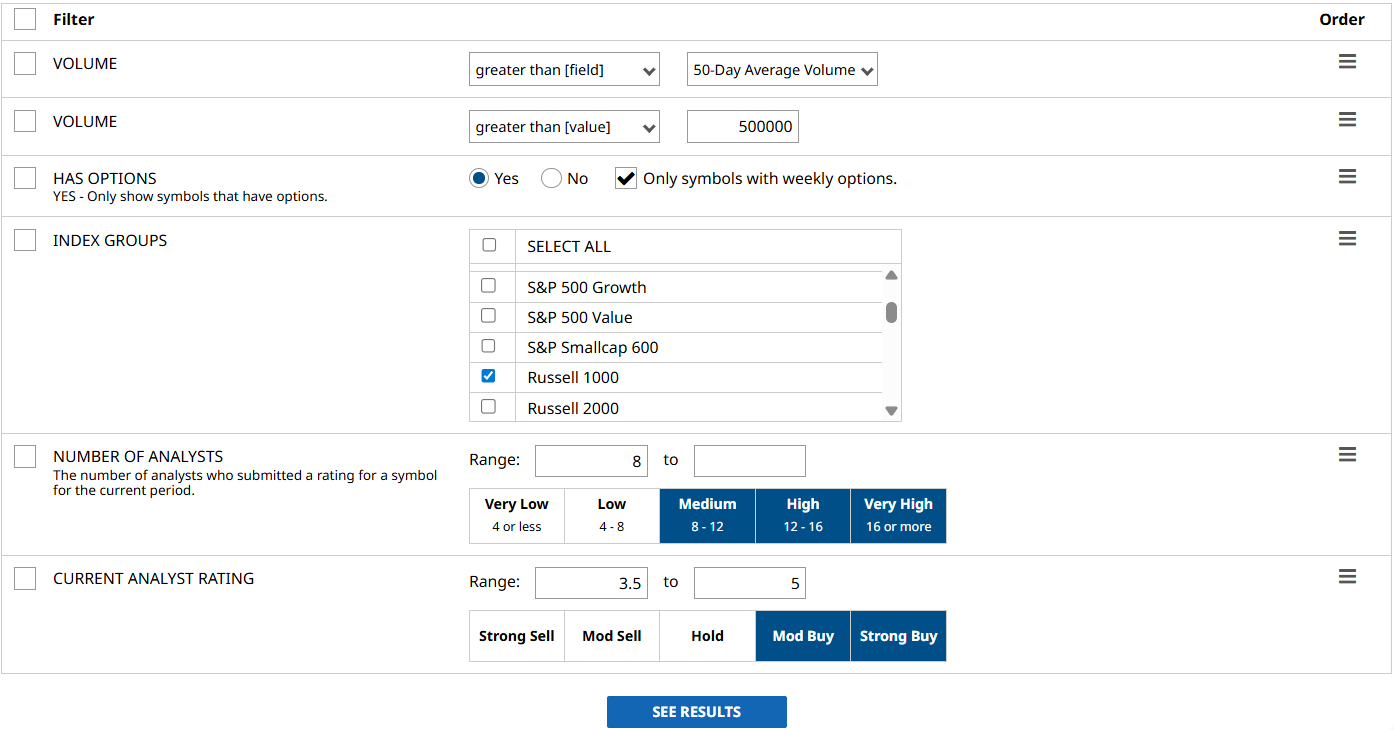 This is what the screener setup looks like.
 When I ran this extremely basic stock screener after the close on Wednesday, April 29, it gave me 85 results — not too bad for such quick work.
As it turns out, I actually do own a number of the stocks on this list, including Advanced Micro Devices (AMD), Microsoft (MSFT), Coca-Cola (KO), McDonald’s (MCD) — and even one of my personal biggest bags, Viking Therapeutics (VKTX), which I will happily sell to any takers, at some point.
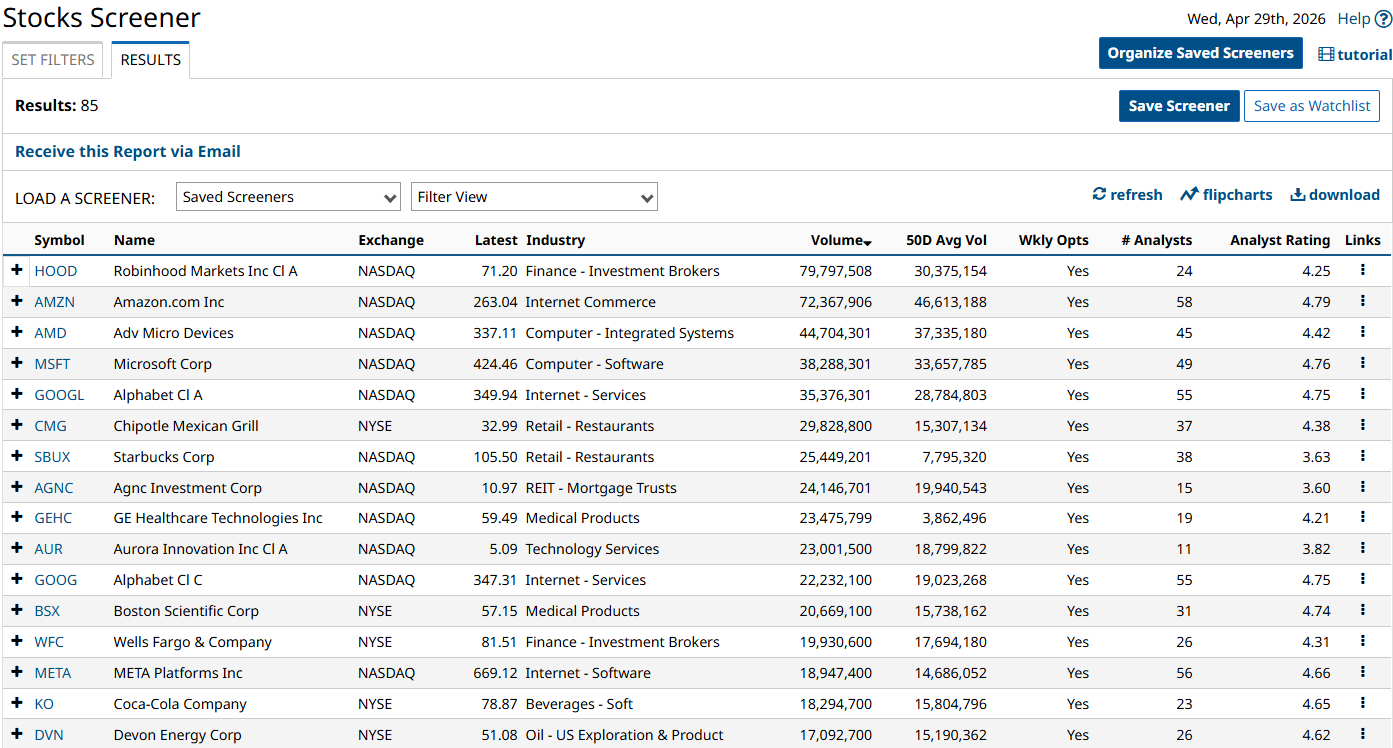 Wednesday's top results sorted by volume.
 You can check out this basic screener here, along with the results, and save it to your own Barchart account for further research.
📊 View & Save the Stock Screener
What’s Next?
Whether you’re a trader, an investor, a Cat Power fan pretending to be a finance bro, or just someone with a deep-rooted appreciation for high-quality liquid stocks, I hope this screener is a useful starting point to start tailoring your own path toward a place on the investor-trader continuum.
If you’ve noticed that I haven’t really touched on the third-rail issue of which technical indicators work best . . . well, that’s another essay. But to start finding which signals work best for the way you trade, go ahead and explore our library of indicators and how to use them.
Because, as Gordon Gekko not-quite-as-famously said, “The most valuable commodity I know of is information.”
The rest is just conversation.
On the date of publication, Elizabeth H. Volk had a position in: AMD , MSFT , KO , AVGO , VKTX , MCD . All information and data in this article is solely for informational purposes. For more information please view the Barchart Disclosure Policy here.
More news from Barchart
Dozens of Experts Built This Simple Stock Screener for Traders & Investors. It Was Me. Kinder Morgan Stock Is Normally Boring, but the Iran War Just Created an Exciting Short-Term Trade in KMI These Low IV Stocks May Be Setting Up for an Explosive Move Intel Corp Has Unusual Long-Term Call Options Activity - Investors Bullish on Intel Stock?