


GameStop (GME) CEO Ryan Cohen is swinging big, but the key question is whether Wall Street believes him.
GameStop shocked markets with a non-binding proposal to acquire eBay (EBAY) for $125 per share, a deal valued at roughly $55.5 billion. The offer is split 50% cash and 50% GME stock. It comes at a 46% premium to eBay's closing price on Feb. 4, 2026, the day GameStop began building a 5% stake in the e-commerce company through derivatives and direct stock ownership.
More Top Stocks Daily: Go behind Wall Street’s hottest headlines with Barchart’s Active Investor newsletter.
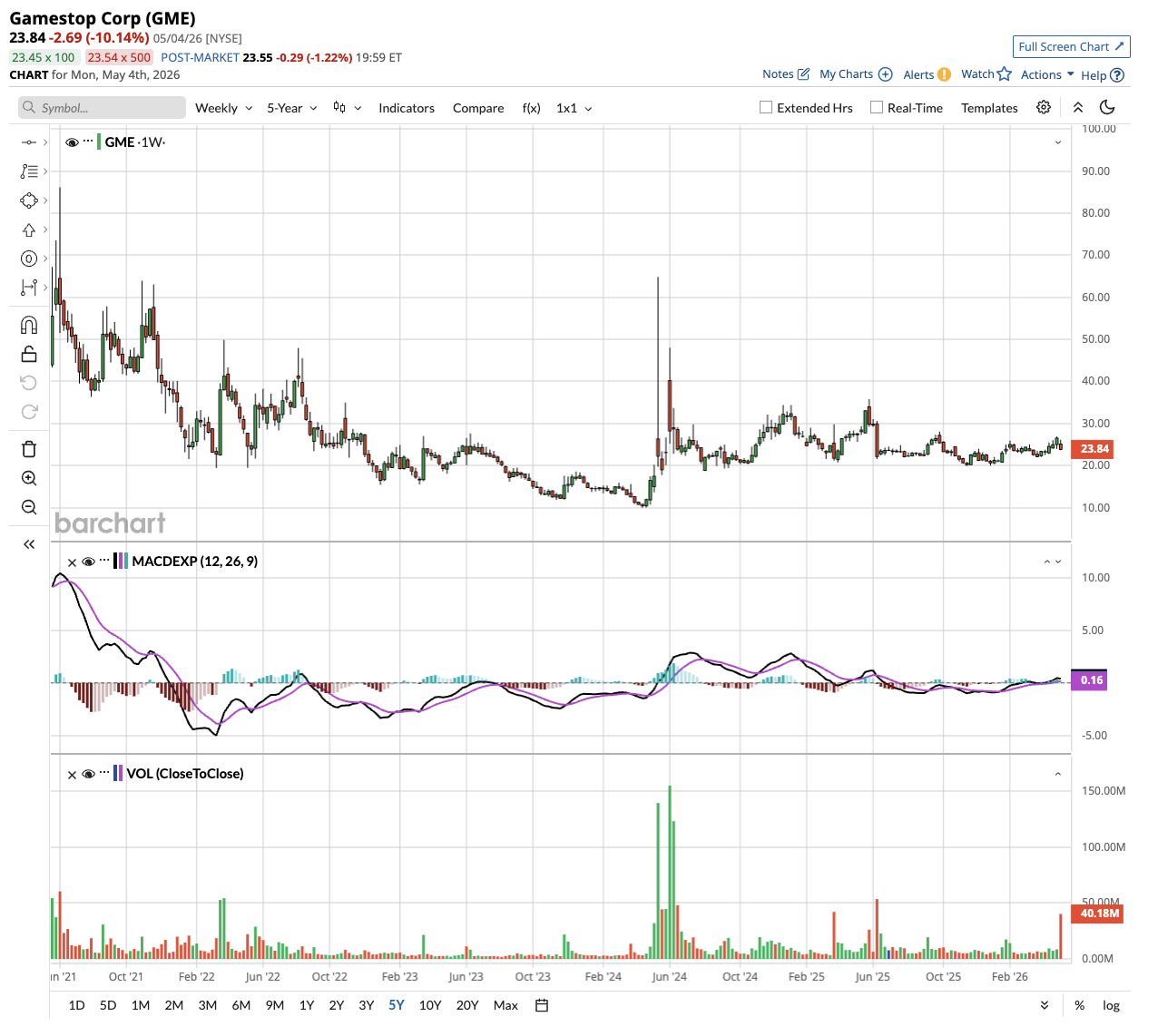
The market's reaction is skeptical, to put it mildly.
 www.barchart.com
 Will the GameStop and eBay Deal Go Through
Analysts at multiple firms quickly moved to pour cold water on the idea.
Wedbush flagged a very low probability of deal completion, saying uncertainty is the main driver of the current sell-off in shares of both GME and EBAY.
Morgan Stanley added that the two companies operate on "fundamentally different" business models, while Bernstein pointed directly to GameStop's smaller balance sheet compared to the size of the deal, noting it would be "surprised if anything became of it," according to BBC News.
Cohen said in his offer letter that he is willing to take the proposal straight to shareholders if the board walks away. eBay said it will review the proposal but has made no commitments.
The financing picture is complicated, too. GameStop plans to fund the cash portion of the deal using its balance sheet cash, which totaled approximately $9.4 billion as of Jan. 31, 2026, plus up to $20 billion in acquisition financing from TD Securities.
That means GameStop would be taking on significant long-term debt for a company that only recently retired its legacy obligations.
GME's Balance Sheet Tells a More Complex Story
A closer look at the GameStop balance sheet through January 2026 shows a company that has transformed its financial position over the past five years.
Total assets climbed to $10.4 billion as of January 2026, up sharply from $5.9 billion in February 2025 and just $2.5 billion in January 2021. Cash and cash equivalents stood at $6.3 billion, with total cash, including short-term investments, rising to $9 billion. Total liabilities also grew. Long-term debt ballooned to $4.2 billion in January 2026 from just $6.6 million in February 2025. That spike reflects the $4.2 billion in long-term debt GameStop raised at a 0% coupon to fund investment activity, including the eBay bid.So, while the cash pile looks impressive, a meaningful chunk of it was borrowed. Still, the underlying business has improved.
In fiscal year 2025, GameStop posted net income of $418 million compared to $131 million the prior year. Selling, general, and administrative (SG&A) expenses fell to $910 million from $1.13 billion. Operating income came in at $232 million, up from an operating loss of $26 million the year before, according to a company statement.Cohen has also restructured GameStop's retail presence and launched new initiatives like Power Packs, a digital trading card platform that went live to the public in April 2026.
Ryan Cohen Believes He Can Remake eBay
Cohen's pitch to eBay is that the company's spending is wildly inefficient.
He points to eBay spending $2.4 billion on sales and marketing in fiscal 2025 while growing its active buyer base by fewer than one million users, a gain of less than 0.75%.
His plan involves cutting roughly $2 billion in annual costs within a year of closing, including about $1.2 billion in sales and marketing, $300 million in product development, and $500 million in general and administrative expenses.
Cohen argues those cuts alone would nearly double eBay's diluted earnings per share from continuing operations, pushing it from $4.26 to $7.79. He also believes GameStop's roughly 1,600 U.S. retail locations could serve as a national network for authentication, product intake, fulfillment, and live commerce.
It is an ambitious vision. Cohen has earned credibility by turning GameStop from a company that lost $381 million in fiscal 2021 to one that posted $418 million in net income four years later. He owns roughly 9% of GameStop, takes no salary, and receives no cash bonuses.
But turning around a struggling video game retailer is a very different task from integrating a $55 billion e-commerce platform. For now, Wall Street is treating this less like a done deal and more like a long shot.
On the date of publication, Aditya Raghunath did not have (either directly or indirectly) positions in any of the securities mentioned in this article. All information and data in this article is solely for informational purposes. For more information please view the Barchart Disclosure Policy here.
More news from Barchart
GameStop Stock Is Selling Off on Its Bid for eBay. Wall Street Doesn't Think the Deal Will Go Through Anyway. Investors Just Discovered BlackBerry’s Software Potential. The Stock Is Surging. Wall Street Has Been Panicking About AI Taking Search’s Lunch, But Google Just Grew Search Revenue 19% Roblox Stock Plunged as Child Safety Measures Hurt Its Bottom Line, But the Average Analyst Still Thinks It Can Rise 86% From Here