

My wife and I are Starbucks people.
Not in the "I need my venti triple-shot caramel macchiato to function" way, but in the "this is our road trip stop of choice" way. We've racked up enough points over the years to feel financially responsible about our habit, and Starbucks (SBUX) has consistently impressed us with how it updates its menu to stay trendy and relatively healthy.
More Top Stocks Daily: Go behind Wall Street’s hottest headlines with Barchart’s Active Investor newsletter.
It's not a health food store by any means, but it makes us feel a lot better than a gas station run. (Though we'll never turn down a Buc-ee's when the opportunity presents itself.)
Here's the problem: for years, we've loved being Starbucks customers but refused to become Starbucks shareholders.
According to Peter Lynch, I’m making a mistake. You're supposed to invest in what you know. We know Starbucks. We use Starbucks. We watch Gen Z flock to their Refreshers and see them constantly evolve their food offerings. But the stock has been hammered for years, and watching a company you love underperform the market while you're actively giving them money is a special kind of painful.
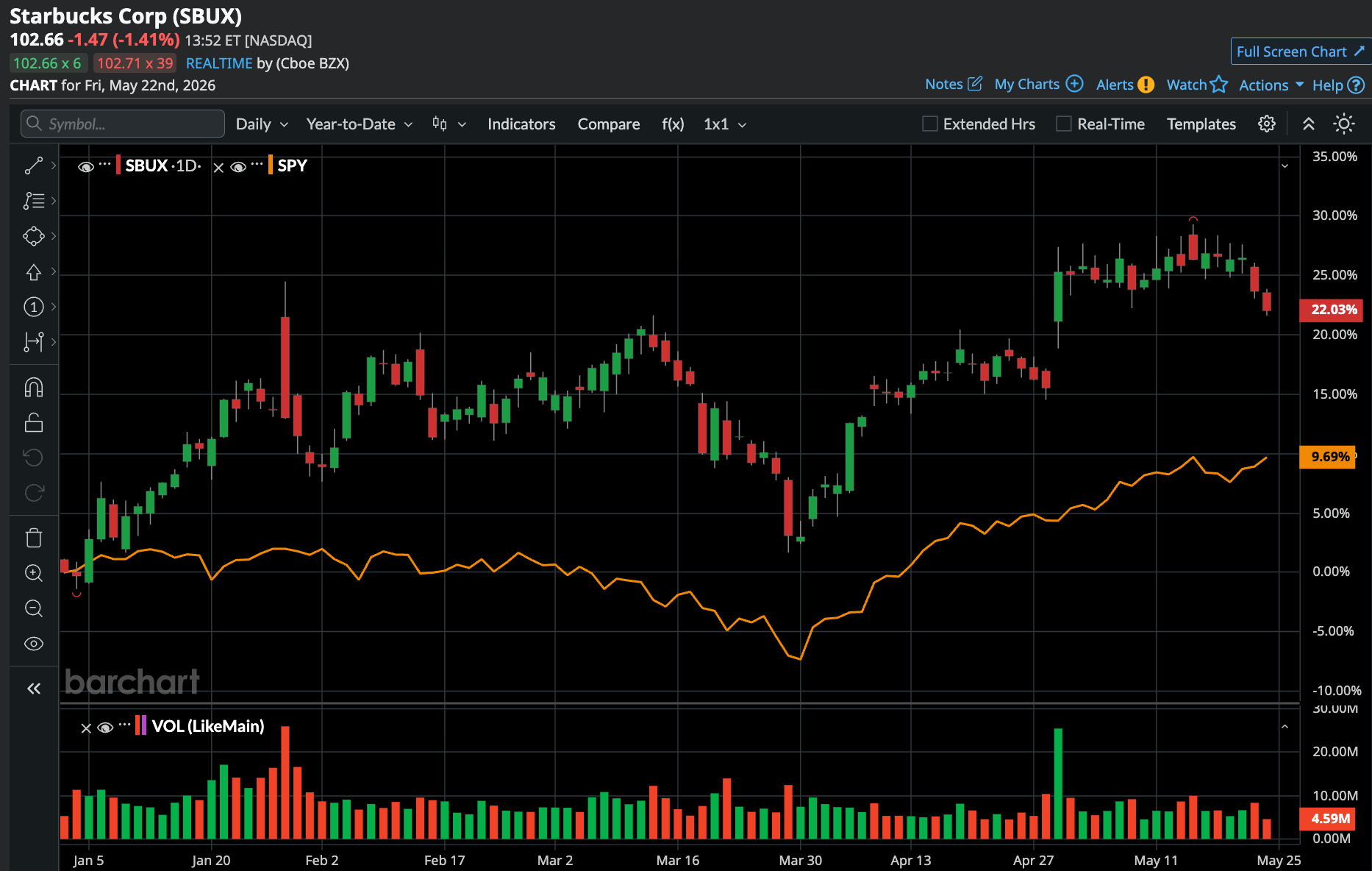
But 2026 is different. Starbucks is up more than 22% year-to-date, and while multiple factors are driving the turnaround, I think we can point to one unexpected catalyst: Khloé Kardashian's popcorn.
The Khloud Factor
When the influencer’s Khloud protein popcorn landed in Starbucks snack cases in January, it didn't seem like a big deal. Just another celebrity food product trying to cash in on name recognition.
But according to a Los Angeles Times report published Thursday, sales of Khloud's kettle corn flavor nearly doubled on Amazon (AMZN) in the month following its Starbucks debut. Performance picked up at Target (TGT) stores too. The brand has now added a second flavor, white cheddar, to Starbucks shelves.
Dana Pellicano, Starbucks' senior vice president of global product experience, explained the snack strategy to Bloomberg: customers during slower afternoon hours are "probably not looking for a packaged meal from us, but they might want a bag of popcorn."
That's where Khloud fits in. Along with Mush overnight oats, SkinnyDipped almond bites, and Ellenos yogurt, these third-party snacks provide variety without adding to baristas' workflow, while targeting the 3 p.m. energy-slump demographic.
Call it the Starbucks effect. Getting into those snack cases at more than 10,000 U.S. locations is a stamp of approval that drives sales everywhere else. "What Starbucks has done for the company cannot be understated," Khloud Inc. CEO Jeff Rubenstein told Bloomberg.
But here's what makes this interesting for investors: the Kardashian-stock connection isn't new, and it's not speculation.
Kardashians Have Been Moving Markets Since 2015 (At Least)
Back in 2015, a report by Daria Woods made a prescient argument: tracking Kardashian business ventures could lead to legitimate investment insights. She found that Kim Kardashian's mobile game helped double Glu Mobile's share price in 30 days during the summer of 2014, bringing in $74 million.
Woods' thesis was that social mentions (not just follower counts) were a better predictor of celebrity influence on consumer behavior and, by extension, stock performance.
At the time, the idea of using Kardashian partnerships as a leading indicator seemed almost satirical, but the data supported it.
Now, more than a decade later, we're seeing the same pattern with Khloé and Starbucks. And this time, the stakes are higher because Starbucks isn't a mobile game company; it's a $118 billion coffeehouse chain trying to execute a massive turnaround.
The $500 Million Turnaround Is Working
Starbucks has put more than $500 million to work on its "Back to Starbucks" plan, mainly through extra labor hours and bigger store rosters, according to a Barchart report published in April. The strategy is paying off.
In fiscal Q2 2026, Starbucks delivered revenue of $9.53 billion (up 8.8% year-over-year and 4.3% above estimates) and adjusted EPS of $0.50 (beating forecasts by 13.6%). Same-store sales grew 6.2% after declining the prior year. Operating margin improved to 8.7% from 6.9%. Free cash flow turned positive to $91.8 million.
The company is also executing strategic restructuring. Starbucks this month announced layoffs of 300 corporate employees and the closure of several regional offices, which it’s expecting to incur $400 million in restructuring charges while targeting $2 billion in cost reductions over the next two years.
The Starbucks Snack Case Is the Ultimate Marketing Hack
Here's what makes the Starbucks partnership so valuable: shelf space is incredibly limited (about 30 ready-to-eat items across 10,000+ locations), and products sell at a premium compared to other retailers. For example, Mush oats sell for about $3.75 at Starbucks versus $2.49 elsewhere.
But brands accept those terms because the visibility drives sales everywhere. "If you've gotten your brand into Starbucks, it's a stamp of approval in a way," Ashley Thompson, co-founder and CEO of Mush, told Bloomberg. "Other retail partners look to see what Starbucks is doing."
Lior Lewensztain, CEO of That's It fruit bars – sold at Starbucks since 2014 – said people constantly tell him, "I found you at Starbucks." That brand recognition translates to sales at Target, Amazon, and grocery stores nationwide.
In that regard, Khloé's persistence in landing the partnership wasn't just good for Khloud. It was good for Starbucks shareholders.
I’m On the Fence, But Monitoring the Situation
Despite the momentum, I'm still not quite ready to put my money where my mouth (and my road trip coffee habit) is.
Starbucks has a lot to prove. The stock is trading at a forward price/earnings ratio (P/E) of 44.09, well above the sector average of 15.56. The dividend yield is 2.33%, but the forward payout ratio of 122.44% puts pressure on management to grow earnings into that dividend.
TD Cowen recently upgraded shares to "Buy" with a $120 price target, indicating potential upside of another 13% from current levels. Analysts expect the company to reach an annual EPS of nearly $4 within three years.
If Starbucks can maintain this trajectory, leveraging celebrity partnerships for the "Starbucks effect," cutting costs without sacrificing experience, and continuing to attract Gen Z with trendy products, then maybe I'll finally make the leap from customer to shareholder.
In the meantime, if you see a Kardashian in your neighborhood, maybe thank them for giving Starbucks' share price an extra jolt.
On the date of publication, Justin Estes did not have (either directly or indirectly) positions in any of the securities mentioned in this article. All information and data in this article is solely for informational purposes. For more information please view the Barchart Disclosure Policy here.
More news from Barchart
Starbucks Stock is Up YTD – Thank a Kardashian How to Trade Lockheed Martin Stock Now Amid Escalating U.S.-Iran Tensions Micron Stock Is Up 726%. This Options Strategy Pays You to Buy the Dip Lowe's Delivers Strong Free Cash Flow, But the Stock Fell - Time to Buy LOW?