

Markets have a way of turning short-term relief into long-term optimism. Investors see an asset bounce off its lows and quickly start talking about new highs. Bitcoin's (BTCUSD) recent recovery is following that script. After briefly falling below $60,000 amid the Iran war and renewed concerns over Federal Reserve policy, the cryptocurrency has clawed its way back above the $62,000 mark. Bulls are once again forecasting six-figure prices.
The problem is that a recovery is not the same thing as a successful investment. When investors zoom out beyond the latest bounce, Bitcoin's record over the last five years looks far less impressive than many advocates would like to admit.
Join 200K+ Subscribers: Find out why the midday Barchart Brief newsletter is a must-read for thousands daily.
 www.barchart.com
Bitcoin's Lost Half-Decade
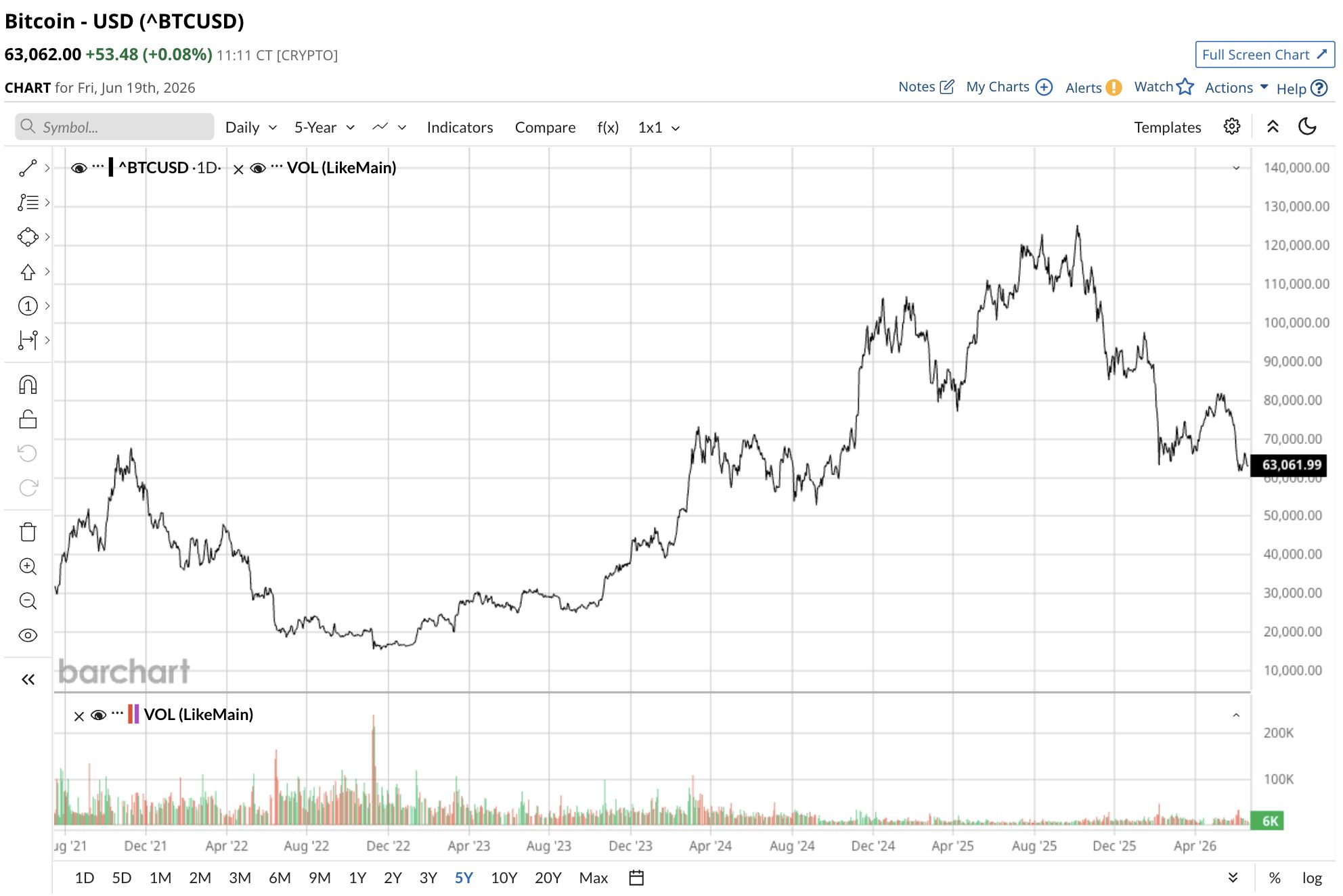
Bitcoin reached a peak above $126,000 last year before the October flash crash marked what increasingly appears to be its cycle high. Since then, the trend has been downward, interrupted by periodic rallies that have failed to regain prior highs.
More importantly, Bitcoin has produced essentially no return over the last five years. Where the S&P 500 ($SPX) has returned around 62% since November 2021, BTC has gone exactly nowhere over the same period.
That's the comparison many crypto enthusiasts prefer to avoid. While traders focus on dramatic short-term price swings, long-term investors care about total returns. By that measure, Bitcoin has badly trailed a simple investment in an S&P 500 index fund.
The headwinds continue to mount. Spot Bitcoin exchange-traded funds (ETFs) have experienced ongoing outflows, stablecoin growth has slowed, and digital asset treasury activity has weakened. Those trends suggest fresh capital entering the crypto ecosystem remains limited.
Strategy Isn't Sending a Bullish Signal
One of Bitcoin's biggest corporate supporters has also delivered a reality check. Strategy (MSTR) recently resumed purchasing Bitcoin after pausing acquisitions. More notably, the company did something many investors once considered unthinkable: It sold Bitcoin for the first time.
Strategy now owns 847,363 bitcoin acquired at an average purchase price of $75,651 per coin. With Bitcoin trading near $62,400, the company's position remains underwater. MSTR stock's performance has been even worse than the performance of BTC, with shares down approximately 77% from the 52-week high.
Even since November 2021, MSTR stock has returned less than 50%, trailing the S&P 500 despite employing an aggressive Bitcoin accumulation strategy. That's a remarkable outcome considering the company transformed itself into what is effectively a leveraged Bitcoin holding vehicle.
Gold Is Winning the Store-of-Value Debate
For years, Bitcoin advocates argued that the cryptocurrency would replace gold as the preferred store of value. The evidence increasingly points the other direction.
Periods of geopolitical uncertainty have historically benefited precious metals, and the recent Iran war reinforced that pattern. Gold has continued attracting capital while Bitcoin has sold off alongside other risk assets.
A store of value is expected to preserve purchasing power during uncertainty. Bitcoin's sharp declines during periods of stress have gradually weakened that narrative. Gold, meanwhile, continues to occupy the role it has held for centuries.
Granted, Bitcoin still attracts passionate supporters who see prices reaching $100,000 by year-end and much higher levels over time. Those forecasts may eventually prove correct. But investors should separate possibility from probability.
Key Takeaway
In short, Bitcoin's recovery has generated excitement, but the long-term numbers tell a different story. Despite reaching $126,000 last year, Bitcoin is trading near levels first seen five years ago while the S&P 500 has delivered a gain of 62%.
Meanwhile, spot ETF outflows continue, stablecoin growth has slowed, digital asset treasury activity remains weak, and even Bitcoin's biggest corporate champion sits underwater on its holdings.
Regardless of where Bitcoin trades next month or next year, investors should view it for what it is: a speculative trading asset rather than a core portfolio holding. For most investors, Bitcoin belongs in only a small portion of a diversified portfolio. The last five years suggest betting heavily on it has come with a very high opportunity cost.
On the date of publication, Rich Duprey did not have (either directly or indirectly) positions in any of the securities mentioned in this article. All information and data in this article is solely for informational purposes. For more information please view the Barchart Disclosure Policy here.
More news from Barchart
With Its MEXT Acquisition, Advanced Micro Devices Stock Could Rally to Higher Highs The $89 Million Reason AVAV Stock Is Down Today Stop Celebrating Bitcoin’s Recovery. It’s Been Dead Money for 5 Years. Amazon Could Soon Sell Its Custom AI Chips. That Could Be Bad News for Google Stock.