


Fusion energy promises nearly unlimited clean power, but there is a catch: The fuel is almost nonexistent in 2026.
That fuel is tritium, a rare radioactive form of hydrogen. The entire planet produces only so many pounds of tritium each year, yet a single fusion power plant would need roughly a pound a day to keep running.
More Top Stocks Daily: Go behind Wall Street’s hottest headlines with Barchart’s Active Investor newsletter.
Now, though, a team comprised of Oak Ridge National Laboratory (ORNL), Cleveland Clinic, and IBM (IBM) says quantum computers just helped clear a path toward solving this problem. Let's take a closer look.
 www.barchart.com
 Why Tritium Is Fusion's Biggest Bottleneck
Fusion reactors work by fusing tritium and deuterium — a more common hydrogen isotope — inside a superheated ring of plasma. The reaction releases enormous amounts of energy, the same process that powers the sun.
Since tritium barely exists in nature, future fusion plants will need to make their own while they run. The plan is to surround the reactor core with a thick blanket of liquid salt made of fluorine, lithium, and beryllium, known as FLiBe.
When stray neutrons from the fusion reaction strike lithium atoms in the molten salt, the atoms split, producing new tritium. In practice, however, predicting how tritium will behave once it forms has been nearly impossible. If tritium bonds with fluorine, it becomes corrosive and difficult to extract. If it stays loose, it can be pulled out as a gas.
How Quantum Computing Is Helping Crack the Chemistry
Modeling molten salt chemistry this precisely has been beyond the reach of classical supercomputers. Traditional methods, such as density functional theory, can be off by as much as 10% when estimating the energy behavior, according to researchers. That margin is far too large to reliably predict tritium's behavior.
To close that gap, ORNL, Cleveland Clinic, and IBM turned to quantum-centric supercomputing, a method that splits a large chemistry problem into smaller pieces and distributes the simpler fragments to traditional computers while a quantum computer tackles the more complex parts.
This is the same general approach Cleveland Clinic and IBM used earlier this year to model a protein made up of 12,635 atoms, one of the largest molecular systems ever simulated with the help of a quantum computer. In the new work, researchers modeled nine different configurations of FLiBe and checked the quantum-assisted results against the best available classical methods, per the researchers' preprint published on arXiv.
"In order to demonstrate the capabilities catalyzed by the Genesis Mission, we have built a team of leading experts across seven DOE national labs, four universities, three industry partners, and Cleveland Clinic to pursue a multi-pronged discovery cycle aimed at optimizing tritium production in molten salt fusion blanket materials," said ORNL Section Head for Science Engagement Tom Beck. “Quantum computers, such as those built by IBM and enhanced by AI and exascale computing, are key tools that accelerate the discovery and design cycles needed to produce sufficient tritium to fuel fusion reactors.”
The tritium research fits into a much larger effort backed by the U.S. Department of Energy's (DOE) Genesis Mission, which aims to combine artificial intelligence, quantum computing, and high-performance computing across the country's national labs.
"Bringing quantum, AI, and classical computing together is essential to tackling our society's most fundamental scientific challenges," said IBM Chief Technology Officer of Quantum-Centric Supercomputing Jerry Chow.
Scaling up what the team has done up will take years of additional work. Still, the significance is that quantum computers produced trustworthy results on a problem that has long stumped classical methods. Researchers plan to grow the size of the molecular clusters and expand the number of configurations studied.
Several experimental fusion reactors are already under construction worldwide. If this kind of computing keeps improving at pace, it could help those reactors solve their fuel problem before they ever go online, turning fusion from a decades-away concept into a workable source of clean power.
What's Next for IBM Stock?
IBM is a key player in the quantum computing space. Last month, the company disclosed plans to invest around $10 billion over the next five years to widen its quantum computing moat. The investment spans research and development, partnerships, acquisitions, and manufacturing scaling.
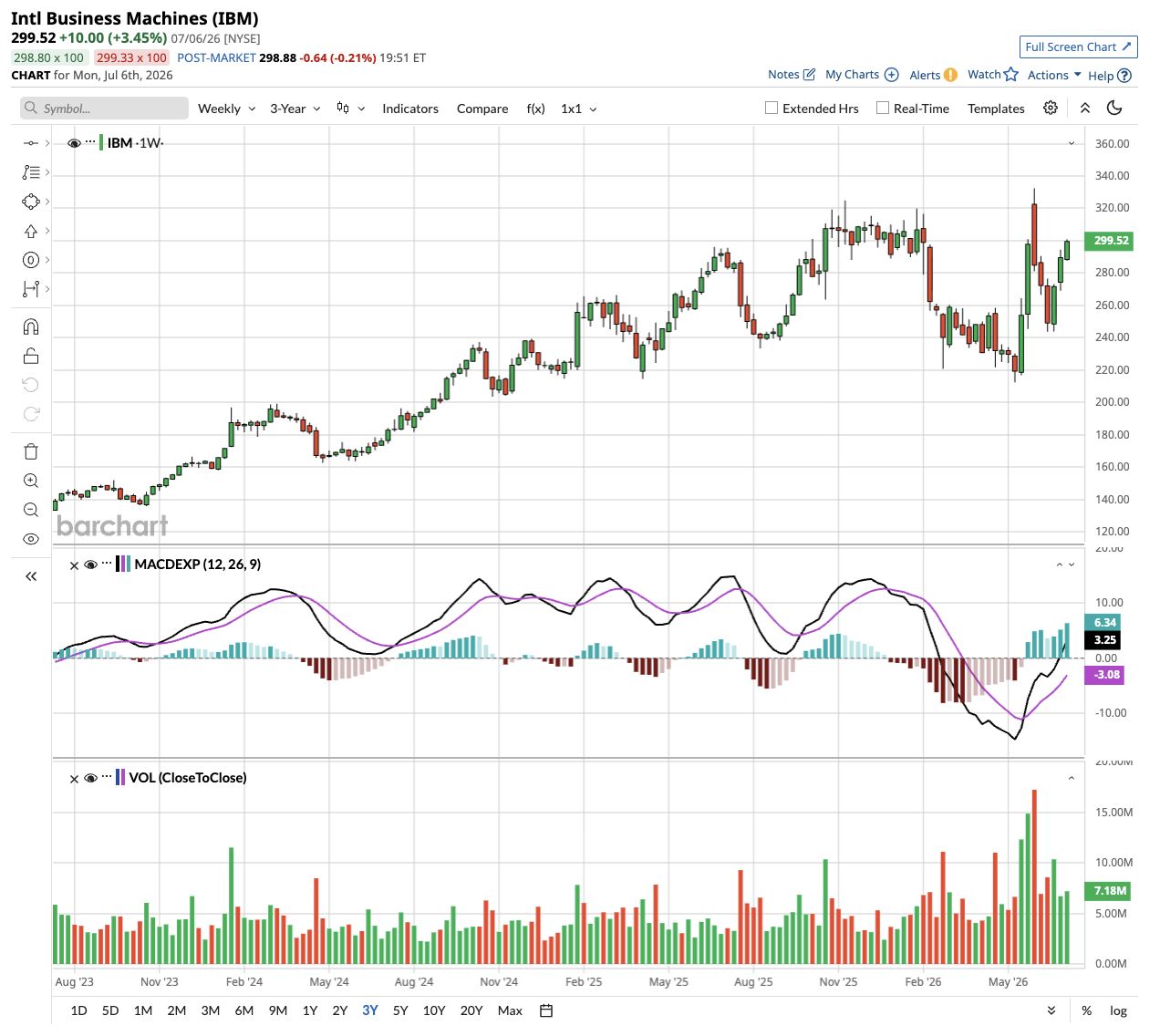
IBM's quantum-computing investments and AI developments have helped the tech stock more than double over the last three years.
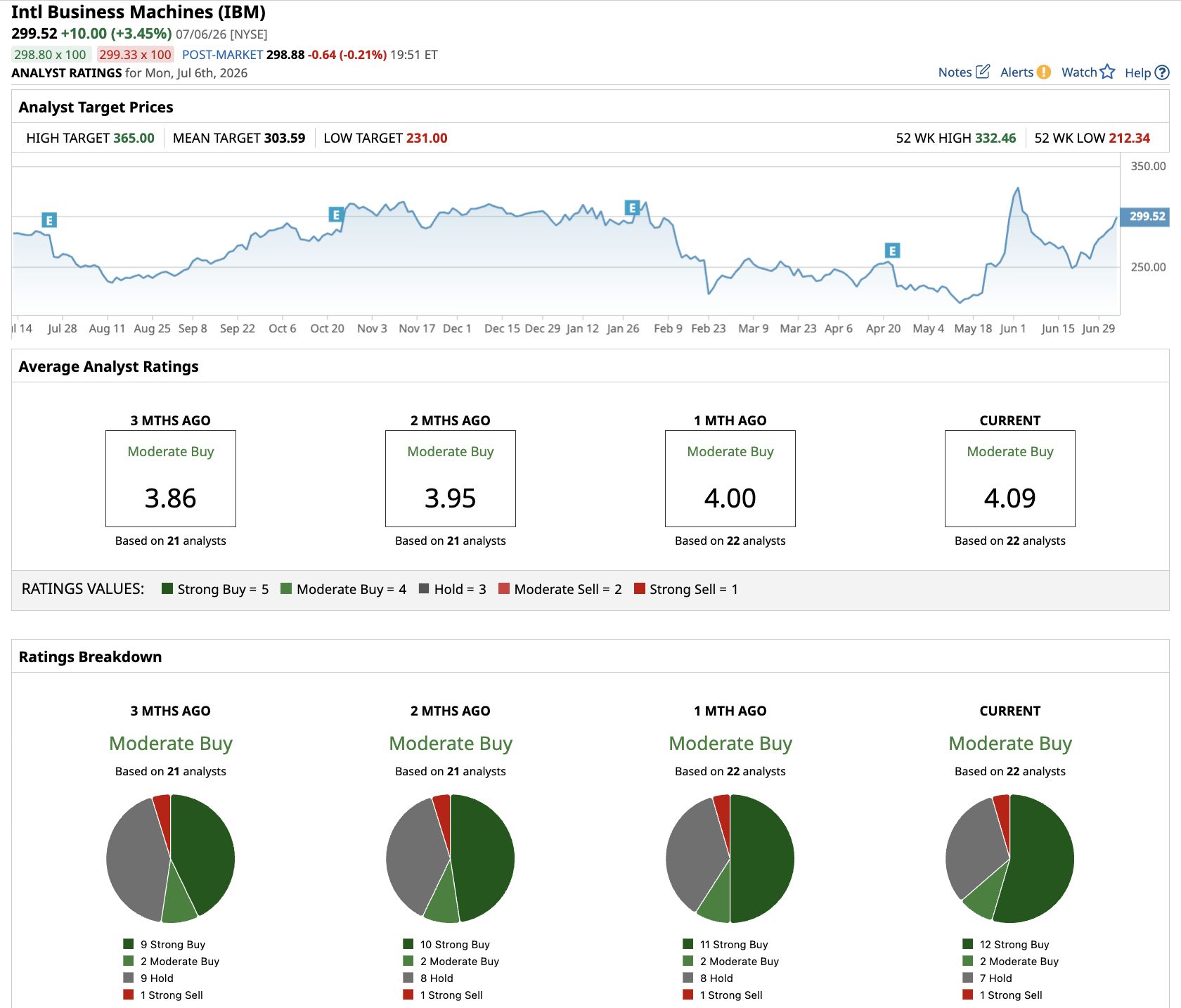
Overall, IBM stock has a consensus “Moderate Buy” rating on Wall Street. Out of the 22 analysts covering IBM stock, 12 recommend a “Strong Buy,” two recommend a “Moderate Buy,” seven recommend a “Hold” rating, and one recommends a “Strong Sell.” The average price target of $300.71 is slightly below current levels, while the high target of $365 implies potential upside of 21% from here.
 www.barchart.com
 On the date of publication, Aditya Raghunath did not have (either directly or indirectly) positions in any of the securities mentioned in this article. All information and data in this article is solely for informational purposes. For more information please view the Barchart Disclosure Policy here.
More news from Barchart
Bank of America Says AI Will Drag Down Adobe Stock Why Chapter 11 Might Be the Best Move for JetBlue Stock in 2026 IBM’s Quantum Breakthrough Sends Massive Clean Energy Signal DeepSeek Just Dealt Nvidia Stock a Potentially Major Blow