

Broadcom (AVGO) has become one of the most important companies in the artificial intelligence (AI) infrastructure boom, thanks to its growing role in custom silicon, networking chips, and semiconductor solutions used by some of the world’s largest technology companies. While memory chipmakers have captured much of the spotlight this year, Broadcom has quietly strengthened its position behind the scenes by helping major customers design application-specific integrated circuit (ASIC) chips tailored to their own AI workloads.
That position became even more important this week. Broadcom announced an expanded long-term partnership with Apple (AAPL) under which it will develop and supply custom ASIC chips through 2031. While Broadcom did not disclose the financial terms, Apple later revealed that it expects to spend more than $30 billion under the agreement.
More Top Stocks Daily: Go behind Wall Street’s hottest headlines with Barchart’s Active Investor newsletter.
So, what does Apple’s $30 billion chip agreement actually mean for Broadcom? Let’s take a closer look.
About Broadcom Stock
Broadcom is a global technology company that designs, develops, and supplies semiconductor and infrastructure software solutions. Its semiconductor products serve markets such as networking, wireless connectivity, broadband, servers, storage, and industrial applications, while its infrastructure software business includes private cloud, mainframe software, cybersecurity, enterprise software, and storage management solutions. The company has also become an important player in AI infrastructure through its custom silicon, networking chips, and software platforms used by large enterprises and cloud customers. Its market cap currently stands at $1.76 trillion, making it the world’s eighth-most valuable public company.
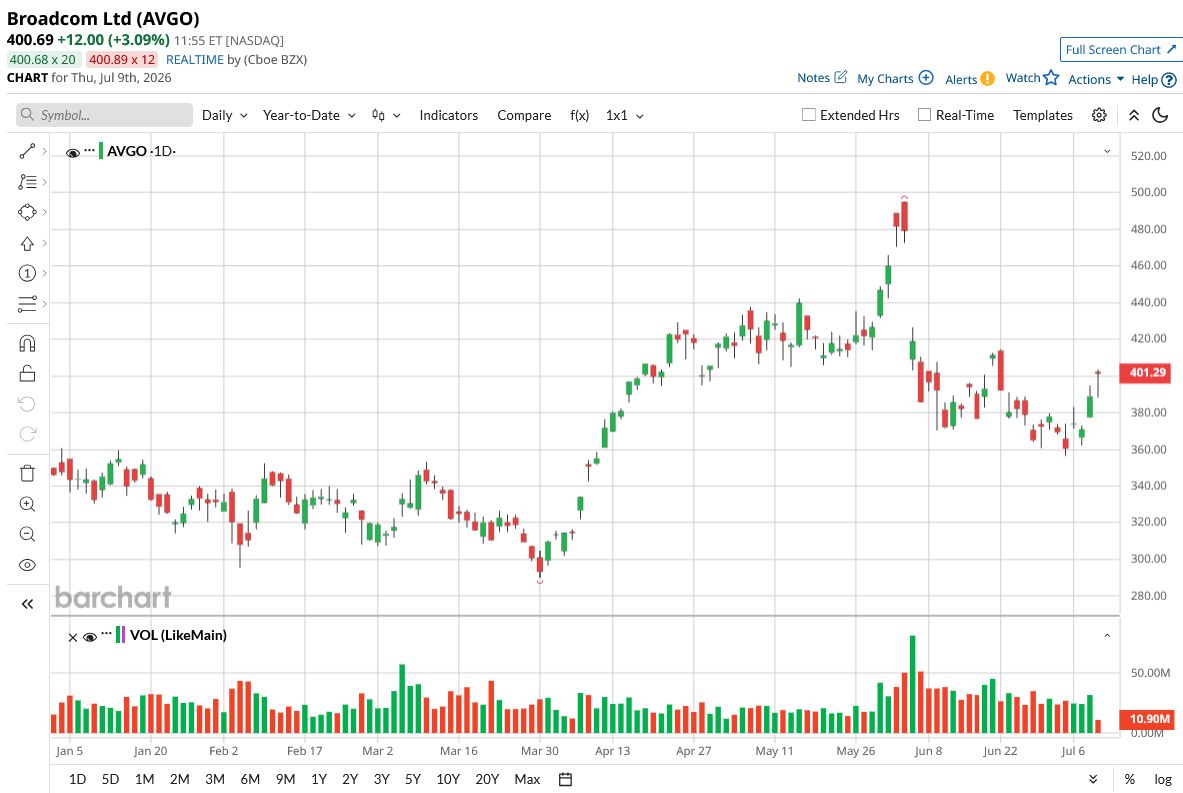
Shares of the semiconductor and software maker have risen 15% on a year-to-date (YTD) basis. The gains have been more muted than those of most of its peers, as the stock took a hit in early June after the company issued below-consensus FQ3 AI semiconductor revenue guidance.
 www.barchart.com
 Apple Deepens Broadcom Partnership With $30 Billion Chip Agreement
Broadcom shares climbed more than 3% on Monday after the chipmaker expanded its long-standing partnership with Silicon Valley giant Apple. Broadcom said it will develop and supply Apple with a range of custom application-specific integrated circuit (ASIC) silicon products through 2031. These types of chips will be used across “multiple generations of Apple products,” according to a Broadcom filing.
Broadcom’s filing did not disclose the financial terms, but Apple shared key details of the agreement on Wednesday, saying it plans to spend more than $30 billion. The iPhone maker said the deal will involve manufacturing more than 15 billion chips in the U.S., supporting hundreds of jobs. In addition, the partnership includes a $1.5 billion investment in Broadcom’s Fort Collins, Colorado, manufacturing facility, where advanced radio frequency components for wireless chips will be produced. AVGO stock gained more than 4% on Wednesday after Apple disclosed the financial details of the new agreement.
The most significant part of the expanded partnership involves Broadcom’s custom ASIC business. ASIC chips are designed for specific applications and are increasingly being used to process AI workloads. Wedbush Securities said the expanded agreement “seems to suggest AVGO will be assisting with more compute-oriented products,” though it said it remains unclear whether the custom ASICs will be used for device-level applications, such as edge AI, or for data center infrastructure similar to Broadcom’s existing work with companies including Google (GOOG) (GOOGL), Meta Platforms (META), and OpenAI.
Interestingly, Bloomberg reported in early May that Apple is developing more advanced AI servers that it plans to deploy as early as 2027. And even before the new agreement was announced, The Information reported that Apple’s AI server project would use a component developed in partnership with Broadcom. So, it is reasonable to assume that Broadcom will develop and supply custom compute silicon for Apple’s next-generation AI server infrastructure. At the same time, the reference in Broadcom’s filing to “multiple generations of Apple products” suggests the ASICs could be used for device-level applications. I would not be surprised if they are ultimately used in both areas. Regardless of the end use, Wedbush viewed the development as a positive for Broadcom, calling it “another customer win.”
Apple has been one of Broadcom’s largest customers since 2010, primarily purchasing hardware for wireless connectivity. While Apple developed its own N1 chip—a combined Wi-Fi and Bluetooth component used in recent iPhones, iPads, and Macs—Broadcom continues to supply some cellular networking components that work alongside Apple’s in-house modem. The companies entered into a multibillion-dollar agreement in 2023 for Broadcom to develop and manufacture 5G radio frequency components for Apple.
The latest extension builds on that agreement and secures Broadcom’s position in Apple’s supply chain through the end of the decade. Analysts estimate that Apple accounts for roughly 20% of Broadcom’s annual revenue, making the extension with one of its largest customers through 2031 a major positive for the chipmaker, as it provides long-term revenue visibility from one of Broadcom’s most important customers. Moreover, the deal expands Broadcom’s relationship with Apple beyond traditional wireless and RF components into custom ASICs, a higher-value area tied to AI.
It is also worth noting that the expanded partnership is equally beneficial for Apple, making the new agreement a win-win for both companies. First, it provides supply chain certainty at a time of chip shortages while eliminating the need for Apple to bring key iPhone components in-house. Second, the agreement advances Apple’s efforts to build an end-to-end silicon supply chain in the United States. Finally, these investments are part of Apple’s commitment to invest $600 billion in the U.S. economy over four years, reinforcing a pledge that has largely shielded the company from the Trump administration’s tariff plans.
What Do Analysts Expect for AVGO Stock?
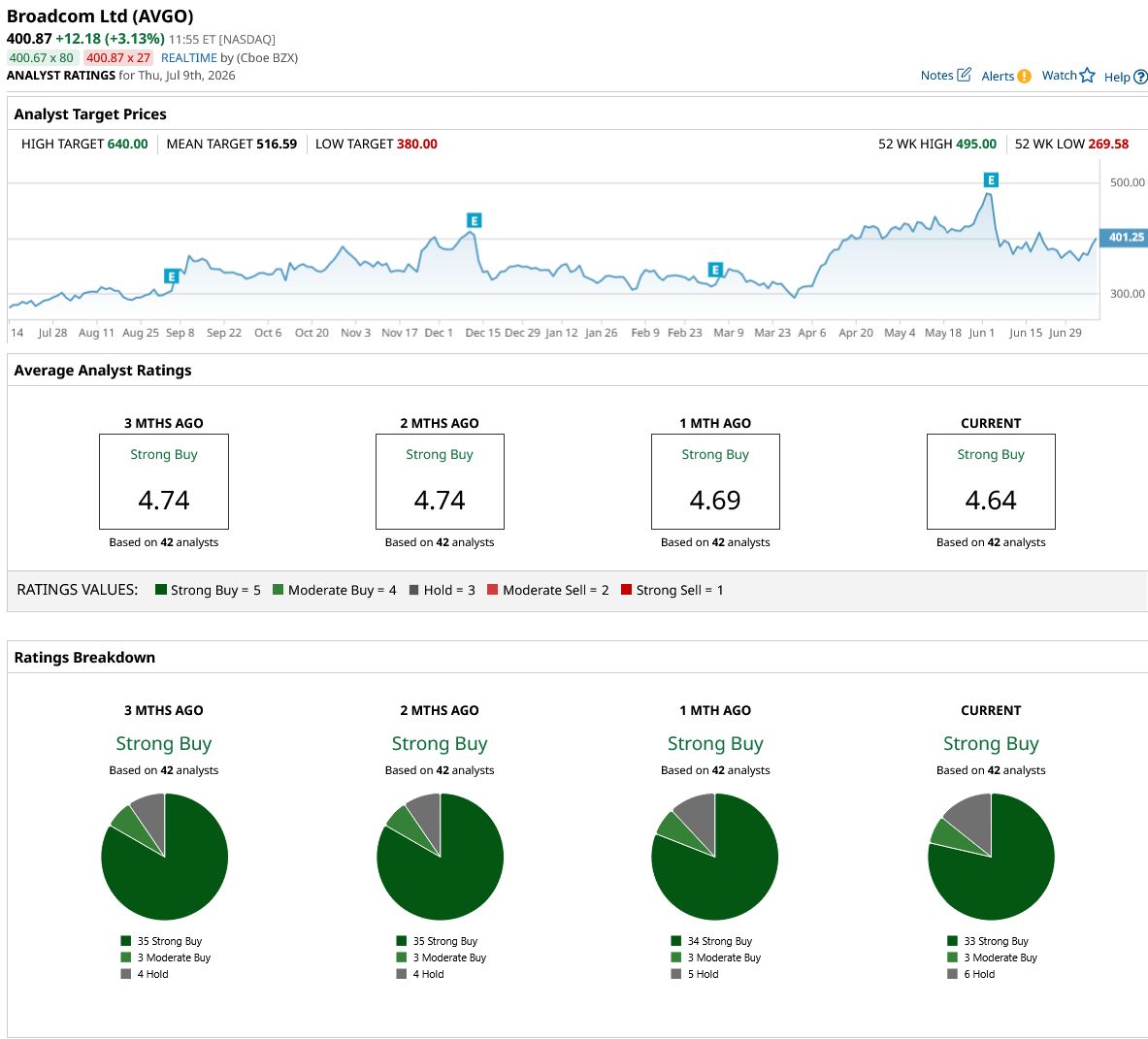
Wall Street analysts remain strongly bullish on AVGO stock, as shown by its consensus “Strong Buy” rating. Of the 42 analysts covering the stock, 33 have a “Strong Buy” rating, three assign it a “Moderate Buy” rating, and six advise holding the shares. The mean price target for AVGO stock stands at $516.59, implying a 29% upside potential from current levels.
 www.barchart.com
 On the date of publication, Oleksandr Pylypenko did not have (either directly or indirectly) positions in any of the securities mentioned in this article. All information and data in this article is solely for informational purposes. For more information please view the Barchart Disclosure Policy here.
More news from Barchart
Broadcom Lands $30 Billion Chip Deal With Apple. Why It’s a Win-Win for AAPL and AVGO. Amazon Is Spending So Much on AI That Even Its Cash Isn’t Enough. Why Investors Shouldn’t Be Worried. A $225 Million Reason to Sell FuelCell Energy Stock Now The 2 Best (and 1 Worst) Single-Country ETFs to Buy from the World Cup’s Round of 16