

Seasonal tendencies in the October lean hog futures contract often begin to emerge during the final week of July 03, as the market shifts its focus from peak summer demand toward the larger supplies expected later in the year. While broader USDA supply-and-demand data may remain supportive over the longer term, the period between approximately July 22 and August 3 has historically been marked by increased downside pressure. This transition reflects changing consumption patterns, evolving production fundamentals, and the behavior of large institutional traders as they adjust positions ahead of the fall marketing season.
One of the primary drivers behind this seasonal weakness is the gradual slowdown in summer grilling demand. As retailers and wholesalers move beyond the peak buying period for products such as ribs and bacon, pork cutout values often begin to soften, reducing support for nearby futures prices. At the same time, hog supplies typically start to expand as animals born during the productive spring farrowing season reach market weight, increasing slaughter availability and easing the tight supply conditions seen earlier in the summer. Adding to this pressure, managed money traders have maintained a sizable net short position in lean hog futures, limiting bullish momentum and increasing the likelihood of technical selling and profit-taking during this historically weak seasonal window.
Don’t Miss a Day: From crude oil to coffee, sign up free for Barchart’s best-in-class commodity analysis.
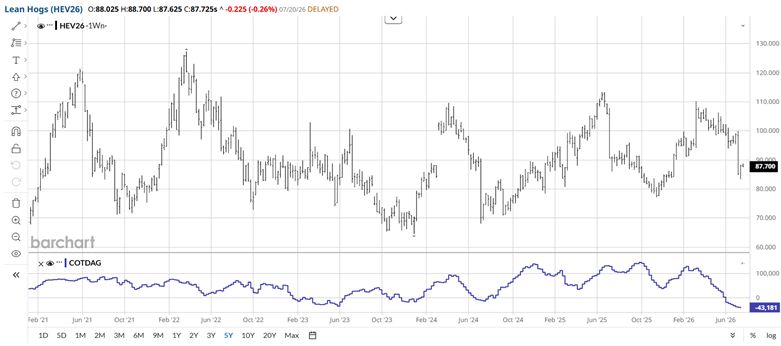
Commitment of Traders (COT) Report
Source: Barchart
The COT report shows that managed money (blue line) has more short positions than at any time in the past five years. This can be a bearish and bullish pattern simultaneously. The short positions have been built over several months, showing the resilience of the bearish sentiment. The danger of having such an enormous short position is that at any moment, if an event causes the cash market to rise, there will be more short positions that may need to be liquidated. This could cause a knee-jerk price rally. But for now, sentiment is bearish.
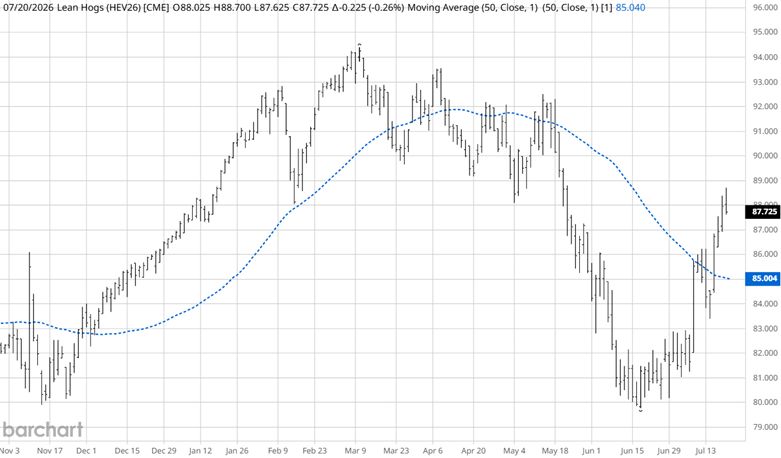
Technical Picture
Source: Barchart
The recent rally initially paused at the down-sloping 50 simple moving average (SMA), but has since traded beyond it. As a trend follower, I would be nervous about being short hogs too quickly. There is still time for the optimal seasonal sell window to open; perhaps we will see clearer signs of weakness before then. The 50 SMA is still sloped down, but a turn up might create some more short covering in the hog market.
Seasonal Pattern
Source: Moore Research Center, Inc. (MRCI)
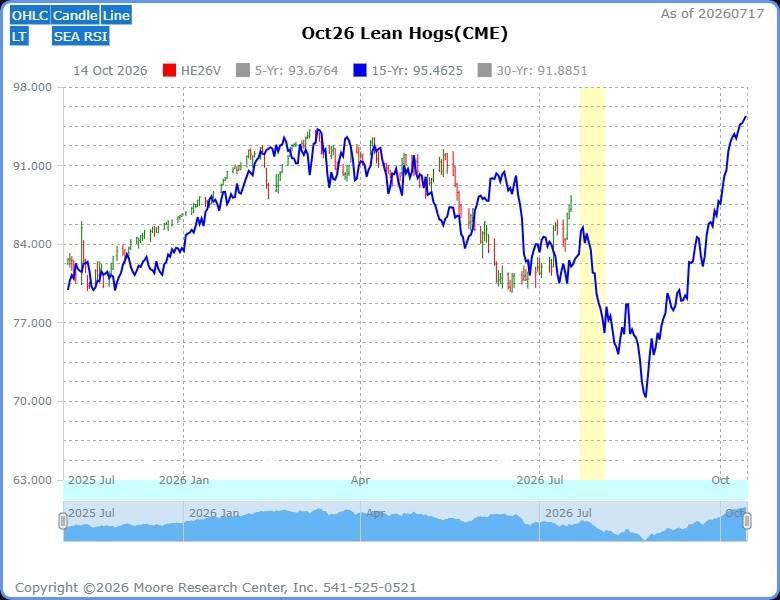
The 15-year seasonal pattern (blue line), identified by MRCI, shows lean hog prices peaking in late May to early April, and this year, the pattern has held. The upcoming seasonal sell has been a significant price decline, based on the 15-year seasonal pattern. Selling into strength may put a trader in harm's way; a more reserved strategy might be to wait for confirmation of some weakness before entering this trade.
Through hypothetical testing, MRCI has found that October lean hog futures closed lower (yellow window) on August 03 than on July 22 in 14 of the past 15 years, a 93% occurrence. During this period, the average profit per contract was $1,039.20, with one losing trade of $240.
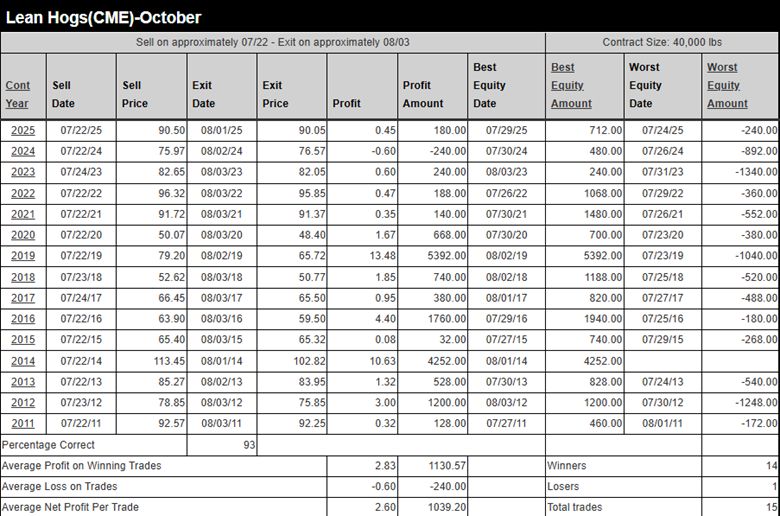
Source: MRCI
As a crucial reminder, while seasonal patterns can provide valuable insights, they should not be the basis for trading decisions. Traders must consider technical and fundamental indicators, risk management strategies, and market conditions to make informed, balanced trading decisions.
Assets to Trade: Lean Hogs
Futures traders can trade the standard-size 40,000-pound futures contract using the symbol (HE). Options on the futures contract can also be traded. This is a cash-settled contract, so there's no worry about physical delivery. There are no lean hog equity market products to trade. Two exchange-traded funds (ETFs) hold lean hog futures contracts; they are considered commodity index funds, not just lean hog-focused funds. These products are the Invesco DBA and DBC ETFs.
In Closing…
The October lean hog market is entering one of its most historically reliable seasonal windows, but history alone is never enough to justify a trade. The combination of softening post-summer demand, expanding hog supplies, persistent bearish fund positioning, and a seasonal pattern that has produced lower prices in 14 of the past 15 years creates a compelling setup worth watching. At the same time, the recent strength above the declining 50-day moving average serves as a reminder that patience can be just as valuable as timing. Rather than anticipating the move, traders may be better served by waiting for technical confirmation that sellers have regained control. If the seasonal pattern begins to align with both the technical and fundamental picture, the coming weeks could present one of the more attractive short-side opportunities in the lean hog market this year.
On the date of publication, Don Dawson did not have (either directly or indirectly) positions in any of the securities mentioned in this article. All information and data in this article is solely for informational purposes. For more information please view the Barchart Disclosure Policy here.
More news from Barchart
Could Lean Hogs Be the Next Big Opportunity? There’s a Trainwreck Happening in Cattle Prices. Here’s What You Need to Watch This Week. The Cattle Conundrum Cattle Prices Are Trapped in Downtrends as Energy Prices Spike on U.S.-Iran Volatility