


Chinese holographic company MicroCloud Hologram (HOLO) recently revealed that it has acquired 140,268 shares of the world's largest Bitcoin (BTCUSD) treasury, Strategy (MSTR) (formerly MicroStrategy). The investment, valued at about $16 million, is MicroCloud's first in Strategy. The company cited Strategy's prominent portfolio of Bitcoin-related assets as the rationale for the investment, as it looks to continue to grow its overall digital asset footprint.
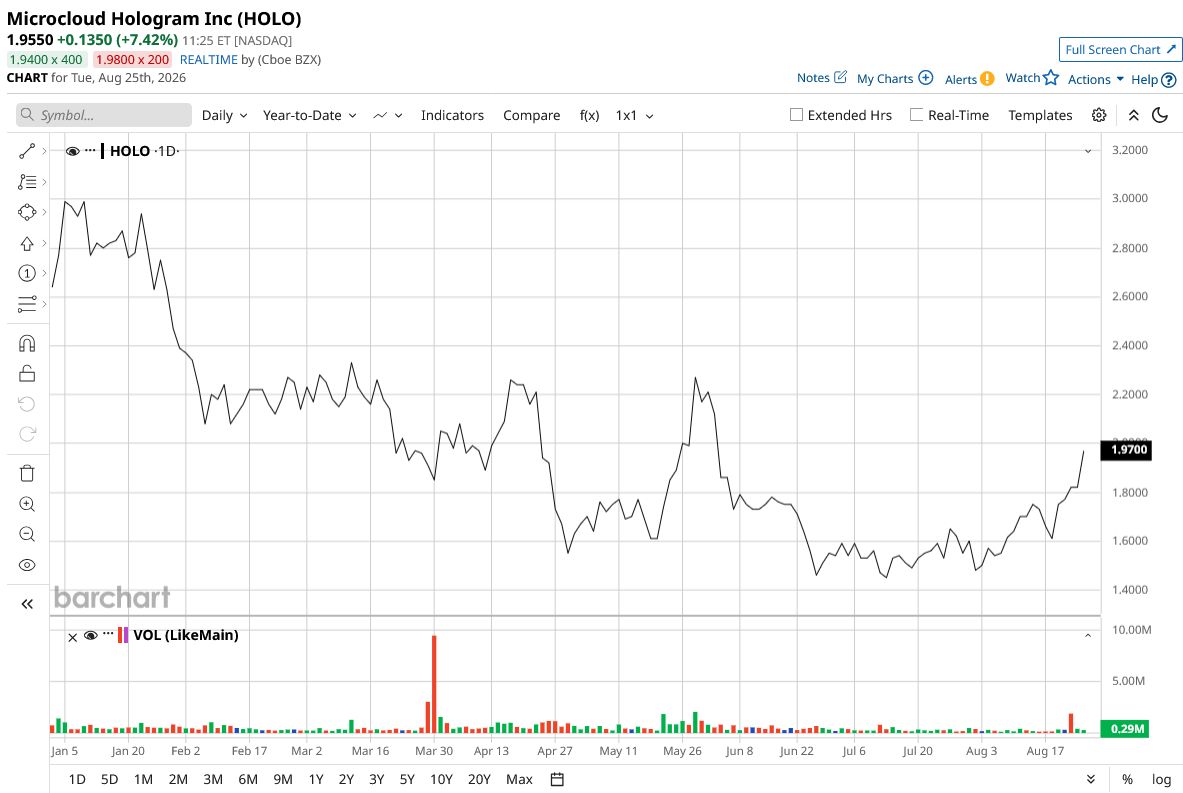
The market reacted positively to the news, as shares of HOLO ended about 3% higher in Friday's trading session and are up over 7% today. However, on a year-to-date (YTD) basis, it is down 27% and about 57% over the past year. Why? This can be attributed to the lack of clarity on where its core business truly lies.
Join 200K+ Subscribers: Find out why the midday Barchart Brief newsletter is a must-read for thousands daily.
 www.barchart.com
 MicroCloud's Confused Identity
In just about a dozen years (the company was founded in 2014), MicroCloud Hologram has dabbled in several businesses, ranging from holography to quantum computing. In between, it is also building a portfolio of financial assets, of which the latest Strategy investment was a part. The company is headquartered in China, yet the holding company is listed in the Cayman Islands.
Currently, the company reports two operating business segments, and both are related to holograms, its traditional business, which includes holographic LiDAR, LiDAR point-cloud algorithm structure, holographic imaging, LIDAR sensor-chip design, and holographic cloud algorithms, among others. Customer concentration risk remains a core issue of this supposedly core business of the company, with close to half of the revenues coming from the five largest customers, and the largest customer accounting for about one-fifth.
Then, in late 2025, the company announced its foray into quantum computing with R&D investments in quantum synchronization technology, quantum-enhanced big-data computing, quantum-driven 3D models, and FPGA-based quantum simulation. This gained momentum in 2026, with the most noteworthy development being the company's claim that its proprietary technology could reduce quantum circuit depth by more than 50% versus exact state loading in certain applications. Concurrently, MicroCloud also announced planned investments of about $400 million in blockchain, quantum computing, and adjacent technologies.
Crucially, question marks hang over the financials of MicroCloud as its disclosures for the fiscal year ended Dec. 31, 2025, continued to flag risks and ongoing concerns regarding internal controls over financial reporting, a lack of sufficient dedicated US-GAAP accounting personnel, and complex technical accounting requirements.
Losses Add to Woes
Unsurprisingly, MicroCloud Hologram is an unprofitable company. And from the way it is going about its business, it will be a long, windy road towards it.
According to its latest available results for the year ended Dec. 31, 2025, total revenues for the year were RMB 403.7 million. This denoted a growth of 39.1% from the previous year, which is decent enough. Notably, all the revenues were from the holographic segment. However, the company continued to report losses, although they narrowed to RMB 50.2 million from RMB 64.2 million in the year-ago period.
Further, the total number of customers declined to 128 from 142, with the more worrying aspect being that high-paying customers remained stagnant at 69, and the customer retention rate within this cohort fell to 41% from 43%. High-paying customers are generally high-margin ones, and their growth/retention is imperative for the sustainable growth of the business, and MicroCloud is falling short on this front.
However, some positivity emanates from its cash flows. Net cash from operating activities for the year ended Dec. 31, 2025, was RMB 56.4 million. This compares favorably to an outflow of RMB 98.6 million reported in 2024. Overall, MicroCloud ended 2025 with a cash balance of RMB 1.8 billion, with no material short-term debt on its books.
In terms of market cap, HOLO's is currently at $26.5 million.
Final Take
MicroCloud has to get its act right and identify where it will direct its efforts. It cannot be a holographic company, a digital assets company, and a quantum computing company at the same time. Even if it tries to juggle all this, prudent capital allocation will be an issue, considering the company's revelation that it cannot comply with its books with the accounting rules in the U.S.
Here, MicroCloud can take inspiration from its newly turned investee company: Strategy. Strategy has successfully pivoted from being a software company to being the world's largest holder of Bitcoin. The people at the helm were clear in their belief that Bitcoin would be at the center of the financial world in the future, and owning it would make Strategy one of the most strategically important companies in the world.
The success or failure of this strategy (pun intended) is up for debate, and its results would only be seen in the future. Yet, the management has conviction and is working towards it. That is certainly not the case at MicroCloud now, and the sooner this is resolved, the better it will be for the company.
On the date of publication, Pathikrit Bose did not have (either directly or indirectly) positions in any of the securities mentioned in this article. All information and data in this article is solely for informational purposes. For more information please view the Barchart Disclosure Policy here.
More news from Barchart
MicroCloud Hologram Invests $15.8 Million in Strategy Shares. What This Means for HOLO Stock. Duquesne Entered a New Position in Riot Platforms During Q2. What This Means for RIOT Stock. MSTR Stock Leads Crypto Stocks Higher as Bitcoin Passes $71K A $350 Million Reason to Buy HIVE Digital Technologies Stock