


The quantum computing sector continues to evolve, with companies still trying to overcome technical and commercial hurdles. Amid the challenges, D-Wave Quantum (QBTS) and Rigetti Computing (RGTI) have just received an important vote of confidence from the U.S. government. Both companies have secured as much as $100 million each through the CHIPS and Science Act, in deals that give the Department of Commerce a minority ownership position without control over either company.
With access to significant capital to advance their quantum-computing ambitions, the question now is what each company can actually do with this money. And that is where the case for D-Wave looks more intriguing.
More Top Stocks Daily: Go behind Wall Street’s hottest headlines with Barchart’s Active Investor newsletter.
Rigetti Has A Big Technical Challenge To Solve
Rigetti plans to use its $100 million award to tackle some of the biggest scaling problems facing superconducting quantum computers. Its projects include shrinking readout electronics, expanding cryogenic capacity and developing manufacturing capabilities for higher-connectivity chip architectures. These projects will eventually help Rigetti build larger and more useful quantum systems. However, all this relies on the company successfully overcoming technical bottlenecks that sit further along the commercialization curve.
This is exactly where D-Wave has an advantage.
D-Wave could Accelerate Its Commercial Opportunity
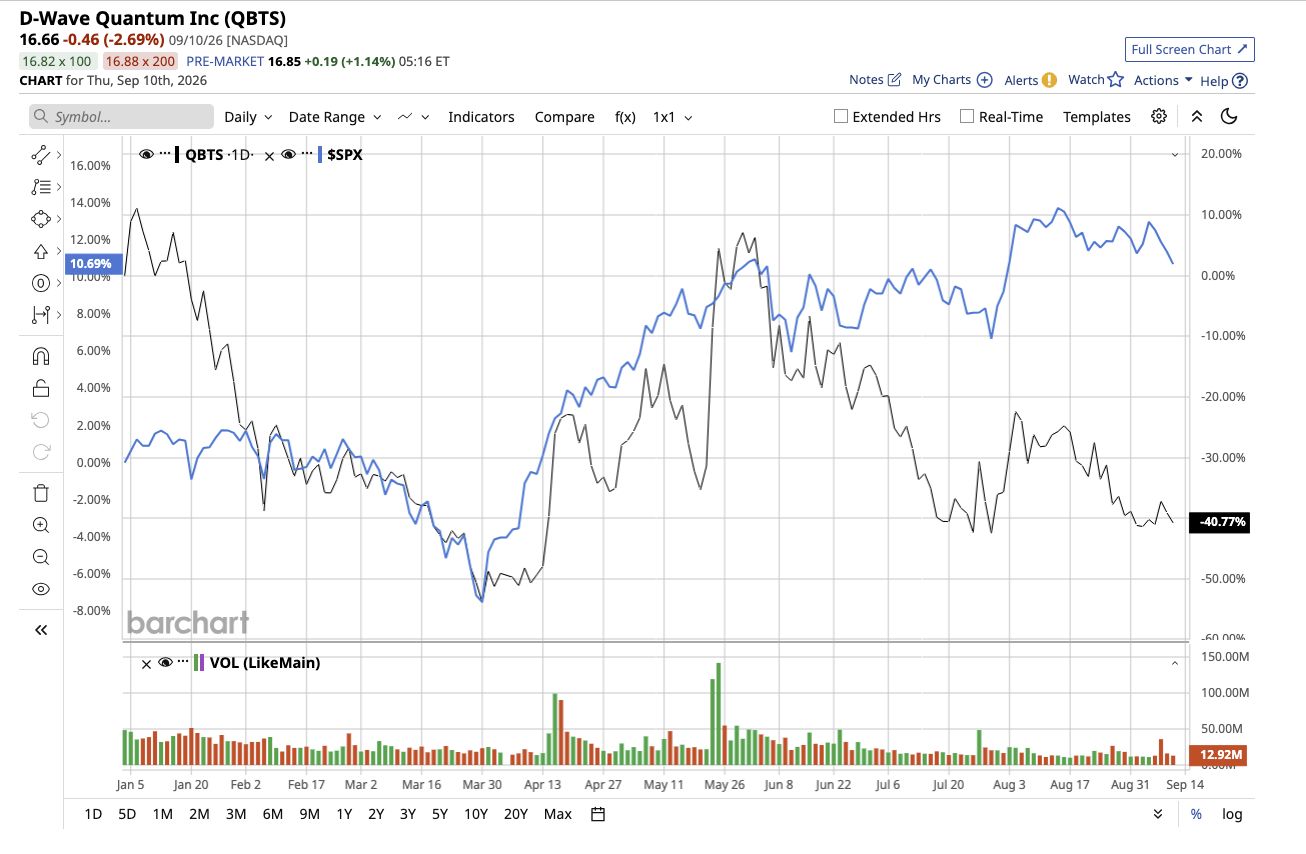
Specifically, D-Wave enters this new funding cycle with a growing base of customers already putting its technology into production. In the second quarter, commercial enterprises generated 62.4% of D-Wave's revenue, out of which companies in the Forbes Global 2000 accounted for 47.7%. This suggests that D-Wave is increasingly expanding into larger businesses with possibly much larger application needs.
 www.barchart.com
 Q2 revenue came in at $3.1 million, unchanged from the year-ago quarter. However, bookings climbed 59% year over year (YOY) to $2.1 million, while the average booking size increased more than 87%. D-Wave's bookings reached $35.5 million in the first six months of the year, a sharp increase from the same period last year, largely reflecting a $20 million system deal with Florida Atlantic University. The company is signing larger commitments that can be converted into revenue over time. Its remaining performance obligations (or RPO) reached $40.7 million, up 668% from a year earlier, with 57% expected to be recognized as revenue within the following 12 months.
This is where the funding comes in. D-Wave can use the additional capital to improve its technology while its existing backlog and customer commitments generate revenue. This plan will allow the company to advance both its technological and commercial position.
What’s more, the Department of Commerce funding will support research and development across D-Wave's annealing and gate-model superconducting systems. This is significant since D-Wave now has a commercial annealing business, with clients utilizing its technology for production applications, while its gate-model platform is still in development. The company’s commercial pipeline is also growing. Management stated that the sales pipeline rose by 120% between the end of 2025 and June 30, 2026. D-Wave aims to provide two to three annealing systems per year, with each potentially generating $20 million to $40 million. The funding could therefore speed up the process without burdening the balance sheet.
Why D-Wave Has The Better Advantage From The Deal
Rigetti and D-Wave have essentially received the same funding. Rigetti is using the money to attack critical scaling challenges. Meanwhile, D-Wave can use this money to advance its technology while having commercial customers, production applications, a growing cloud business, a large increase in bookings, and a rapidly expanding sales pipeline. This difference suggests D-Wave has the better advantage from the deal. It could strengthen the company's position in the quantum computing race.
That said, none of this means D-Wave is a low-risk quantum computing investment. The company remains deeply unprofitable. In the second quarter, adjusted EBITDA loss widened to $37.1 million from $20 million a year earlier. The company had $546.2 million in cash and marketable securities at the end of June, mostly due to the $250 million cash from the Quantum Circuits acquisition.
Does This Deal Make D-Wave a Buy-Now Stock?
The bullish case for D-Wave rests on the sharp improvement in bookings, a $40.7 million backlog, growing commercial adoption, and rising production use of its quantum cloud platform. Although the $100 million government award strengthens D-Wave’s long-term case, the stock is still expensive relative to current revenue growth, and the company remains unprofitable.
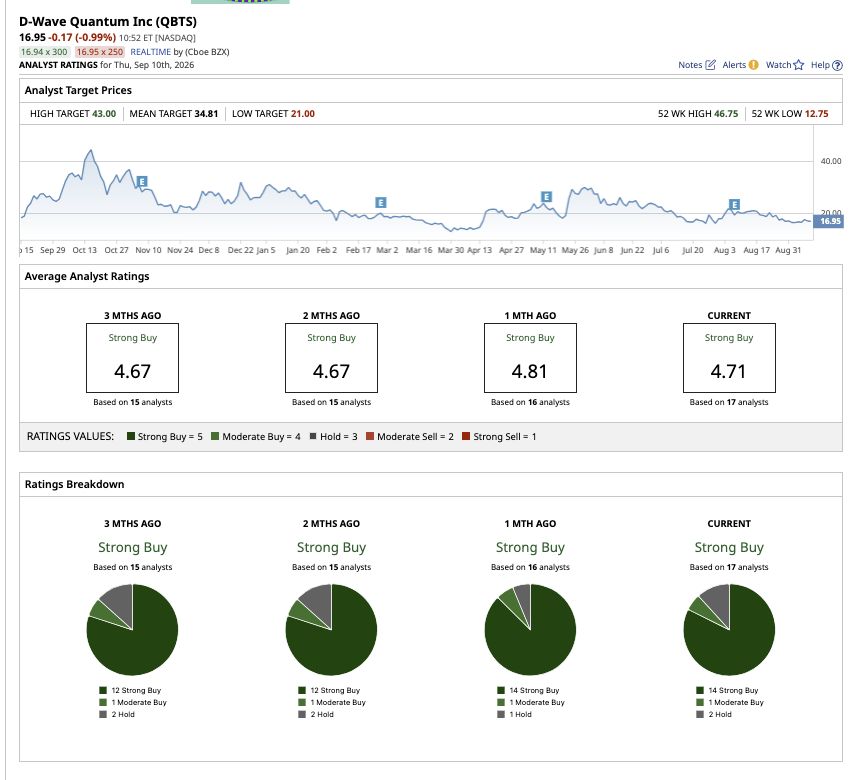
On Wall Street, while QBTS stock is a consensus “Strong Buy” it remains a high-risk, long-term bet for investors who can tolerate very high volatility.
Of the 17 analysts covering the stock, 14 rate it a “Strong Buy,” one recommends a “ Moderate Buy,” and two say it is a “Hold.” The average target price of $34.81 implies the stock can climb 105% from current levels. The most bullish estimate of $43 suggests an upside potential of 153% over the next 12 months.
 www.barchart.com
 On the date of publication, Sushree Mohanty did not have (either directly or indirectly) positions in any of the securities mentioned in this article. All information and data in this article is solely for informational purposes. For more information please view the Barchart Disclosure Policy here.
More news from Barchart
Rigetti and D-Wave Just Got $100 Million Each. 1 Quantum Stock Has More Upside From Here. Palantir Stock Remains Attractive Even After a 50% Rally in August 3 Tech Stocks Grew Their Dividends Up to 212% in 5 Years Without Breaking a Sweat SWKS Stock Just Hit a New 52-Week High. What Comes Next.