

UnitedHealth Group Incorporated (UNH) is one of America’s healthcare heavyweights, spanning health insurance through UnitedHealthcare and healthcare services through Optum. Its stock, however, has been volatile in 2026. After gaining impressively over the past six months, helped by quarterly earnings reports, bullish analyst upgrades, and management’s claim that its $3 billion AI investment is already paying off, enthusiasm has cooled since July.
Now, UnitedHealth is providing investors another date to circle—Oct. 1. That’s when UnitedHealthcare plans to eliminate prior authorization requirements for 1,700 medical services across most commercial, Medicare Advantage, community, and individual-exchange plans. The move builds on its commitment to cut prior authorization requirements by 30% this year and aligns with an industry effort to simplify a process long criticized for delaying patient care.
More Top Stocks Daily: Go behind Wall Street’s hottest headlines with Barchart’s Active Investor newsletter.
For patients, fewer forms and faster decisions sound like an easy win. For investors, though, there’s another side to the story. UnitedHealthcare generated $86 billion in Q2 revenue but only $3.9 billion in operating profit, or a 4.6% margin, leaving little room for costs to creep higher if easier approvals drive utilization.
So, as Oct. 1 approaches, the question is whether less bureaucracy can also mean a more efficient and profitable UnitedHealth. Let’s take a closer look at UNH stock and what this change could mean for investors.
About UnitedHealth Stock
Founded in 1974 and headquartered in Minnesota, UnitedHealth is one of the largest healthcare organizations in the United States, combining insurance expertise with a broad healthcare services platform. The company has built a diversified business model that spans coverage, clinical services, pharmacy solutions, healthcare analytics, and technology.
Its scale gives it a significant presence across the healthcare ecosystem, connecting patients, physicians, employers, and public sector programs. UnitedHealth continues to invest in technology, data capabilities, and care models designed to improve how healthcare is delivered and managed. With its broad operating footprint and diverse revenue streams, the company remains a closely watched name among healthcare investors. Its market capitalization currently stands at about $359.8 billion.
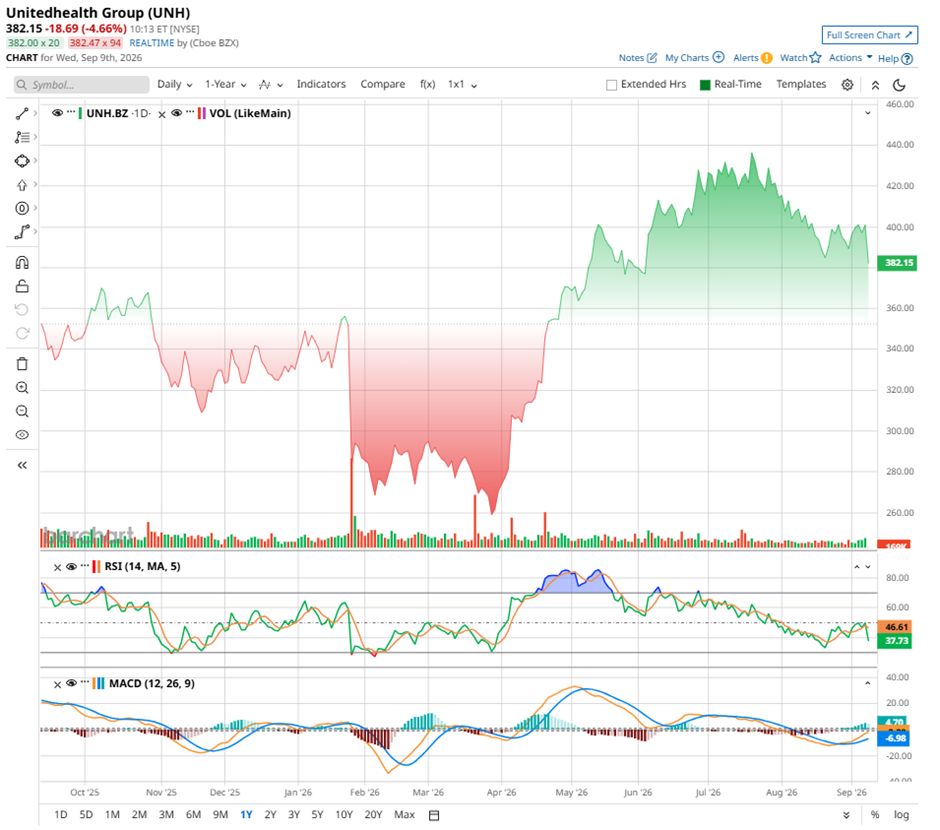
If we look at UNH’s price action this year, it is pretty clear that investors have been slowly coming back around to the stock. The recovery has been anything but boring, though. UnitedHealth’s shares have gained 19% on a year-to-date (YTD) basis and are up 34.7% over the past six months. Over the past 52 weeks, the stock is up 13%, while the rebound from its March low of $255.96 has been an impressive 53%.
A big part of that comeback showed up in July. After UnitedHealth reported its second-quarter results on July 16, the stock jumped to $461.62, its highest level in about a year. Investors liked that its earnings came in ahead of expectations, management raised its full-year guidance, and the company announced plans to buy back at least $5 billion worth of stock. For a company that had spent months trying to rebuild investor confidence, that was a pretty solid message.
But UNH has not exactly kept its foot on the gas since then. The stock has pulled back 15% from that July peak, showing that investors are still keeping one eyebrow raised.
More recently, the mood around UNH has turned a bit cautious. At the Wells Fargo 21st Annual Healthcare Conference, management said the turnaround is moving in the right direction, pointing to better Medicare Advantage performance, a steadier Medicaid outlook, and growing use of automation and AI to bring costs down.
Still, it was not all roses. Pressure in parts of the commercial business, ongoing work at Optum Health and Optum Insight, and higher medical costs—including out-of-network arbitration expenses—reminded investors that the recovery still has some hurdles. That caution has weighed on managed-care stocks, with UNH now trading below $400.
 www.barchart.com
 At this point, UNH’s valuation is starting to look pretty interesting. The stock trades at about 21.7 times forward earnings and just 0.81 times forward sales, putting it comfortably below both sector medians and its own five-year averages.
And then there is the dividend, which adds another layer to the investment case. In August, UnitedHealth declared a quarterly payout of $2.32 per share. The company has raised its dividend for 16 consecutive years and has paid one for 24 straight years. With an annual yield of 2.32%, more than twice S&P 500 SPDR’s ($SPX) 0.98% yield, that steady income stream could give investors a little extra cushion while they wait for the turnaround to fully play out.
A Closer Look at UnitedHealth's Q2 Results
UnitedHealth’s second-quarter numbers were solid, with the company comfortably beating Wall Street’s expectations and showing better control over medical costs.
For the quarter, UnitedHealth generated $112 billion in revenue, slightly ahead of the $111.6 billion reported a year earlier. Adjusted EPS jumped to $6.38 from $4.08, helped by tighter medical cost management, disciplined pricing, and stronger execution across both UnitedHealthcare and Optum.
The improvement was particularly visible in healthcare costs. UnitedHealth’s Q2 premiums totaled $87 billion, while its medical care ratio improved to 86.7% from 89.4% a year ago. Medical costs fell to $75.4 billion from $78.6 billion, suggesting that lower utilization and better cost controls are beginning to work in the company’s favor.
There were some softer spots, though. Growth in commercial fee-based membership and strong performance at Optum Insight helped the quarter, while weakness in Optum Health and Optum Rx, along with declining risk-based membership, kept the results from being a clean sweep. UnitedHealthcare served 48.5 million people as of June 30.
Optum generated $65.7 billion in revenue, with adjusted earnings from operations reaching $4 billion. Its adjusted operating margin also improved meaningfully to 6.1% from 4.6%. At the group level, earnings from operations surged 53.8% year-over-year (YoY) to $8 billion.
UnitedHealth ended the quarter with $31.5 billion in cash and short-term investments. Operating cash flow reached $20 billion in the first half of 2026, up sharply from $12.6 billion a year earlier. The company paid $4.1 billion in dividends during the first half and had repurchased $4 billion of stock through mid-July.
Management raised its 2026 outlook. Adjusted EPS is now expected to be between $19.50 and $20.00. The full-year medical care ratio is projected to be around 88.1%, plus or minus 25 basis points, and operating cash flow is estimated to be $24 billion.
For 2026, the company expects at least $5 billion in share repurchases, $8 billion in dividends, and $3.8 billion in capital expenditures. Revenue is still expected to exceed $439 billion.
Analysts tracking the company predict EPS to be $19.82 for fiscal 2026, a 21.2% YoY growth, and then rise by another 13.7% to $22.54 in fiscal 2027.
What Do Analysts Expect for UNH Stock?
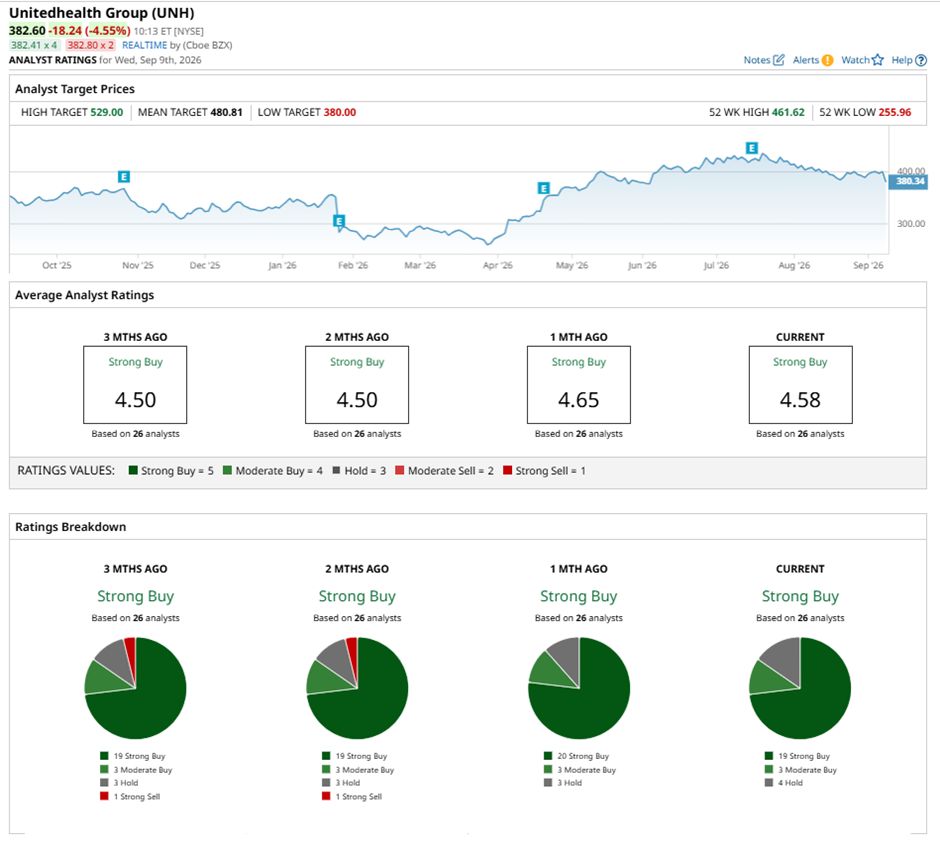
UNH has a “Strong Buy” consensus overall, reflecting broadly favorable sentiment toward the stock’s outlook. Of the 26 analysts covering UNH stock, 19 advise a “Strong Buy,” three suggest a “Moderate Buy,” and four analysts are playing it safe with a “Hold.”
The mean price target of $480.81 implies the stock could rise as much as 25%. The Street-high target of $529 signals that UNH has an upside potential of 38%.
 www.barchart.com
 Final Thoughts on UNH Stock
UnitedHealth’s decision to remove prior authorization requirements could be a win for patients and potentially a test for investors. Fewer approval hurdles may mean faster care and lower administrative friction, but if easier access also drives utilization higher, medical costs could get a little less cooperative. That’s the catch.
For UNH shareholders, the stock’s rebound and improving earnings picture are encouraging, but the recent pullback shows Wall Street still wants proof. With stronger guidance, buybacks, and a solid dividend in the mix, there is plenty to like. Whether UnitedHealth can keep this momentum going remains to be seen. For now, investors want to see real results.
On the date of publication, Sristi Suman Jayaswal did not have (either directly or indirectly) positions in any of the securities mentioned in this article. All information and data in this article is solely for informational purposes. For more information please view the Barchart Disclosure Policy here.
More news from Barchart
Dear UnitedHealth Stock Fans, Mark Your Calendars for October 1 Foxconn Just Delivered a Major Bullish Signal for Nvidia Stock Why AMD Stock Forecast Has Room to Run ‘Not a Marketing Stunt’ — Ex-OpenAI and Anthropic Researcher Who Quit Explains Why They Keep Building AI That ‘Could Kill Us All’ Within 10 Years