

Mizuho has identified four clear tailwinds for Intel (INTC): ongoing CPU supply shortages, a stronger PC refresh cycle, accelerating demand for agentic AI, and growth in advanced packaging. Normally, such a setup would provide a reason to raise a price target. Instead, the firm cut its price target from $109 to $92, citing short-term multiple compression across Agentic AI stocks, and maintained a “Neutral” rating. The contradiction becomes more important because Intel’s re-rating still depends on a foundry turnaround that has yet to prove itself.
Real Tailwinds, but Still a Lower Target
Mizuho remains cautious on INTC stock despite outlining four separate tailwinds that could support the company’s growth. The firm lowered its price target from $109 to $92 on Sept. 3, pointing to short-term multiple compression across agentic AI companies while keeping its “Neutral” rating unchanged. Mizuho analyst Vijay Rakesh highlighted four developments that could support Intel’s outlook. According to the analyst, accelerating agentic AI demand could improve CPU-to-GPU ratios and drive additional server refreshers. Ongoing CPU supply constraints could also leave the company unable to fully meet demand through 2027. In addition, advanced packaging revenue is expected to reach $3.5 billion by 2029, with external foundry revenue potentially reaching a similar level through the 14A node. Finally, a stronger PC cycle could extend the upgrade cycle as corporate refreshes combine with ongoing memory tightness.
More Top Stocks Daily: Go behind Wall Street’s hottest headlines with Barchart’s Active Investor newsletter.
About Intel Stock
Intel designs, develops, manufactures, and sells computing-related products, especially its well-known CPUs. The company has become a household name in personal computing, though it has a significant foothold in the enterprise market as well. Most recently, the firm has become a focal point due to the AI race, attracting investment even from the U.S. government. It is headquartered in Santa Clara, California.
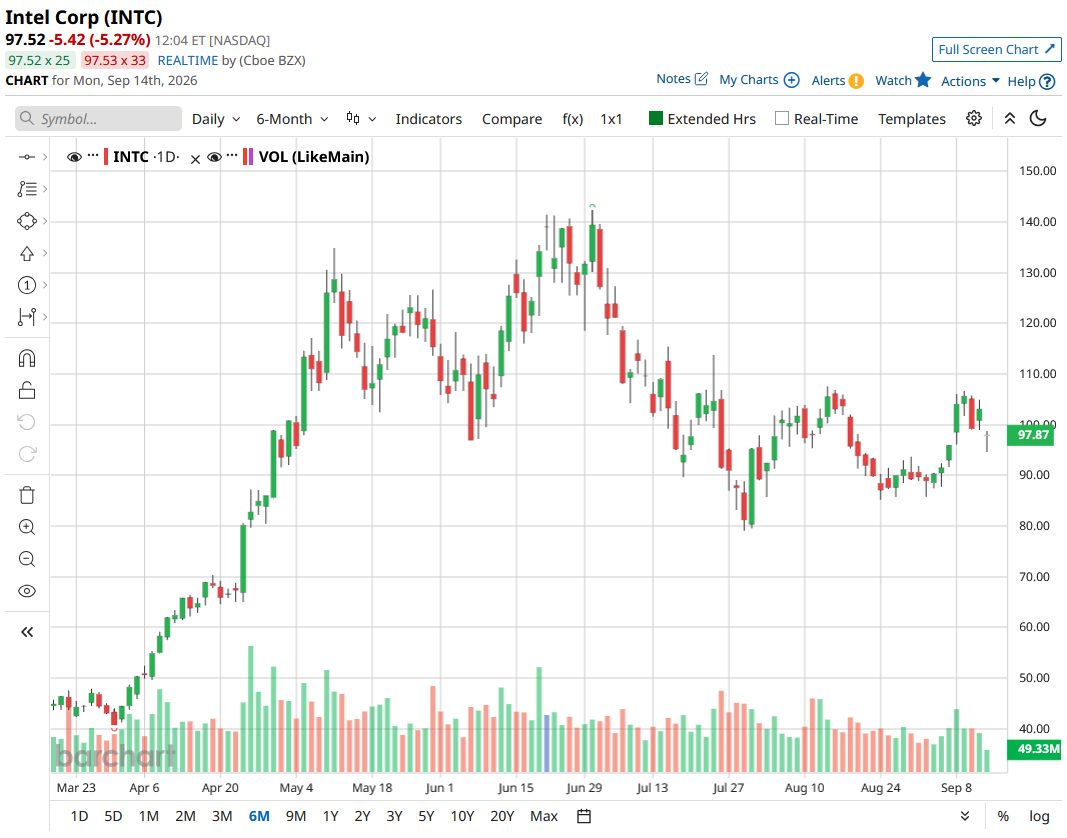
Intel's stock is up nearly 300% over the last 12 months, and a lot of that has to do with the increasing U.S. government interest in seeing the firm succeed. That’s not to say the company isn’t doing a good job, with its 18A processor expected to turn around the company’s fortunes. The company is riding the AI boom, with its closest competitor, Advanced Micro Devices (AMD), also gaining 200% over the same period. I previously covered how these two companies continue to threaten each other, a battle they've been fighting for decades.
 www.barchart.com
A Valuation That Leaves Little Room for Error
Intel’s external foundry opportunity is still at an early stage. Nvidia’s (NVDA) engagement with Intel on advanced nodes remains in the early discussion stage, and potential partnerships with OpenAI and Microsoft are still unconfirmed. The transition to new nodes also carries meaningful yield and execution risks once Intel attempts to produce at a high-volume scale. Those risks matter more after the stock rallies around 180% this year, with shares now trading at nearly 50x 2027 earnings. With expectations already elevated, even a small disappointment could pressure the stock, which is precisely what Mizuho’s price target cut reflects.
Intel’s demand outlook looks credible, but the higher-end estimates still rely on foundry commitments and yield improvements that have yet to be proven at scale. That likely helps explain the lower price target despite the list of bullish tailwinds.
AI Demand Drives Intel’s Fastest Growth Since 2011
Intel reported its second-quarter 2026 results on July 23, blowing past Wall Street on both key metrics. Revenue of $16.1 billion rose about 25% year-over-year (YoY), well ahead of the $14.4 billion analysts expected. This was its fastest growth since 2011. Adjusted EPS of $0.42 also comfortably beat the $0.21 estimate. The Data Center and AI segment led the way, up 59% to $6.3 billion, with AI-driven businesses now roughly 70% of revenue. It was Intel’s seventh straight quarter of beating its own guidance.
For the third quarter, Intel guided revenue to a $15.8 billion to $16.8 billion range and adjusted EPS of $0.38, both above consensus. CFO Dave Zinsner said the company is supply constrained, with data center demand exceeding what it can produce. Intel also pointed to long-term supply deals it is signing with customers, locking in pricing and volume as it works to keep pace with the AI buildout.
What Are Analysts Saying About INTC Stock?
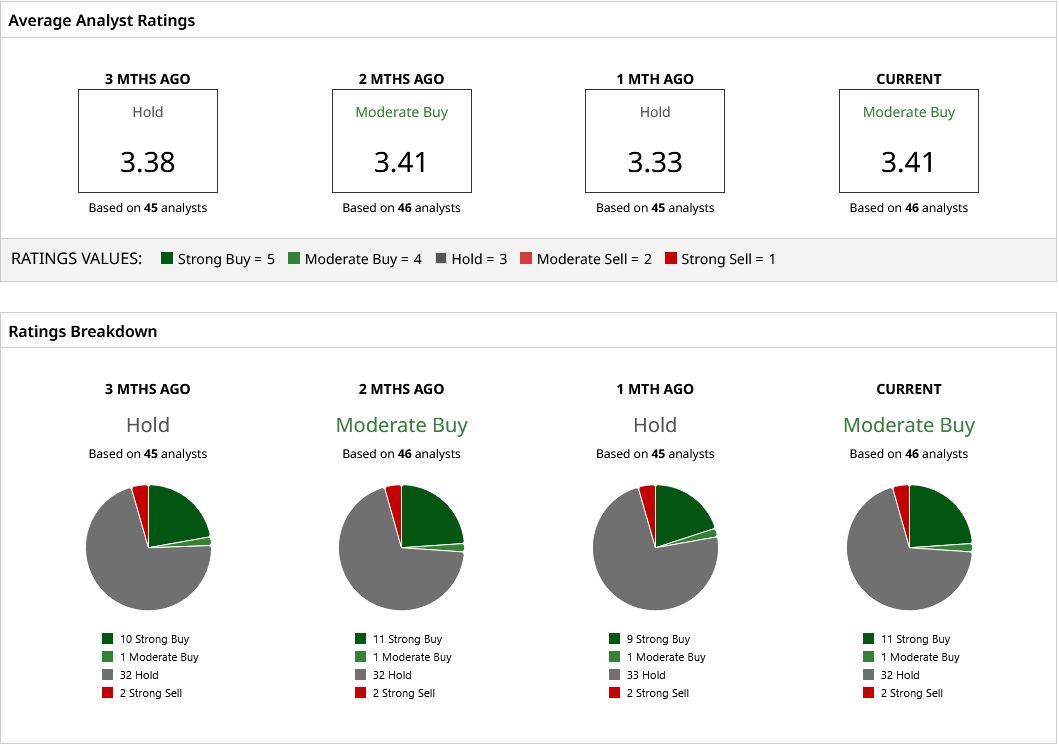
Despite the stock price retracing, INTC continues to trade at a lofty valuation, which is understandable considering its important position in the AI race. According to ratings from 46 different Wall Street analysts, the stock has a mean target price of $113.90, which suggests 17% upside from here. These targets would easily be revised upwards as soon as the company can manufacture the 18A process node at scale.
 www.barchart.com
 On the date of publication, Jabran Kundi did not have (either directly or indirectly) positions in any of the securities mentioned in this article. All information and data in this article is solely for informational purposes. For more information please view the Barchart Disclosure Policy here.
More news from Barchart
A $100 Million Reason to Buy AVAV Stock This Retail Stock’s Post-Earnings Pop Is a Good Speculative Bet on a 2027-28 Payoff Why UBS Just Turned Bearish on NuScale Power Stock Intel Has 4 Major Tailwinds According to This Wall Street Analyst, Yet 1 Red Flag Caused a Price Target Cut