

For an aerospace and defense company, having a lot of orders is one thing. Knowing that those orders can stretch years into the future is where the real value lies. That is what makes RTX's (RTX) roughly $289 billion backlog as of June 2026 worth a closer look.
RTX Chairman and CEO Chris Calio recently highlighted the figure at Morgan Stanley’s annual Laguna Conference, noting that it does not include five major munitions framework agreements or the recently awarded seven-year, $22.9 billion Tomahawk contract.
More Top Stocks Daily: Go behind Wall Street’s hottest headlines with Barchart’s Active Investor newsletter.
In other words, there is still plenty of business outside that headline number. And the CEO is not just counting on more orders, but anticipates Collins Aerospace reaching 19% to 20% operating margins over the medium term, while RTX is targeting about $8.6 billion in free cash flow for 2026.
The backdrop is also working in RTX’s favor. Airlines continue to need more fuel-efficient aircraft and aftermarket support, while governments around the world are increasing defense spending as geopolitical tensions reshape military priorities. About 48% of Raytheon’s backlog is now international, up four percentage points from a year earlier.
That mix gives RTX exposure to two long-term demand streams. So, the interesting question is no longer simply how large RTX’s backlog is. It is whether the company can steadily convert that mountain of orders into higher sales, stronger margins, and growing free cash flow, giving investors a reason to keep watching RTX stock.
About RTX Stock
Arlington, Virginia-based RTX is a major aerospace and defense company serving commercial aviation, governments, and military customers around the world. Created in 2020 through the merger of Raytheon and United Technologies, RTX operates through three core businesses: Collins Aerospace, Pratt & Whitney, and Raytheon. Together, they cover everything from aircraft engines and avionics to missile systems, sensors, and integrated defense technologies.
With a market capitalization of about $263.5 billion, RTX has a broad presence across both the aerospace and defense markets. The company focuses on advancing aviation, strengthening defense capabilities, and developing next-generation technologies and manufacturing solutions. Its scale and diversified portfolio allow RTX to address complex requirements across air travel, national security, and other critical aerospace applications.
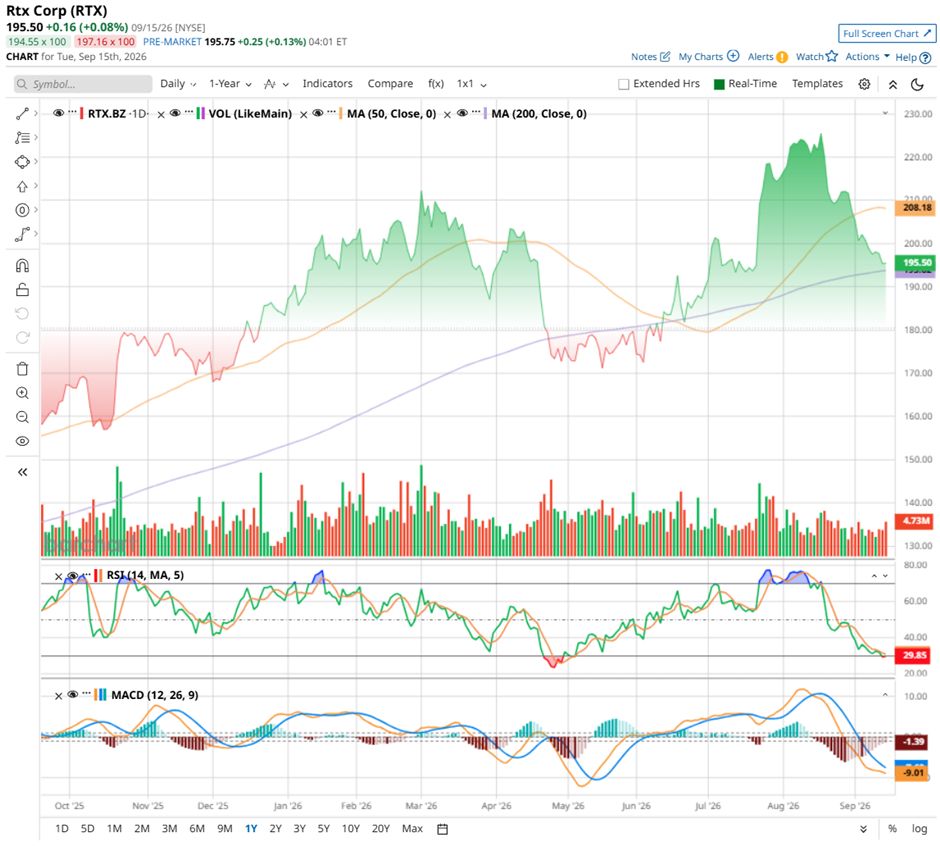
RTX stock has seen its strong summer rally lose some steam. Shares climbed to a high of $226.88 on August 10, only to give back a sizable chunk of those gains since then. The stock is now about 13.8% below that peak and has slipped 12.3% over the past month. Still, zoom out, and the picture looks considerably different. RTX remains up roughly 23.5% over the past 52 weeks and is up about 6.6% on a year-to-date (YTD) basis.
That longer-term strength has been supported by a combination of solid defense demand, improving earnings momentum, and higher global military spending. Investors have also increasingly viewed RTX as a beneficiary of the broader push to rebuild defense inventories. That came into focus again in August, when the company landed a $22.9 billion U.S. Navy contract to accelerate Tomahawk missile production, with annual output expected to exceed 1,000 missiles.
The recent pullback, however, has changed the technical picture. RTX is trading below its 50-day moving average, signaling that near-term momentum has weakened. Plus, the shares remain just above the 200-day moving average, which keeps the longer-term trend from looking as damaged as the recent sell-off might suggest.
Meanwhile, the 14-day RSI is around 30, right at the traditional oversold threshold, suggesting the recent selling has become fairly intense. Meanwhile, the MACD oscillator gives bearish signals, with the MACD line below the signal line. The negative red histogram bars reinforce that downward momentum is still in play rather than showing a clear reversal.
 www.barchart.com
 RTX’s valuation tells the story of a company sitting between two worlds. At roughly 27 times forward earnings, the stock commands a premium to defense-focused peers Lockheed Martin (LMT) and Northrop Grumman (NOC), at about 17.5 and 18.3 times, respectively, but remains below GE Aerospace’s (GE) roughly 38.8 times. That middle-ground multiple makes sense given RTX’s unusual blend of commercial aerospace and defense exposure, giving investors two distinct engines of growth.
A Snapshot of RTX's Q2 Report
RTX released its second-quarter results on July 23, giving investors plenty to like, and the numbers signal that demand is coming from both sides of the business. Revenue jumped 14.5% year over year (YOY) to $24.7 billion, beating expectations, while organic sales climbed 16%. Adjusted EPS rose 21.1% annually to $1.89, also ahead of analysts’ forecasts. The company ended the quarter with $289 billion in orders, up 22.5% YOY, giving the company a sizable cushion of future work.
The growth was broad-based. Commercial aftermarket revenue rose 18%, defense sales increased 16% organically, and commercial original-equipment sales grew 9%. RTX also secured $43 billion in new awards during the quarter, including nearly $20 billion at Raytheon. Of the $289 billion backlog, $170 billion came from commercial customers and $119 billion from defense, offering visibility across both aviation and military programs.
Collins Aerospace generated $8.2 billion in sales, up 8% annually on an adjusted basis and 13% organically. Commercial original-equipment sales jumped 26%, while aftermarket revenue increased 10% and defense sales rose 7%. Pratt & Whitney was even stronger, with sales up 16% to $8.89 billion and organic growth of 17%. Its commercial aftermarket business surged 25%, while military revenue climbed 23%; commercial original-equipment sales, however, fell 8% because of the engine mix.
Then there is Raytheon, the defense engine of the company. Sales climbed 18% to $8.3 billion, helped by higher volumes across land and air defense, naval programs, and air and space systems, including Patriot, Standard Missile, and AMRAAM programs.
RTX had $8.3 billion in cash at June 30, versus $7.4 billion at year-end 2025, while long-term debt declined to $31.9 billion from $34.3 billion. Operating cash flow jumped to $3.55 billion, compared with just $458 million a year earlier. After $669 million of capital spending, free cash flow reached nearly $2.9 billion, versus negative $72 million in the prior-year quarter.
That strength prompted RTX to raise its 2026 outlook. Adjusted sales are now expected at $95 billion to $96 billion, up from $92.5 billion to $93.5 billion, while organic growth is projected at 8% to 9%, compared with 5% to 6% range estimated previously. Adjusted EPS is expected to be between $7.10 and $7.25, and FCF at $8.50 billion to $8.75 billion.
Still, there is a wrinkle worth watching. More than half of the backlog sits within Collins and Pratt, meaning a large portion is tied to commercial aviation. With the Iran conflict disrupting energy markets and pushing fuel prices sharply higher, airlines could face pressure on costs and capacity. That does not erase RTX’s strong order book, but it adds a layer of uncertainty to the commercial side just as the defense business remains robust.
Analysts tracking RTX predict he company's EPS to be around $7.22 for fiscal 2026, up 14.8% YOY, before surging by another 7.5% annually to $7.76 in fiscal 2027.
What Do Analysts Expect for RTX Stock?
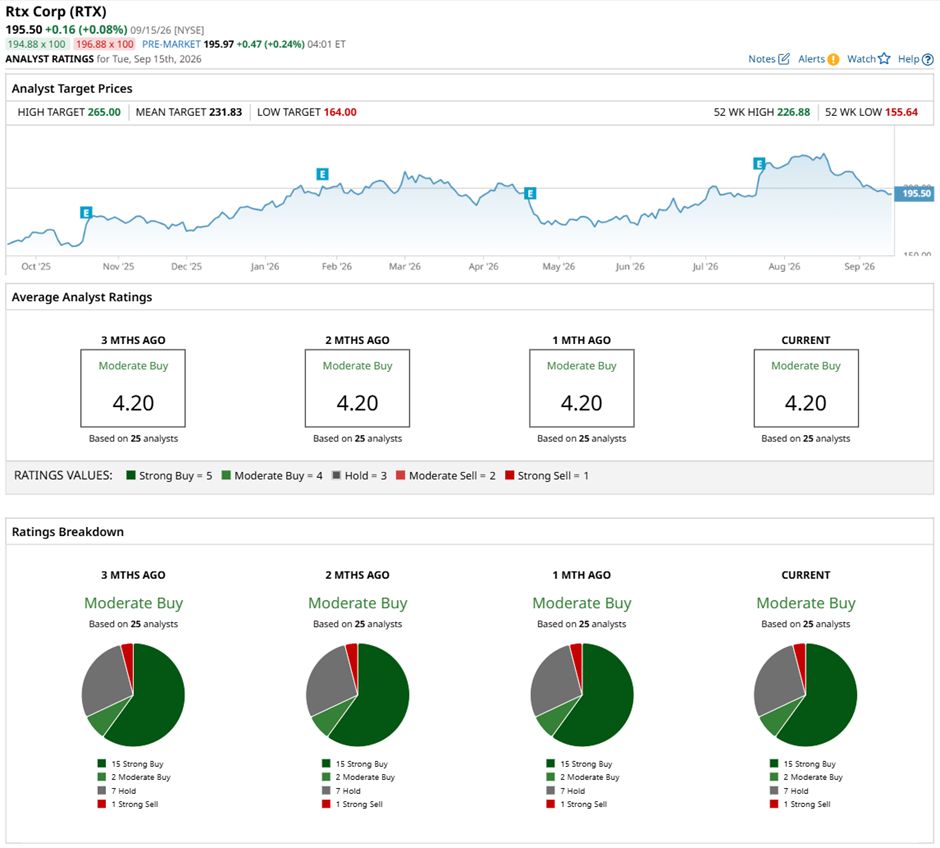
Overall, RTX has a consensus “Moderate Buy” rating. Of the 25 analysts covering the stock, 15 advise a “Strong Buy,” two suggest a “Moderate Buy,” seven analysts are on the sidelines giving it a “Hold” rating, and one recommends a “Strong Sell.”
The average analyst price target for RTX is $231.83, indicating potential upside of 18.6%. The Street-high target price of $265 suggests that the stock could rally 35.5%.
 www.barchart.com
 On the date of publication, Sristi Suman Jayaswal did not have (either directly or indirectly) positions in any of the securities mentioned in this article. All information and data in this article is solely for informational purposes. For more information please view the Barchart Disclosure Policy here.
More news from Barchart
Dear Amazon Stock Fans, Mark Your Calendars for October 6 With a Strong Product Pipeline, Tesla Stock Is Positioned for Growth Acceleration A $289 Billion Reason to Buy RTX Stock Dear Future Electra Therapeutics Stock Fans, Mark Your Calendars for Sept. 18