

SpaceX (SPCX) just gave investors a new reason to believe in its growth story. Speaking at a Goldman Sachs conference, CFO Bret Johnsen said he has gained even more conviction that the company can hit a $100 billion annual revenue run rate. The driver is a new deal to supply AI computing power to an unnamed customer. It’s worth $1.11 billion a month starting in December, or roughly $13 billion a year. That deal also supports a bigger shift. After absorbing xAI, Musk’s AI startup, in February, SpaceX now runs AI computing as a third business alongside Starlink and rockets. Its AI compute deals with Google (GOOGL) and Anthropic already bring in over $2 billion a month. On top of that, a $6.7 billion cloud-services agreement starts ramping in October. Johnsen even said this AI infrastructure can pay itself in under a year, thanks to contracts already locked in.
A Lift On September 21
There’s also a near-term boost coming. On September 21, SpaceX’s weighting in the Nasdaq-100 ($IUXX) is set to rise, likely from 1.25% to around 2.25%. The reason is that more than a billion shares have come off lock-up, lifting its free float to nearly 30%. J.P. Morgan estimates this forces index funds to buy about $15.5 billion of SpaceX stock. The stock has been flat lately, so this buying could give it a short-term lift.
More Top Stocks Daily: Go behind Wall Street’s hottest headlines with Barchart’s Active Investor newsletter.
SpaceX still needs to grow substantially before it can achieve the $100 billion milestone. It did $7.8 billion in revenue last quarter, or about $2.6 billion a month. To hit the target, that monthly figure needs to more than triple to around $8.3 billion. The index may lift the stock now, but the target still rests on these deals.
About SpaceX Stock
Space Exploration Technologies — commonly called SpaceX — designs, manufactures, launches, and operates products and services built on technologies, including rockets and spacecraft. Founded in 2002, the company is headquartered in Starbase, Texas, and operates through three main segments: space, connectivity, and AI.
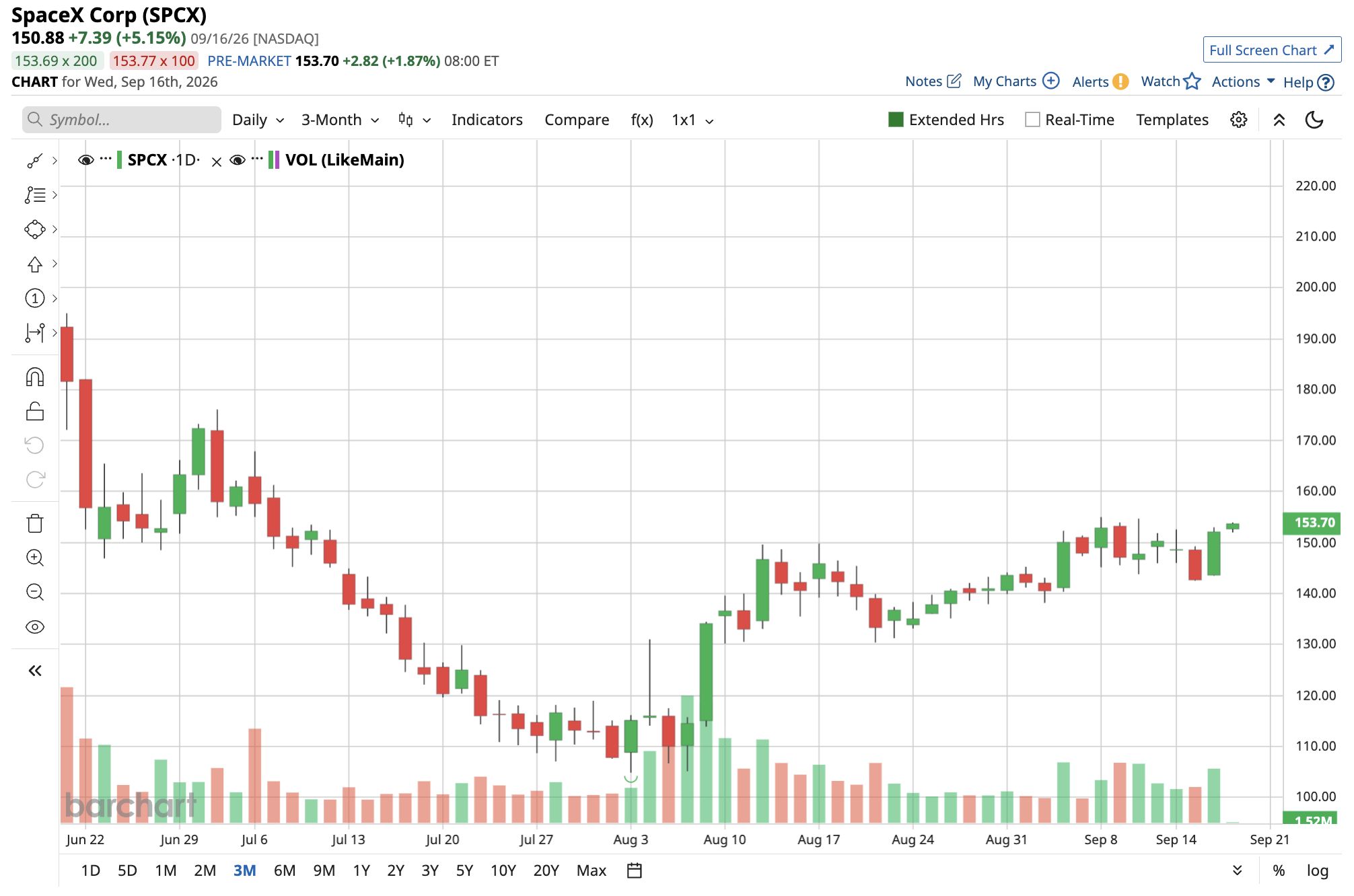
Since its IPO, SPCX’s stock has fallen 6%, underperforming the iShares US Aerospace & Defense’s (ITA) 8% gain during the same period. The performance gap highlights the stock’s volatility compared with the relatively stable performance. After trading at $152 on July 9, the stock declined approximately 28.95% to $108 by July 31. Since then, the stock has recovered most of its losses and is currently trading at $150.
 barchart.com
SpaceX Is Racing Ahead on Capacity. Can Revenue Keep Pace?
SpaceX reported its second-quarter fiscal 2026 earnings on August 4. It reported a sharp rise in second-quarter revenue, which came in at $7.8 billion, up 92% year over year. The connectivity segment remained the biggest business, with revenue of $4.3 billion, up 66 YoY, while AI segment revenue was $2.6 billion. CEO Elon Musk said the company completed 2 successful flights of Starship V3 and that flight 14 will be the first flight to carry the company’s Version 3 Starlink satellites. The company, which added more than 1.7 million Starlink subscribers globally in the quarter, has approximately 10,200 Starlink broadband and mobile satellites in low Earth orbit, accounting for roughly 65% of all active working satellites currently orbiting Earth. Total company capital expenditures in the second quarter were approximately $18.4 billion, of which roughly $15.8 billion supported AI compute infrastructure.
Looking forward, management said it expects to reach a $100 billion annualized revenue run rate by the end of 2026, based on expected December revenue. The company expects to end the year with over 2 gigawatts of compute. Morgan Stanley analyst Adam Jonas asked about SpaceX’s plans to expand its AI computing capacity. Elon Musk said the company aims to have 20 gigawatts of power and cooling capacity online by the end of next year, significantly higher than earlier expectations. He added that the company expects to receive a large share of Nvidia’s (NVDA) supply next year, which would support its AI infrastructure expansion.
What Do Analysts Expect for SPCX Stock?
On September 15, Jonas assigned a Buy rating to SPCX with a price target of $300. The analyst’s price target reflects 100% upside from the current levels. Similarly, Bernstein analyst Douglas Harned reiterated a Buy rating and assigned a price target of $248. In contrast, MoffettNathanson kept a Hold rating on SPCX while raising the firm’s price target from $131 to $142.
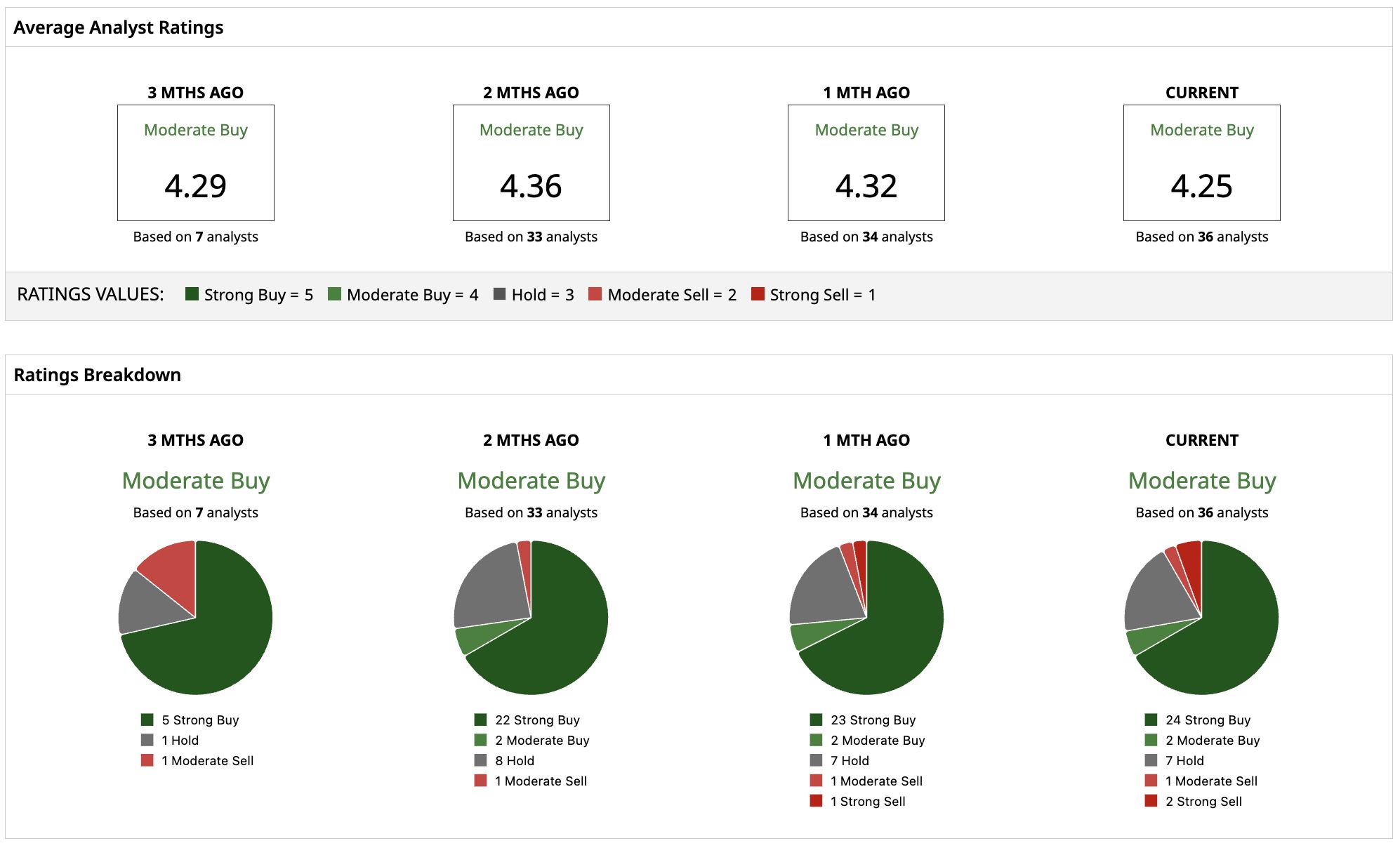
Based on 36 Wall Street analysts covering the stock, SPCX holds a consensus Moderate Buy rating. The mean price target of $219 reflects an additional 51% upside from the current levels. The company’s high price target of $800 is quite impressive, which further implies a 459% upside from the current share price. This shows that Wall Street remains optimistic about SPCX’s growth prospects.
 barchart.com
 On the date of publication, Jabran Kundi did not have (either directly or indirectly) positions in any of the securities mentioned in this article. All information and data in this article is solely for informational purposes. For more information please view the Barchart Disclosure Policy here.
More news from Barchart
SpaceX CFO’s Confidence in Its $100 Billion Goal Grows. Investors Need to Pay Attention Before September 21. Michael Burry Says OpenAI and Anthropic’s AI Slowdown Push Is ‘Self-Serving.’ Who’s Right? Mag 7 Laggard Meta Has Quietly Turned Positive for 2026. What Comes Next. Robinhood’s CEO Says Prediction Markets Are Starting a ‘Supercycle That Could Drive Trillions In Annual Volume’ After 12 Billion Contracts Traded in 2025