


The tokenization of real-world assets is shifting from experimental pilots into institutional use. By early 2026, on-chain tokenized assets (excluding traditional stablecoins) had already surpassed $25 billion, with U.S. Treasuries, private credit, and commodities accounting for much of that total.
Datavault AI (DVLT) added a concrete data point to that trend on Sept. 15, announcing a $100 million initial purchase order for its $QEST tokenization services. The order marks the commercial launch of its Information Data Exchange, NILvault, and American Political Exchange platforms. Its shares responded the next day sharply, gaining 12.62%.
Join 200K+ Subscribers: Find out why the midday Barchart Brief newsletter is a must-read for thousands daily.
The move has brought the small-cap data-monetization and RWA tokenization company back into investor attention. Whether the nine-figure order signals the start of a sustained revenue ramp or remains an isolated headline is the question now. Let’s dive in.
Datavault’s Growing Revenue
Datavault AI, headquartered in Philadelphia, develops technology for data valuation, tokenization, digital-rights management, and marketplace settlement. The company, which has a market capitalization of roughly $149 million, generates revenue from AI infrastructure, data licensing, live events, and tokenized digital assets.
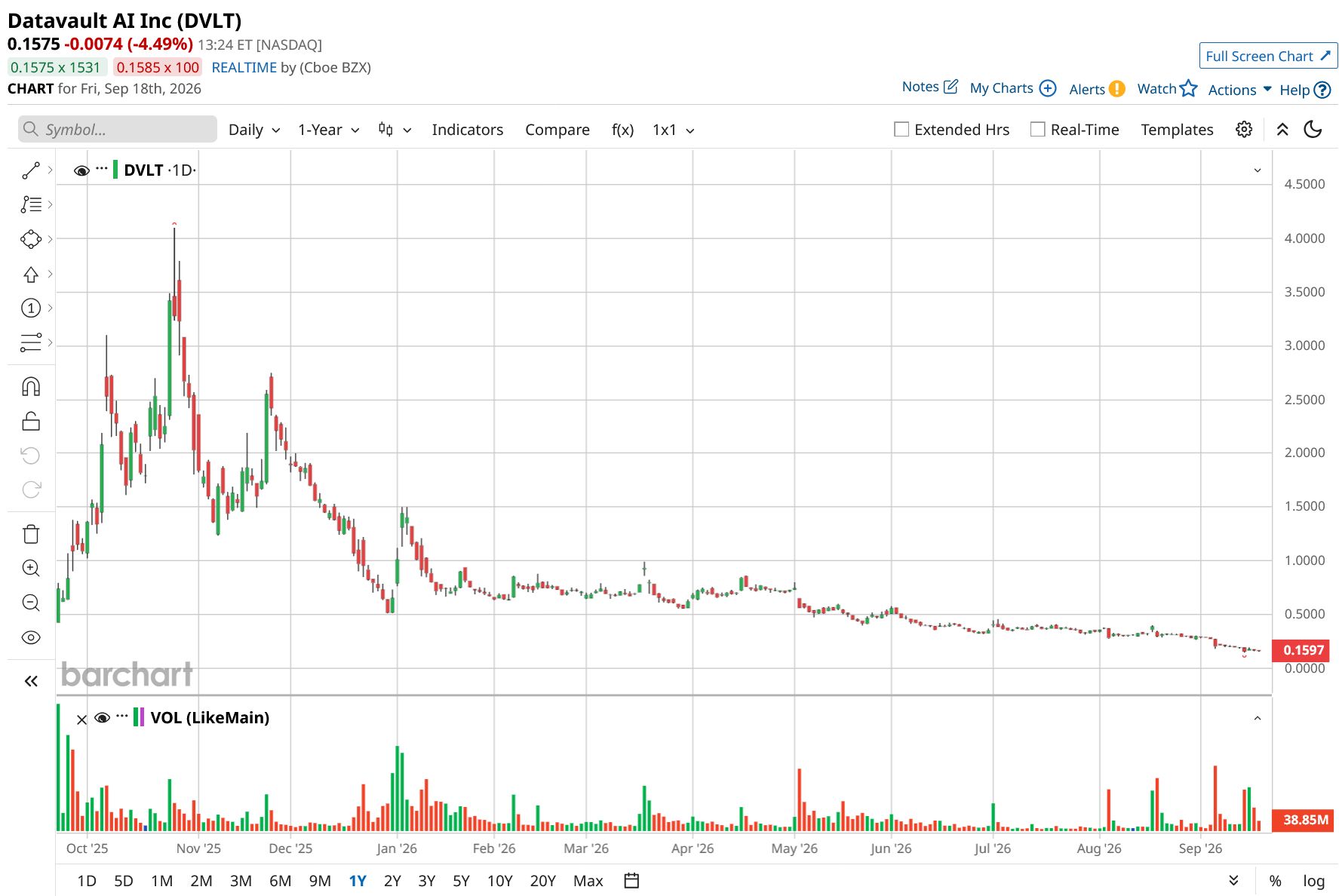
On Sept. 16, despite DVLT stock's 12.62% jump during the day's trading, it closed at $0.1767, leaving the stock still down 72.90% year-to-date (YTD) and 60.29% over the past 52 weeks. The stock has spent the rest of the week in the red.
 www.barchart.com
At 4.66x sales, DVLT trades above its sector median of 3.58x, while its 0.67x price-to-book ratio sits well below the sector median of 3.80x.
Datavault released its second-quarter 2026 results on Aug. 19, as revenue rose to $6.7 million for the three months ended June 30, up $5.0 million, or 287%, from $1.7 million in the prior-year quarter.
That growth came with higher costs, as research and development spending rose to $7.2 million from $4.2 million. It also saw its sales and marketing expense increase to $7.2 million from $1.7 million a year earlier.
Datavault’s Q2 operating expenses totaled $29.3 million, more than four times its quarterly revenue.
The company also reported an $88.0 million net loss, compared with a $37.1 million loss in the year-earlier quarter. That report included a $56.4 million impairment of non-marketable securities and an $8.1 million loss on crypto assets.
Its balance sheet provides some support, with total assets of $276.6 million at June-end against $30.8 million in total liabilities. However, cash generation remains the more pressing issue. Operating cash flow was negative $80.0 million during the first half of 2026, a sharp deterioration from negative $8.7 million in the prior-year period, while net cash flow was negative $600,000.
What the Tokenization Deal Means for DVLT
The $100 million $QEST order gives DVLT its most significant commercial catalyst yet. The amount is nearly 10 times Datavault’s $10.1 million in first-half 2026 revenue and supports management’s goal of producing at least $200 million in 2026 revenue. If the company delivers the services and recognizes the revenue, the order could materially change the scale of Datavault’s business.
More importantly, the agreement provides an initial commercial use case for Datavault’s tokenization strategy. The company launched its Information Data Exchange (IDE), NILvault, and American Political Exchange, or APEX, on Sept. 15. These platforms are intended to generate revenue from the valuation, creation, listing, and exchange of tokenized data and digital rights.
The $QEST tokens provide access and usage rights related to Available Infrastructure’s Project Qestrel edge-AI fleet. That gives Datavault a way to apply its technology to AI-compute infrastructure, rather than limiting its opportunity to media, data, or sports-related assets.
NYIAX strengthens the commercial case for those platforms. Its acquisition added electronic matching, price discovery, contract lifecycle management, transfer, and settlement tools. It also brought four issued U.S. patents into Datavault’s portfolio. Those capabilities could help Datavault generate activity after tokenized assets are created, including transactions between buyers and sellers.
Their proposed BankWyse acquisition could further extend that system into banking and custody services. BankWyse is a Cheyenne, Wyoming Special Purpose Depository Institution, although the deal remains subject to regulatory approval and customary closing conditions.
Datavault’s planned $94.5 million all-cash acquisition of CyberCatch adds another layer to the strategy. CyberCatch provides AI-enabled penetration testing and quantum-resistant compliance intellectual property. Datavault plans to integrate those assets into its Quantum Private Network.
Together, these developments give DVLT a broader route to monetize tokenized assets through valuation, marketplace activity, settlement, banking, and security.
What Are Analysts Expecting
Datavault is scheduled to report its September-quarter results on Nov. 13. Analysts expect a $0.03 loss per share, versus a $0.33 loss in the prior-year quarter. That forecast points to a 90.91% year-over-year (YoY) improvement, although the company would remain in the red.
The upcoming report will also indicate whether Datavault is gaining traction toward its full-year target of at least $200 million in 2026 revenue, roughly 400% annual growth. DVLT’s management expects a stronger second half following the mid-September launch of its exchanges.
Institutional investors have also built positions in the stock. Vanguard owned 11.8 million shares, while State Street (STT) and BlackRock (BLK) held another 14.1 million shares combined, based on the company’s March disclosure. Those holdings reflect interest in Datavault’s data monetization strategy, but they offer no assurance of future performance.
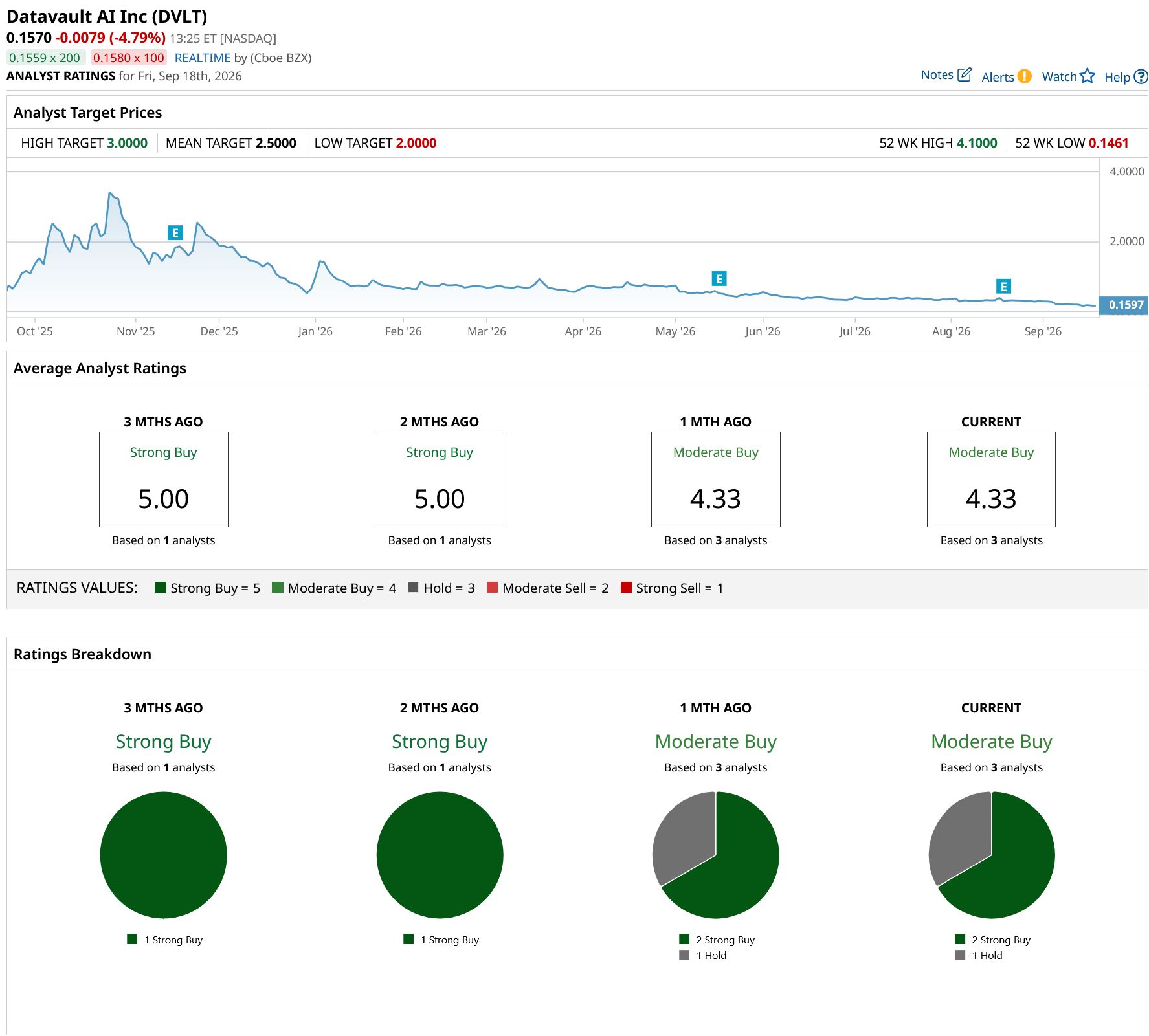
Analyst sentiment remains constructive, with three surveyed analysts assigning DVLT stock a consensus “Moderate Buy” rating. Their average $2.50 price target implies about 1,315% upside from the Sept. 16 share price.
 www.barchart.com
Conclusion
Datavault’s $100 million $QEST order gives the company a real commercial catalyst and a clearer path toward its $200 million 2026 revenue target. The deal could validate its tokenization strategy if the company delivers the services and records the revenue as planned. Still, DVLT stock remains speculative because cash burn, losses, dilution, and execution risks have not disappeared. The most likely near-term direction depends on updates around revenue recognition and platform adoption. Strong delivery could extend the rebound, while any delay could quickly pressure shares again.
On the date of publication, Ebube Jones did not have (either directly or indirectly) positions in any of the securities mentioned in this article. All information and data in this article is solely for informational purposes. For more information please view the Barchart Disclosure Policy here.
More news from Barchart
Datavault AI Stock Jumped More Than 10% After a Tokenization Deal. What This Means for DVLT. Odell Beckham Jr. Took His $750,000 Rams Salary in Bitcoin and Was ‘Happy’ When It Hit Record Highs — Here’s What It’s Worth Now After the Crash Is Bitcoin Going to Trade Above $100,000 Before the End of 2026 Why AMC CEO Adam Aron Dislikes Robinhood’s New Tokenized Assets