

The race to build artificial intelligence (AI) chips is no longer just about who can make the fastest processor. Now, it is increasingly becoming a China-U.S. technology contest, with companies on both sides pushing to build more of their own AI-computing capabilities as U.S. government restrictions limit China’s access to advanced U.S. chips.
Huawei just gave that race another jolt. The Chinese tech giant is reportedly moving up the launch of its next-generation Ascend 960DT AI chip to the first quarter of 2027 from its previously planned Q3 timeline. Huawei also plans to launch the Ascend 960PR in Q3 2027, accelerating its broader Ascend roadmap as it works to expand China’s domestic AI infrastructure.
More Top Stocks Daily: Go behind Wall Street’s hottest headlines with Barchart’s Active Investor newsletter.
Huawei is not stopping at individual chips, either. The company is developing UnifiedBus technology to connect groups of AI processors so that they work as larger computing systems. Huawei has developed 11 chips around the technology for its supernode and supercluster systems and has reportedly already shipped more than 1,000 supernode systems.
That matters because Nvidia (NVDA) has become almost synonymous with the AI infrastructure boom. The company's GPUs power the training and running of advanced AI models, while its advantage stretches beyond chips into networking and the broader software ecosystem. Huawei is now aiming at that system-level advantage, particularly in China, where U.S. export restrictions have made access to Nvidia’s most advanced hardware more difficult.
So, is Huawei’s faster roadmap just another headline, or could it eventually change the competitive landscape for Nvidia? Let’s take a closer look at what the move could mean for Nvidia and where NVDA stock stands from here.
About Nvidia Stock
Nvidia hardly needs an introduction these days. Once known mainly for making graphics chips for gamers, the company has become one of the biggest names in the AI revolution, and one of Wall Street’s favorite ways to play it. Founded in 1993 and headquartered in Santa Clara, California, Nvidia spent decades building its expertise in GPUs before the technology suddenly became central to the AI boom.
As companies raced to train and run increasingly sophisticated AI models, demand for Nvidia’s computing power exploded. Its GPUs now sit at the heart of AI data centers, cloud computing, robotics, autonomous vehicles, and high-performance computing. With a market capitalization of roughly $5.3 trillion, Nvidia has grown into one of the world’s most valuable companies.
That makes NVDA stock more than just another chip stock. Its performance has become closely tied to the broader AI investment cycle, making it one of the first names investors turn to when gauging the strength of the AI trade. Few stocks get pulled into that conversation as quickly as Nvidia. The company has delivered extraordinary returns, but 2026 has shown that even an AI heavyweight can face periods of volatility.
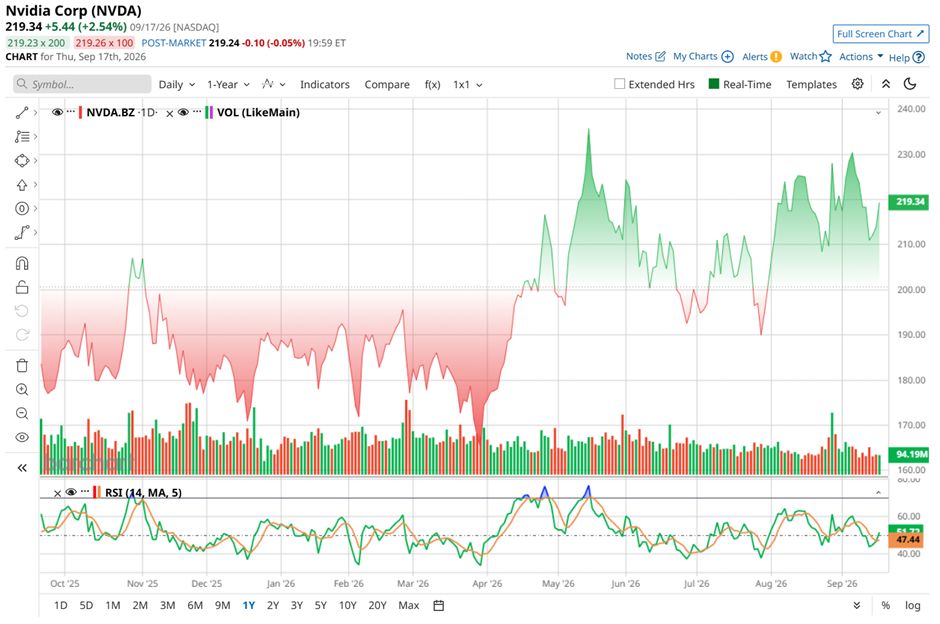
Shares of Nvidia have gained 22% in 2026, including a 32% advance over the past six months. Zooming out further, NVDA stock has surged 29% over the past 52 weeks, 434% over the past three years, and an eye-popping 12,875% over the past decade.
Still, the ride has not been smooth. The stock pulled back this year as investors questioned whether hyperscalers could keep spending on AI infrastructure at such a furious pace, while competition across the semiconductor industry continued to intensify. Then came a fresh dose of skepticism in late July, when a wave of AI-related deals put the staggering cost of the AI buildout back in focus.
Lately, though, NVDA stock has been finding its footing again. Strong demand for AI infrastructure and easing concerns about how hyperscalers will finance their spending have helped shares recover. Nvidia is now just 4% below its all-time high of $236.54.
Technically, the picture looks fairly balanced. The 14-day RSI sits at 58, which is close to neutral territory.
 www.barchart.com
 For a company at the heart of the AI boom, the valuation may look less intimidating than its headline success suggests. NVDA stock currently trades at a relatively reasonable 24 times forward earnings, while its price-to-sales (P/S) ratio of 24.8 times is higher than many peers That makes the valuation story a little more nuanced — investors are still paying for growth, but not quite at the same premium seen in the past.
The shareholder-return story adds another layer. Nvidia raised its quarterly dividend from $0.01 to $0.25 per share in May 2026, reflecting its ability to generate substantial cash while returning more to shareholders. The payout is small relative to the stock's valuation, but the increase signals growing capacity for shareholder distributions.
A Snapshot of Nvidia’s Q2 Numbers
Nvidia reported its second-quarter fiscal 2027 results on Aug. 26, with revenue jumping 106% year-over-year (YOY) to $96.2 billion, comfortably ahead of Wall Street’s expectations. Non-GAAP EPS was just as eye-catching, climbing 120% YOY to $2.22, while non-GAAP gross margin expanded 2.5 percentage points to 75%.
The Data Center segment once again stole the spotlight. The division pulled in a massive $89 billion in revenue, up 117% YOY and representing more than 92% of total revenue. Hyperscaler spending on AI infrastructure remained the key driver, while enterprise adoption of accelerated computing continued to broaden. Sequential growth also benefited from the initial volume rollout of Nvidia’s next-generation Vera Rubin architecture, alongside continued full-scale production of Blackwell systems for major cloud customers like Microsoft (MSFT), Alphabet (GOOGL), and Oracle (ORCL).
Nvidia’s Edge Computing business generated $7.2 billion, up 27% YOY, as AI increasingly moves closer to devices and commercial applications.
Meanwhile, the company continued turning its enormous cash generation into shareholder returns. Nvidia returned about $26 billion through buybacks and dividends during the quarter, with roughly $99 billion still available under its repurchase authorization. Operating cash flow reached $24.1 billion, while free cash flow came in at $21.3 billion. Cash, cash equivalents, and marketable debt securities totaled $56.6 billion at quarter-end.
Looking ahead, management anticipates Q3 revenue to be around $108 billion, plus or minus 2%, with GAAP and non-GAAP gross margins expected at 74%, plus or minus 50 basis points. Management also expects fiscal 2028 revenue to grow approximately 70%, although supply is expected to remain a bottleneck through at least the end of that year.
Analysts tracking Nvidia forecast Q3 fiscal 2027 revenue of around $109 billion, while EPS is projected to climb 99% YOY to $2.47 per share. Zooming out, EPS is expected to rise 102% YOY to $9.25 in fiscal 2027, then climb another 66% YOY to $15.33 per share in fiscal 2028.
What Do Analysts Expect for NVDA Stock?
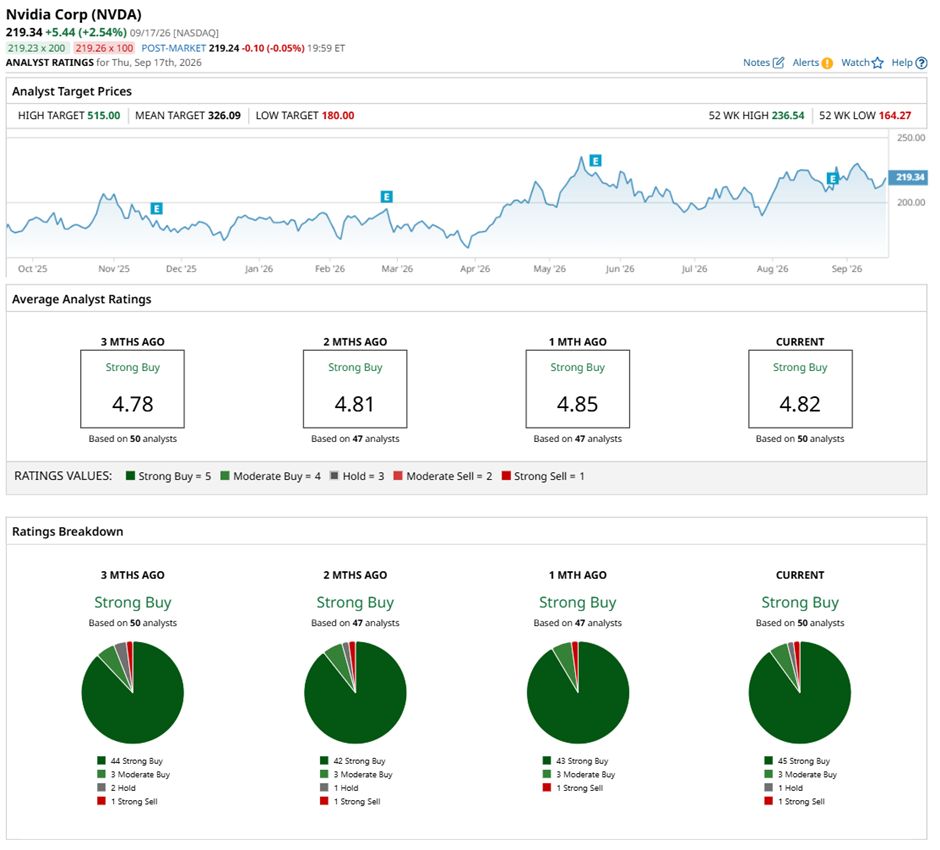
Overall, analysts are upbeat about NVDA stock’s growth potential, giving Nvidia a consensus “Strong Buy” rating. Of the 50 analysts covering the stock, 45 advise a “Strong Buy,” three recommend a “Moderate Buy,” one analyst has a “Hold” rating, and one suggests a “Strong Sell" rating.
The average price target for NVDA stock is $325.88, indicating potential upside of 43% from current levels. Meanwhile, the Street-high target price of $515 suggests that the stock could rally as much as 127% from here.
 www.barchart.com
 Final Thoughts on Nvidia Stock
So, should Nvidia investors hit the panic button? Not really. For investors, Huawei’s latest move is less an immediate threat and more a sign of where the AI chip race could be heading.
Nvidia remains deeply entrenched in the market, with its GPUs, networking technology, and software ecosystem widely used by AI developers worldwide. Meanwhile, Huawei is building its own ecosystem, with thousands of developers already working on its AI platform.
The China angle makes this especially important. Access to Nvidia’s most advanced chips in China remains restricted, while U.S. policy has allowed only limited sales of products such as Nvidia’s H200 processors. Shipments have also been constrained, with only a small number of H200 shipments having begun. That gives Huawei a natural opening to strengthen its domestic alternative.
Huawei is clearly moving faster, but turning a chip roadmap into a scaled, widely adopted AI platform takes time. For NVDA stock investors, this is not a panic signal yet, although Huawei’s next moves deserve attention.
On the date of publication, Sristi Suman Jayaswal did not have (either directly or indirectly) positions in any of the securities mentioned in this article. All information and data in this article is solely for informational purposes. For more information please view the Barchart Disclosure Policy here.
More news from Barchart
RBC Is Bullish on Kraft Heinz Stock and Expects Growth to Return in 2027 Huawei Is Ramping Up to New Chips in 2027. What That Means for Nvidia Stock Now. Meta’s Muse Is Dominating the App Store. What This Means for META Stock. This Blue-Chip ‘Loser’ Just Might Offer Contrarians a Pleasant Surprise