


At first glance, the strike selections for Yum China (YUMC) look terrible. And it’s all the more disappointing considering how poor YUMC stock has performed. Right off the bat, we know that the ticker has ignominiously earned an 88% Strong Sell rating from the Barchart Technical Opinion indicator. That stems from, at least in part, the ticker’s year-to-date loss of nearly 13%.
It doesn’t end there. On Tuesday, YUMC stock represented one of the 200 names listed in Barchart’s “1-Month Large Cap Percent Change Declines.” It got the title thanks to a 15% loss in the trailing 30 days. However, from a contrarian perspective, the crimson stains would initially seem to be a positive.
Can’t Get Enough Options?: Join the list for Barchart’s daily unusual options report, delivered free.
As the theory goes, large-capitalization entities are among the most proven and relevant enterprises in the global economy. Because of this hard-earned fact, these securities are much more likely to rebound than, say, a speculative small-cap player. With that perspective, you go look up bull call spreads for Yum China stock.
Unfortunately, that’s where the disappointment begins. For the October monthly options chain, there’s only one unrealistic debit spread — the 42.50/45. Here, the breakeven probability (at $43.30) is listed at only 27.8%.
What about November? That’s not much better. There is a 42.50/45 bull spread but the maximum payout only comes out to 72.41%. You’d be risking $145 for the chance to profit $105 — that’s asymmetric against you. At the far end, you have the 45/47.50 spread, which offers a payout of over 194%. With this trade, you only risk $85 for the chance to profit $165.
I think we can all appreciate that kind of positive asymmetry but the challenge comes in the form of likelihood of success.
A Supposedly Tough Pill for YUMC Stock
At time of writing, Yum China stock is only exchanging hands for $41.58. So getting into $45 territory and above represents a steep challenge. You want to get rewarded for taking that risk yet these strike selections leave much to be desired in terms of probabilistic margin of safety.
Let’s consider the actual stats. For the latter 45/47.50 November call spread to break even, YUMC stock must trigger a price of $45.85 on expiration. Wall Street’s options pricing mechanism implies a probability of that event occurring at only 20.8%. Even more challenging, a reverse-engineering of Barchart’s Expected Move calculator pegs the odds of full profit (at $47.50) at only 14.09%.
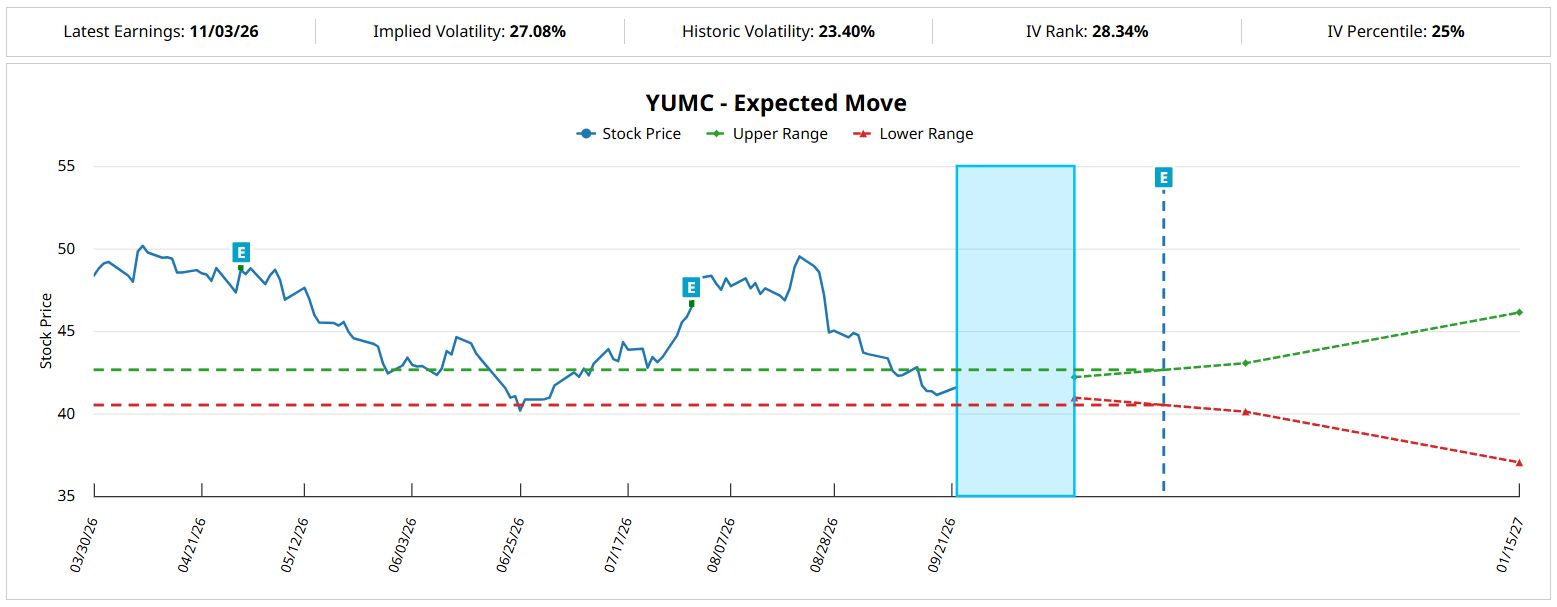
So, you don’t need to run a formal expected value calculation to recognize the core dilemma. Under these conditions, running this exact trade over an extended period will quickly lead to portfolio erosion as the number of losses outpaces the number of wins.
However, the question that needs to be asked is this: are the current probabilities the best estimate of market reality or would an alternative framework be more illustrative? Since these probabilities are assuming a random walk between now and the expiration date, I would argue that this particular framework would apply best if the measurable sentiment between bulls and bears were relatively even.
For example, if you were looking at a stable, relevant industry stalwart stuck in a sideways consolidation pattern, I would be more inclined to accept the random walk model. But it’s difficult for me to accept that for YUMC stock specifically.
As I stated earlier, the ticker is currently ranked among the worst-performing blue-chip securities in the past month. That right there already distinguishes Yum China stock from most other blue chips. And because the perception of YUMC has changed, I am theorizing that its forward trajectory will also change relative to expectations under a random walk model.
Path Dependency Could be Pivotal
As for an alternative model, here’s what we know. In the last 10 weeks, YUMC stock has only managed to print two positive weekly candlesticks, thereby leading to a downward slope. In other words, during the defined period, 80% of eligible sessions were negative.
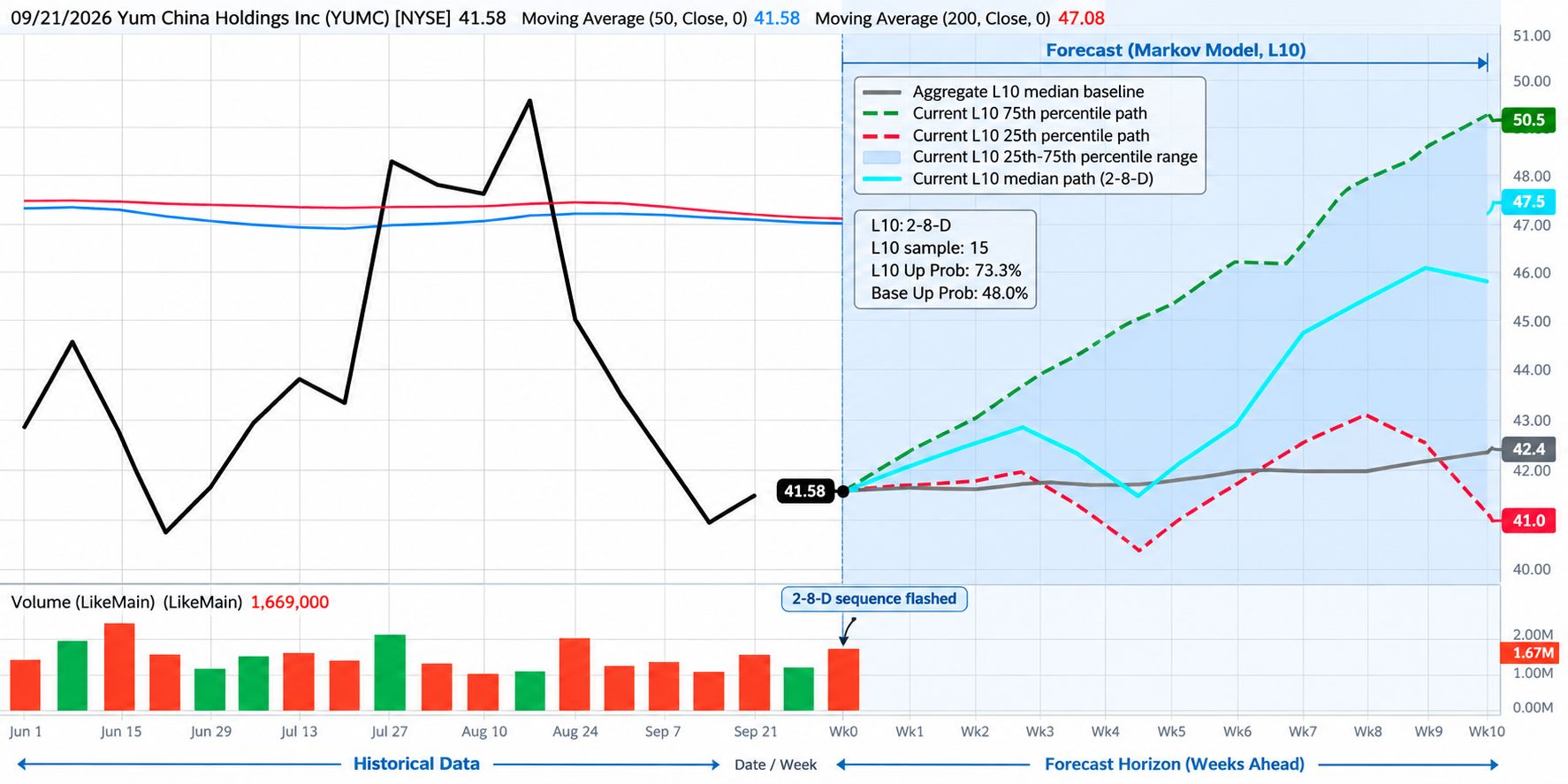
If we were to classify this behavioral state using a binary language, we might call this sequence 2-8-D: two up, eight down, downward slope. Using technology, we can then search through historical data to find out how many times this sequence has materialized and, more importantly, what has typically transpired following the flashing of this signal.
Since January 2019, we know that the 2-8-D sequence has only materialized a total of 13 times on a rolling basis. We also know that YUMC stock has exceeded the equivalent of the $47.50 second-leg strike seven times on week 9, which turns out to be a 53.8% hit ratio.
Of course, the extremely small sample size means that percentage-based conclusions need to be taken with a huge grain of salt. This is certainly not a trade where you throw everything at it; it’s highly speculative.
Still, the defense is that this 2-8-D sequence happens so infrequently that it’s impossible to have a robust dataset. Further, under this particular state, the typical response has been for a near-term recovery. If you’re a risk-tolerant trader looking for an unusual idea, Yum China stock should be on your radar.
On the date of publication, Josh Enomoto did not have (either directly or indirectly) positions in any of the securities mentioned in this article. All information and data in this article is solely for informational purposes. For more information please view the Barchart Disclosure Policy here.
More news from Barchart
Yum China Stock Is Satistically Terrible. Here’s What Wall Street Isn’t Telling You. Microsoft Is Cutting 268 Xbox Roles as Activision Takes Over Halo. This Is a Simple Restructuring, Not a Broader Panic Signal for MSFT Stock. Nvidia Partner IonQ Sparks a Quantum Computing Stock Rally — Here’s One Way to Invest. Late Billionaire Charlie Munger Said American Medical Costs Are ‘A Disgrace’ And That Singapore Does It Better At ‘20% Of What We Pay’