

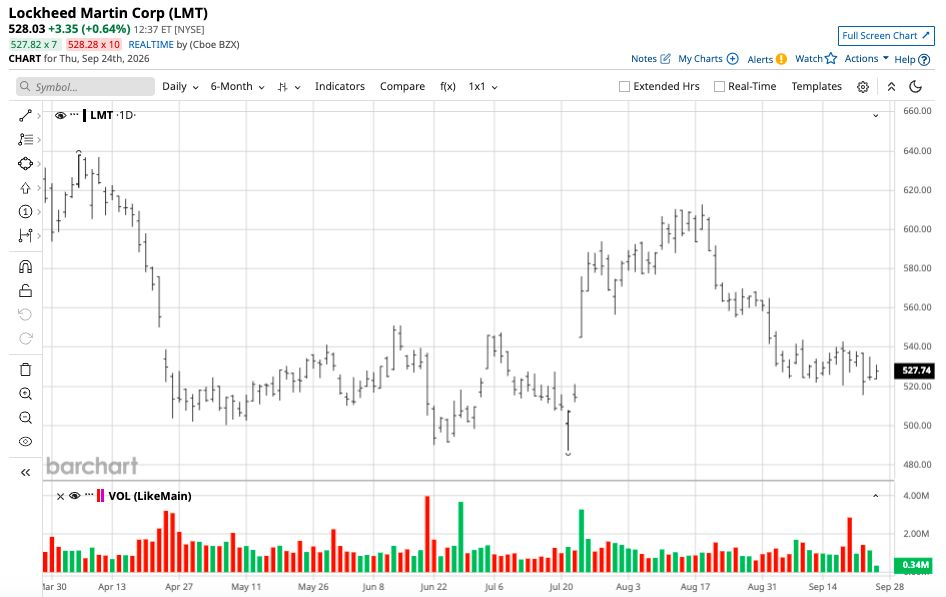
Lockheed Martin (LMT) is well-positioned to benefit in the medium-to-long term from increased purchases of several of its products by the U.S. and other nations. Meanwhile, although some investors seem to believe that Democrats in Congress will impose large U.S. defense spending cuts next year, that view — which has sparked major declines in LMT stock and its peers — appears to be inaccurate. Finally, in the wake of the weakness of LMT stock over the last six months, Lockheed Martin's valuation is quite attractive right now.
Given these points, long-term value investors may want to consider buying Lockheed Martin stock. Let's take a closer look.
More Top Stocks Daily: Go behind Wall Street’s hottest headlines with Barchart’s Active Investor newsletter.
 www.barchart.com
 Lockheed Martin Keeps Landing Deals
The United States, Saudi Arabia, and multiple countries in Europe look poised to meaningfully increase their purchases of Lockheed Martin's costly F-35 fighter jets.
On Sept. 18, the U.S. Department of State approved Saudi Arabia's request to buy 48 of Lockheed's F-35 Lightning II planes for $24.3 billion. The Middle Eastern country has reportedly sought to obtain these aircraft for some time, but the U.S. had previously declined to grant it permission to do so. However, Congress still needs to ratify the recently announced deal.
As for Europe, Germany reportedly obtained its first F-35 Lightning II earlier this month and has already ordered a total of 35 of the planes. The country is considering buying more F-35 jets after a planned Europe-made alternative to the aircraft was cancelled. Germany and multiple other European countries may very well decide to buy more F-35s rather than wait for new planes to be developed, as that appears to be their only alternative at this point.
Meanwhile, the Pentagon is looking to buy 85 F-35s in fiscal 2027, up from 47 F-35s in fiscal 2026.
In August, the U.S. Department of Defense also awarded Lockheed a contract to increase its production of interceptors for PAC3 missile-defense systems. By 2030, the company expects to triple its output of the interceptors. The deal could be worth as much as $58.6 billion.
Lockheed has also obtained a seven-year contract with a ceiling of $35 billion to increase production of interceptors for Terminal High Altitude Area Defense (THAAD) missile defense. Under the agreement, which was announced in June 2026, Lockheed will quadruple its output of the interceptors.
Finally, Lockheed recently made a deal with the Pentagon to produce its AIM-260 Joint Advanced Tactical Missiles (JATM). The agreement will probably lead to the firm selling many more of these missiles to the U.S. and a number of its allies.
Democrats Probably Won't Slash the Defense Budget
Some investors reportedly believe that defense outlays could be meaningfully reduced if Democrats gain control of Congress next year. However, there seems to be a good chance that Republicans will seek to pass the fiscal 2027 defense budget during the “lame duck” session between the election and early January, when the new Congress is due to be sworn in. During that period, the GOP will still have a majority in both houses. So, the fiscal 2027 defense budget may very well not even be affected by potential Democrat wins in the upcoming election cycle.
What's more, as someone who has closely followed the U.S. political scene for decades, my impression is that presidents can still get most of what they want in exchange for some concessions when dealing with a Congress controlled by the opposite party. For example, during President Donald Trump's first term, he convinced Democrats to boost defense spending in exchange for similar hikes in domestic funding. Consequently, a divided U.S. government could still pass increased defense spending as long as Democrats also get some of their priorities enacted.
The Valuation of LMT Stock Is Very Attractive
Finally, the valuation of LMT stock appears attractive right now.
Despite the rapidly growing demand for some of Lockheed's most costly products, shares of LMT stock are changing hands at a low forward price-to-earnings (P/E) ratio of 17.1 times. That's below the S&P 500's ($SPX) average forward P/E ratio of about 19 times. Lockheed's P/E ratio is also much lower than the iShares U.S. Aerospace & Defense ETF's (ITA) P/E ratio of 35 times.
Overall, based on 22 analysts with coverage, Lockheed Martin stock currently has a consensus “Moderate Buy” rating on Wall Street.
On the date of publication, Larry Ramer did not have (either directly or indirectly) positions in any of the securities mentioned in this article. All information and data in this article is solely for informational purposes. For more information please view the Barchart Disclosure Policy here.
More news from Barchart
ORCL Stock Sinks as Oracle Issues Force Majeure Notice About New Mexico Data Center Why Michael Burry Is Bullish on Build-A-Bear Workshop Stock Amid Rapidly Growing Demand for Several of Lockheed’s Offerings, LMT Stock Looks Meaningfully Undervalued This Top Cloud Giant Just Won the First Ever Alliance Approval for NATO Data