

Unless a company is in a sector known for paying out most of its earnings as dividends, a high dividend yield usually signals trouble. Nike (NKE) is no exception here, as the sneaker giant’s dividend yield has risen to almost 5%. That is, incidentally, a number markets have fixated on, with U.S. 10-year Treasury yields above that level, a multi-year high.
Nike’s Dividend Yield Is Near All-Time Highs
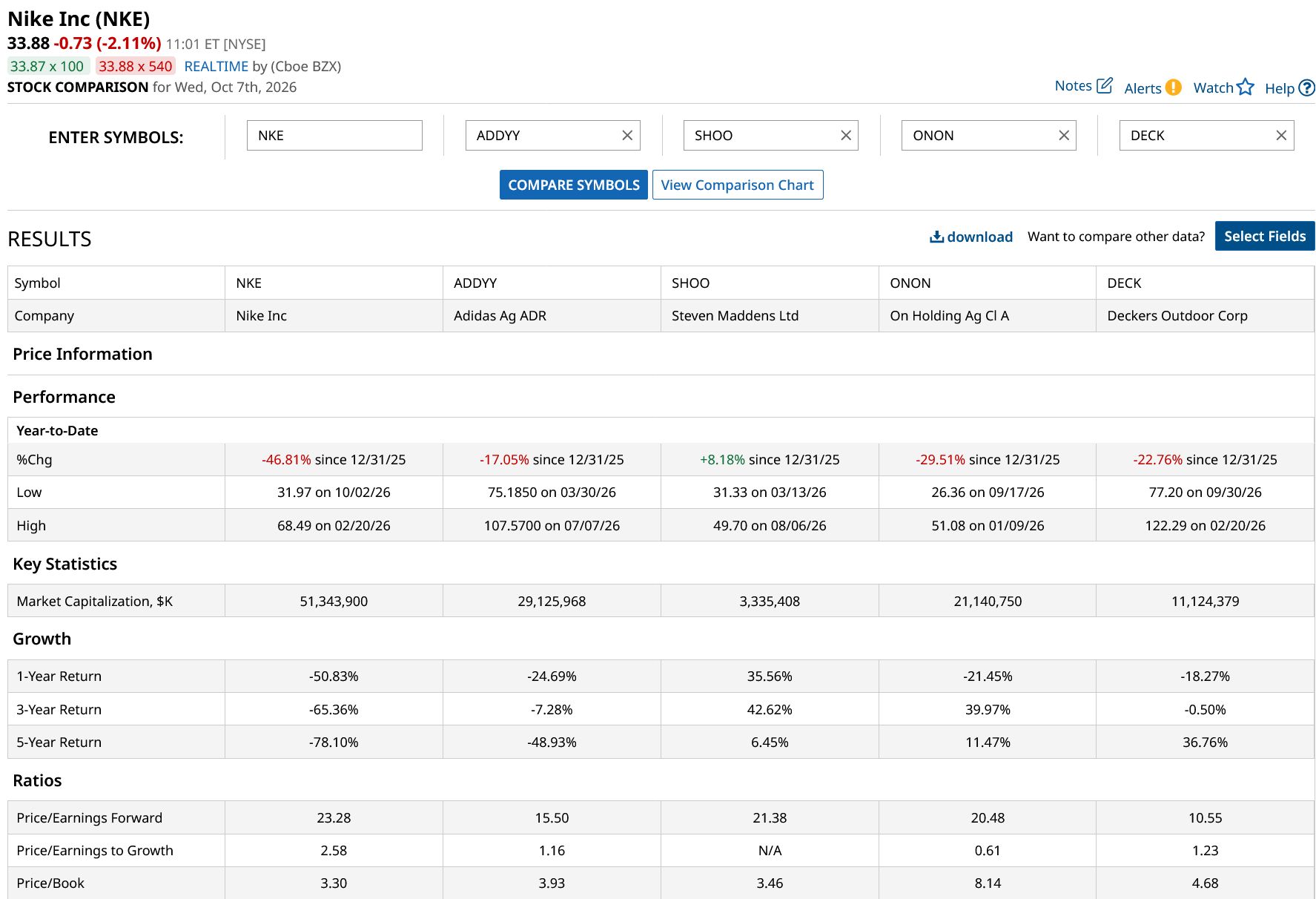
In Nike’s (NKE) case, its dividend yield is at an all-time high. In fact, Nike’s dividend yield has been rising gradually as it has raised its dividends every year and is on track to become a Dividend Aristocrat while its share price has plummeted after peaking in November 2021. Until about a few years ago, Nike wouldn’t have been the subject of an article exploring dividend stocks. However, things have changed, and Nike now ranks among the top 35 S&P 500 Index ($SPX) stocks based on the dividend yield.
More Yield, Less Trap: Sign up free to get Barchart’s daily Dividend Investor newsletter straight to your inbox.
 www.barchart.com
 While buying a high-yield dividend stock, we need to be watchful of two things. The first is whether the dividend is sustainable, as it is not uncommon to see many of the high-yielding companies slashing/suspending their dividends amid mounting troubles. The second is the stock’s forecast, as dividends are only a part of the story and changes in stock price are the key driver of total returns. More so in a name like Nike, where dividends should ideally be the cherry on the cake, and the bulk of the returns should come from capital gains.
NKE’s Dividend Payout Is Expected to Be Over 100%
Let’s begin by analyzing the sustainability of Nike’s dividend. Theoretically, dividends come from the profit pool, and the dividend payout should ideally be below 100%, even though the final number is idiosyncratic and depends on several variables like capex needs, deleveraging, and share buybacks.
In Nike’s case, its dividend payout was more than 100% last fiscal year, and looking at its guidance, it looks set to breach that level this year as well. The company has also been burning cash, as its operating free cash flows don’t suffice for capex and dividends. Needless to say, this is not a sustainable scenario for any company beyond a point.
Nike Commits to Dividend Despite the Woes
Meanwhile, Nike’s management has committed itself to the dividend. During the fiscal Q1 2027 earnings call earlier this month, incoming CFO David Denton talked about “discipline” in capital allocation but went on to add, “dividend remains a significant priority in our capital allocation strategy.”
His remarks naturally triggered a question from one of the participating analysts considering the elevated dividend payout ratio. Denton yet again described dividends as a “significant priority.” He emphasized, “And under all scenarios, we have support for maintaining and ultimately growing the dividend over time. So just—we can put that to bed with that statement.” He later called upon the analyst community to wait until the Investor Day next month, where the company would provide its long-term financial roadmap.
As I have noticed previously also, Nike might not cut its dividend at this stage, as slashing the payout now would send a signal that the turnaround would take much longer. Moreover, given how close the company is to becoming a Dividend Aristocrat, it might not cut the dividend unless an activist investor really pushes the company.
That said, while Nike has plenty of cash on its balance sheet and would be able to maintain and modestly increase payouts for the next couple of years, eventually the dividends have to come from the profit pool.
There looks to be no quick turnaround for Nike, and investors would need to wait for at least the next fiscal year for that elusive increase in earnings. However, I believe that after the recent crash, Nike’s risk-reward has started to look attractive, and I bought the post-earnings dip even as analysts turned incrementally bearish following the earnings, with BNP Paribas lowering NKE’s target price to a Street-low of $19. The stock would particularly appeal to dividend investors, as the yield is now too tempting to ignore, even in an era where even the 2-year Treasury is yielding around 5%.
On the date of publication, Mohit Oberoi had a position in: NKE . All information and data in this article is solely for informational purposes. For more information please view the Barchart Disclosure Policy here.