

SpaceX (SPCX) and Tesla (TSLA) CEO Elon Musk recently stated that his two companies would build and manage Terafab, the planned Texas-based chip factory. Despite earlier speculation that Taiwan Semiconductor (TSM), also known as TSMC, would partially own and manage the plant, Musk clarified that "Maybe TSMC subleases part of the Terafab if they want, but nothing more than that."
Still, SpaceX will presumably share some of the profits from the facility with Tesla, so its profits from the factory probably won't be very high even if TSMC plays no role in managing the plant. Intel (INTC) may get a cut of the profits as well, or at least charge fees in exchange for the use of its 14A technology. That could meaningfully impact profits related to the project.
More Top Stocks Daily: Go behind Wall Street’s hottest headlines with Barchart’s Active Investor newsletter.
Notably, Terafab is also expected to be extremely expensive. The plant will reportedly cost about $119 billion to build, while even if all goes according to plan — and Musk's timetables have been known to be far too ambitious in the past — the facility will likely not start churning out chips until mid-2028 at the earliest. Until then, SpaceX will probably keep paying very high prices for Nvidia's (NVDA) chips, impacting its profit margins as well.
Meanwhile, another big AI and space play — Amazon (AMZN) — designs its own AI chips and trades at much lower valuations than SpaceX stock. Unlike SpaceX, Amazon also pays TSMC to physically produce and package its chips, limiting its capital expenditures in this area.
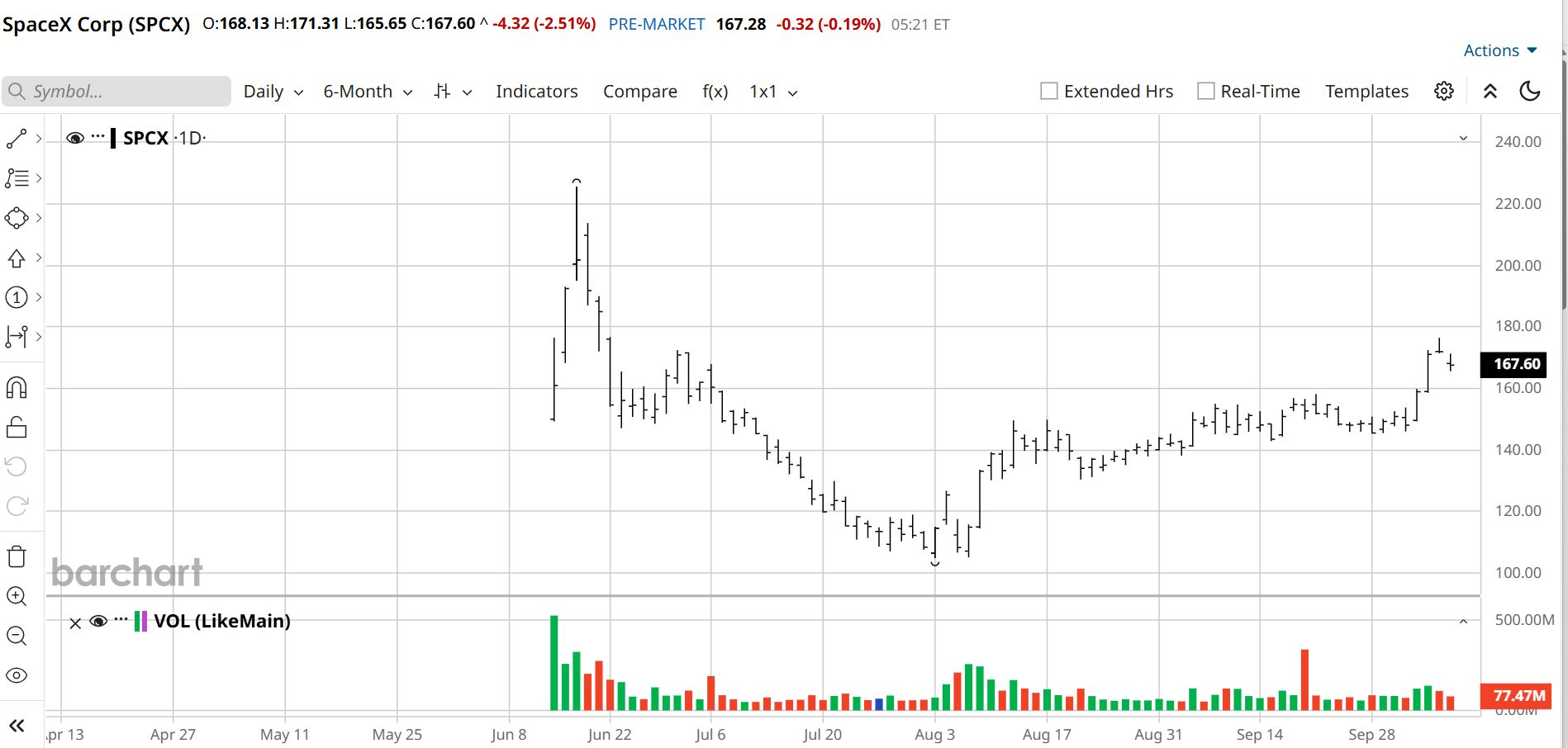 www.barchart.com
 A Likely Profit Split and Long Wait
Earlier reports pointed to Terafab being launched as a joint venture between SpaceX, Tesla, and Intel. However, more recent reports have stated that the joint venture is only between Tesla and SpaceX, while Intel will be a partner that provides technology for the project. Whether Intel gets a share of the profits or only charges high fees, SpaceX's overall profit margins in relation to Terafab may be suppressed after Tesla and Intel receive their payments.
Of course, SpaceX and Tesla may also merge in the future. But that potential business combination could very well never occur, for a variety of reasons.
Meanwhile, some analysts expect Terafab to start churning out chips no earlier than mid-2028. In the past, Elon Musk's timetables regarding Tesla's Robotaxi efforts and other projects have been far too optimistic, so it's certainly possible that Terafab won't start production until 2029 or later.
SpaceX Could Be Buying Nvidia Chips Until at Least 2028
SpaceX is reportedly looking to obtain $40 billion in financing in order to buy Nvidia's expensive artificial intelligence (AI) chips, according to two unnamed sources cited by Reuters. So, it seems that SpaceX's plan for the foreseeable future is to equip its data centers with these very costly processors. With this approach, SpaceX's profit margins from its data centers, to the extent that its capital costs are factored in, may not be as high.
Because Terafab is not slated to start churning out chips until 2028, and because SpaceX is reportedly looking to raise $40 billion to buy Nvidia chips, it seems that Musk plans to rely on the latter's chips at least until the second quarter of 2028.
Amazon Has Its Own AI Chips, Better Valuation
Meanwhile, Amazon is already churning out its own AI chips. In fact, the tech giant reported in April 2026 that Anthropic would “secure up to 5 gigawatts (GW) of current and future generations of Amazon’s Trainium chips to train and power […] advanced AI models."
With that in mind, and because the company does not need to buy chips from Nvidia, Amazon's AI chip profit margins are in all likelihood higher than SpaceX at this point. Amazon also does not have to share profits from its chips, in contrast to what the Terafab arrangement portends for SpaceX.
Finally, as I have reported before, the valuation of AMZN stock appears much more attractive than SpaceX's valuation right now. Amazon has a forward price-to-earnings (P/E) ratio of 31.6 times, a P/E-to-growth (PEG) ratio of 1.9 times, and a price-to-sales (P/S) multiple of 3.8 times. By comparison, SPCX stock has a forward P/E ratio of above 1,700 times, a PEG ratio of 89.2 times, and a P/S ratio of 113.3 times. That gap in valuation gives interested investors something to consider.
On the date of publication, Larry Ramer had a position in: AMZN , AMZU . All information and data in this article is solely for informational purposes. For more information please view the Barchart Disclosure Policy here.
More news from Barchart
Dear Taiwan Semi Stock Fans, Mark Your Calendars for October 15 SpaceX’s Terafab Probably Won’t Deliver Very High Profits, Despite Taiwan Semiconductor’s Limited Role Micron’s Taiwan Union Authorized a Strike Over a Bonus Dispute. What This Means for MU Stock. AMD Stock Is Set to Benefit From Both Physical and Agentic AI