

CoreWeave (CRWV) just had its worst week since November 2025, with CRWV stock falling more than 25% on debt worries. Its bonds came under pressure, too. Yields on some of CoreWeave's unsecured notes climbed to around 15%, and the cost of insuring its debt against default jumped past 1,000 basis points. According to Reuters, that implies a roughly 63% chance of default within five years. Investors are mostly worried about the roughly $51 billion CoreWeave owes, a problem that, as I covered previously, only got worse when the Fed started raising rates.
Speaking to CNBC, LNW Chief Investment Officer Ron Albahary said investors will now judge artificial intelligence (AI) companies on whether their spending can earn enough to cover their debt. “Prior to this wave, this selloff, I think investors were assuming that all AI investments were going to pay off, and that’s not the case," said Albahary.
More Top Stocks Daily: Go behind Wall Street’s hottest headlines with Barchart’s Active Investor newsletter.
Why the Bond Market May Be Overreacting
Goldman Sachs sees it differently, however. On Oct. 19, the firm upgraded CRWV stock to a “Buy” rating while cutting its price target from $139 to $106.
Goldman Sachs is focused on how CoreWeave borrows. Most of the firm's funding comes from loans backed by its GPUs, so the 15% bond yields don’t reflect what most of its debt costs. Goldman Sachs expects CoreWeave’s overall borrowing costs to rise by no more than one to two percentage points. Demand looks solid, too. CoreWeave has a backlog of about $104 billion, and Cantor Fitzgerald says nearly all of its 2027 capacity is already booked.
Albahary is right that investors are getting pickier about AI debt. But if Goldman Sachs is correct that CoreWeave's overall borrowing costs won't rise much, the bond market may be reading too much into one set of bonds.
About CoreWeave Stock
CoreWeave is a U.S. cloud infrastructure technology company that offers the CoreWeave Cloud platform, which helps businesses manage large-scale AI systems more efficiently. The company also provides services like GPU and CPU computing, data storage, networking, and AI development tools. CoreWeave was founded in 2017 and is based in Livingston, New Jersey.
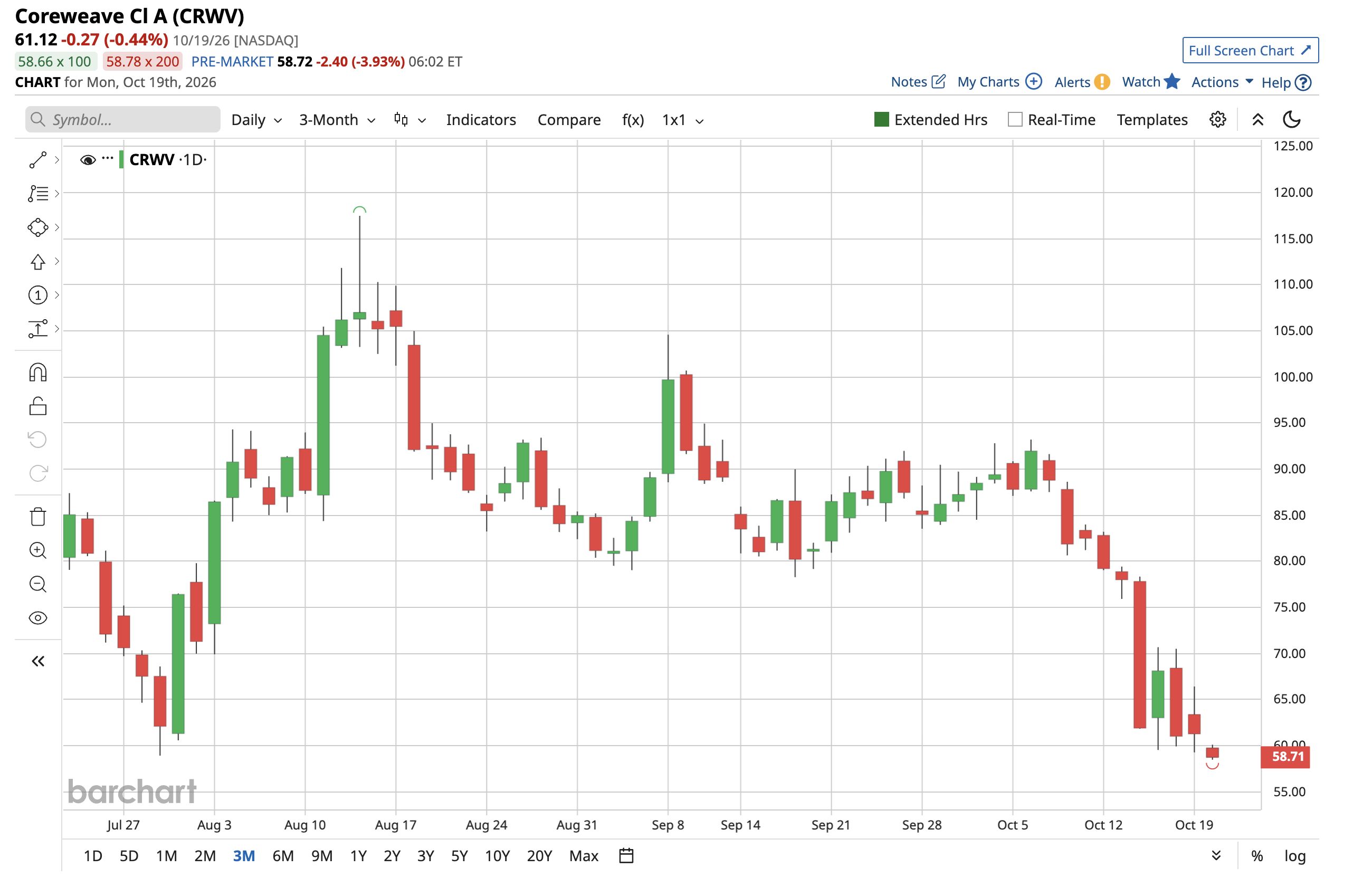
Looking at the past year, CRWV stock and the Invesco QQQ Trust (QQQ) tell opposite stories. QQQ has gained about 16% over the past 52 weeks and sits near its 52-week high, reflecting broad strength in Big Tech. Meanwhile, CoreWeave has lost 54% over the same period and recently hit a 52-week low. This reflects investor concerns that some tech companies are borrowing too heavily to build out AI. The gap shows diversification versus a single high-risk debt.
 www.barchart.com
CoreWeave's valuation shows why the debt debate matters so much. The forward price-to-earnings (P/E) ratio isn't meaningful, since the company is still losing money. Meanwhile, the price-to-sales (P/S) ratio of 5.5 times looks more reasonable for a business that more than doubled revenue year-over-year (YOY) in its latest quarter.
The balance sheet remains the area of concern. CoreWeave carries more than $51 billion in debt and lease liabilities against just $5.54 billion in cash. That debt is considerably larger than its entire $28.3 billion market capitalization. Analysts expect CoreWeave to turn profitable by 2028, with its P/E falling to about 7 times by 2029. If Goldman is right about borrowing costs, that path looks reachable.
Revenue Growth and 2026 Guidance
CoreWeave reported its second-quarter fiscal 2026 earnings on Aug. 11. Revenue came in at $2.57 billion, up 112% YOY, while revenue backlog ended the quarter at $104 billion. CFO Nitin Agrawal noted that adjusted EBITDA for the quarter was $1.5 billion, with an adjusted EBITDA margin of 59%. Meanwhile, CEO Michael Intrator said that the company continues to execute its power strategy, reaching 1.5 gigawatts of active power in Q2 and remaining on track to reach 8 GW by 2030.
Looking forward, CoreWeave expects to end the year with more than 1.85 GW of active power, up from its previous guidance of more than 1.7 GW. Q3 revenue is expected to be in the range of $3.45 billion to $3.6 billion, while adjusted operating income is expected to be between $200 million and $260 million. The company also provided guidance for its Q3 capital expenditures. Capex for the upcoming quarter is expected to be between $11.5 billion and $13.5 billion. This shows management’s confidence in the long-term return on investment of CoreWeave's product and capacity investment.
What Do Analysts Expect for CRWV Stock?
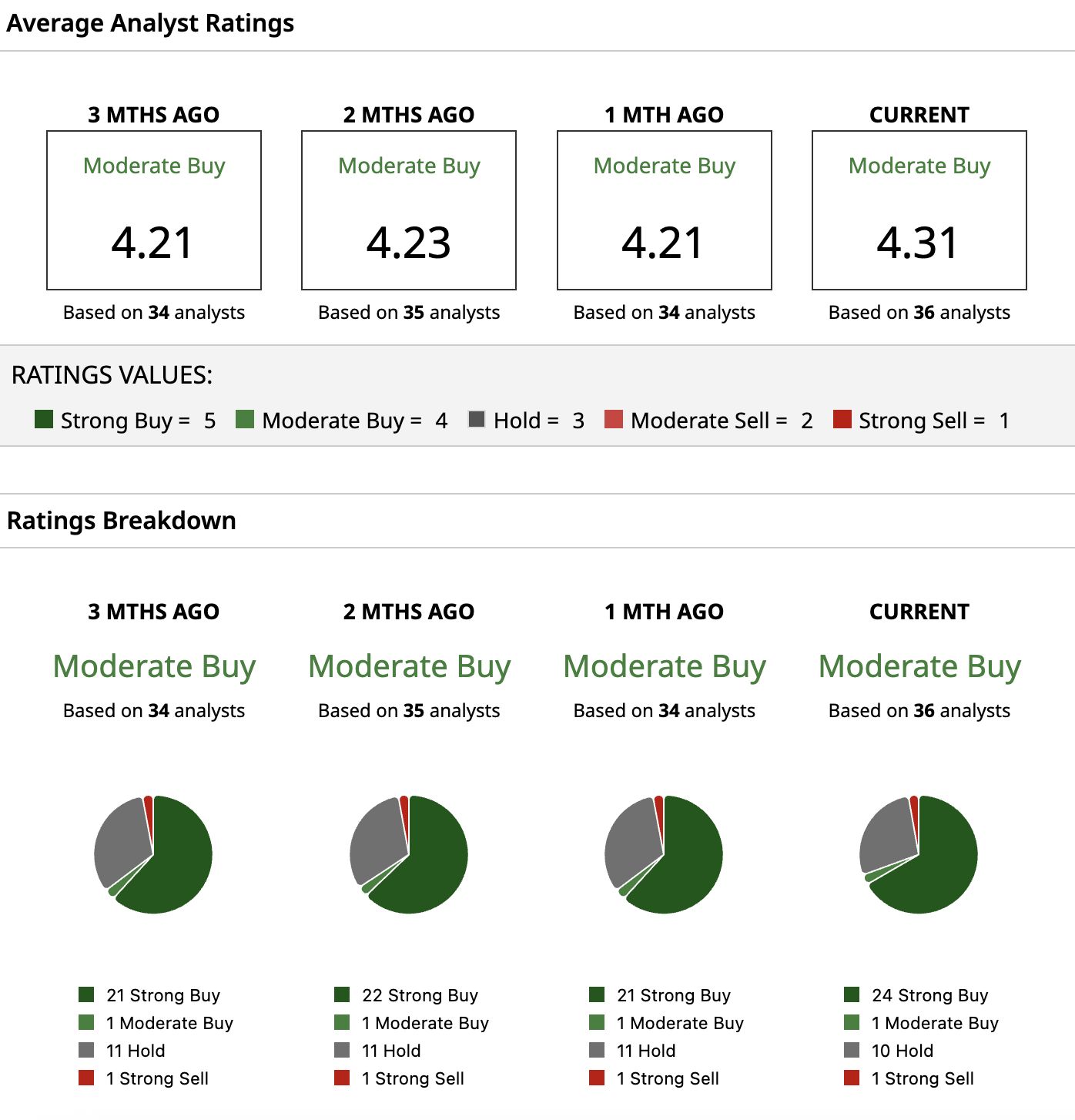
Analysts are split, but the majority lean bullish on CRWV stock. Based on 36 Wall Street analysts with coverage, CoreWeave has a consensus “Moderate Buy” rating. The average price target of $131.80 suggests impressive potential upside of roughly 137% from current levels.
Individually, on Oct. 19, MoffettNathanson lowered its price target from $107 to $89 while keeping a “Hold” rating. The firm believes CoreWeave has several ways to raise money, although some options may be costly or unattractive. In contrast, Goldman Sachs analyst Gabriela Borges upgraded CRWV stock to “Buy” from “Neutral” with a price target of $106.
 www.barchart.com
On the date of publication, Jabran Kundi did not have (either directly or indirectly) positions in any of the securities mentioned in this article. All information and data in this article is solely for informational purposes. For more information please view the Barchart Disclosure Policy here.
More news from Barchart
63 Reasons Point to CoreWeave’s Default. Yet Goldman Sachs Upgraded It to a 'Buy' for 1 Key Reason. Tech Stocks Are Crashing. Don’t Make the Mistake of Selling All of Them ‘What a Conservative Is Today Is Far Different Than It Was 11 Years Ago,’ Says Mark Cuban. If It Were Up to Him, He’d ‘Get Rid of All Political Parties.’ Citadel's Ken Griffin Says AI is in a Bubble Right Now. Billionaire Data Center Backer Jon Gray of Blackstone Disagrees.