

Indian investors are no longer content with watching Wall Street from the sidelines. With domestic stocks struggling and U.S. markets offering exposure to some of the world’s biggest technology companies, Indian trading platforms are now opening the door to a whole new investment opportunity.
India’s benchmark Nifty 50 ($NIFT) has fallen 10% since the start of 2026, while the S&P 500 ($SPX) has climbed more than 11% on a year-to-date (YTD) basis. Add in a weakening Indian rupee and the lack of major homegrown artificial intelligence (AI) champions, and it is easy to see why India-based investors are looking beyond domestic markets. For many, investing in U.S. stocks also offers a chance to diversify their portfolios across companies and currencies.
More Top Stocks Daily: Go behind Wall Street’s hottest headlines with Barchart’s Active Investor newsletter.
Major Indian investment platforms are responding to this growing appetite. For instance, Groww recently introduced U.S. stock trading, giving users access to more than 10,000 U.S. stocks and exchange-traded funds (ETFs), including fractional shares. Early favorites include prominent names like SpaceX (SPCX) and others like Nvidia (NVDA), Apple (AAPL), Amazon (AMZN), Alphabet (GOOGL), and Meta Platforms (META). Zerodha is also testing U.S. stock trading, while Angel One is reportedly considering a similar move.
For SpaceX, this expanding access could put the company on more investors’ radars, particularly those eager to own a piece of the space exploration and technology revolution. However, greater accessibility does not automatically make a stock a bargain, and investors still need to weigh its valuation and risks.
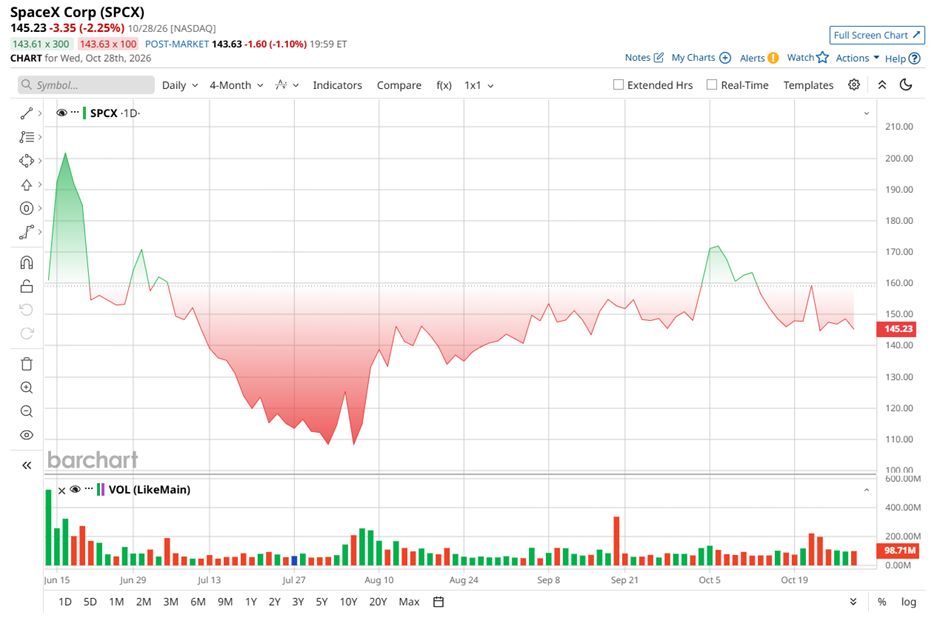
SPCX stock has fallen considerably from its all-time high of $225.64 but has staged some recovery, gaining nearly 30% over the past three months. With Indian trading apps now reaching U.S. stocks, could this increased access give SpaceX another boost? Let’s take a closer look at what investors should know about SpaceX and its stock prospects.
About SpaceX Stock
Founded by CEO Elon Musk in 2002 and headquartered in Starbase, Texas, SpaceX operates across space transportation, satellite communications, and artificial intelligence. Its reusable Falcon rockets and Dragon spacecraft have reshaped the economics of spaceflight, while Starship is designed to take exploration deeper into space. Starlink has also grown into a global satellite-broadband business serving consumers, enterprises, and governments. After expanding into AI through xAI, SpaceX now has Cursor under its wing as well, adding a leading AI coding platform to its growing tech ecosystem. Together, these businesses give SpaceX several long-term growth engines beyond rockets. Currently, SpaceX's market capitalization stands at around $1.8 trillion.
SpaceX may be moving at rocket-speed as a business, but SPCX stock has had a much bumpier ride since its June 12 debut. Shares opened at an initial public offering (IPO) price of $135, quickly surged above $200, and hit an all-time high of $225.64 within the stock's first three trading sessions. But the early excitement faded as investors questioned its lofty valuation and worried about upcoming insider lockup expirations.
The selloff was brutal. On Aug. 3, SPCX stock reached an all-time low of $104.83. However, bargain hunters soon stepped in, helping shares recover as investors looked ahead to SpaceX’s first public earnings report. The initial results brought another reality check, with shares tumbling about 12% as investors weighed the company’s massive AI spending plans. Surprisingly, the first lockup expiration did not trigger the heavy selling many had expected. Dip buying and short covering helped shares climb back above their IPO price.
More recently, SPCX stock has regained some ground, rising roughly 30% over the past three months. Still, the recovery has hit a few bumps. Shares have slipped about 4% over the past five trading sessions and have struggled since early October. After SpaceX reported third-quarter earnings, shares fell sharply as investors shifted their attention from strong earnings to the enormous cost of funding the company’s next growth phase.
That concern is understandable. SpaceX is investing heavily in AI computing capacity, satellite networks, and rocket infrastructure, raising questions about future capital needs and potential share dilution. Musk’s suggestion of a possible merger with Tesla (TSLA) adds another layer of uncertainty, with questions surrounding valuation, governance, and how resources would be allocated.
 www.barchart.com
When it comes to valuation, SPCX stock is not exactly offering a bargain. The stock trades at 1,088 times forward earnings and 104.6 times sales. Clearly, investors aren’t just paying for today’s business — they are betting big on tomorrow’s space and AI ambitions.
A Snapshot of SpaceX’s Q3 Numbers and Outlook
SpaceX’s Q3 earnings report revealed just how quickly the space company is evolving. Revenue jumped 161% year-over-year (YOY) to $14.6 billion, beating Wall Street’s estimates. Even more impressive, the company swung from a -$1.1 billion loss a year ago to a $4.4 billion profit, or $0.35 per share, more than double what analysts were expecting.
But the biggest surprise was not about rockets or satellites. It was AI. Musk has rebranded SpaceX’s AI division as “Super Intelligence,” covering its computing infrastructure, AI models, and software businesses. The SI division generated $7.6 billion in Q3 revenue, an extraordinary 830% YOY jump, accounting for more than half of the company’s total sales. That put it ahead of SpaceX's Connectivity business, which brought in $5.2 billion.
SpaceX is increasingly looking like an AI infrastructure powerhouse rather than only a rocket-launch company. It is building massive data centers to supply the computing capacity needed to train and run advanced AI models. The company ended the September quarter with 1.7 gigawatts of computing capacity, and Musk said demand is so strong that SpaceX could rent out its available resources several times over. The company is also putting that infrastructure to work internally, supporting AI products such as Grok and the Cursor coding platform.
However, this AI ambition comes with a hefty price tag. SpaceX spent $19.6 billion on capital expenditures in Q3, more than twice its $8.8 billion in adjusted EBITDA. The SI division alone accounted for $16.4 billion of that spending. Musk has discussed expanding computing capacity to 13 GW by the end of 2027, although this remains an ambitious projection, not a guaranteed outcome.
Meanwhile, Starlink continues to provide a strong financial foundation. Connectivity grew revenue 69% YOY to $5.2 billion, with 13.6 million Starlink consumer subscribers at the end of September.
SpaceX is also looking to expand its presence in the U.S. mobile market. Its recent spectrum acquisition plans, along with regulatory approval for a proposed constellation of 15,000 satellites, could strengthen the Connectivity business and help the company reach more customers.
SpaceX also offered an optimistic outlook for the coming quarters. CFO Bret Johnsen projected Q1 fiscal 2027 revenue of $33 billion to $37 billion, comfortably above Wall Street’s average estimate. Johnsen attributed the upbeat forecast to better visibility into the company’s computing contract pipeline over the next six months, suggesting that demand for SpaceX's AI infrastructure could continue to grow.
Elon Musk has even bigger ambitions in mind. On the Q3 earnings call, the CEO said SpaceX could reach $500 billion to $1 trillion in annual recurring revenue (ARR) by the end of 2027. That would be an extraordinary milestone, but the target is also considerably higher than analysts' current expectations for full-year 2027 revenue, making it an ambitious goal rather than a guaranteed outcome.
During the analyst call, Musk reignited speculation about a potential merger between SpaceX and electric vehicle (EV) maker Tesla, a deal that has been rumored for months. He revealed that both companies had formed “special committees” comprised of independent directors to discuss the possibility, while cautioning that an agreement was not likely to happen anytime soon.
Analysts tracking SpaceX currently expect it to generate about $22.9 billion in revenue and EPS of $0.30 for Q4. For fiscal 2026, the consensus calls for earnings of about $0.19 per share. Looking ahead, however, analysts see a much different picture emerging in fiscal 2027, with SpaceX expected to swing to EPS of $4.10. That would mark a significant YOY improvement and could indicate that the company’s massive investments in AI, Starlink, and its broader infrastructure are finally starting to show up in the bottom line.
What’s Wall Street’s Take on SpaceX Now?
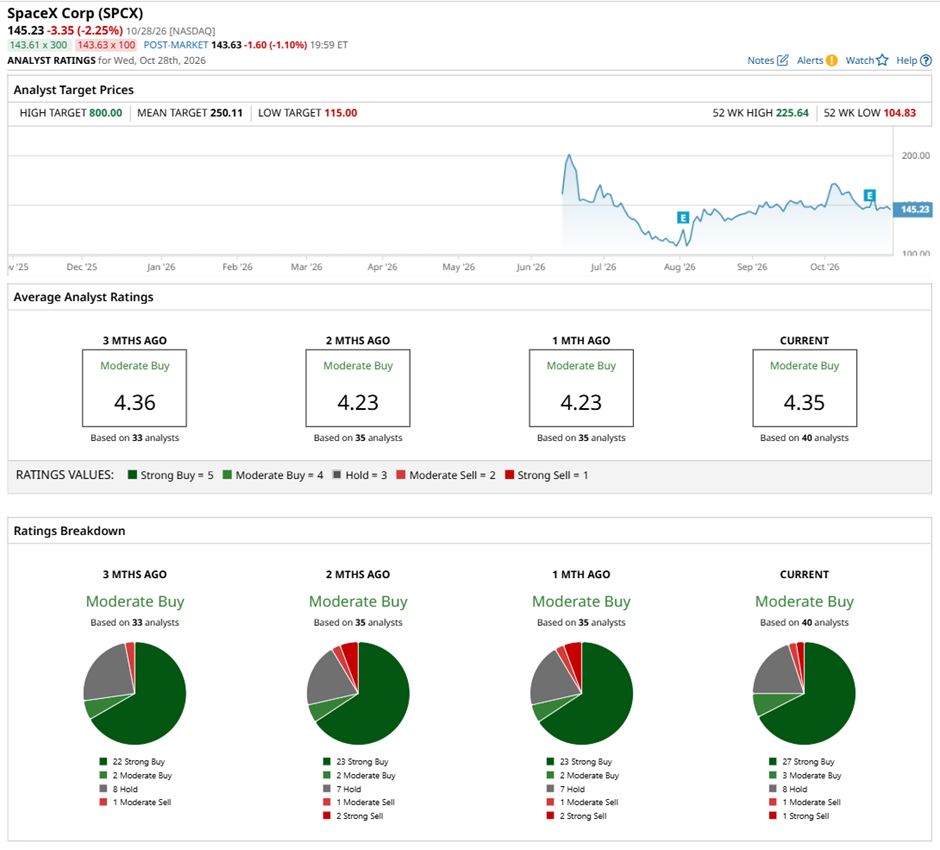
Overall, SPCX stock carries a consensus “Moderate Buy” rating. Of the 40 analysts covering the stock, 27 recommend a “Strong Buy,” three have a “Moderate Buy,” eight analysts have a “Hold” rating, one has a “Moderate Sell,” and one analyst has a "Strong Sell" rating.
At current levels, the average price target of $252.94 suggests that SPCX stock has potential upside of about 81% from here. Meanwhile, the Street-high price target of $800 implies that SpaceX could rally as much as 474% from current levels.
 www.barchart.com
On the date of publication, Sristi Suman Jayaswal did not directly have a position in any of the securities mentioned in this article. All information and data in this article is solely for informational purposes. For more information please view the Barchart Disclosure Policy here.
More news from Barchart
Nvidia Stock Looks Surprisingly Cheap. Why NVDA Could Rise 61%. Indian Trading Apps Just Opened the Floodgates for SpaceX Stock PepsiCo Generated Strong FCF - Huge, Unusual Put Options Volume Trade Today is a Bullish Signal Dear Cloudflare Stock Fans, Mark Your Calendar for November 5