


The stock market has undergone a dramatic psychological shift. For a growing subset of investors, the market is no longer a mechanism for long-term wealth preservation. It has instead turned into a sport indistinguishable from gambling.
Part of that is “buy the dip” becoming less of a choice, and more of a religion. The current mindset for many investors relies on a set of deeply flawed assumptions: success is defined solely by picking the right stock or ETF, position sizing is irrelevant, bonds are for the weak, and defense is entirely unnecessary.
More Yield, Less Trap: Sign up free to get Barchart’s daily Dividend Investor newsletter straight to your inbox.
Why bother playing defense, much less learn how to profit from markets that continue to post lower lows, when we “know” stocks will just bounce back?
Here’s why: The past 18 years have been a historical anomaly and with each passing week, it looks more and more like this time could be… dare I say… different.
Hello Mr. Bear. Have We Met Before?
I have seen this exact cycle play out three times during my career, and it has ended the same way each time with investors pointing fingers and swearing they will never touch stocks again. This might be the fourth of those.
The reality is that S&P 500 indexing has become the most crowded trade in history, and the technical indicators are signaling that it is finally rolling over.
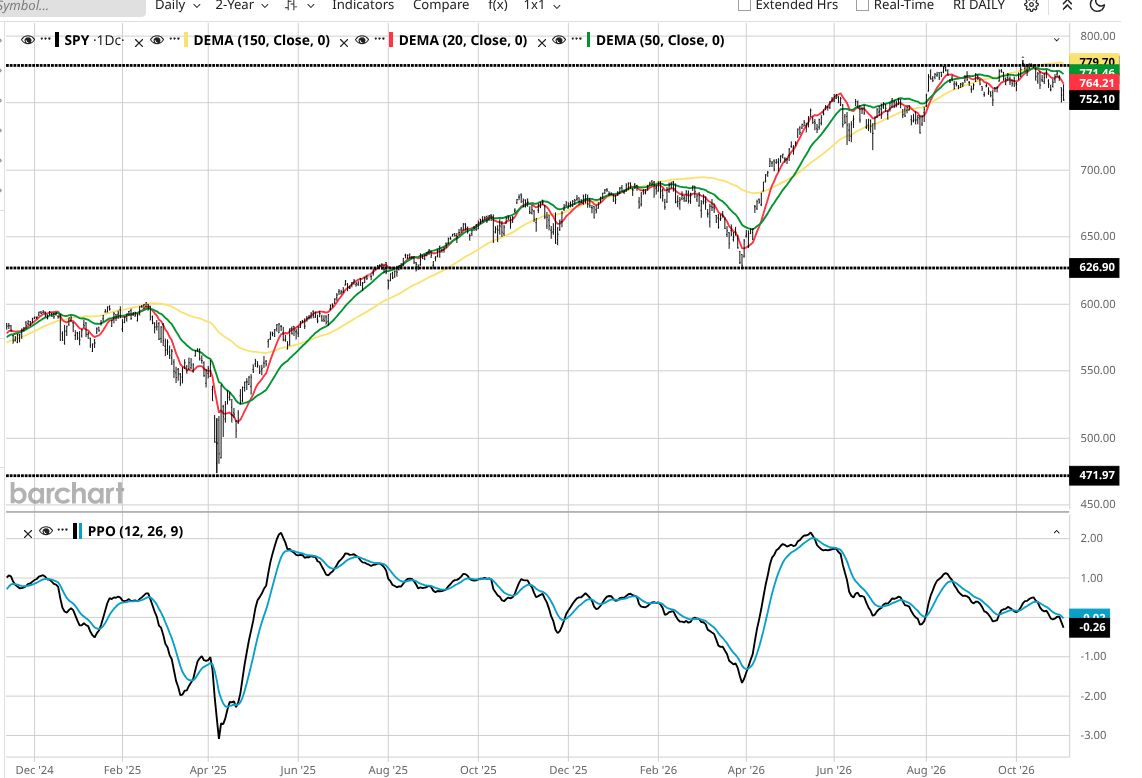
This is the SPDR S&P 500 ETF (SPY), and it looks to be on the edge. Oh, there will likely be some single stock saviors in a few sectors. But for the most part, the index that sucks in all that 401(k) money is showing signs of major fatigue.
 www.barchart.com
In the chart above, compare Monday’s close, as well as the PPO indicator, to this past March. They look like twins to me, or at least close cousins.
That March move only produced a 9% dip in SPY. However, the market has a lot more baggage now as the AI trade’s luster is vanishing.
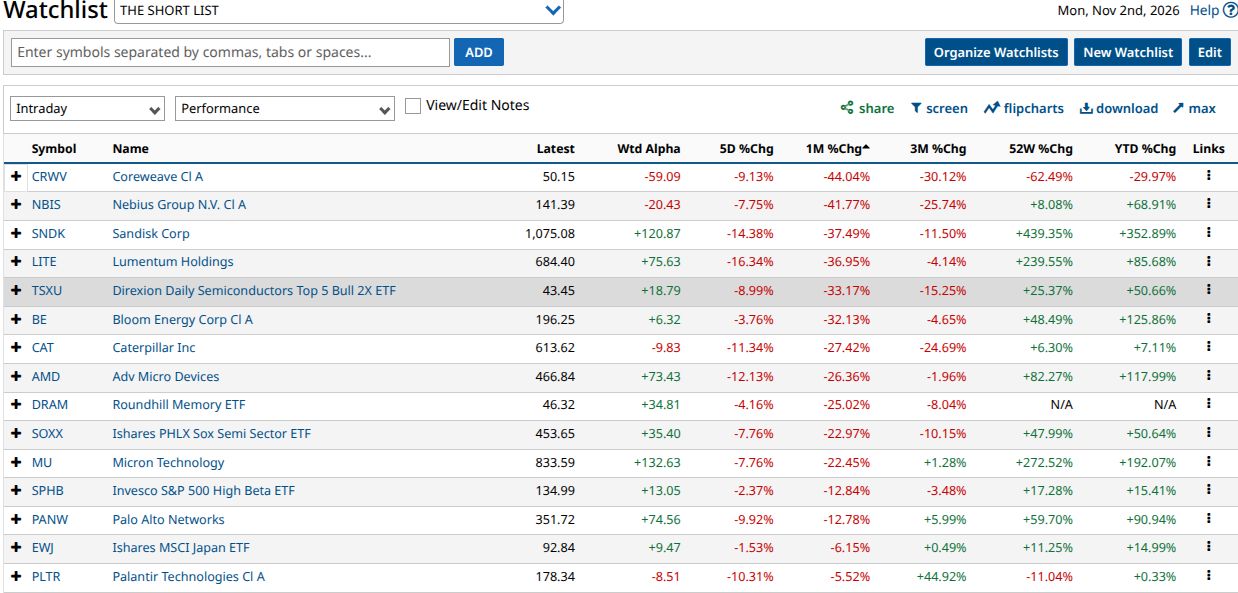
Here’s a Barchart Watchlist I showed you earlier this quarter. I affectionately named it “The Short List” – a list of stocks that are candidates to sell short. Check out how they’ve done over the past 1 month.
It turns out they have averaged a more-than-20% “dip.” That’s some folks’ definition of a bear market.
 www.barchart.com
How I’m Playing Offense and Defense Simultaneously
How do you safely navigate a stressed equity market that was priced for AI perfection but is now fraying at the edges? To me, while cash-like ETFs such as the State Street SPDR Bloomberg 1-3 Month T-Bill ETF (BIL), the iShares 0-3 Month Treasury Bond ETF (SGOV), and the U.S. Treasury 3 Month Bill ETF (TBIL) are comfortable, it doesn’t have to stop there.
Here is the four-part approach I am using right now to manage my own capital:
The ‘Big, Bad Bond Ladder’: This remains the core of my allocation. With the U.S. Treasury yield curve offering rates we have not seen in recent memory and exceeding 5% at the long end, fixed income provides the best baseline return in a generation. And if rates decline, there’s a total return potential that I do not think stocks can match. Interest Rate Hedges: My bond ladder is not a passive vehicle. I pair my fixed income with tactical hedges designed to explicitly protect against the risk of rising interest rates. Conservative ETFs: Alongside my bond portfolio, I utilize a conservative growth model built on 10 specific ETFs, which can be managed systematically to capture steady, lower-volatility equity exposure. The ‘Trading Account’: I maintain a modestly sized trading account. I’ve already logged over 1,000 trades this year.I’m a career investor who realized a few years ago that the whole market landscape was starting to favor shorter-term trading. Not entirely, but to be on the other side of that bond portfolio, to make a barbell.
My trading account these days is mostly options and leveraged ETFs (long and inverse), held for days or weeks at most. The key is not the speed of the trading moves. It is the idea of adjusting continuously to market risk as I perceive it.
We might just be entering a period the likes of which most investors have not experienced. Take it from someone who has. Even if the market doesn’t follow through to the depth we saw in 2000 and 2008, without a dip to buy profitably for years, one thing I’ve learned remains true. You are better off having a plan for any market, than hoping for a market you like.
Rob Isbitts is a semi-retired CIO, former fiduciary investment advisor, Barchart columnist, and straight-talker. Download his new free e-book on hedged bond investing for retirement at ETFYourself.com. His research and model portfolios are at ROAR.PiTrade.com.
On the date of publication, Rob Isbitts did not directly have a position in any of the securities mentioned in this article. All information and data in this article is solely for informational purposes. For more information please view the Barchart Disclosure Policy here.
More news from Barchart
Follow This 4-Part Total Portfolio Strategy to Prepare for Any Market – Not Just the Bull Market You Want How Quant Strategies and Leveraged ETFs Helped Fuel Thursday's QQQ Bloodbath on Wall Street — and Whether It's Safe to Buy Yet Don’t Make Any Sudden Moves After the Midterm Elections (and 3 Charts I’m Watching Here) Most Investors Are Stuck Between Anxiety and Denial. Here’s How Barchart Tools Can Help You Face Reality and Protect Against a Crash in AI Stocks.